

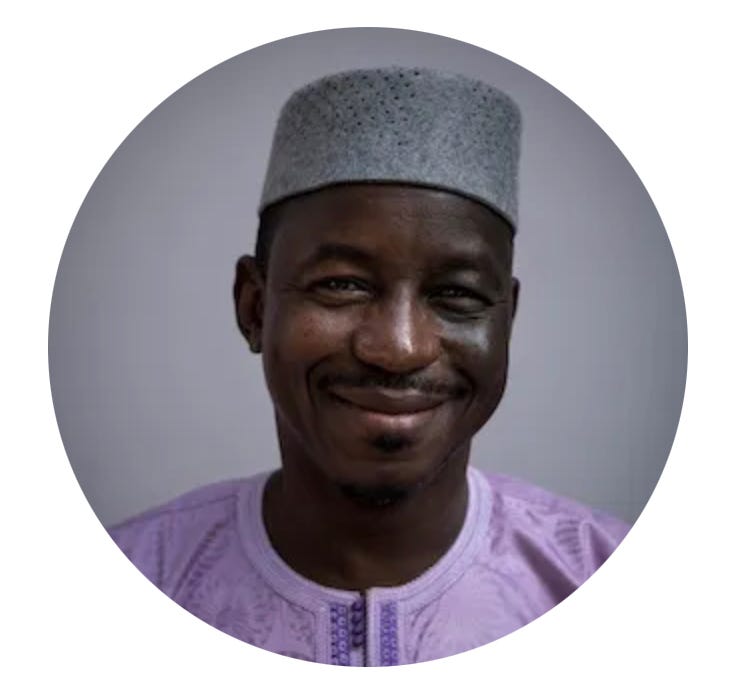
Mamadou Goïta is a member of the IPES-Food panel, the executive director of the Institute for Research and Promotion of Alternatives in Development (IRPAD), and a development socio-economist and specialist in education and training systems. He works closely with farmers’ organizations in Africa and other continents.
He has been executive secretary of ROPPA (West Africa Farmers and Producers Organization). Prior to his position at IRPAD, he worked in West Africa with UNICEF, UNDP, OXFAM-Belgium and ACORD. He is a founding member of COPAGEN (the Coalition to Protect African Genetic Heritage) and a founding and honorary member of the Alliance for Food Sovereignty in Africa (AFSA). He has also worked as academic support for the UN Committee on World Food Security (CFS) Civil Society Mechanism Working Group on ‘smallholders’ access to markets’ (2016) and was director of CODESRIA’s Institute of Governance (2014). In 2013, he served as a project team member of the CFS’s High Level Panel of Experts on Food Security and Nutrition.
He currently sits on a numerous international boards – including Afrique Verte International, More & Better network, Global Green Grants, Enda Pronat, IED Africa – and is a member of several African networks (Pan-African Network in the Defence of Migrants’ Rights (PANiDMR), African Development Bank’s CSOs coalition, AIMES, POSCAO). He teaches at different universities and has an integrated agroecological farm in Mali.
For years, the agroecology movement has been warning against the consequences of the globalized industrial food system. Year by year, we’re witnessing these predictions come true through consecutive and relentless global crises. Time has proven the fragility of the Green Revolution model that has violently taken over the world’s farmlands, and is fundamentally tailored for profits and corporate control.
Simultaneously, we’re also observing the resurgence of resilient farming models that have sustained humanity for millennia. They are deeply localised, relying on local inputs and farming ingenuity, shaped, over generations, by harmonious conversations between farmers, their fields, their plants, and the beings inhabiting those complex ecosystems.
For many, what we’re witnessing is collapse. For others, it’s revival.
AGC recently spoke to Mamadou Goita, a farmer and panel member of IPES-Food, about the effects of the fertiliser crisis caused by the U.S. war against Iran and the blockades of the Strait of Hormuz. A conversation that aimed to explore the risks of an industrial, trade-dependent food system turned into reassurance. Mamadou shared many examples of African farmers taking the lead in shifting farming models, countries changing policies, and communities reviving native foods. In this moment of crisis, Mamadou shared hope. Not for the future. But for the already unfolding present.
AGC: How is the war that the U.S. is waging against Iran affecting agriculture in Africa?
Mamadou: This is another layer adding to the crises that have happened over the last few years and have been affecting the farming communities in Africa, particularly in West Africa.
COVID-19 was an issue, because we realised that many regions of our continent were depending on international trade to access inputs. Then, the war between Russia and Ukraine was very instrumental, because we realised that these two countries, particularly Ukraine, were providing more than 60% of the fertilisers used in West Africa. There were only a few fertiliser industries in Africa; like in Nigeria. Most countries were importing chemical fertilisers from either Ukraine or Russia. This war showed that we are too dependent on very few countries.
Now, with the war between the US and Iran impacting the oil system, the increase in oil prices is increasing transport costs. Even for industries that are making fertilisers—the few that we had are now impacted.
For me, that is a good thing. It is the best opportunity we have to create other conditions in our continent. It’s been more than 30 years now that I’ve been talking about this, and now all the phenomena that we were describing is happening: that your production system is depending on external inputs and one day you will pay for it. We have been saying that for a long time, and now we have a complete range of casualties and consequences that are coming. During COVID-19, we were talking about it as a potential risk, but now we are no longer talking about potential. It’s happening.
It has been impacting not only the transport, but also our access to some inputs. The rural producer is also a consumer, and prices are impacting their lives, so rural areas are suffering a lot from this war.
I love what you said about this being a good opportunity and about it proving something you have been saying for such a long time. Do you think we can have global food production without chemical or synthetic fertilisers?
Mamadou: Yeah, it’s possible. If you look at the African continent, you know that it is. Five years ago, we did the agroecological profile of some regions in Mali. In some regions of Mali, people don’t have access to chemically synthesised products on their farms. They are not using it. And they are producing a lot. They are exporting the surplus out of the region. They also have a trade system linked to the territorial markets, they are creating jobs.
If you look at the level of chemical fertiliser use in West Africa, you will see that we are considered to be barely using it. You have 3 or 6 kilograms per hectare, which is way lower than the 33 kilograms, or sometimes even 300 kilograms, that are used in other countries. Chemical fertilisers are used mainly for some key products and are not common for us; they can be considered an exception.
In the Kayes region in Mali, we had a sample of 380 family farms, none of them using chemical products, and they are planting the crops that usually require more chemicals in the region, like maize and cotton.
The largest quantity of fertilisers is used in commercial products, such as maize. Among those planting millet, for example, out of 100 farmers, only 10 or 12 are using chemical products, and at small doses.
Even in regions where we produce cotton, like the Sikasso region in Mali, companies have been training 800 people to produce organic fertilisers and manure. In the last three months, the government has also been telling people to produce their own organic products, because access to chemical inputs will be very problematic.
So yes, it can be slow, but it’s possible.
I am a typical example. I have my farm, and I’m out of this [chemical] system, but my production, in terms of yield and quality, is far bigger than any conventional farm. Sometimes I have more than 30% increase in yield compared to my neighbours. I have mangoes, papayas, millet, sorghum, maize. I’ve never used chemical products, but my production is better, and my cost of production is lower, because I have an integrated system using different options that can support each other.
It’s really hopeful to hear that it is possible. What would it take to shift this dependency on synthetic fertilisers? What would that process look like?
Mamadou: It depends on the way every country will develop its own strategy on the agroecological transition, which is the reason why we are pushing countries to get into it soon. We can talk about 15 years or 30 years, but you have to set a limit to fix the different gaps existing in the system.
Fertilisers can be less problematic, but the biggest problem actually is herbicides. The farming system has changed, and many people will say they don’t have the labour to deal with weeds and herbs growing on farms. The easiest method is to use herbicides. You kill everything, the soil and the herbs at the same time, and you are done.
So, for fertilisers, you can change everything completely in a cycle of five years, because you can use organic fertilisers. You will recover this soil and come back with higher yields than you had with chemical fertilisers, because you are working on the health of the soil. If some countries in West Africa commit themselves to agroecological production and soil health, a change can happen between 20 and 25 years.
But there’s the other side, which is: how these conditions are developed on the market. Transforming the kind of crops that people eat is also important. In many countries in Africa, for example, rice production is very problematic. This is not a traditional crop for us, even in countries like Senegal.
When they say that Thieboudienne is a traditional food, no, it’s not at all. It’s a national dish, actually, but it’s not traditional food because in Senegal, up to the 80s, people ate more millet than rice. It’s because of the Structural Adjustment Programs, when they opened the door to the market, with all these imported products from Asia, that Senegalese have been bound to rice consumption. And then now, the question is about how to change this trend.
And people are creating many conditions to have the texture of rice using millet or maize. We are changing the content of the bread: instead of wheat, we are producing bread with sorghum, millet or other crops planted here. So this is the longest step, because you can not change the production alone, if you don’t change the eating habits of people.
What is the correlation between high-yielding seed varieties and the use of synthetic fertilisers?
Mamadou: There is a strong correlation, because hybrid seeds come with their own package of chemical fertilisers, pesticides and herbicides. If you don’t use the dosage that companies recommend, they are no longer responsible for what is being harvested on your farm. So it’s a commitment. This has opened doors for many traders to bring fertilisers into our countries. And then to create dependency on them.
There is a strong correlation between different varieties of seeds and chemical use. And there is also the genetic erosion of most traditional seeds, which have disappeared. However, in Mali, 73% of the country’s food comes from the farmers’ seed system. Our new policy emphasises that and says we need to make that number even higher.
My institute, IRPAD Africa (Institute for Research and Promotion of Alternatives in Development), has been working for more than 10 years to recover some lost varieties. We found 17 varieties, including sorghum, okra, beans, millet, and tomatoes. These varieties had disappeared, people didn’t know where they were. We found some in remote villages with some elders, we found people who continue to grow them. And they don’t need any kind of fertiliser.
We’ve learned that if you add organic manure, the yields are fantastic in some cases. And in some cases the yields will remain a bit low, but the quality and the medicinal character of these seeds are so high that they can avoid many different illnesses.
So there is a correlation between the kind of seed that we use, and this push for the synthetic fertiliser, pesticide and herbicide.
What is the role of agroecology in this shift away from chemical-based agriculture, and what part do you think peasants and small farmers play in it?
Mamadou: This is a big question of strategy and also policies. We all know that small stakeholders are those who are really open to change, some because of economic reasons, because they don’t have resources to buy chemical products, and some because they really want biodiversity per se. So, there is a lot of education that needs to be done in some countries, individually.
Each country is different. In West Africa, for instance, most farmers’ organisations are fully engaged in the agricultural transition, because ECOWAS (Economic Community of West African States) has been investing in it. Other organisations like ROPPA(Farmers’ and Producers’ Organizations Network of West Africa) or RBM (Billital Maroobé Network) for pastoralism, also put pressure on advocacy work. They invest resources to ask countries to engage in an agroecological transition.
But the food system is not only about production, but also how trade and consumption are organised, and how it can create wealth and jobs in their countries.
The second thing, also very important, is the role of women and youth. Many people are running away from agriculture. But today, young men and women are coming back, because they know that the system is more autonomous with agroecological approaches. This perception and the economic perspective are bringing young people in, because they know they can make their own lives, create wealth and jobs.
And women have been keeping the farmer seeds in the production areas, and now agriculture is adding value to it, so they become teachers, examples, case studies for countries to scale up.
Mamadou, it was very inspiring to hear so many good examples that are not only theoretical but already underway. You work with many farmers, not only in Mali but also in other countries. What have you been seeing that gives you hope in the future?
Mamadou: Well, first thing is that now, in West Africa, there are many people engaged in the transition. There are different ways of supporting organic fertilisers, some are giving subsidies, some are just calling for farmers to get out of synthetic fertilisers.
Countries like Mali, for the last seven years, offer 50% subsidies for organic manure, and it’s not even enough. Last year, there was a shortage of organic manure. This is a good hope for me, as many farmers and organisations are actually doing their best to get out of that [chemical farming].
Second, there’s the policy change that we are slowly facing in Africa. In many cases, countries are really politically committed. Last week, for example, we gave a reward to the Minister of Niger, who is really pushing hard for agroecology in his country.
And my third hope is that the market is more organised. Territorial markets are slowly being more organised; some of the major municipalities are engaged now, they are creating space for agroecological products and creating conditions for job creation around agroecology, so it’s also becoming a political agenda in some municipalities.
So, for me, this is hope.
We are also seeing more farmers’ seed system initiatives. We have more and more networks in the region, not only in West Africa, but also in Central Africa, East Africa, and larger ones like AFSA. I’m a member of COPAGEN (Coalition for the Protection of African Genetic Heritage), WASP (West Africa Seed Program), but also ABN (African Biodiversity Network). They are connected at an African Union level. Very soon, we’ll have a pan-African model for farmers’ seeds.
There are risks and threats, but I have more hope than fears in terms of agriculture.
Three years ago, I would have been very skeptical, but actually, there is a big push, and the crisis has also been very instrumental in creating hope for me. Even though there are many, many challenges, we can overcome them.
(Perspectives are 100% our own and do not reflect our sponsors.)
Comments
Nothing yet. Say the first thing.
Sign in to join the conversation.