
There’s a reason Congress is in Article I of the Constitution and the presidency is in Article II.
The founders didn’t put the executive first. They put us first: through representatives, checked by a Constitution. They did not want a king, and they didn’t want mob rule. Not a pure democracy. A republic. The people’s branch, listed first, on purpose. The President is supposed to execute the laws Congress makes. That’s why it’s called the Executive branch.
So here’s the question that should bother you. If the system was built to put power in our hands, why does it feel like we never get what we actually want?
Turn on the news, and you’d think America is split down the middle on everything. It isn’t.
From the earliest days of this country, the wealthy and powerful have used one tool to stay on top: keep the rest of us fighting each other instead of looking up. It’s class warfare dressed up as culture war. I hear some saying we don’t want class warfare. We’ve been in it since the beginning. But the middle and lower classes have unilaterally disarmed.
It’s never been more effective than it is right now. It’s also never been easier to see, if you know where to look.
Look at the polling. Not one poll, not one pollster with an agenda, but the pattern across many of them, on issue after issue. The exact number moves depending on who’s asking and how the question is worded. That’s true of every poll on every topic. But the pattern is undeniable. On issue after issue, Americans land in the same place, in some cases huge majorities. Democrats. Republicans. Independents. Yet, here we are— not getting what we want.
This isn’t a left or right issue. It’s a top-versus-bottom issue.
Healthcare. Whatever you call the fix, most Americans think the system is broken and want the government to do more, not less. Polling on some version of Medicare for All has landed anywhere from the low 50s to mid 60s depending on how it’s framed, but it’s been a majority position for years now. The Affordable Care Act was demonized even while most conservatives liked most of what was in it. Progressives didn’t like it because it didn’t go far enough. The polling lumped both groups together in saying they didn’t like it.
Money in politics. This might be the least controversial issue in America and the most ignored. Poll after poll, going back over a decade, across every methodology, shows roughly 60% to 80%+ of Americans, across party lines, want less corporate and dark money in our elections. Our Supreme Court has ruled corporations are people and money is speech. Who actually buys that?
Taxing the wealthy. Ask Americans if billionaires and large corporations should pay more, and majorities from around 60% up into the 70s say yes, including a meaningful chunk of Republicans every single time. Income tax rates used to top out at over 90% marginal rates, and it wasn’t socialism.
Reproductive rights. Most Americans favor legal access to abortion in most or all cases, even in states where the laws don’t reflect that.
The Electoral College. A majority of Americans, across parties, have told pollsters for years they’d prefer the popular vote decide the presidency. The Electoral College is an archaic system designed to protect slave holding states. It makes no sense.
Military aid to Israel. Public opinion has shifted hard here in the last two years. Recent polling, Quinnipiac among others, puts opposition to sending more weapons at roughly 60%, including a majority of independents.
Paid family leave and childcare. This one isn’t close. Support routinely runs into the 70s, red states included.
A pathway to citizenship. Majorities well above 60% consistently favor a legal path for undocumented immigrants already here, even alongside support for border security. The choice of open borders versus the punitive, complicated, and cruel system we have now is a false choice.
LGBT protections. Broad, durable majorities, well past 60%, support basic anti-discrimination protections.
Supreme Court reform. Trust in the Court has cratered enough that ideas like term limits and ethics rules poll in the 70s and 80s, across party lines. Almost no one is happy with our current court and system.
Gun reform. Background checks and other common-sense measures poll well above 60%, including among a majority of gun owners. Again, we’re presented with a false choice of “taking away our guns” or no gun laws at all.
Criminal justice reform. Majorities in the 70s support sentencing and policing reforms, even when the word “reform” itself has become politically loaded.
Legal weed. This one’s basically settled. Legalization polls around 70%, and has for years.
A living minimum wage. Raising the federal minimum wage polls in the 60s, sometimes higher, in red and blue states alike.
Climate action. Some version of aggressive climate investment, jobs plus emissions, polls at a majority, even as the phrase “Green New Deal” itself polarizes people who agree with what’s actually in it.
Affordable housing. Nobody’s against this one. It polls around 70% because everyone, everywhere, is feeling it.
These aren’t 51-49 wedge issues. Most of them are 60-40, 70-30, sometimes 80-20. On any other topic, that margin would be called a landslide mandate.
So why doesn’t any of it happen?
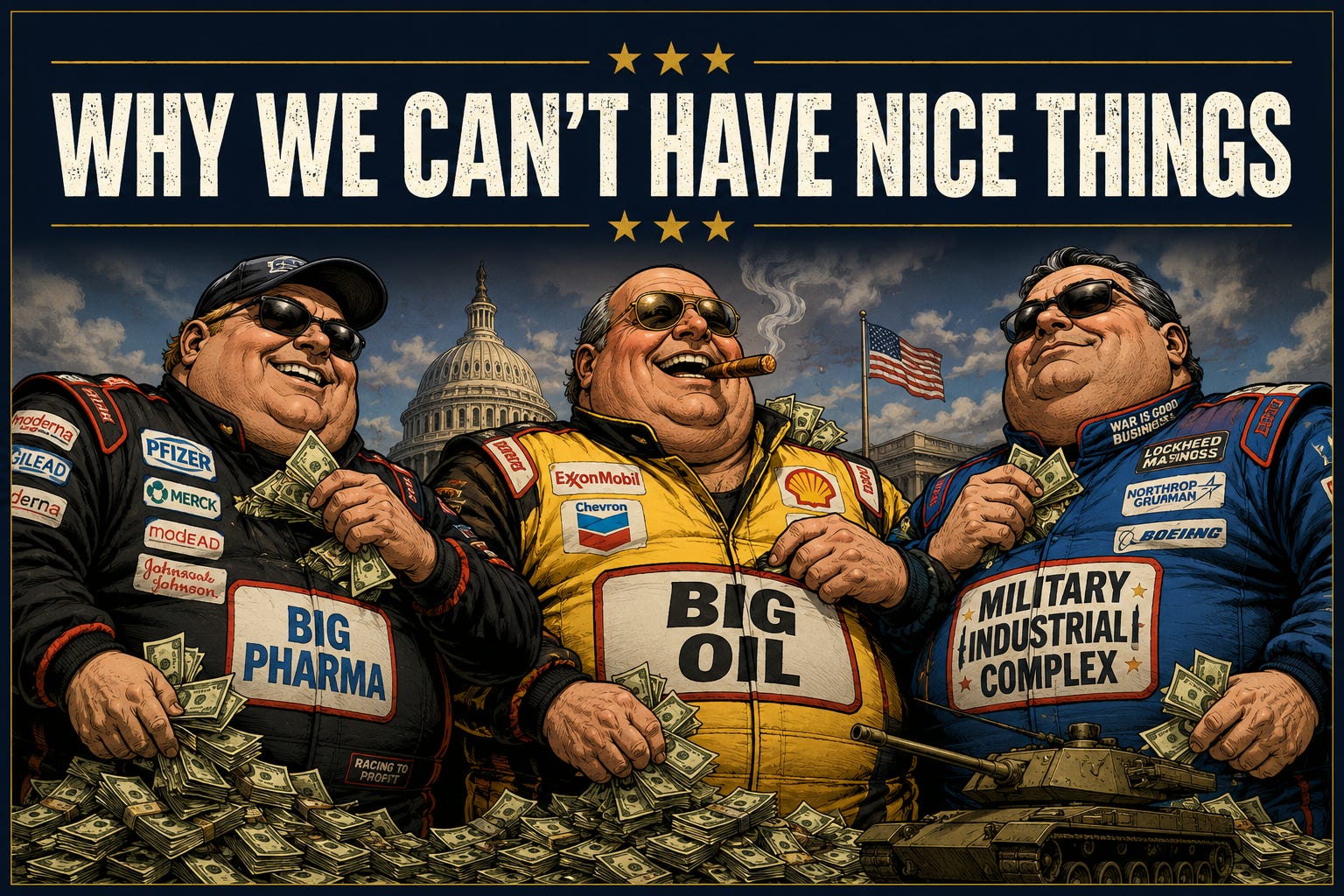
Here’s the uncomfortable answer: Congress is bought. Both parties. Not equally, not identically, but both.
I know “bought” is a strong word. Call it what you want: access, influence, “the way things work.” But when a corporation or a billionaire donates seven or eight figures to a campaign, they’re not doing it out of civic pride. And it’s certainly not charity. It’s an investment, and investments are made expecting a return. And boy, do they get them.
In April 2024, Donald Trump sat down with about twenty oil and gas executives at Mar-a-Lago for what got called an “Energy Round Table.” One executive had the audacity to complain that the industry had spent $400 million lobbying Washington the year before and still couldn’t get the regulations it wanted. Trump’s answer, according to the Washington Post: you’re all wealthy enough that you should raise a billion dollars to put me back in the White House. They didn’t donate a billion dollars. But they donated by the multiple millions.
And the ask? Roll back environmental rules, lift the freeze on gas export permits, open more drilling leases in the Gulf, and the industry’s money would follow. They donated, and Trump delivered.
Executives who helped raise it later landed seats in the administration itself, including one who became Energy Secretary. Within months of Trump’s return to office, the drilling leases opened, the export freeze lifted, and the emissions rules came down, pretty much exactly as promised at that dinner.
That’s just one example. I’m not picking on Trump. I’m not picking on the Republicans. It happens on both sides.
Both parties talk about serving the people. Both parties, when the money’s on the table, serve whoever put the money there. it. A pox on both their houses.
The real divide in this country isn’t red versus blue. It’s the people who write the checks against everybody else, and everybody else is most of us, whichever way we vote.
The DSA has been getting a lot of attention lately for a platform that goes further than I would: abolishing the U.S. Senate entirely and replacing the presidency and the Supreme Court with an executive and judiciary chosen by, and answerable to, Congress. They’re nuts. That’s a real position, formally adopted, not a strawman. DSA’s own co-chairs have confirmed it on camera.
We don’t need to go that far. Blowing up the structure isn’t the fix. The structure was designed to represent us; it got captured, that’s all. You don’t demolish a house because someone changed the locks. You get your key back.
Getting the key back starts with getting money out of politics. It’s not a coincidence that it’s the number one plank of candidates like Abdul El-Sayed’s platform. The people agree! It’s the one reform that makes almost every other reform on this list achievable.
The most achievable version of this probably isn’t a total ban (courts have struck those down before on free-speech grounds). I’d do it if I had my way. The way we can get there is public financing that actually works: every candidate gets the same pool of money to run on, full stop. New York City’s small-donor matching system is one real-world example of this working at scale. It’s not theoretical.
Here’s where I’ll go further out on the limb.
Imagine, someday, more of our laws being voted on directly by us, the way many states already let citizens do through ballot initiatives. You’d need its own guardrails against chaos and manipulation. It’s never been practical nationally. Organizing an election for 330 million people used to be too complicated and too expensive to do more than once every couple of years.
It isn’t anymore. We carry a device in our pocket capable of things the founders couldn’t have imagined. It wouldn’t be easy to get there. Getting there would take a constitutional amendment and strong safeguards against a tyrannical majority. That’s a conversation for people smarter about constitutional law than I am. I’m just an idea guy. But the direction is worth naming out loud: less power concentrated in the 535 people who answer to donors, more power sitting where the founders always said it belonged. With us.
We’ve been told for so long that we’re hopelessly divided that most of us believe it. We’re not, and the list above proves it.
The wealthy and powerful have never needed us to actually disagree. They’ve just needed us to believe we do, while they write the checks that decide what Congress does next.
That’s the con too many of us have been fooled by. Seeing it is the first step out of it.
What do you think? Which of these hits closest to home for you, and is there one on this list you actually push back on? I’d genuinely like to know. Drop it in the comments.
Wondering why you’re getting this?
You signed up for Grief 2 Growth, and this is Common Ground — a different lens, same writer.
New here? Start with What Common Ground Is and Isn’t.
This is where I write about the systems and policies shaping how we live and care for each other — not partisan takes, just where we actually agree.
Not for you? Opt out anytime and keep everything else from Grief 2 Growth. Just visit the link and turn off notifications for Common Ground
Comments
Nothing yet. Say the first thing.
Sign in to join the conversation.