
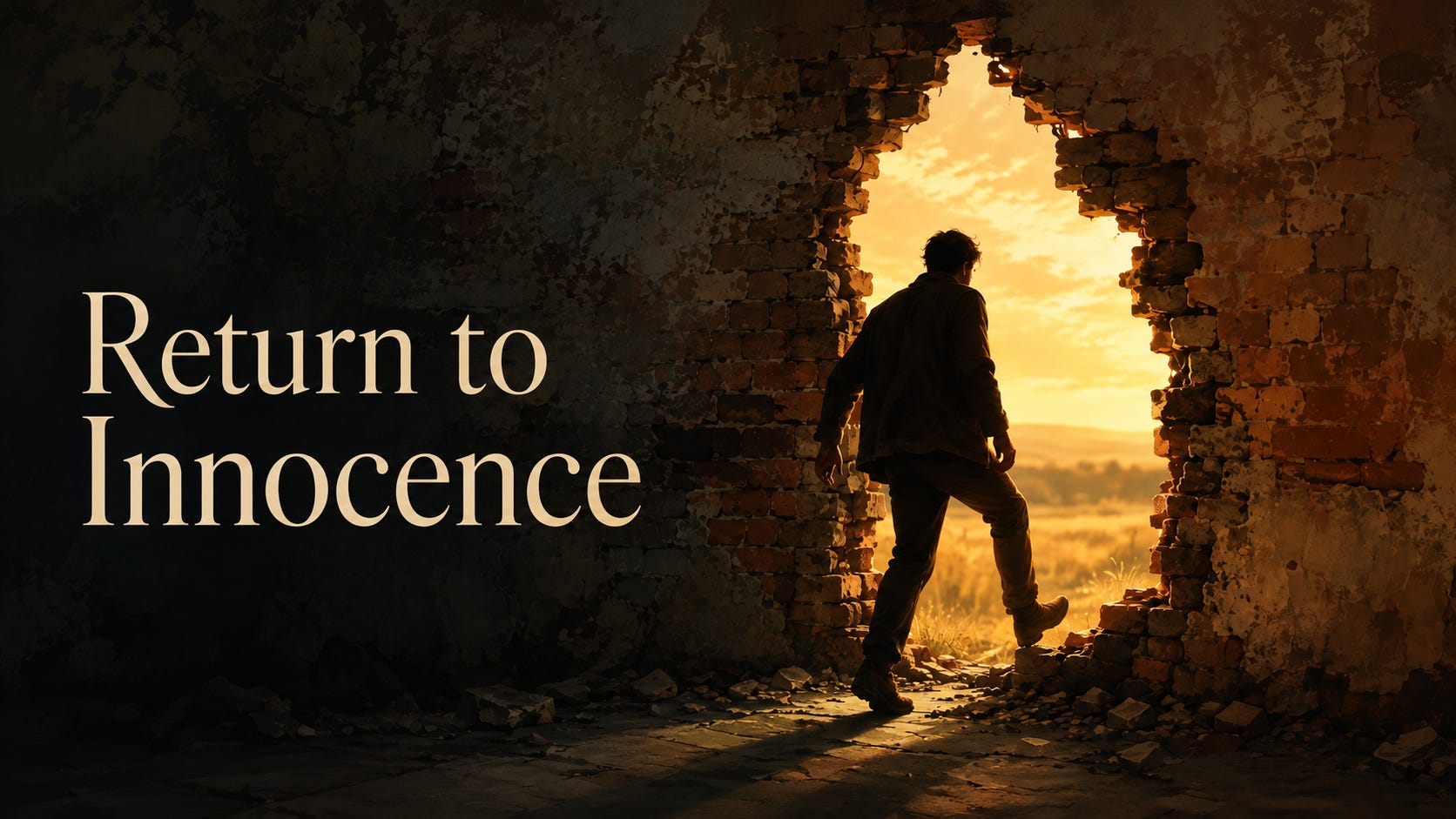
A song comes on. Three minutes later, you don’t know if you just got sad or got healed. Maybe both.
That’s what a handful of songs do to me. Earth, Wind & Fire’s “That’s The Way of the World.” Enigma’s “Return to Innocence.” Supertramp’s “The Logical Song.” Pink Floyd’s “Another Brick in the Wall.”
Four different decades, four different sounds. Same wound. Each deeply resonated with me at various points in my life. I never knew exactly why at the time. Now I do.
Every one of them is about a kid who shows up wide open, and what the world does to shut that down. Oh, how I can relate to that.
I’ve linked to the songs referenced in the article. You can read the article without listening. If you can find the time, go down the rabbit hole with me and give them a listen.
“The Logical Song” reads almost like a case file. A kid starts out amazed by everything, magical, mystical, alive with wonder. Then he gets sent off to be educated. Somewhere along the way, the wonder gets swapped out for something more useful to everyone but him. Logic. Responsibility. Straighten up and fit in if you want to succeed.
Pink Floyd names the same thing and turns it into a chant. “We don’t need no education”. No subtlety about who’s doing the shutting-down. The institution grinds kids through a system built for control, not curiosity. In the movie, there’s even a meat grinder as the kids are turned into something pliable and void of individuality. Extended movie version linked below.
Both songs are diagnoses. They tell you where it went wrong and who did it. Neither one tells you what to do once you know.
And honestly, that’s where most of us stop. We spend years confirming the diagnosis. Yes, the world did this to me. Yes, I can point to the exact moment. We go to therapy, and they tell us why we are the way we are. I was inspired to write this after seeing someone claim our entire personalities are just trauma responses. Yeah. It can seem that way, huge parts of them anyway.
Naming the wound is real work. It’s just not the whole job. Now that we know, what do we do?
“That’s The Way of the World” isn’t a diagnosis so much as a lament. It describes what the world rewards and what it costs you to keep up. This is the view from inside the compromise. The song doesn’t ask how you get free of it. It just tells the truth about what playing along does to you.
Supertramp and Pink Floyd show you the wall going up. That’s The Way Of The World shows you what it’s like to live inside it, knowing the game is rigged, playing it anyway, because everyone around you is doing the same thing.
I went back to all four of these songs years into doing grief work, and here’s what got me: only Enigma talks about the way back.
Not backward. You’re not un-learning anything. They call it a return to innocence. The video is brilliant, showing a life going backward, Benjamin Button style, as the old man becomes a baby again.
But the truth is more subtle. It’s forward, into something that got buried but never actually left.
The song barely has lyrics. It’s more chant than statement, more feeling than explanation. No instructions. Just an insistence that what got taken from you wasn’t taken forever. It’s still under there, somewhere beneath everything the world piled on top.
I didn’t understand why that distinction mattered until I found the word for it.
Emanuel Swedenborg, the 18th-century theologian, drew a distinction that has captivated me since I first heard it a few years ago. I think it’s the missing instruction manual for all four of these songs.
He said there are two kinds of innocence.
The first is the innocence of infancy. The wonder-filled child Supertramp sings about, the beautiful creature EW&F talks about. The uncorrupted kid Pink Floyd names. They're all about the openness the world eventually shuts down. But look closely, that innocence is really ignorance. Ignorance is not used as a pejorative here. It’s literally not yet knowing. I think, in the case of our returns to Earth, it’s a matter of forgetting. Starting with a relatively blank slate. It’s not earned innocence. It’s a starting condition, handed to you before the world gets a chance to test you. You come in wide-eyed and open.
The second innocence is a different animal entirely. It only exists on the other side of experience. You can’t fake it, and you can’t stay young enough to skip needing it. It shows up after you’ve been out in the world, after you’ve lived what “That’s The Way of the World” describes, after you’ve felt the wall go up brick by brick. And you choose it anyway. Not once. Over and over. It’s what awaits at the end of The Wall album by Pink Floyd when the Wall is torn down.
The first innocence gets lost the moment life happens to you. Nobody has a say in that.
The second innocence you build. On purpose. Slowly, and it costs something.
This is what Enigma is pointing at, whether the songwriters knew it or not. Not a return to not-knowing. A return to you, carrying everything you now know.
If you’ve lost someone, you already understand the second innocence. You just might not have had a word for it.
You don’t get the first innocence back. You don’t get to unknow what loss taught you, how fragile this life is, how fast it can change, what it costs to love someone all the way through.
But something else opens up. Not the return of what was. The emergence of someone who has metabolized the damage instead of being defined by it. Someone still capable of wonder, not despite what happened, but because they walked all the way through it and came out the other side still able to feel. The world becomes magical again. You begin to trust again. Not out of ignorance. But out of experience.
I call this planted, not buried. You are not who you were before the loss. You are also not only broken. Something in you can grow into a shape that couldn’t have existed any other way.
That’s the second innocence.
Supertramp, Earth Wind & Fire, and Pink Floyd are right about what happens to us. The world closes something in us. There’s a machine. It builds a wall.
But Enigma got hold of something they never touched.
The way back isn’t back at all.
It’s through. Through the grief, through the disillusionment, through everything the world piled on top of who you actually are. Out the other side, into a self who knows what you know now and stays open anyway.
What would it take for you to return to that kind of innocence? Not the one you had before the world got to you. The one that’s only available now, on the other side of what you’ve already survived.
Another Brick In The Wall, the song I referenced, is just one song from an album that is a masterpiece. Released in 1979, I was a sophomore in college when I heard the album. I knew there was something special about it. I listened to it at least once a day for months.
But I don’t think I fully got the album's arc until I saw the movie. The album is about the return to innocence. Our hero, Pink, is bandied about by the vicissitudes of life- an overprotective mother, an absent father, a school system that stifles him, a wife that cheats on him, and a music career that only cares about what he can produce on stage. He spends his life building one brick at a time on a wall to keep the world out, only to find out the wall has become a prison. The last song is about life on the other side of the wall after he is forced to destroy it.
Brian D. Smith is a grief guide, certified grief educator, and host of the Grief 2 Growth podcast. After losing his daughter Shayna in 2015, he has dedicated his work to helping others find evidence-based hope in the face of loss.
📣 Join the First 100 — Founding Member Rates
Substack promotes its bestsellers. Bestseller status helps me reach people who are hurting and don’t yet know this community exists. You can help get me there.
90 of 100 seats are filled. 10 remain.
Click the tier to sign up
💛 The Lightbearer — $2/month ($20/year) You believe this work matters. That’s enough.
💚 The Steady Hand — $4/month ($40/year) Present, consistent, quietly holding space.
💙 The Shoulder-to-Shoulder — $6/month ($60/year) Walking beside those who are carrying the most.
After year one, your subscription renews at the standard rate — cancel anytime before then. No penalty. No guilt.
Comments
Nothing yet. Say the first thing.
Sign in to join the conversation.