
A young man passed away alone in his apartment in Japan.
He wasn’t destitute. He had a place to live. He could buy his own food. What he didn’t have was a single person in his life.
Miist told me his story, and then she told me what she couldn’t stop thinking about afterward. Every time that young man stepped outside into a city that size, he walked past hundreds of people. Maybe thousands.
“If anybody just made a meaningful eye contact with him, or let him borrow their smile for a second, that could have changed his life. Because his life means something.”
She wrote a song about him called “Could You Lend Me a Smile.” Lend. Just let me borrow it for a second, so I can hold onto hope a little longer.
"Could You Lend Me a Smile" achieved historic success as a global humanitarian project, setting a Guinness World Record for the most language versions of a music video released simultaneously. The track featured an elite musical team with over 60 combined Grammy wins and nominations, drawing millions of views across social media. Additionally, its companion mental health podcast peaked at #13 globally, and its American Sign Language version earned direct curation on Apple Music.
Loneliness after loss is the grief nobody brings a casserole for. There’s no service. No card. Nobody checking in on the anniversary. It settles in, and it stays.
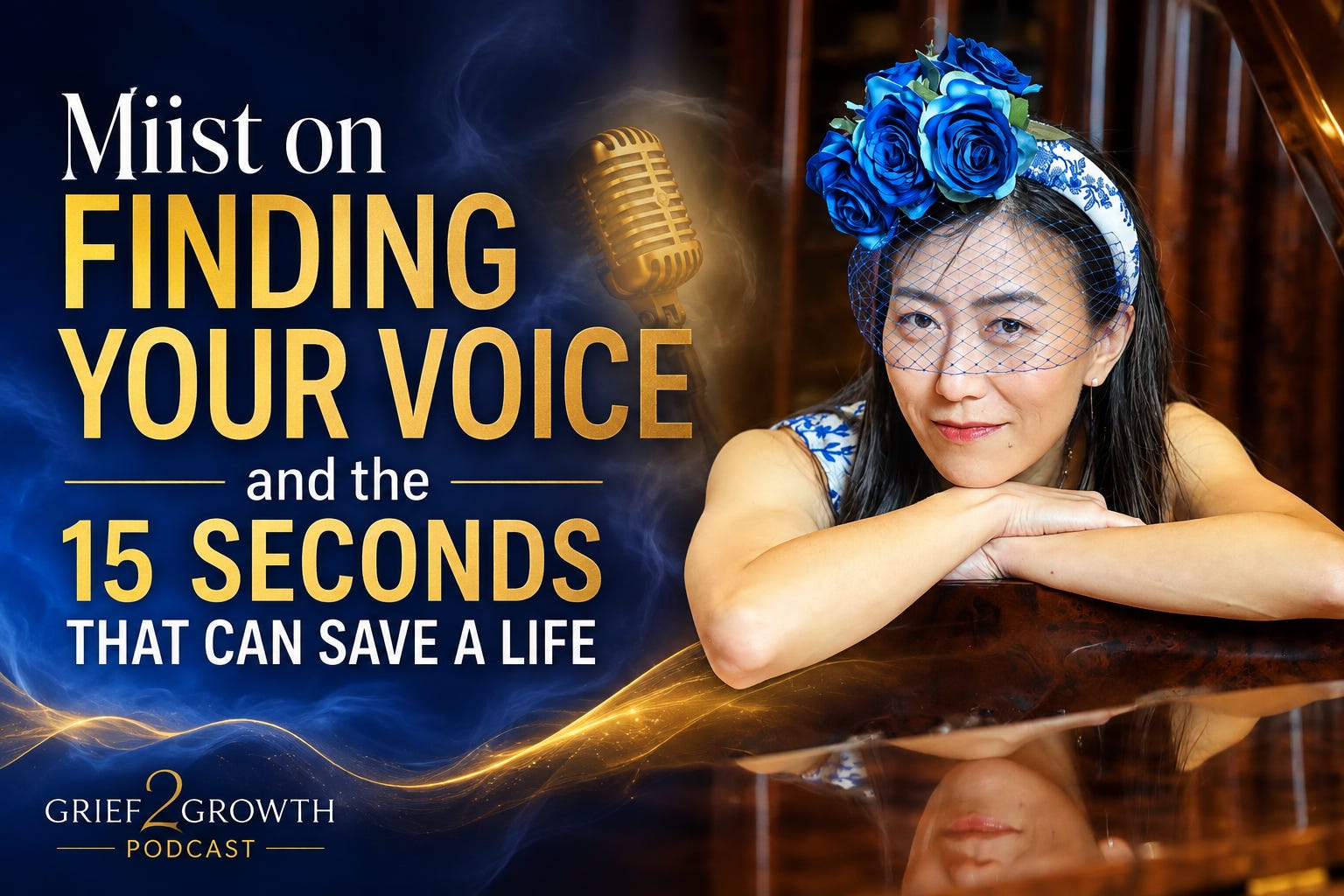
Miist’s résumé will get your attention. Billboard charting. The first native Chinese artist to reach the Pop AC chart. A top-ranked mental health podcast, and now a book.
I invited her for a different reason.
She was abandoned at five, handed a terminal cancer diagnosis at 28, and didn’t write her first song until she was 34. Every one of those things could have hardened her. She turned them into a question she asks out loud, in public, over and over.
How do we reconnect with ourselves and with each other when everything around us says shut down?
I’ve recorded almost 500 of these conversations. I’ve never once interviewed someone who had an easy life. Not one.
Miist is a living example of grief to growth.
Miist was five years old when her parents removed themselves from her life. They chose to go.
“They yanked themselves out of my life. It’s not like they couldn’t contact me or come and see me. I know they can. They just chose not to.”
She said something I want you to hear carefully, because she was careful when she said it. She believes abandonment can hurt worse than losing a parent to death, and she meant no disrespect toward anyone’s loss in saying it.
I think she’s right. Here’s why.
When someone passes, the story your mind tells is that they were taken. When someone leaves, the story your mind tells is that you weren’t worth staying for.
A five-year-old can’t hold that distinction. So she does what every child does. She decides it must be about her.
I see this in almost every kind of loss, honestly. There’s an irrational thread of abandonment running through grief no matter how the person left. It shows up loudest in suicide loss, where survivors carry a feeling of being left behind that logic can’t argue away.
Here’s what that wound did to her friendships.
Every time she got close to someone, every time it started to click, she got scared. Then she cut it off.
“Subconsciously, I was asking myself, what if they also leave me? It’s going to hurt. So things are going too well. I better cut it off.”
She lost people who could have been best friends for life. Self-protection did that, not conflict.
Now she’s an adult, she understands exactly what she was doing, and she can’t find those people to apologize.
So she writes them songs instead.
That’s what she does with an apology she can’t deliver. She puts it in a lyric, sends it out into the world, and hopes it finds them.
I told her what I’d tell you. Don’t judge the child who did the only thing she knew how to do.
That little girl wasn’t being cruel. She was trying to survive an unbearable feeling with the tools a five-year-old has. Which is to say, almost none.
In her late twenties, doctors told Miist she had a month to live. Maybe three.
After all of these conversations, this part didn’t surprise me. She doesn’t feel anything bad toward that diagnosis.
Why? Because it brought her family back.
She traced it back further, to middle school, when she had her appendix removed. Her father, the one who left when she was five, showed up and stayed with her in the hospital for a few days. It was the first stretch of time they'd spent together since he walked out.
“So I always had this good feeling about being in the hospital. That’s when people show up in my life.”
Her family traveled city to city with her, chasing the best treatment. She was surrounded by love for the first time she could remember. No work, no studying. Just waiting on appointments and test results.
So she picked up a ukulele.
That’s how badly a human being needs to be loved. It overpowered the fear of a terminal diagnosis.
We talked about Maslow, how the hierarchy puts food and shelter at the bottom and self-actualization at the top. I’ve come to think it’s upside down. Take away love and hope, and the rest of it doesn’t hold a person here.
The ukulele videos went up on her social media and then sank down the feed, buried under everything that came after.
Years later, a friend introduced her to a man with a five-year-old daughter. They scrolled back far enough to find those old clips. They started listening.
The little girl started crying.
He asked Miist to record lullabies for his daughter. Every time she listened, she cried again. That’s the reason he decided to actually talk to this woman.
They married during COVID. And then he did something amazing.
Miist wanted to learn a few piano chords from YouTube. He kept stopping her.
“He said, from listening to you, I know that you have the gift of writing your own music and play by ear. Don’t let YouTube videos limit how you use your gift.”
They argued about it for six months. Six months.
Finally she sat down at the piano to prove him wrong once and for all. She couldn’t do it and she would show him.
She wrote three songs that day.
Not long after, a musician they met at a house show passed her music along to a friend, who passed it to producer Narada Michael Walden. He called and asked her to come to his studio.
When she got there, he sat her at the piano where Aretha Franklin recorded “Respect” and said, “Sing me something.”
Three hours later, he told her he wanted to produce her album.
“Narada, this is like a dream that I’m afraid to dream. But after what you told me, I’m not afraid to dream again.”
He told her to write a song about it. She did. It’s on the album.
Last December, Miist’s family lost their dog of twelve years. Before she passed, Miist said something to her husband that I’ve never heard anyone say out loud.
She told him they had to agree, in advance, to embrace the grief when it came.
“Because I know once the emotions kick in, I might not be able to think straight and pace myself. I’ll just try to grab everything to get rid of that feeling.”
She knew her own pattern. She’d spent her whole childhood learning how to make uncomfortable feelings go away.
So she made the choice before the feelings arrived, while she could still think clearly.
“So also in the moment, I wouldn’t feel that I was forced into having to deal with this. I chose to sit with it.”
There’s a world of difference between grief that happens to you and grief you consent to.
I tell people all the time that grief is patient. It waits as long as it needs to. You can outrun it for thirty years, and it will still be standing there when you finally stop running.
Miist decided not to make it wait.
When the vet came and explained that their dog was no longer enjoying her life, that she was staying alive for the family’s sake, Miist asked for three more days.
Three days to say yes to everything that dog wanted. Three days of a whole family, including their twelve-year-old daughter, paying complete attention to someone they were about to lose.
Out of those three days came something she didn’t expect.
She decided to find her father.
He left the family more than thirty years ago, when she was five. Apart from those few days beside her hospital bed in middle school, she hadn’t seen him in over twenty years.
She reconnected with him, and she forgave him.
“I re-thinked how I should treat everyone in my life if I had the knowledge of I’m going to lose them in three days.”
Then she said the thing that’s been rattling around in my chest ever since.
We should treat everybody the way we’d treat them if we knew we had three days left.
Because sometimes you do.
My daughter Shayna is fine one day and passes in her sleep the next. A friend of mine passes a few weeks shy of his sixtieth birthday. No warning. No vet at the door. No three days granted.
We tell ourselves we’ll make it up later. Later isn’t guaranteed to anybody.
Here’s where Miist’s work gets practical.
We look at loneliness, at whatever enormous thing is breaking in the world, and we think: I can’t fix that. So we do nothing.
Her answer was to shrink the action until nobody could refuse it.
Fifteen seconds. That’s it.
She created something called the Kindness Kube, and each side carries one action:
Smile. Everybody was given the ability to smile. Everybody has a second.
Be silly. Her family tests every action before she recommends it. For this one, they skip down their neighborhood walk while their twelve-year-old dies of embarrassment. People laugh. On the way back, they pass the same people and do it again. By the second round, the daughter joins in.
Be grateful. Even in the worst situation there’s something. That’s your little bit of light.
Say a kind word. To the person who makes your coffee every morning. You might be the first one to say something kind to them today.
Remind someone that you love them.
Every episode of her podcast, she stops and takes fifteen seconds to do one. Then she comes back and tells listeners what she did and how it felt.
Small enough that “I don’t have time” stops being available to you.
We recorded this episode on my birthday. My sixty-fifth.
I spent that day getting hundreds of messages telling me people are glad I’m here. My father called. It was lovely.
And it only happened because the calendar gave everyone permission.
Miist asked a question that I thought was profound.
“When was the last time you received a phone call that somebody you know just said, oh, there’s nothing, I just want to tell you I love you, have a good day, bye. How would you feel? If it’s a voicemail, how long would you keep it?”
I told her about the most viral thing I’ve ever posted on Substack.
It was a short post about calling my father on an ordinary Tuesday for absolutely no reason. No afterlife research. No grief theory.
That post went further than anything else I’ve written, and I’ve thought a lot about why.
Almost nobody does it. Everybody wishes someone would.
There’s a shirt I own that says “you are enough” on the front. The back says: dear person behind me, the world is a better place with you in it. People have said that seeing a shirt like that saved a life.
Mother Teresa said small things done with great love change the world. I’d argue they only look small from where we’re standing.
Miist said something in the last stretch of our conversation that I want to underline.
“I want to tell everyone that I’m still struggling. So that also helps them to see that even people who’s been through very tough stuff, they’re still struggling.”
She’s right, and it matters that she says it out loud.
People look at someone who does this work and assume we’ve arrived. That we’ve processed it and moved on to somewhere stable.
Shayna’s angelversary is about a month away. It’s always a hard stretch for me.
I was on vacation last week with my other daughter, in the same place we vacationed twelve years ago. I missed Shayna badly the whole time.
Ten years of work didn’t fail me. That’s what love does when the person is somewhere you can’t reach with your hands.
Every new struggle wakes up all the old ones. Miist described the feeling of thinking you’ve done the work and then having to do it again. She’s stopped expecting anything different.
Struggle is the norm. Once you accept that, you stop punishing yourself for still hurting.
You know my tagline. Planted, not buried.
Burying and planting are the exact same physical motion. You put something in the ground either way. What changes is your intention, and what you expect to happen next.
You bury what you don’t expect to see again. You plant what you’re waiting on.
Near the end, I pointed out to Miist that when I’d asked about the grief events in her life, she’d struggled to name them.
She doesn’t file them under grief anymore. She files them under the ways she was planted, and what grew out of that ground.
The compassion she has for lonely people didn’t come from nowhere. It grew out of a five-year-old who knew exactly what it felt like to be left.
Her newest song is called “Love Will Show Us Our Way.”
“I’m not asking anybody to change any action. But before you take that action, try to let love guide it, and see how you actually want to do it.”
I don’t believe the struggle in your life is an accident. I think it’s a feature, not a bug. It’s what we came here to do.
Take the fifteen seconds. Right now, before this feeling wears off.
Call the person you’ve been meaning to call. Not for a birthday, not for an occasion. Just to say you love them and you’re glad they’re here.
Somebody out there is holding on by whatever they can borrow today.
Listen to my full conversation with Miist wherever you get your podcasts, or on YouTube. She talks about her music, her book, and the fifteen seconds that might change somebody’s whole day.
Leave a comment below and tell me which of those five actions is hardest for you right now. I read every one.
Share this with somebody who’s feeling disconnected. That’s a fifteen-second action of your own.
Brian D. Smith is a grief guide, certified grief educator, and host of the Grief 2 Growth podcast. After losing his daughter Shayna in 2015, he has dedicated his work to helping others find evidence-based hope in the face of loss.

Comments
Nothing yet. Say the first thing.
Sign in to join the conversation.