
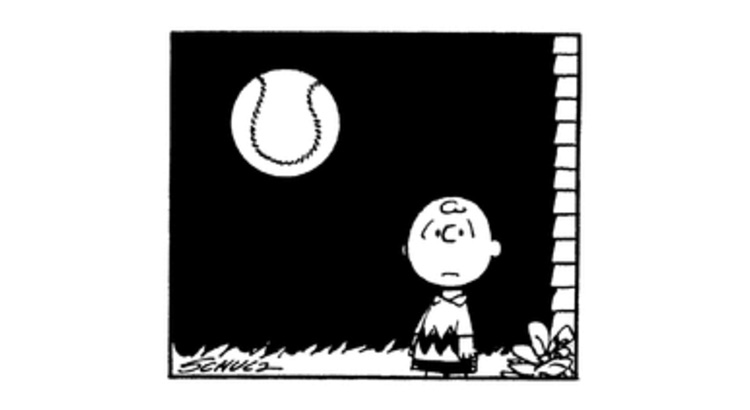
In 1963, on Saturday, July 20, a solar eclipse took place that passed in its totality through parts of Japan, the Soviet Union, Alaska, Canada, and Maine. For some reason, this particular eclipse seems to have been a notable cultural phenomenon at the time, with a big publicity build-up and a lasting cultural footprint.
Stephen King, who is from Maine, constructed a plot called The Path of the Eclipse around it, eventually the companion novels Gerald’s Game and Dolores Claiborne. John Updike, who would have experienced about 90 percent totality in nearby Massachusetts, wrote a short story in 1963 called “Eclipse” and specifically mentioned the 1963 eclipse in his 1968 novel Couples. Decades later, the third season of Mad Men depicted Don Draper in 1963 defying warnings against looking directly at the eclipse.
Before any of that, though, Charles Schulz did a weeklong series of Peanuts dailies for the actual week of the eclipse, ending on July 20, the day of the eclipse itself. In celebration of today’s total eclipse, here is the full 1963 eclipse storyline from Peanuts (with, of course, commentary, because I can’t help myself).
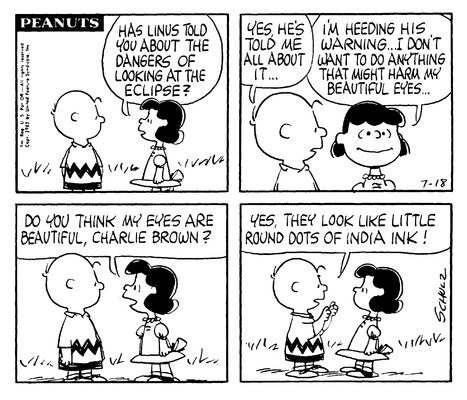
Per the Mad Men storyline, part of the publicity build-up to the 1963 eclipse (and any eclipse) were much-reiterated warnings about the dangers of looking directly at an eclipse. For his first eclipse strip on Monday, July 15, Schulz devoted his script to this PSA theme; he also touched on visual eclipse safety in three more strips below. I’m reminded a little of C. S. Lewis, in The Lion, the Witch, and the Wardrobe, repeatedly emphasizing to children how very foolish it is to shut oneself up in any wardrobe.
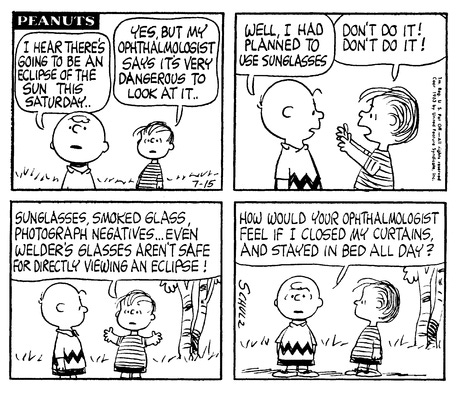
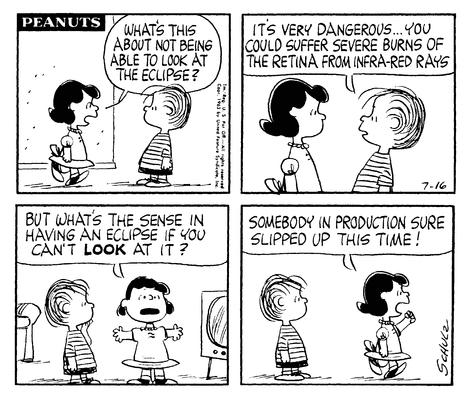
In his strip below for Tuesday, Schulz bent this theme, as was his wont, to tongue-in-cheek theological disappointment. Surely the universe could have been better designed to facilitate the awe and wonder, not to mention the enjoyment, of creatures like us?1
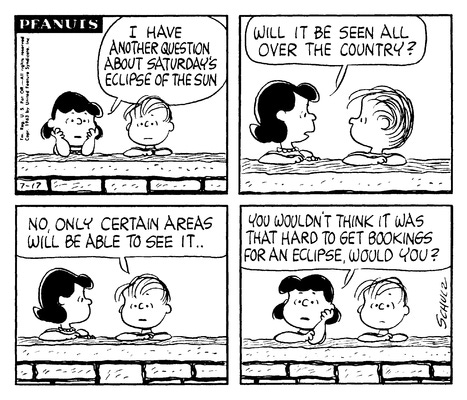
On Wednesday, Schulz gently expanded the theme of eclipse-related disappointment to the limited geographical range of the phenomenon. Not only cosmic production, but distribution also has let us down!2
Thursday’s strip below contains a flash of meta-humor surprising in its rarity in Schulz’s work. Commenters sometimes say that it was rare for Schulz to “break the fourth wall,” but this is far from true: Schulz often had characters turn straight to the camera to deliver the punchline to the audience.3 What is very uncommon is for his characters to express meta-awareness of being in a comic strip.4 Perhaps even more rare is what happens here: a character speaking to another character manifesting some kind of meta-awareness of the media that is their world.5
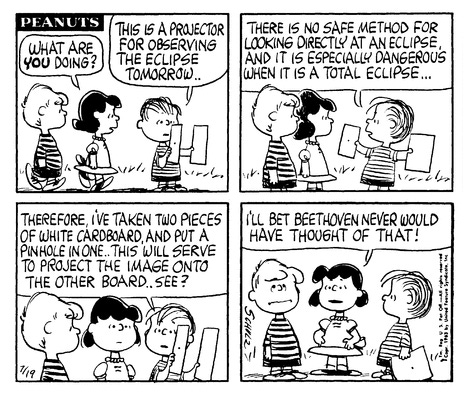
For Friday, Linus demonstrates the pinhole technique I mentioned in Monday’s eclipse post (in which I shared a photo of a collander projection of scores of little eclipse crescents). Schroeder has not a word of dialogue; he appears here solely to occasion Lucy’s punchline.6
Schulz turned in his work several weeks in advance, so the characteristic disappointment of his final Saturday eclipse strip below was based entirely on his sense of humor—not forecasts of the actual weather, which, in a number of Maine locations, turned out to mirror Schulz’s projection all too well.
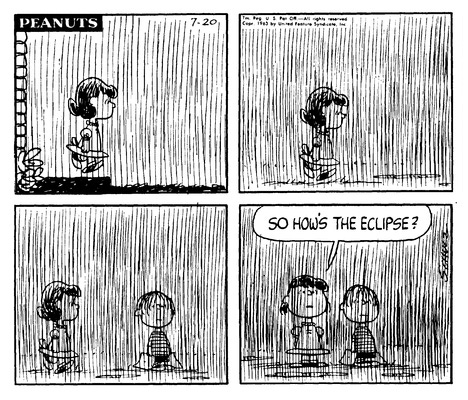
Note that poor, bedraggled Linus is still clutching his two sheets of white cardboard.
If you’re in Spain or some other eclipse-friendly location today, I hope you have better weather! (And if you’re interested in obscure Peanuts lore, be sure to read the footnotes.)
While working on this post yesterday morning, I paused for a brief exchange about Monday’s eclipse-related post with Orthodox Jewish writer (and serious Peanuts fan) Daas Yochid—and, on returning here, it occurred to me that the perilous, blinding power of an eclipse might be seen, not, as Lucy does, as a frustrating design fail, but as a salutary reminder of the existence of overwhelming realities exceeding the capacity of our senses—resonating with warnings in the Hebrew scriptures regarding the perils of seeing God.
Perhaps most notably, Exodus 33 famously highlights Moses’ “face to face” intimacy with God (33:11), but also depicts God telling Moses, “you cannot see my face, for no one can see me and live” (33:20). Revealing his “glory” to Moses, God positions Moses in the cleft of a rock, and covers Moses protectively with his divine “hand” as his glory passes by; finally, removing his hand, God allows Moses a glimpse of his “back,” but not his face (33:21–23).
Curiously, for this Wednesday strip, Schulz chose the iconic brick wall as the location for Lucy and Linus’s continuing conversation about the eclipse. Lucy and Linus Van Pelt are siblings, and their conversation starts indoors at their home; it’s the only indoor setting in the whole week of strips. On Monday, Thursday, and Friday, with one or Van Pelts chatting with a non–family member (Charlie Brown or Schroeder), Schulz unsurprisingly sets the dialogue outside, in generic grassy locations (Monday’s strip features a couple of aspen trees). I wonder why he moved Lucy and Linus outdoors to the wall for Wednesday, rather than using the wall for one of the Charlie Brown strips on Monday or Thursday. It might be that the philosophical tone of Lucy’s last thought was a better fit for the wall. Or perhaps he just didn’t give it much thought.
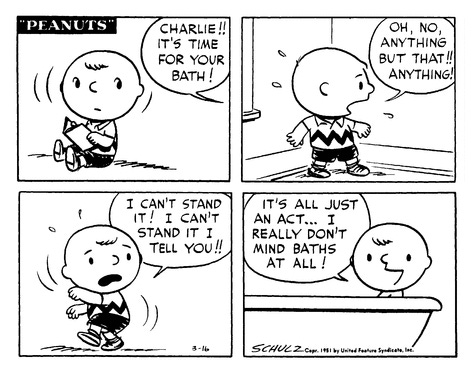
For example, Schulz had Charlie Brown break the fourth wall in a pair of structurally similar philosophical/theological baseball Sunday strips in 1965 and 1967 that I featured in a very popular post last November. The very early strip below, from March 15, 1951, is the very first example of such fourth-wall breaking humor in Peanuts, but Schulz went on to do it quite a bit. It’s not uncommon!
.
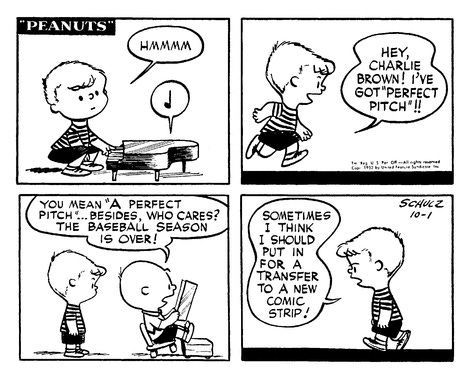
Below is another early strip, from October 1, 1952, is often incorrectly identified as the first example of a Peanuts character breaking the fourth wall, but it’s not (see note 3). In fact, it can be argued that Schroeder doesn’t even break the fourth wall here; unlike Charlie Brown in that 1951 strip, Schroeder might be talking to himself, not necessarily to readers. What he does—for the first time in Peanuts—is indulge in overt meta-humor, explicitly acknowledging his identity as a character in a comic strip. Indeed, this might be the only strip with this level of fully explicit self-awareness.
How rare is this self-aware exchange between Peanuts characters? This Thursday 1963 eclipse strip is the only such example I’m aware of. Could it be that the eclipse theme established an unusual level of convergence between the real world and the world of the strip, making this kind of meta-humor more likely in Schulz’s mind?
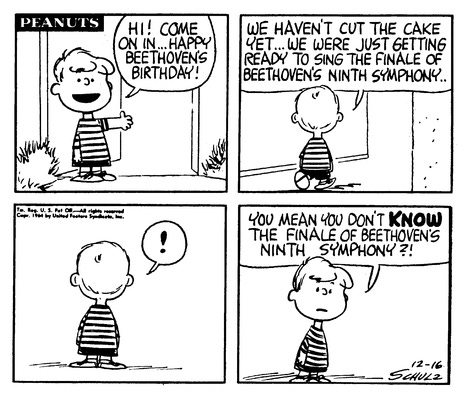
That said, it’s interesting that Schroeder, who back in 1952 had that unique moment of fully explicit awareness of his comic-strip miliu (see note 4), appears immediately after Charlie Brown’s “india ink” meta-joke. Did Schulz associate Schroeder with self-aware meta-humor? Below is a strip, from December 1964, startlingly establishing Schroeder as possibly the only character able to interact directly with viewers, addressing us and inviting us to participate in events as if we were characters in the strip. Largely on the strength of these two strips, it’s been suggested that Schroeder’s level of meta-awareness of his comic-strip milieu may be unique among Peanuts characters.
Comments
Nothing yet. Say the first thing.
Sign in to join the conversation.