
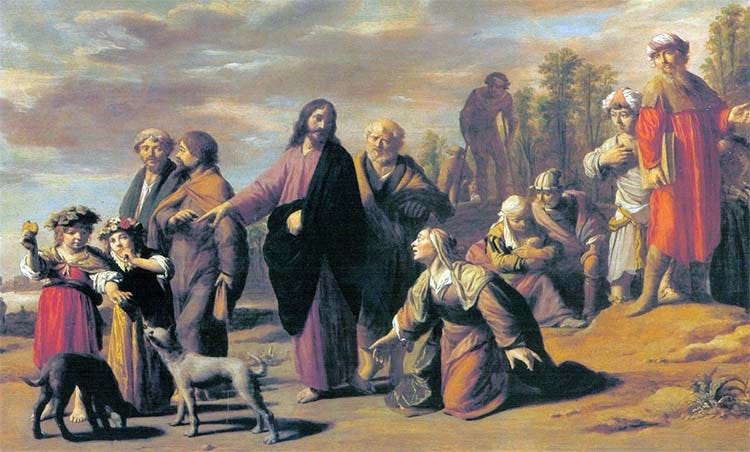
Note: The YouTube video was shot at my parish. The text below is a somewhat lengthier early draft, with content, including contextual scriptural commentary, that I deleted from the homily as I preached it in Mass, partly for length and partly for focus, but which I thought some readers might appreciate. The voiceover audio, recorded at home, follows the text.
An important word at Seton Hall Prep, where I teach theology, is “brotherhood.” An ethic of brotherhood is central to the culture of the Prep, and it’s meant to embrace all students and alumni in a shared bond for life. In principle, every student who enters the doors of the Prep is surrounded by young men who are meant to be family. Boys are boys, and the ethic isn’t always ideally realized, or even ideally understood, but it’s always there to strive for.
Certainly at my high school, when I was that age, there was no conception of anything
like family! Far from it. In my experience, many adults look back at high school as a time of social anxiety, if not actual trauma. Particularly around this time of year, with September looming, each new classroom a new environment with unknown challenges. Will I be accepted? Will I find someone to sit with in the cafeteria?
Acceptance, welcome, is a fundamental human need. We all want and need to belong, to be accepted and valued for who we are and who God created us to be. We all need family. In Catholic teaching, God himself is a family—a community of love, the Holy Trinity, Father, Son, and Holy Spirit—and he created us in his image to be his extended family members, and, therefore, brothers and sisters to one another.
Unfortunately, we fallen human beings find it all too easy to deny to others what we need and want ourselves. To define our cafeteria table by who isn’t welcome to sit with us. This table belongs to us—whoever “us” is. The popular crowd, the cool kids, jocks, stoners, goths, hipsters, whoever. If you aren’t one of us, you aren’t welcome here.
Now put yourself in the position of the Canaanite woman in today’s Gospel: a non-Jewish, Gentile woman turning in desperation to this visiting Jewish holy man and healer. You’re a mother. Your child is in torment. This man may be your only hope. And what does he say? “I’m not here for people like that. I’m here for the children, not the dogs.” Can you imagine hearing words like that from Jesus, of all people? If it were anyone else, we’d say it sounds racist. But if it’s not that, what is it? What’s going on here?
Let’s take a step back. Did you notice that all of today’s readings assume a kind of division among humanity, but also challenge that division?
Pretty much the whole story of the Bible, in fact, can be seen as the Creator of everything and everyone responding to the fall of humanity by establishing a special relationship with one particular group of people—the chosen people of God, the Hebrews or Israelites, later called the Jews—and everyone else, the whole rest of humanity, was not chosen, not included. They were left out. We were left out—we non-Jews, we Gentile “nations,” goyim in Hebrew. We were not invited to join Israel at God’s table.
Not at first.
The prophet Isaiah, in today’s first reading, opens the door to “the foreigners who join themselves to the Lord.” These foreigners, God says, he will bring “to my holy mountain and make joyful in my house of prayer”—the Temple, Solomon’s Temple in Jerusalem, which God says “shall be called a house of prayer for all peoples.” Not just Israelites.
Then there are the words we just sang from our responsorial psalm, Psalm 67: “O
God, let all the nations praise you!” “Nations”: goyim, Gentiles. The Hebrew psalmist is calling for the true God to be praised, not just by Israelites, but by all of humanity. Saint Paul, in the second reading from Romans, writing to Gentile Christians in Rome, calls himself “the apostle to the Gentiles,” and describes God’s ultimate plan to have mercy on all, Jews and Gentiles alike.
From Paul’s perspective, this is what Jesus came to do: to make Jews and Gentiles “one, breaking down the dividing wall of enmity,” as Paul writes in Ephesians. And not just that wall: all dividing walls, all tribal boundaries, separating us and them. In Christ, Paul writes in Galatians, “there is neither Jew nor Greek . . . slave nor free . . . male nor female, for you are all one in Christ Jesus.” No Black or White, Asian, Indian, Hispanic, Latino; rich or poor, young or old, native or immigrant: all are called to be one. Every form of tribalism or prejudice or racism is the opposite of the gospel of Christ. His table is for everyone.
Our Lord himself, starting out his ministry in Nazareth in Luke 4, makes a point of provoking his Jewish neighbors by reminding them of two Old Testament stories about God having mercy on two Gentiles: the widow of Zarephath and Naaman the leper. They weren’t Jewish. One was Phoenician and the other was Syrian. And this woman begging Jesus’ help today is kind of both: She’s Syrophoenician, Mark tells us. So Jesus has already told his own prejudiced neighbors, who tried to kill him for it, that God helps people just like this woman, sometimes before helping Jews!
So why does Jesus turn around and seemingly reject this woman? “I was sent only to the lost sheep of Israel.” In John’s Gospel, in the Good Shepherd discourse, Jesus calls Gentiles “other sheep, that are not of this fold,” and says, “I must bring them also, and … there shall be one flock, one shepherd.” Christ the Good Shepherd wants to make “one flock” of both Jews and Gentiles. He himself was sent by his Father to the lost sheep of Israel, but he’s going to send his apostles to make disciples of all nations, Jews and Gentiles.
So that much makes sense. But why the seeming harshness with this woman? “It’s not right to throw the children’s food to the dogs.” The traditional explanation is that Jesus was testing her faith. Maybe so. He never tested anyone else’s faith that way, though.
Some of you may have heard recent commentators suggest that perhaps Jesus allowed the woman to push back on his own preconceptions, so that he learned something from her. I have a problem with that. Did Jesus learn things in his humanity? Sure, but he definitely understood, at this point in his life, that Gentiles aren’t dogs! (They’re “other sheep”!)
Not all Jews understood this, though—and that may be the point. Look how Matthew depicts the disciples reacting to this woman: not asking Jesus to grant her request; asking him to “send her away.” She’s annoying them. They don’t care about her problem. Is she a “dog” to them? It’s to them, not to her, that Jesus says, “I was sent only to the lost sheep of Israel.” He doesn’t send her away, though, does he? So when Jesus says, “It’s not right to throw the children’s food to the dogs,” could he be voicing a not uncommon Jewish prejudice, shared, perhaps, by some of his disciples? Could he be allowing this woman to push back on their preconceptions?
What about us? Does Jesus push back on our preconceptions?
Jesus’ table is for everyone. We are all called to be brothers and sisters, all family. And not just Catholics! The whole human race is one family with God as our Father—as popes have made particularly clear for the last 150 years. The Church is meant to make the universal brotherhood of all human beings visible on earth. The Church has a beautiful title in the Catechism of the Catholic Church: “the sacrament of the unity of the human race” (CCC 775). The Church is meant to be the sacrament, the efficacious visible sign, of the human race’s unity. How are we doing on that? How are we helping to make this a reality this in our lives, our parishes, our communities?
Here’s a small example: A few weeks ago, at the end of one of our Masses, our celebrant made a point of commenting positively on the presence of infants and young children, even noisy children. I guess one or more children had been making some noise—I hadn’t noticed—and it was important to our celebrant to be totally clear that families with noisy infants and young children are most definitely welcome here, in case there was any lack of clarity on that point. At another parish in this archdiocese, a family I know of that needed a Sunday evening Mass wound up at a Mass last year where apparently infants and toddlers were officially not welcome—and they were asked to leave before Mass had even begun! Can you imagine? Just kicked out. No Sunday Mass for you this week. 7:30 PM, your family is out of options. Not only that, this parish had a long list of finger-wagging rules for families with young children at other Masses. There are enough spaces in our society where families with small children are treated like second-class citizens. The Church is the last place that should ever happen.
In some places in this country, just 75 years ago, there were segregated parishes: separate churches for White and Black Catholics, or separate seating, and White Catholics received Communion first. Just eight years ago, the USCCB wrote a pastoral letter on racism, Open Wide Our Hearts, acknowledging acts of racism “committed by leaders and members of the Catholic Church—by bishops, clergy, religious, and laity—and her institutions.” The bishops wrote:
Some may believe that racism is no longer a major affliction of our society . . . But racism still profoundly affects our culture. . . . What is needed, and what we are calling for, is a genuine conversion of heart, a conversion that will compel change, and the reform of our institutions and society. . . . All of us are in need of personal, ongoing conversion. Our churches and our civic and social institutions are in need of ongoing reform. If racism is confronted by addressing its causes and the injustice it produces, then healing can occur.
Pope Leo, in his encyclical Magnifica Humanitas, writes:
A litmus test for social justice today is the treatment of migrants, refugees and those forced to move due to poverty, violence, climate change and environmental disasters. The way a society treats them reveals whether its sense of justice is driven by fear or by the spirit of fraternity.
The Holy Father has repeatedly criticized mistreatment of immigrants in the U.S. Here in the Newark area alone, three Delaney Hall detainees have now died in the last eight months.
What can we do? None of us can fix the world, but we can start where Jesus does with the Canaanite woman: He listens to her cries. We can listen, without preconceptions or defensiveness, to the cries of brothers and sisters who have been excluded or marginalized for any reason. Pope Leo in Magnifica Humanitas: “Listening to the victims of spiritual, economic, institutional, sexual and power-based abuse . . . is an integral part of a journey toward justice.”
How can I let people around me know that I see and hear them? How can I be alert to the ways that some people around me may contribute to excluding or marginalizing others, and stand up for my brothers and sisters? How have I potentially been part of the problem? What does God want to change in me?
Lord, let your Church be seen more and more clearly as the sacrament of the unity of the human race. May your whole human family on earth be one. Amen.
Comments
Nothing yet. Say the first thing.
Sign in to join the conversation.