
A total eclipse of the Sun is an exciting and dramatic event. The most recent solar eclipse occurred on April 8, 2024, and Suzanne, RN and I both wound up with eclipse-related T-shirts, for very different reasons. I happened to donate platelets on that day, and the company I donate with, Vitalant, gave me an eclipse-themed blood donation T-shirt—and eclipse glasses, which were certainly handy. Also, that date was Suz’s birthday, and I got her a commemorative T-shirt depicting the stars in the sky in the positions they were in relative to the eclipse (and, therefore, on her birthday).
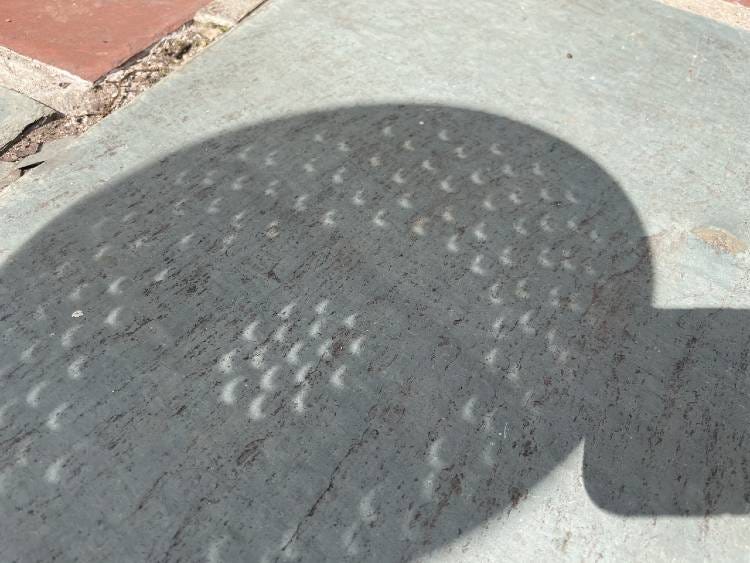
The totality of the 2024 eclipse was not, alas, visible from our location in northern New Jersey: We got about 95 percent totality, which meant that the light dimmed considerably and the temperature dropped, but without eclipse glasses it would have been much less cool. (We also used the pinhole effect to measure the eclipse’s progress. A collander, for example, projected scores of tiny eclipse-shaped light spots on the ground.)
This Wednesday—August 12, 2026—is another total eclipse! However, the totality will not be visible in the U.S., or anywhere in the Americas. On land, it will be visible in eastern Greenland, western Iceland, the north of Spain, and a bit of Portugal. Varying degrees of partial visibility will apply to most of the rest of Europe, the northern part of North America, and western Africa.
A total eclipse happens when the path of the Moon around the Earth takes it directly between the Earth and the Sun, so that the Moon’s shadow passes across the face of the Earth, completely blocking the light of the Sun for some viewers and partially blocking it for others.
A total eclipse as we experience it is possible because of an odd coincidence.
The Sun is of course vastly larger than the Earth (over a million Earths would fit inside the volume of the Sun), while the Moon is much smaller than the Earth. A fortiori, then, the Sun is far, far bigger than the Moon; in fact, the diameter of the Sun is about 400 times that of the Moon. The odd coincidence is that the Sun is also about 400 times farther away from the Earth than the Moon—and the correspondence of these ratios means that, from where we stand on Earth, the apparent size of the discs of the Sun and the Moon are almost exactly the same. In other words, the angular diameter of the Moon and the Sun match almost exactly.
This is what makes an eclipse the dramatic sight that it is: If the Moon were significantly closer to the earth, the totality of an eclipse would obscure, not only the Sun itself, but also the Sun’s corona, and the sky would simply look like night with a big patch missing. If the Moon were just a little further away, it would not be able to block the entire disc of the Sun, and we would get, at best, a partial eclipse in the form of a ring.
The latter, in fact, is not a hypothetical; it is what will happen, though not for a very long time indeed. The number of future total solar eclipses on Earth is limited, because the Moon is very slowly drifting away from the Earth, at an average rate of about an inch and a half per year. Happily, this drift is slow enough that the Earth will continue to get total eclipses for about 600 million years yet! At some point in the far future, though, the Moon will be too far away to block the Sun completely.
Fascinatingly, two other factors that will very slightly affect when the last total eclipse will take place on Earth include changes in the actual (not apparent) diameter of the Sun and the distance in the Earth from the Sun.
The Sun’s diameter is not constant; in the millions and billions of years to come, its diameter will increase—and not in a linear way, like the Moon drifting from the Earth. Over the next 600 million years, the Sun will grow a tiny bit bigger—thus slightly hastening the arrival of that last eclipse. On a time frame of billions of years, the Sun’s diameter will begin to change much more dramatically as it approaches red giant status, eventually expanding to swallow the Earth’s current orbit, and the Earth itself.
Between now and the last total eclipse, though, as the Sun expands, it will also lose mass and therefore gravitational pull, and the Earth’s orbit will slightly expand, slightly decreasing the Sun’s angular diameter, or apparent size from Earth. However, this effect is smaller than the growth in the Sun’s actual diameter. 600 million years from now, despite the Earth being a little further away from the Sun, the Sun will appear larger from Earth than it does today1—and that last total eclipse may arrive somewhat earlier because of it.
The answer here may surprise you: How big do you think the Moon is compared to the Earth?
Here’s a hint, or maybe a riddle: The Moon’s surface gravity is about 17 percent (1/6th) that of Earth. Pick one: Is the Moon about . . .
27 percent as big as the Earth?
7 percent as big as the Earth?
2 percent as big as the Earth?
1 percent as big as the Earth?
(. . . Jeopardy music . . .)
Many astute readers, I’m sure, are wondering just what I mean by “big.” Do I mean diameter? Surface area? Volume? Mass? Some may have guessed that I mean all four—and that each of the above percentages is correct for one of those four measures.
The Moon’s diameter is about 27 percent that of the Earth (about 2,159 miles to 7,917.5 miles)
The Moon’s surface area is about 7.4 percent that of the Earth (about 14.6 million square miles to 197 million square miles)
The Moon’s volume is about 2 percent that of the Earth (5.2 billion cubic miles to 260 billion cubic miles
The Moon’s mass is about 1.2 percent that of the Earth (7.34 x 10^19 metric tons to 5.972 × 10^21 metric tons)
This means, among other things, that the Moon is less dense on average than the Earth (which makes sense for a body of less mass).
But wait! Didn’t I say that the Moon’s gravity was about 17 percent that of Earth? Here’s the riddle: If the Moon has only 1.2 percent of the mass of the Earth, shouldn’t the Moon’s gravity be much less than 17 percent that of the Earth? How can the Moon’s gravity be that strong?
The answer is that when you stand on the surface of the Earth, most of the Earth is much, much farther away from you than any of the Moon is when you stand on the Moon—and all that far-away Earth affects you much less.2 In other words, surface gravity depends not just on the total mass of the body, but also on how much space that mass is spread out over; the bigger the body relative to the mass, the weaker the gravity.3
So, yeah, if you took the mass of the Moon and spread it out to an Earth-sized ball, it would have barely any gravity. Conversely, if you condensed the Earth into a ball the size of the Moon, its gravity would be much, much stronger.
And that’s all I have to say about all of that! Hope you enjoyed this.
Sun and Moon, bless the Lord. Stars of heaven, bless the Lord. Let the Earth bless the Lord: praise and exalt him above all forever.
In principle, I mean. To whatever may be alive on Earth to witness it. 600 million years from now, conditions on Earth will be quite different than they are today, and quite possibly much less hospitable to life as we know it. If recognizable descendants of Homo sapiens are still alive on Earth, they will very likely be vastly different from us in ways we might not be able to begin to guess.
Because gravity always pulls us toward the center of the Earth (or the Moon), it’s easy to imagine gravity originating from the core of the body in question—but this is misleading. Gravity originates from every individual bit of matter; you are being pulled, say, to your left by all the bits of Earth to your left, but also right by all the bits of Earth to your right, etc. and these average out and pull you downward toward the core.
Imagine, say, a hot-air balloon 50 feet in the air, with dozens of cords held by dozens of people evenly distributed in a circle all around it. If all of them pulled their cords at the same time and at the same rate in their various directions, the balloon would move straight down, even though no one is pulling it straight down. That’s a little like how all the bits of Earth around you work together to pull you straight down. Of course the bits of Earth that actually are directly under you do pull you straight down too.
Does this make sense, or am I only making it worse?
More technically: Surface gravity is proportional to mass, but inversely proportional to the square of the radius.
Comments
Nothing yet. Say the first thing.
Sign in to join the conversation.