
The FDA approval of a brand new cholesterol medicine from Merck called enlicitide, which will have the brand name Lipfendra, is big news.
It’s the first oral PCSK9 inhibitor for lowering LDL cholesterol. The other two drugs in the class are both injections. The coverage has been uniformly excited and positive. The New York Times framed it as an unambiguous win.
A lot of that excitement is earned. But as I reread the NEJM paper that led to approval, the Merck press release, and the media coverage, I found myself channeling my inner Bill Simmons.
Sometimes when it seems like a finding is too good to be true, it’s a good idea to raise your hand and wonder, like Simmons does from time to time with athletes, “Are we sure enlicitide is good?”

The answer is that it might be. Enlicitide actually might be great.
But there’s a huge difference between might be and definitely is.
Enlicitide is the first oral version of a type of drug called a PCSK9 inhibitor. When I wrote about PCSK9 inhibitors before, I called them the coolest medical story of the 21st century that you haven’t heard about:
The quick story - investigators found a genetic variant linked to low cholesterol levels and low heart disease risk, and within a decade, we had two drugs, evolocumab (Repatha) and alirocumab (Praluent), that mimicked the genetic defect and were found to prevent heart attacks and strokes.
It’s one of the real triumphs of modern medicine.
Enlicitide goes after that same pathway. In the CORALreef trial it lowered LDL by over 50%, which is similar to what Repatha and Praluent do.
Same mechanism, similar numbers. And it's a pill. The injectables are excellent, but plenty of people just don't want a shot, and that keeps a lot of patients off therapy they might benefit from.
An oral PCSK9 inhibitor fills a real gap. If it holds up, this is a genuine advance, not a me-too.
So far, so good. But that doesn’t get us to the finish line.
Enlicitide has not been studied for that long - CORALreef followed patients for 52 weeks. Heart disease isn’t a condition that we treat over a year. It’s one we may be treating over decades. And the trials establishing the benefit of other drugs in this class follow people for years to help us understand their effect.
So we don’t (and can’t) know that much about whether enlicitide truly saves lives.
Let me be clear about what I am *not* saying. I'm not doubting the theoretical benefit of inhibiting PCSK9.
Someone who is born without normal functioning PCSK9, or someone who has their PCSK9 inhibited with Repatha and Praluent, is less likely to have a heart attack, have a stroke, or die. That mechanism is as settled as anything in cardiology. I’m not questioning that.
What I'm questioning is narrower, and I think is an important part of understanding something before prescribing it widely: how much do we really know about this specific drug?
A mechanism is not a molecule. Enlicitide is a new compound - a macrocyclic peptide that binds to PCSK9.1 It’s a slightly different way of working than the other PCSK9 drugs, which are monoclonal antibodies.
Different compounds can hit the exact same target and behave completely differently once they're inside an actual human being. The only way to tell them apart is to test each one, on its own, against hard outcomes - hard outcomes in this case means heart attacks, strokes, and death.
And we almost certainly need to follow people for years to see that signal.
Enlicitide has lowered LDL beautifully, but it’s been studied just for LDL lowering. We don’t know what that means in terms of the things patients actually care about.2 The outcomes trial, CORALreef Outcomes - studying more than 14,000 patients on the drug for years - won't report for a few more years.
At the end of the New York Times piece on enlicitide’s approval, there’s this important paragraph:
In studies of the injectable drugs, blocking PCSK9 reduced the incidence of heart attacks, strokes and cardiovascular deaths by 20 percent in high-risk people. Merck is conducting a study now to see if Lipfendra has the same effect. Dr. Dean Li, president of Merck Research Laboratories, said he is confident that it will.
I hope he’s right. He may well be. But we’ve heard strong but misplaced confidence from Pharma company executives about drugs before outcomes data in the past.
In 2006, Pfizer had a lipid drug called torcetrapib, a drug from a class of medicaions called CETP inhibitors that raised HDL and lowered LDL incredibly well. Pfizer's CEO told investors it would be "one of the most important compounds of our generation."
Shortly afterward that statement, Pfizer killed the program when the outcomes trial showed a roughly 60% increase in deaths, from an off-target effect that the cholesterol numbers gave no hint of.3
And the part that makes the story of the CETP drugs one the most instructive stories in the history of medicine is that the other compounds in that class of medications didn't all fail the same way, and they didn’t all fail.
Dalcetrapib failed because it raised HDL but didn’t really touch LDL. Anacetrapib succeeded because of its LDL reduction. And obicetrapib might be the most exciting heart disease drug we’ve had in a long time (emphasis on the might).
So just because two PCSK9 inhibitors have been successful does not guarantee that enlicitide will be.
If the CETP story feels too easy to wave off - different target, older drugs - then look at the Repatha story.
Repatha is a drug I didn’t feel fully comfortable with until this past year when VESALIUS was published, which I wrote about here.
The reason for that is that the initial study that demonstrated the heart attack benefit of Repatha, the FOURIER trial, didn’t show a life saving benefit - the group that received Repatha actually had more deaths than the group that received placebo:
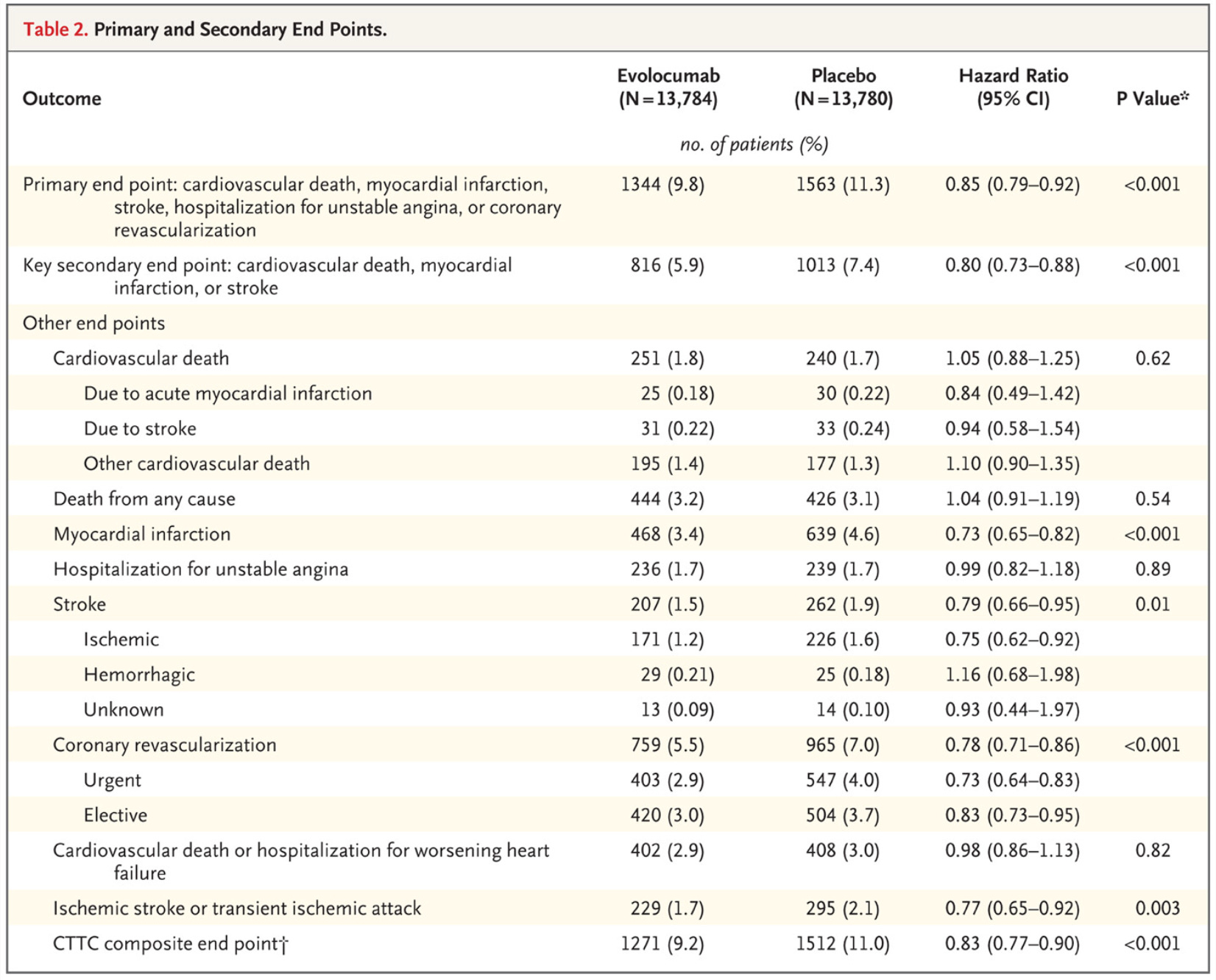
It wasn’t until VESALIUS that we saw the signal for life saving benefit from Repatha.
And so it might be a while before I have any real confidence in enlicitide. A beautiful cholesterol panel doesn't guarantee that a drug is lifesaving.
On the target, enlicitide is on solid ground. On the LDL and apoB impact, it seems like things are great.
It will *probably* work. But "probably" isn't "definitely," and enlicitide is a genuinely new molecule that we can’t assume inherits the safety or outcomes data from the other PCSK9 inhibitors.
As I've said before, the road to hell is paved with biologic plausibility.
So I'm not going to be writing a whole bunch of enlicitide prescriptions just yet.
I’m going to hold this drug to the same standard I hold for inclisiran (which I don’t prescribe because it doesn’t have outcomes data) and that I will for obicetrapib (I’m excited but waiting for the outcomes data).
Show me the data that a drug is life saving and I'm ready to be a believer.
And heart disease isn’t an orphan condition where we have no other options. For a disease where I already have 4 different classes of medications with long-term and outcomes data behind them, "lowers LDL beautifully" isn't enough on its own to change what I do in my clinic.
And I want to be clear which side of this I'm on. I really want enlicitide to work. An oral PCSK9 inhibitor that holds up in CORALreef Outcomes would be a really big deal that would fill a real need for a lot of real patients.
The promise is enormous. But right now it’s potential.
Ask me again in 2029. Until then: are we sure enlicitide is good?
If you believe in what I’m doing with this newsletter, please subscribe and share.
You would be correct to say that enlicitide is a peptide. But I don’t expect it to be embraced by the longevity world the same way they’re embracing GHK-Cu.
I tell patients all the time that you don’t get extra points for having a perfect LDL or any other metric. Your goal is to prevent the bad things from happening, to the extent that we have any control over that.
I know that we have short term safety data on this drug. And I know that Pharma has learned some lessons from past failures. But that doesn’t mean we can forego waiting for evidence.
No posts
Comments
Nothing yet. Say the first thing.
Sign in to join the conversation.