
With the news that Lindsey Graham died suddenly from an aortic dissection, I wanted to put out a quick post about what that it, why people die from it, who is at risk, and what you do about it.1
Graham isn’t the first famous person to die sudden from an aortic dissection - actors John Ritter and Alan Thicke, diplomat Richard Holbrooke, playwright Jonathan Larson all passed away from the same condition.
Ritter, in fact, was notably misdiagnosed and his family created a foundation and PR campaign about the Ritter Rules for thinking about aortic dissection to try to help raise awareness for the condition.
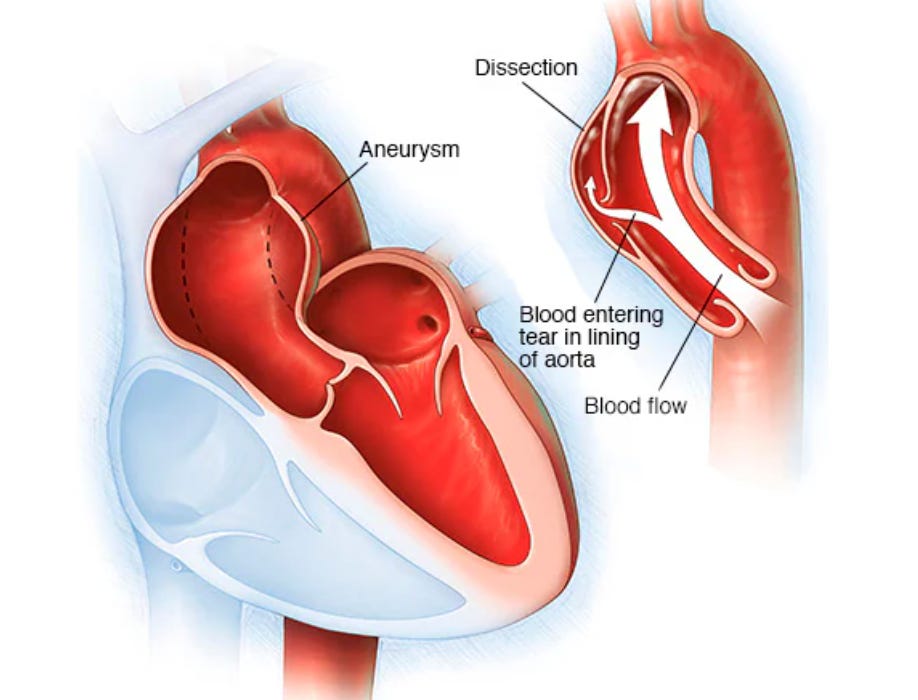
An aortic dissection is when the largest blood vessel in the body - the aorta - has a tear in it.
It’s often quoted that the risk of dying increases by 1-2% every hour for the first 24-48 hours after an aortic dissection happens.2
It’s often described in the hospital as a “can’t miss” diagnosis, but unfortunately, it’s also missed way too often.
The reason that such a dramatic diagnosis can be so difficult to actually diagnose is that people come to medical attention with very different types of symptoms with this diagnosis.
Sometimes the tear stays in a very small area, sometimes it propagates down to the heart (where it can actually tear the arteries around the heart or lead to blood rapidly accumulating around the heart), sometimes it goes up to the blood vessels that go to the brain (where it can mimic symptoms of a stroke), sometimes it can go around the arch of the aorta and then down into the abdomen (where it can tear the arteries to the kidneys, among others).
I’ve seen people come in with a sudden episode of passing out, crushing chest pain, ripping chest pain radiating to their backs, and even just abdominal pain. I’ve seen patients who were initially thought of as stroke patients actually have an aortic dissection.
These patients often have very abnormal lab values - some of the most crazy blood tests I’ve ever seen have been in patients with this diagnosis3 - and, very importantly, they often look sick. Looking sick is a hard thing to explain, but like the famous line, you know it when you see it.
And very importantly when you’re actually thinking about the diagnosis, I’ve never seen a patient with an aortic dissection scrolling TikTok or calmly eating lunch. They can’t, because they’re too sick.
When you talk to these patients after they’ve recovered, you often learn a story about how they were feeling unwell a few days (or even a few weeks) before they ultimately came to medical attention.
That was not part of the classic teaching that I had about making this diagnosis - it’s often described as an abrupt onset of severe chest pain radiating to the back - but my experience has been that these patients often have a some signs before things become catastrophic.
And so the fear of missing that diagnosis is part of why so many patients who come to an emergency room with chest pain (or back pain, or abdominal pain) get CT scans done rapidly when they come in.
It’s also why chest pain symptoms that come on as new shouldn’t just be blown off for many people.
There are 3 major buckets of people who are at elevated risk for aortic dissection, and they all have to do with people who are at risk for having problems with their aorta or other blood vessels:
Chronic, longstanding high blood pressure, which leads to enlargement of the aorta
Bicuspid aortic valve (a condition someone is born with that affects 1% of the population and can lead to an enlarged aorta)
People with connective tissue diseases like Marfan syndrome, Loeys-Dietz syndrome, or vascular Ehlers Danlos syndrome all have problems with the tissue in their blood vessels making them at risk for aortic dissection
The risk of dissection is proportional to the size of the aorta. The bigger it is, the higher the chance of tearing.
That makes intuitive sense - think of a balloon. As it enlarges, there’s more tension on the walls. The more tension there is on the walls, the higher the chance that the walls burst. The aorta is the same way - the bigger it is, the more likely it is to have a problem because there’s more stress on the walls.
Risk goes up as the aorta enlarges, and we usually use around 5cm to 5.5cm as a cutoff for when to think about surgically repairing someone’s aorta preventively. We also think about how fast its growing - faster growth likely means higher risk of rupture and so we intervene sooner.4
There are holes in our understanding of the right time to operate - after all, a 5cm aorta in a 6’4” person is not the same as a 5cm aorta in a 5’0” person.5
An echocardiogram is often thought of as a good screening test for an enlarged aorta.
It’s not a bad test to look for it, but it’s also not the best one. An ultrasound like an echocardiogram is a 2-dimensional picture trying to look at a 3-dimensional structure. It can get the aortic size wrong in both directions. I’ve seen echoes both underestimate and overestimate the true aortic size.
The better tests to do this are CT scans and MRIs, which are 3-D tools for a 3-D structure.6
Not every person with high blood pressure needs to be screened. The highest risk people to be screened that we should be aware of are:
People with a bicuspid aortic valve or a connective tissue problem
People with a family history of aortic dissection
People with suspected aortic enlargement based on other imaging
And ultimately, once you’ve seen an enlarged aorta, you’re likely just doing regular screening to make sure it doesn’t get too big or grow too fast.
The only fix for an enlarged aorta is surgery. Medications to slow the growth of the aorta are really focused on blood pressure control. We often use beta blockers and ARB medications7 to slow the growth, but a strategy of that compared to just excellent blood pressure control hasn’t been rigorously studied.
To summarize the big points here:
Aortic dissection can kill people quickly - 1-2% risk of death per hour.
People can have a lot of different symptoms - chest pain is most classic, but it can cause back pain, neurologic problems mimicking stroke, abdominal pain, passing out suddenly.
Risk is highest in people who have an enlarged aorta.
The most common risk factor for an enlarged aorta is chronic high blood pressure that’s not under control.
If you have an enlarged aorta, regular screening to look at size and growth is the standard of care.
The only fixes that we have for a very enlarged aorta are surgical, but we use blood pressure medications (particularly beta blockers and ARBs) to slow growth.
Knowing the signs to look for and who is at risk can save a life.
This post doesn’t have the usual workshopping and editing that I normally put in these things, because I wanted to get this out quickly in light of the news.
To be precise, there’s a difference between a type A and type B dissection, which impact different levels of the aorta.
Some examples for the medical folks here: the highest lactate I’ve ever seen in a patient who didn’t die (21), the highest d-dimer (over 22,000), the highest ferritin (18,000).
And patients with connective tissue problems often have interventions done at even smaller sizes.
We generally use an imperfect estimate called body surface area (BSA) to figure out the size of something adjusted for a person’s body area. Anything adjusted for size in medicine gets the term “index.” So indexed aortic diameter means the diameter is adjusted for someone’s size. It’s not perfect though because there are so many complexities that go into our body size measurements.
The measurements on these tests need to be taken precisely, because the aorta is moving and there can be considerable variation depending on who is doing the measuring.
No posts
Comments
Nothing yet. Say the first thing.
Sign in to join the conversation.