
“All of my friends told me I should just go do Function,” Harriet said before I could even tap my badge to log into Epic, “but then I realized that I could probably get the same tests from you and my insurance would cover them.”
Harriet’s journey to my cardiology clinic started in a normal way. She came to see me because a month earlier, at a visit with her OB-GYN, the doctor noticed that her blood pressure was high.
Harriet was dealing with some stressful life circumstances, but the doctor mentioned that she should keep tabs on the blood pressure situation.
Harriet did what most people would do. She looked it up on Google and bought a blood pressure cuff so she should could start checking her numbers at home. Her pressure seemed higher than it should be, but she started taking some propranolol that she’d been given for anxiety and that seemed to bring the numbers down.
Then she got captured by the algorithm.
First she came across a few Instagram reels about the natural ways to keep your blood pressure down. The content clicked with her because she’d been monitoring her pressure regularly, so she watched what she was being served.
Then, because she was engaging with the content, she kept getting more and more of it. Metabolic health. Protein intake. Fibermaxxing. Heart rate zones. And then the risk factors for heart disease that your doctor doesn’t test you for.
She had been chatting with her friends about this content. They were all getting plugged into the same world, scrolling through countless longevity doctors, entrepreneurs, and wellness influencers selling variations of losing weight, feeling better, looking younger.
Harriet opened the Notes app on her phone to show me what she’d written down in preparation for the visit.
“There’s a million of these influencers. You’ve probably seen all of their videos. This is the list of the tests they said I should get. I can’t stop watching their stuff, it’s all over my Instagram.”
One of the first things that you’re taught as a med student is to record a patient’s “chief complaint.”
The chief complaint is the reason why they’re seeking medical attention. It’s classically taught to us as something like chest pain, palpitations, or shortness of breath. The timeline of the chief complaint - how long the symptom has been going on for - often dictates a lot about how doctors evaluate a patient.
But in my clinic, I’m seeing the rapidly changing face of what people expect from their medical care and why they’re seeking it out in the first place.
What started for Harriet in a pretty normal way - her blood pressure was too high - was quickly mutated by the algorithm into something different - “these are the heart tests that everyone says I need.”
Harriet’s story is a common one that I see, and it’s a story that I bet everyone reading can identify with. You started on social media focused on one thing and before you know it, your feed is filled with a bunch of brand new strangers who are all giving you somewhat similar recommendations about something tangentially related, but assuredly different.
This is how the modern health internet works. If you engage with something, you get more of it. Then you get served related topics on increasingly emotionally resonant themes.
And the content that comes to you isn’t a bunch of independent thinkers who are each conducting bench research or carefully reviewing the scientific literature.
Instead, it’s a large number of people regurgitating each others’ science-y sounding claims, but they’re slightly reworked so that they come across as being original.
You start to see the same information, but just a tiny bit different, in a bunch of different places and from a bunch of different people.
And that repetition makes you confident that it’s true, because, when it comes to medical content, it’s easy to mistake something that is ubiquitous for something that is valid.
I thought it was interesting that Harriet’s friends all told her to get bloodwork done through Function Health.
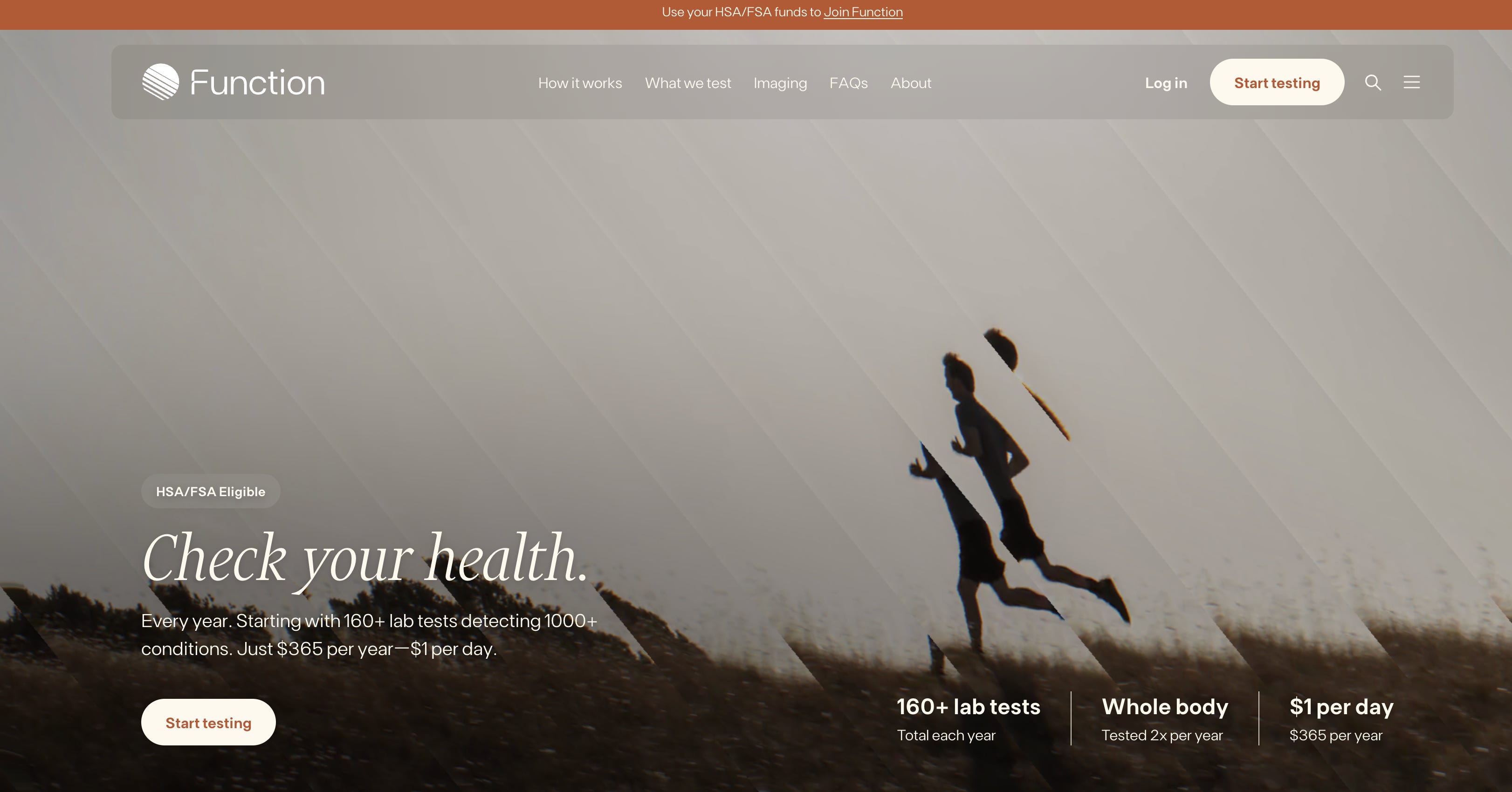
That wasn’t a coincidence.
When you spend time in this area of social media, it’s only a matter of time before you get an influencer recommending Function Health as the best way to understand your health in detail.
If you haven’t heard of Function, they’re a company that sells you over 100 blood tests for $365 a year (just $1 per day!).
Patients bring in Function labs to me all the time. Function markets itself as deeper insights into your health so that you can be proactive in identifying disease.1
They have a lot of big influencer relationships. Influencers are an explicit part of their marketing strategy, and once you learn about the economics of affiliate fees and how influencers make their money it starts to make sense why they’re so eager to hype Function.2 I wouldn’t be surprised if more than one person you follow has recommended doing labs with Function.
But in reality, Function’s service is basically a white label form of Quest Labs that capitalizes on the information gap between even the most sophisticated consumers and medical people.
The best example of why Function is a successful business, and also why so many doctors look down on what they do, is because they simultaneously bundle and unbundle bloodwork, which is the detail that helps you understand much of what drives their marketing.
There’s a famous quote from Jim Barksdale, who says that there are only 2 ways to make money in business: bundling and unbundling.
The bundling part is straightforward - 160 lab tests for $365 - so it feels like you’re getting a great value because of the absurd upcharging that happens in the medical world and what it would cost to buy these a la carte from Quest.
The unbundling part is the sneaky one. They have 15 different lab tests looking at things like blood counts, types of white blood cells, the size of your red blood cells. To Harriet, that looks like 15 independent windows into her health. But to a doctor, that’s just a single test: a CBC with differential.
Harriet recognized the limitations of what Function offers, “it seems like Function is a bit of a rip off. And I read that all the analysis is just done by an AI.”
The thing that Function does really well is their data visualization. They have a sleek interface, break the labs up in a way that makes them feel more “functional” instead of just based on the lab order (like your Quest printout would).
Function has discovered that the feeling of precision is a product. In a way, they’re selling granularity - 160 biomarkers, 14 blood count measurements, metabolic insights that medicine has been hiding.
In the real world, for most people, it’s fairly uncommon for Function labs to reveal anything new or insightful.
I’ve probably seen around 100 people who brought in Function Health bloodwork to the visit, so I’m not just saying this based on my own perception of the testing they do. I ask the patients who come to me what they got from it, and most of them basically have a “meh” response.
But ultimately, what Function sells isn’t much different than what the vast majority of health influencers that you see sell: information theater and the illusion of control.
Medical information for lay people can be useful.
It can clarify the “why” behind a condition that you or a loved one is dealing with.
It can help you know symptoms to look out for that might indicate a serious health issue.
It can motivate you to take action to improve your health - start exercising, get evaluated for sleep apnea, improve your diet, or start a medication for high blood pressure.
But more health information isn’t always better for people. Sometimes it creates unnecessary anxiety. Sometimes it leads to confusion about what’s healthy and what’s not. Sometimes it leads to unnecessary testing that can make someone’s life worse. And sometimes it distracts you with things that are useful for the general population so that you lose focus on would be important for you specifically.
The most insidious thing that this content does is makes people feel like the active process is learning, when it’s actually the doing.3
Mostly, the health content that people are increasingly served - and that increasingly influences what they expect from the medical system - is basically providing info-tainment that masquerades as insight.
Giving you a lists of tests to get doesn’t answer the more important question: what do you do with the information after you get it?
Doctors are always taught to ask “how would this test change your management” before ordering a test, and if it isn’t going to change what you do, why would you bother ordering it?
Influencers don’t need to ask that question, because they don’t have to deal with the results of your test. They make money because they tell you to get it done and they collect an affiliate fee from Function.
Harriet had a real medical issue that was impacting her - her blood pressure was too high - but the algorithm turned it into something different.
What many of these folks are selling is empowerment and control. It’s the premise that you can take charge of your health with the right information, and this is what the right information is.
But there is a real irony about how this plays out in real life - most consumers of this information end up getting served the same content, regardless of their personal circumstances or risk.
People are individuals who have different medical problems and different health needs. That matters for how we apply clinical trials, it matters for how we decide about testing, and it matters for what we decide on for treatment.
Yet the algorithm matches you with what you will watch, not what improves your health.4
So much of what my patients are served strips away that important context. “The 5 heart tests that you need to get” isn’t offered differently to the 35 year old who exercises every day and the 70 year smoker who feels short of breath when they walk up the stairs.
Think about Harriet. In a world where she didn’t get content from the algorithm, the focus of our visit would be almost entirely on her blood pressure.
How low should her blood pressure actually be? What lifestyle changes could be incorporated to improve it? When should she consider starting medications? Which medications make sense for her? What are their side effects? Are there any supplements that lower blood pressure?
The content that she was served deprioritized her most important current medical issue. And so even if it was objectively important content for a general audience, for her, it was actually actively misleading information.
Patients all need different things from the medical system. In Harriet’s case, we talked about her blood pressure as it related to her overall heart attack and stroke risk.
We discussed her family history, her stress levels, her other lab testing, her sleep quality, her obstetric history,5 what her preferences and goals of treatment would be.6
We settled on a strategy of monitoring the numbers regularly at home, trying to increase aerobic activity, and checking some additional tests to help understand her other risk factors.
And, as far as the tests on her Notes app, we did some of them but we didn’t do them all.
Because for most people, there is no absolute list of the “5 things you must do.” There are tests and there are people, and matching those in a way that makes sense to the individual is how I believe medical care should be.
They’re incredibly well capitalized with a bunch of celebrity investors - and a doctor-celebrity co-founder in Dr. Mark Hyman.
I’ll save the details of the influencer economy for another newsletter.
When I wrote about the patients coming to see me who were inspired by Peter Attia, I talked about something related that Attia talks about a lot: the operative part of acting early is taking action.
It’s ironic that the social media companies - who know almost everything about all of us - serve many of us the same depersonalized, generic information, regardless of our demographics.
An underappreciated part of evaluating cardiac risk is looking at obstetric risk factors for heart disease - PCOS, preeclampsia, gestational diabetes/hypertension, etc.
Personal preferences matter a lot when it comes to testing. Understanding how medicalized someone wants to be is a core part of my evaluation for them. Every time you send someone for a test, there’s the possibility that you get an incidental finding that you can’t ignore. And so no test exists in isolation - there’s always the possibility of a diagnostic cascade.
No posts
Comments
Nothing yet. Say the first thing.
Sign in to join the conversation.