
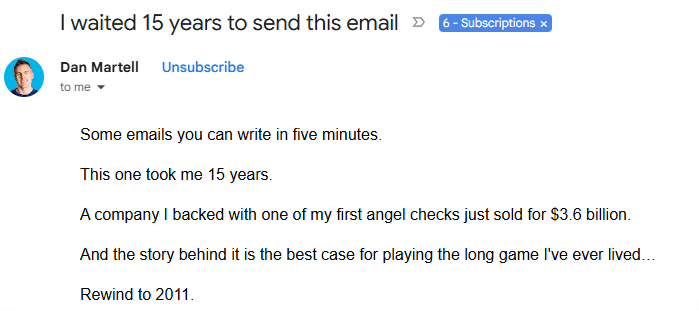
A few weeks ago, Dan Martell sent an email I could not stop thinking about:
If you don’t know Dan, he coaches founders, helps build companies as an angel investor, and is as honest as they come about money. One of his first angel investments, a check he wrote in 2011 to an Irish founder named Eoghan McCabe, is about to become one of the largest paydays of his life.
The company was Intercom, recently renamed Fin, and Salesforce has signed an agreement to buy it for approximately $3.6 billion, a transaction that’s expected to close later in Salesforce’s 2027 fiscal year. After fifteen years, Dan is finally about to see what his original bet became.
His email was about the importance of holding an investment instead of panicking and selling. Every few years, somebody would ask whether he wanted to sell his shares, and Dan would write to Eoghan and ask, “Are you still building?” Eoghan would say yes. Dan would hold, and he continued to hold through years when it looked to the outside world as if nothing was happening, as well as through years when taking the money would have been paid nicely. But because he trusted Eoghan, he waited. Now, Dan’s patience looks like a prophecy.
“The slow way is the fast way,” Dan wrote. Then he said something else that stayed with me: “I won because I wouldn’t walk away on him.”
Dan wants to be inspired by the founder, to understand the problem the company is solving and to know that he can be useful for more than the check. For him, investment is a relationship, which helps explain why his question to Eoghan was not, “What is the latest valuation?” It was, “Are you still building?”
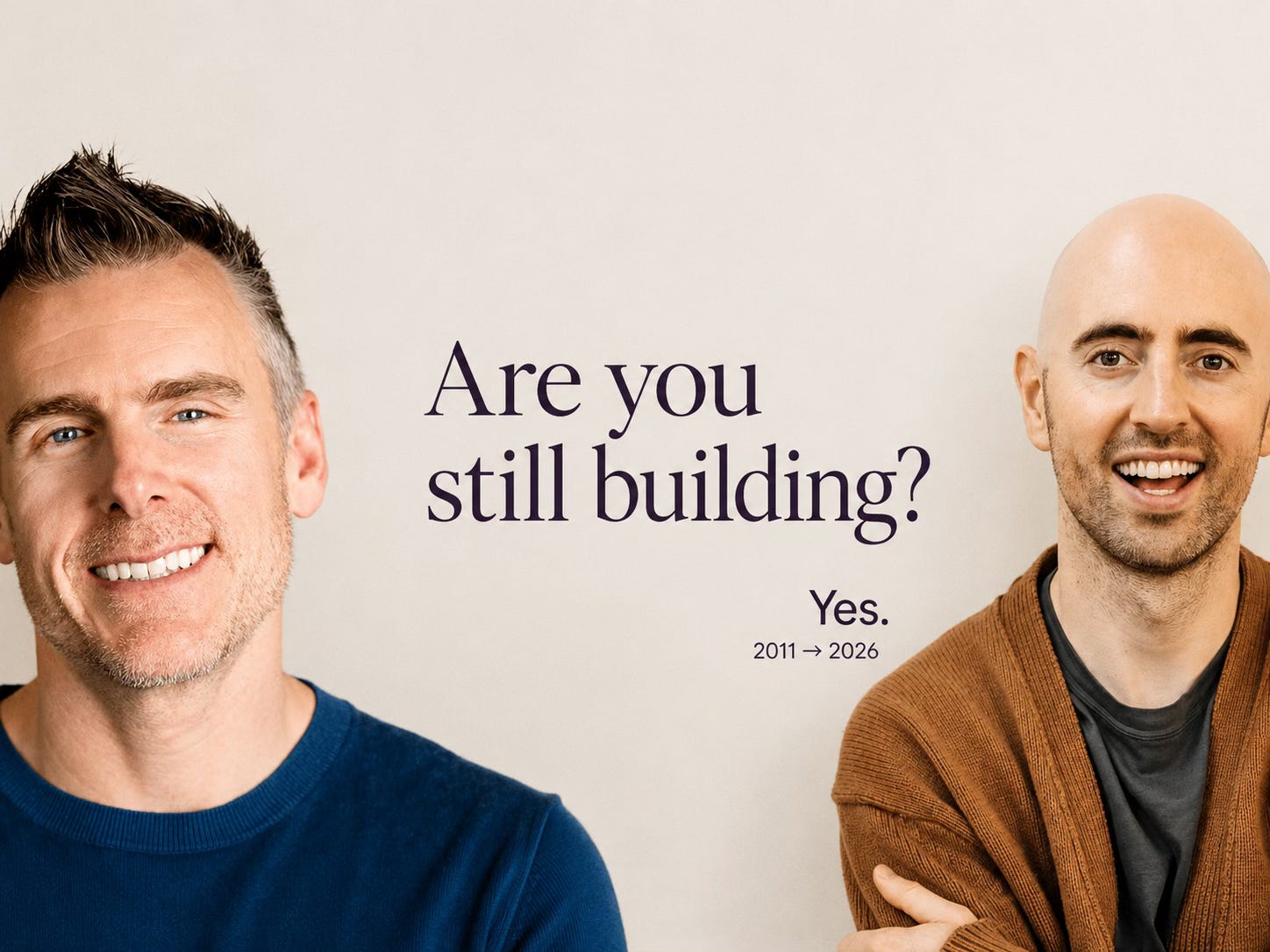
Dan held the investment, because he had faith in Eoghan. I love that part of this story. But, it got me thinking: while that small investment was becoming a fortune, whose name did it grow in?
If Dan lived in the U.S. (he doesn’t, he lives in Canada), and that investment was in his own name (I have no idea if it was), when that wire landed with Dan’s share of the $3.6B sale, the whole gain would be sitting in his name, in his estate, fully exposed. To tax. To anyone who ever comes looking. To his spouse and kids, if they aren’t properly prepared to receive what he’ll leave behind.
• • •
In my previous article, when I wrote about building a family office before you feel rich enough to need one, this is what I meant. Not that you should rent an office and hire twelve people to sit around a polished boardroom table discussing your $25,000 investment. I meant that someone should be looking across your legal, financial, tax and family life while the decisions are still small enough to be made without setting off alarms.
They would be asking questions like, for example, what’s the title on the asset? What could it grow to over time? If it does grow in value, where will that value sit? Who is supposed to benefit from that growth, and what could leave it at risk?
Those are family office questions.
So I decided to take a look at Dan’s investment in Intercom through this lens. A VC analyst went back and estimated what Intercom’s earliest backers made: about thirty-six times their money. So a fifty thousand dollar stake, held for fifteen years, becomes around $1.8 million.
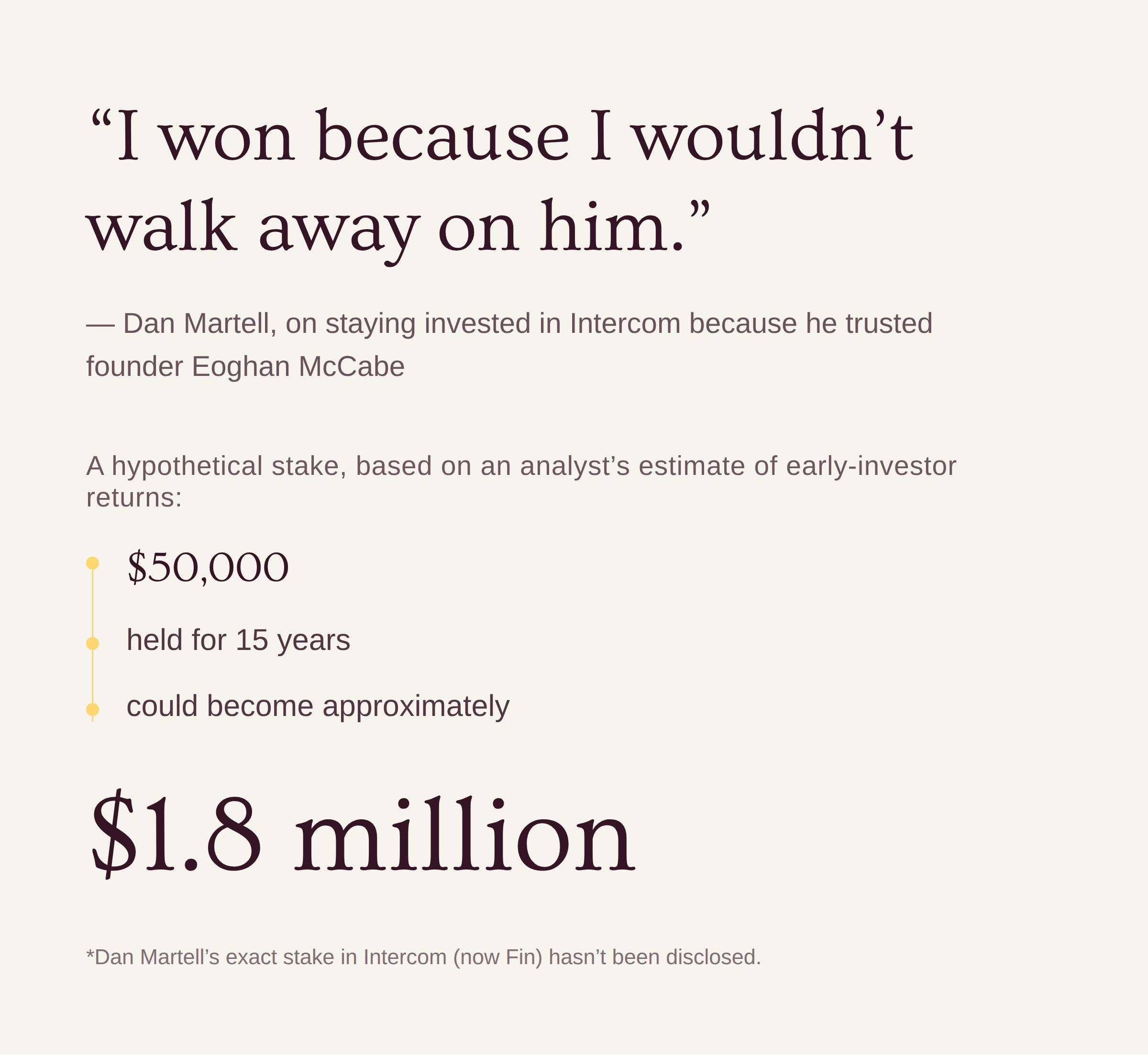
The investment earns the same whether the shares are held in your own name or transferred early into a trust. But the ownership structure determines who and what ultimately receives it, and how much.
If an asset is personally held, it’s usually part of the owner’s larger financial and estate picture. For a U.S. taxpayer (again, Dan lives in Canada, so I’m not talking about his specific situation here), it could create estate tax exposure if the estate is large enough.
For a family already above the estate tax threshold, federal estate tax can take roughly forty percent when you die (it’s been as high as 77 percent between 1941-1976, we could get there again), and just at the 40 percent rate, that could be $700,000 gone, on money you already earned.
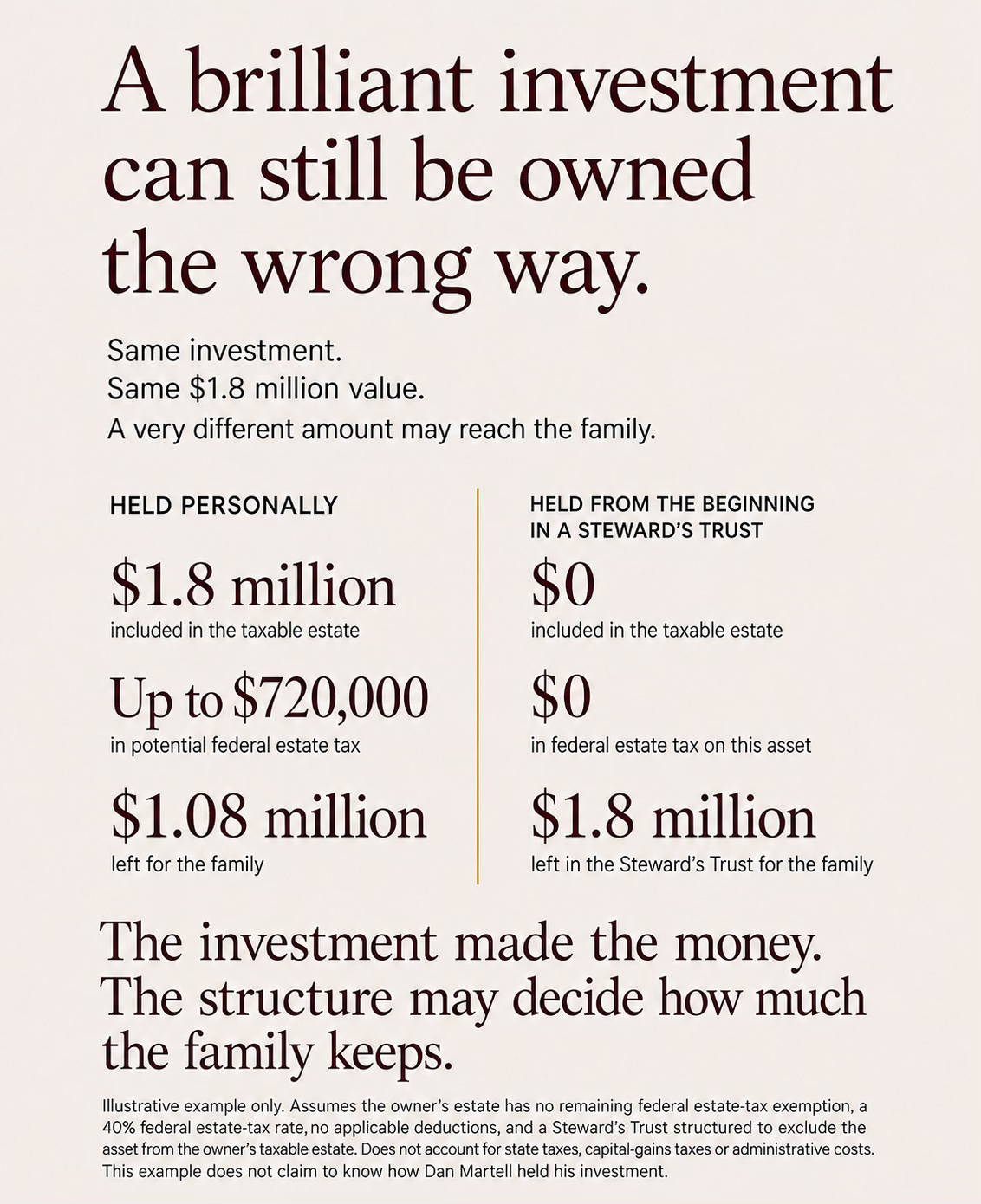
And that’s just Federal. If you live in a state with estate tax, it’s more. And this isn’t even including what can happen to personally held assets that get caught up in litigation, creditor claims, divorce, incapacity, or a badly planned transfer after death.
There is another way to hold an investment like Dan’s that could have provided his family with protection. Same investment, same fifteen years, same return, but with one difference. This difference is the thing I’ve spent twenty years trying to get people to see before it is too late instead of after the fact.
• • •
Here’s the move.
You do not wait until an asset is worth millions to protect it. Instead, you make your investments (in your own business or in someone else’s) through a protected structure, an irrevocable trust I call a Steward’s Trust.
I use the word “steward” very specifically because stewardship is the point: the asset is not being hidden from the family or shoved into a vault where nobody can touch it. It is being held with an understanding that the asset has a purpose and it will be well and intentionally cared for while it grows into something meaningful.
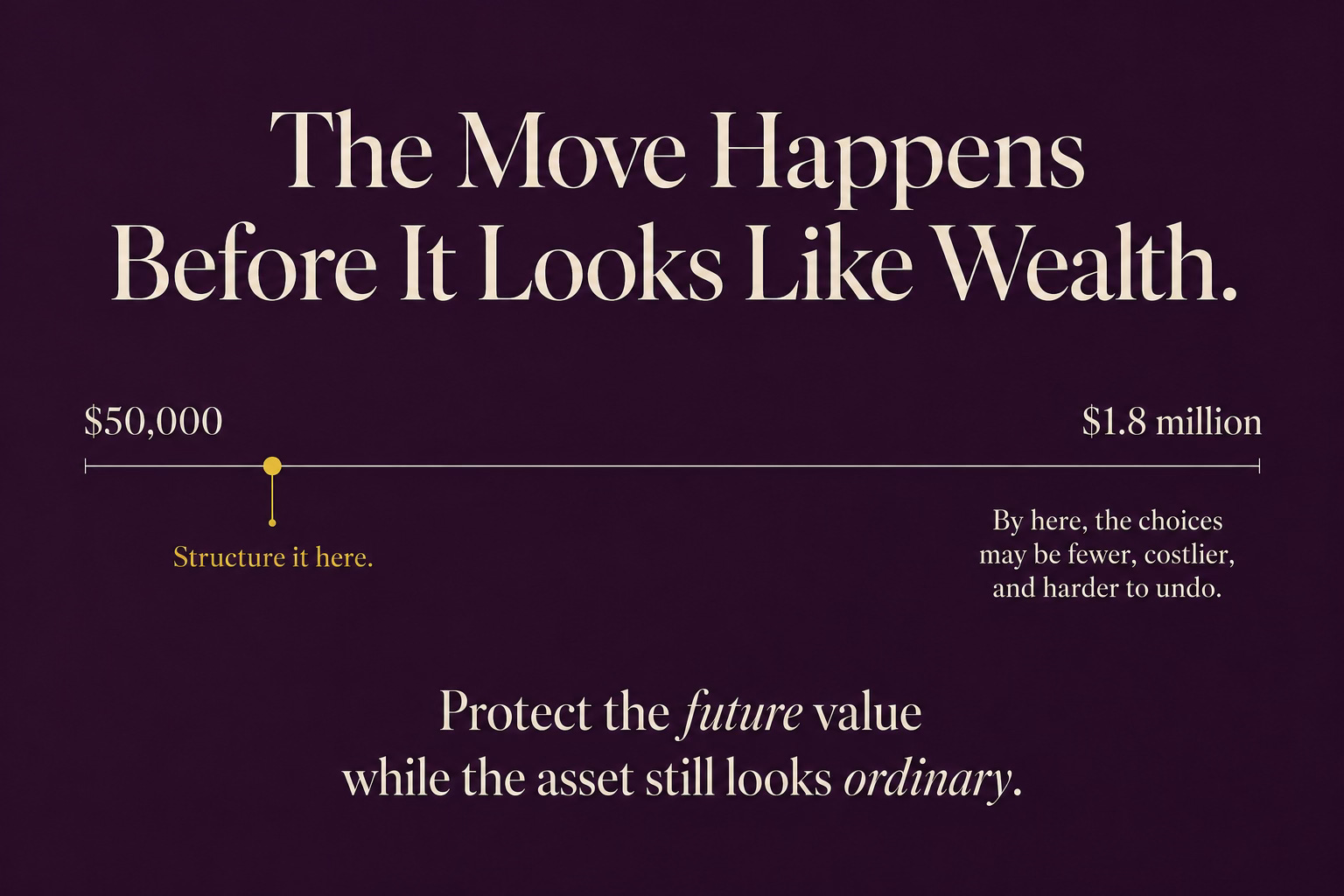
You set it up while your investment is still just a relatively small check nobody is thinking much about. A stake worth even ten thousand dollars is worth it. I’m talking about investments like pre-IPO shares or the rental property you want to buy before the neighborhood turns. Or equity in the thing you are building right now. You get the idea.
If you structure it right, this is your vehicle for creating and caring for generational wealth, and it’s the simplest way to set it up right from the start. The best part is you can benefit from what is in that trust your entire life, and you can pass it on to your family free of estate taxes, and totally protected, for many generations. This is how the wealthiest families created wealth from way back, and kept it in the family.
There is one catch, and it is the thing that trips up even the smartest people: it’s way better if you don’t do this for yourself.
If you set up this kind of trust and fund it with your own money or an asset you already own, if it’s not in there long enough or set up in the right jurisdiction, a judgment could pull it right back into your estate and the whole structure collapses. The safe harbor is to have someone who loves you set up the trust, and have the trust make investments for you.
Now, all the upside grows inside the trust. And, we structure the trust so you maintain investment control. So, imagine that Dan put $50,000 into Intercom, and that $50,000 grew to $1.8 million; if he had done it through a Steward’s Trust, now that $1.8 million is protected. Same growth, same money, but the estate tax on it down the road will always be zero.
The full $1.8 million passes to the kids, the grand kids, and even the great grands, no matter how much it grows over time, and no matter what the estate tax rate or exemption is, protected the whole way. Same asset, same fifteen years (in Dan’s case). One version could hand $700,000 to the IRS. The other keeps every dollar in your family.
Does that mean you put something into a trust and continue behaving as though nothing changed? No, and anybody promising that should make you nervous. Who creates the trust and serves as trustee matters. The powers retained by the person who built the asset also matter, as do the beneficiaries, the jurisdiction, and the tax treatment, as well as the way the trust is administered ten years after everybody has forgotten the enthusiastic meeting in which it was signed.
A good structure is not necessarily complicated, but it is precise. It has to work in the life of the family using it, not just on the day the lawyer produces the hefty binder with the fancy documents.
• • •
I talked with a founder a few weeks ago who learned this the hard way, though he may not know yet that he has a problem waiting to happen. He has done something both clever and complicated by setting up foreign trusts for his kids, with people living overseas as the trustees, the ones actually in charge. It works, technically. For now.
But let’s look at what he built. The people holding the keys to his children’s future live on the other side of the world. They can die, go missing, or stop answering his calls or emails. He wired his family’s security to strangers in another country because that was the structure that was recommended to him.
Here is what he could have done instead. He could have had his own parents set up a Steward’s Trust for him, one for him and one for each of his kids. It would be kept here in the United States, with independent trustees he actually knows and could replace if he needed to. His parents could make the gift, which keeps the structure intact. And every asset he built inside that trust would have grown inside a protected, American, family-controlled structure that does not depend on someone he might not be able to reach if things change.
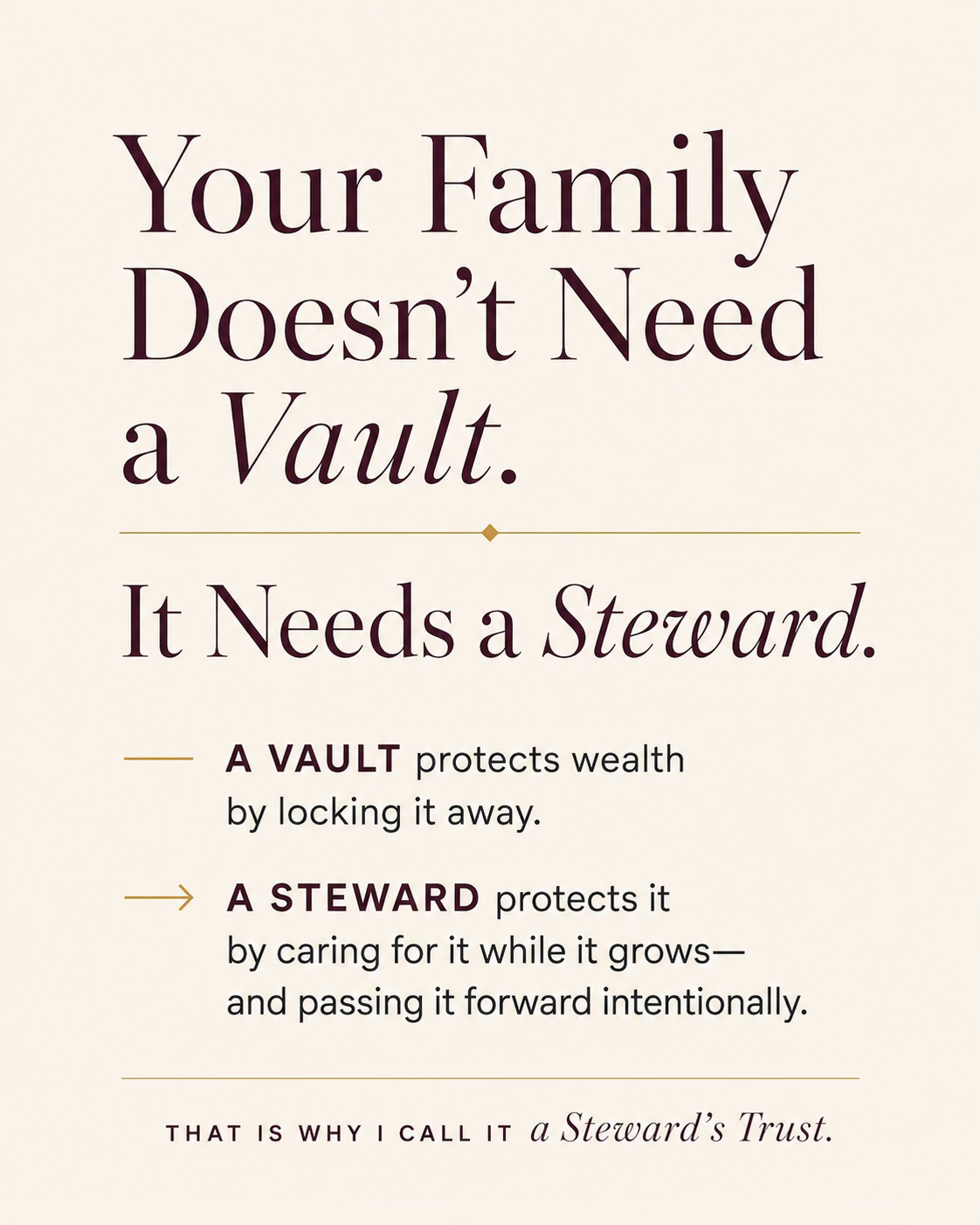
This offers the same protection with none of the fragility. The difference was not intelligence. The founder I’m talking about is a brilliant man. The difference is that no one ever told him, and he didn’t know what he didn’t know.
• • •
Because Dan’s story involves an angel check and a multibillion-dollar technology company, the lesson is easy to see. It can also make the rest of us dismiss the whole thing as something that happens to guys who invest in software companies. The other reason that people dismiss the value of setting up a trust like this, is, frankly, because most appreciating assets look pretty unimpressive at the beginning. In fact, they can look like a potential mistake.
People tell themselves that they’ll revisit “structuring something” after the next funding round, after the investment property is renovated, when their business turns a profit, or when somebody who seems legitimate tells them that the thing they’re building is worth something.
But if you wait too long, things can get complicated and expensive, with the result that you could lose a major chunk of the returns on your investments to taxes, creditors, and more. In fact, this is one of the reasons wealth so often remains unprotected even in ultra-wealthy families.
Dan understood that the founder and the company were worth staying with before the outcome proved him right, but his form of vision is rare. I am not telling you to start chasing early-stage companies or that every investment will reward your patience. Most absolutely will not. Dan himself makes clear that the long game works only when you are in the right game, with people you understand and want you to be actively involved.
My recommendation (not legal or financial advice): look at what you are building, holding or acquiring, and ask yourself, “Do I really believe in it and that it could grow into something meaningful?”
If so, it’s worth planning for and protecting now. If you think to yourself, “Eh, I don’t know, I don’t really have enough to take it seriously now.” That could be your money dysmorphia talking, and it’s the very thing that keeps many of us from creating real wealth.
Money dysmorphia doesn’t just make us feel poorer than we are. It can cause us to look directly at something with the power to change a family’s future and decide that it’s not enough to plan well for now. The very reason so many families perpetuate not enough instead of creating the generational wealth they have so close at hand.
• • •
In my next article, “You Are Not Bad With Money. None of Us Are,” I will dig deeper into money dysmorphia: the distortion that tells capable people they are failing at money while keeping them from seeing the financial power they already hold. If you want it in your inbox, subscribe.
This is not legal or tax advice, and every structure I described has to be built with real counsel for your real life, ideally a Personal Family Lawyer who knows how to set up these structures and ensure they are maintained the right way.
New to this conversation? Read “The Great Wealth Transfer Is Not Just a Rich-People Story,” where I explain why this historic transfer includes far more families than most of us realize.
No posts
Comments
Nothing yet. Say the first thing.
Sign in to join the conversation.