
For years, I thought my fear of running out of money meant something was wrong with me. No matter how much I earned, how much I learned, or how much I built, I was always chasing another number.
It was never enough.
I thought this meant I was bad with money. I can now see that what I had was what I call “money dysmorphia,” and you may too.
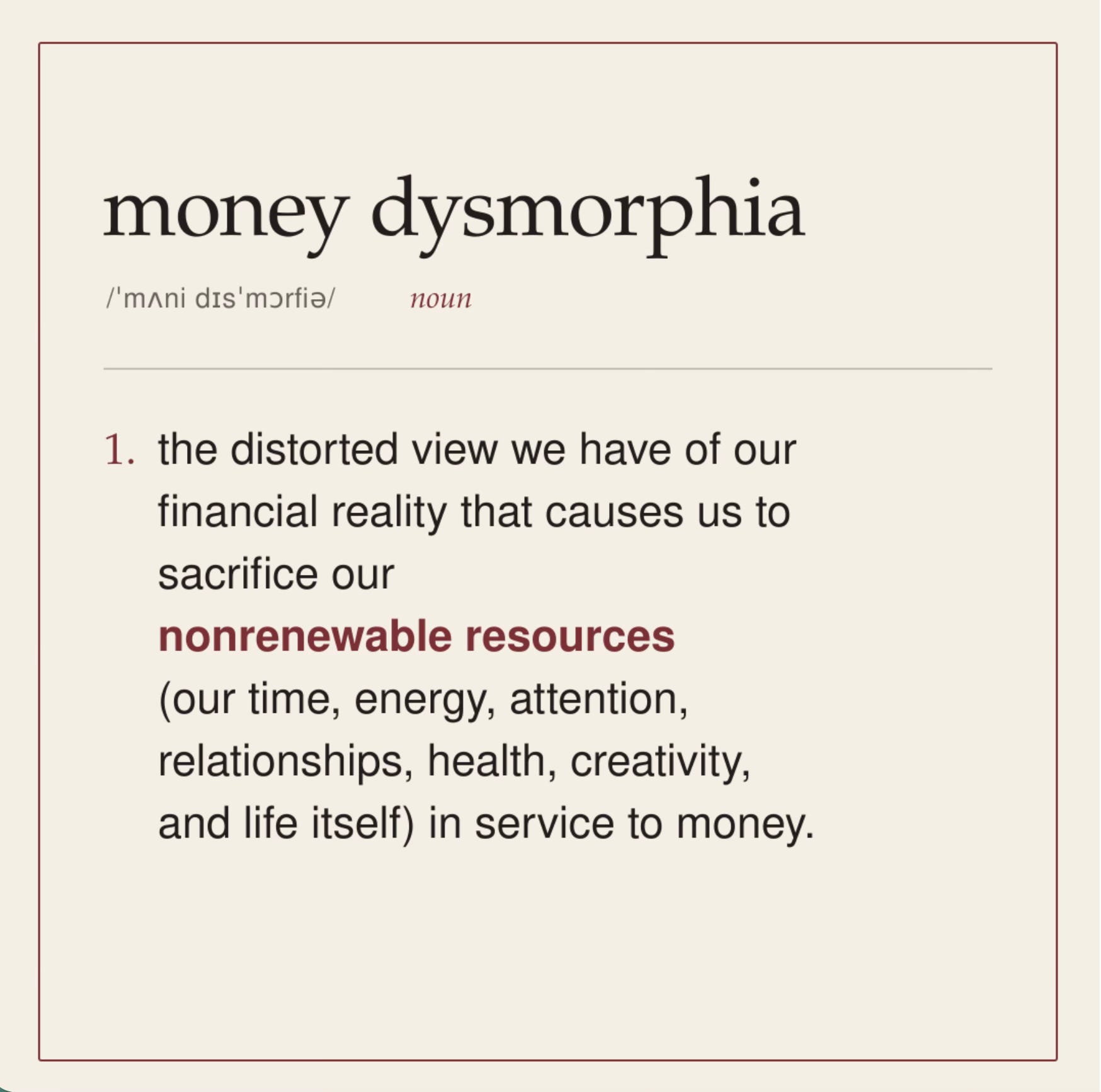
But, here’s the thing: money is infinitely renewable, when we know how to use our non-renewable resources well. Most of us don’t. As a result, we get trapped on what I’ve come to see as a never-ending quest for financial freedom, which then gets leveraged against us in so many ways. When you see it, you can break free of it, and get financially liberated. The voice of money dysmorphia sounds like this:
Most of us assume that voice is telling us the truth. We think it is pointing to a personal flaw, a discipline problem, a budgeting problem, a planning problem, something we could finally fix if we earned more, spent less, optimized harder, or became the kind of person who understands all the financial things we imagine everyone else already knows.
But what if the voice is not the truth? What if it is the symptom of a system that needs you to believe the problem is you?
• • •
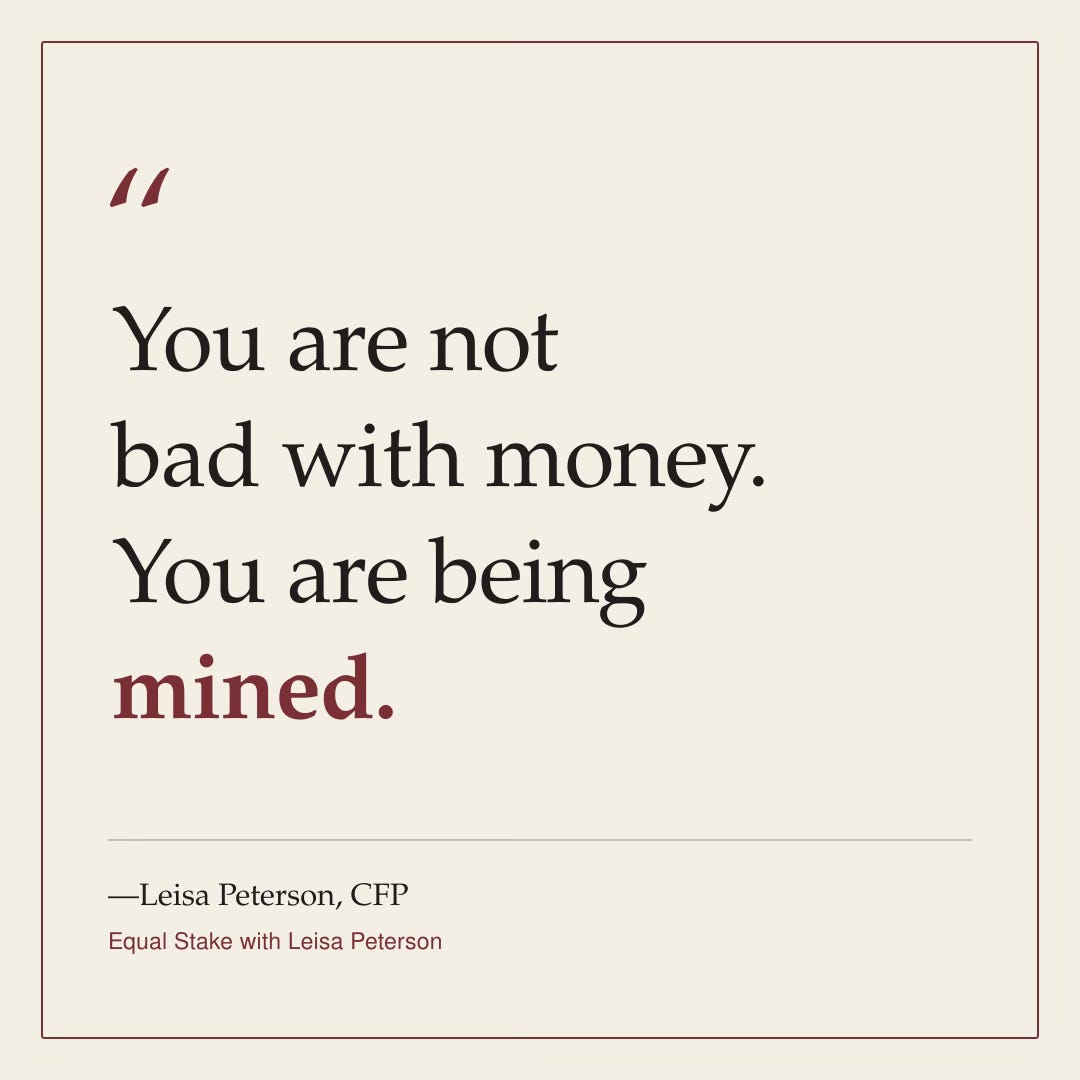
The first time I encountered this line from Leisa Peterson, a Certified Financial Planner and the author of The Mindful Millionaire, she named something I had been circling for years: the feeling of personal failure that is embedded within our economic system.
Peterson describes the mechanism with extraordinary clarity this way:
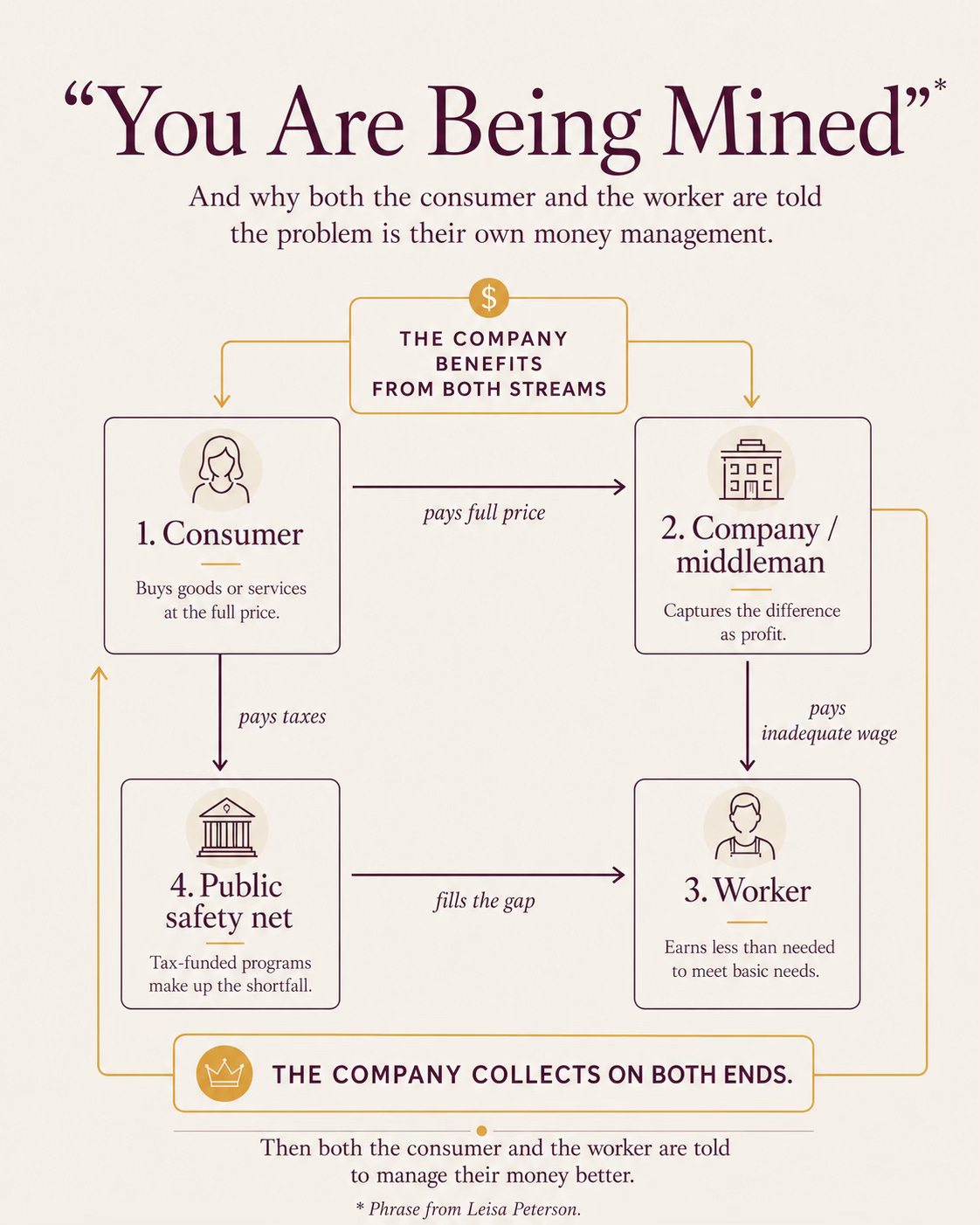
A few large companies consolidate an industry and place a middleman between the person buying the service and the person actually doing the work. That middleman charges you as much as you will pay and pays the worker as little as the worker will accept. The worker cannot survive on the wage, so public programs fill part of the gap. You fund those programs through your taxes, which means you pay once when you buy the product, and then you pay again to subsidize the worker the company is not paying enough to live.
The company collects on both ends. And then you and the worker are both told to manage your money better.
The federal minimum wage has remained $7.25 since 2009 and is now at its lowest real value in nearly seventy years. There is not one county in the United States where a full-time minimum-wage worker earns enough to cover a basic single-person budget.
That gap is not evidence that millions of people have individually failed at money. It is what the model was built to produce. That is the design. Not your character.
In other words, our extractive economic system creates chronic insecurity. Then, it teaches us to interpret our insecurity as evidence of our own financial inadequacy. Our internalized blame is a root cause of money dysmorphia.
(I’m going to be talking to Leisa on an upcoming episode of The Great Wealth Transfer Podcast, so subscribe here to get the heads-up for when it drops.)
• • •
Charles Eisenstein names the engine underneath it in his work Sacred Economics. Because our economic system is committed to endless growth, it is always finding something new to sell. Once our basic needs are met, that growth comes from packaging something people used to do for themselves or for each other and selling it back to them as a “value-added” product. For example, care is no longer what we do for each other: it’s marketed as a service. We’re discouraged from co-creating and fostering community and encouraged to buy a subscription to a community instead. Our spending counts as “growth,” even though the life underneath it has been exploited.
We are living inside a machine engineered to make us feel as if there is never enough, because the machine itself runs on never enough.
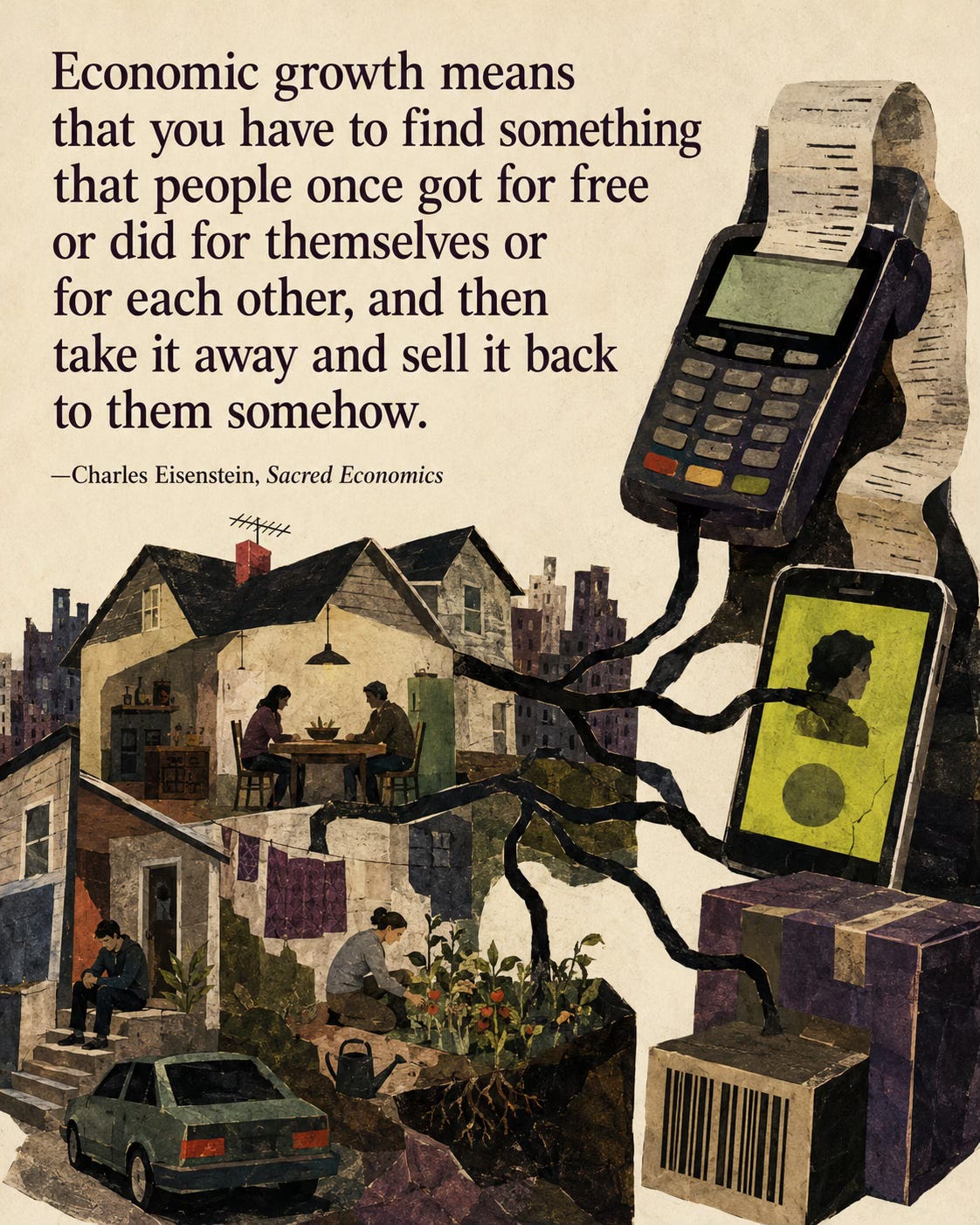
Eisenstein says that, yes, it’s horrifying to realize that much of the service economy is designed to deprive you of your money, your agency, and your humanity, but it’s also a revelation that you can act on. When we see what’s happening, we can make active, engaged decisions to steward our money based on what we value, not what’s being marketed to us as “value.” I call it “eyes wide open” decision-making.
This is the whole invitation of my work around the Great Wealth Transfer. See the machine. Then quit feeding it on autopilot, and start directing our resources toward the world we actually want to live in.
We have a huge amount of power when we wake up, see what we have, become our own best advisors and start directing what we have, not just money, but our time, energy and attention (our non-renewable resources) to what we want to create. We can see that we are the creators of the economy, not victims of it.
(And, I’m also going to be talking to Charles on an upcoming episode of The Great Wealth Transfer Podcast, so subscribe here to get the heads-up for when that one drops, too.)
• • •
If you are what the financial industry calls a High Earner Not Rich Yet, or a HENRY:
You may earn more than your parents ever did but not feel wealthy.
You may have a retirement account but no real cash cushion.
You may have a home with substantial equity alongside credit card debt, or stock options that look impressive on paper while student loans are deducted every month.
You may be supporting children and helping aging parents at the same time.
And so you keep thinking: when I finally have enough, then I will learn how all of this works. Then I will pay attention. That, my friend, is your money dysmorphia talking.
Here is the reality.
$31.9 TRILLION in retirement assets alone are held by the mass affluent, roughly 31 to 33 million HENRY households.
U.S. households collectively hold approximately $67.8 trillion in corporate equities and fund shares. The wealthiest 1 percent own about half, which means the other half, roughly $34 trillion, is owned by everyone else.
By us.
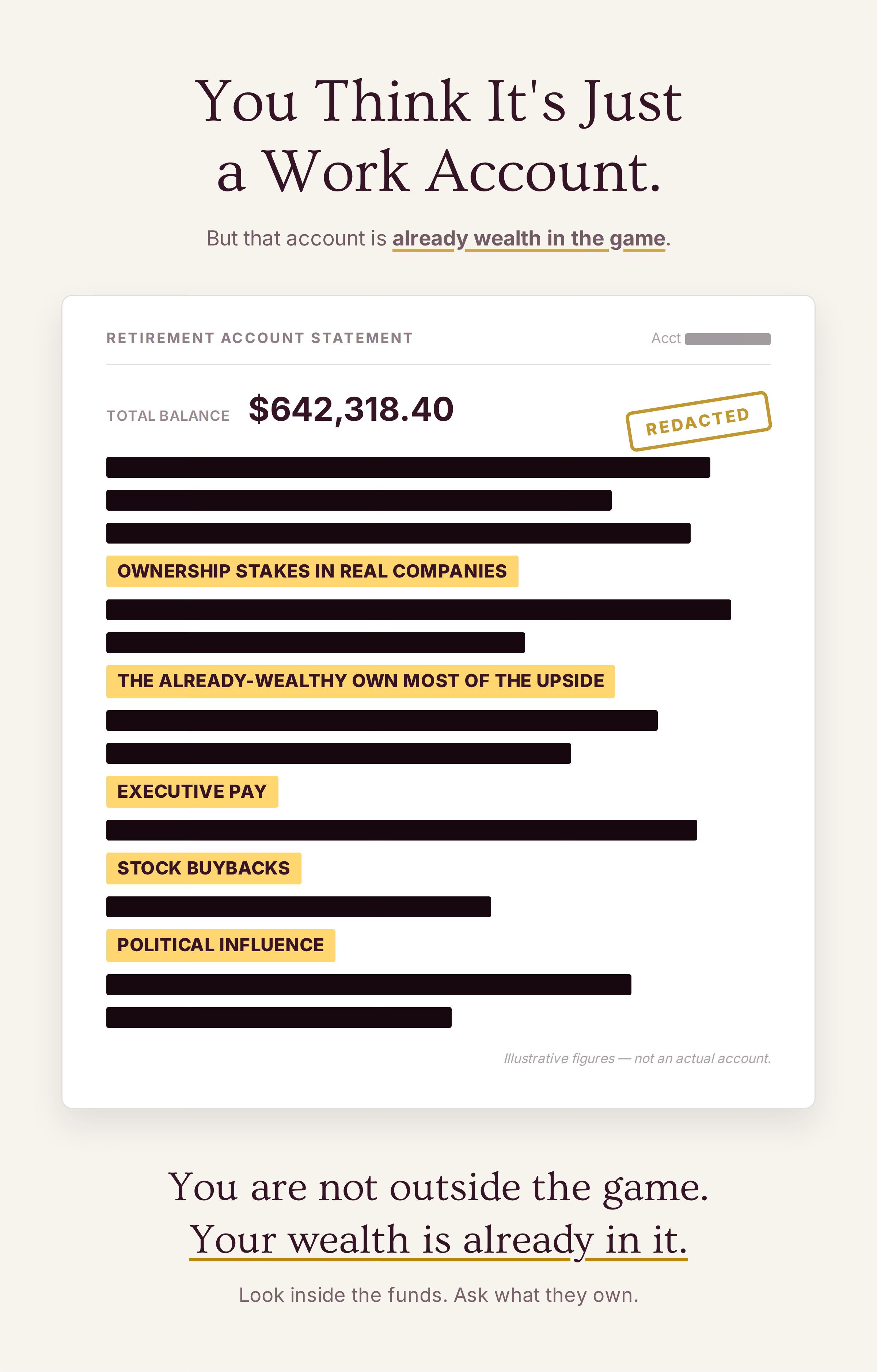
You are in the game, and your retirement accounts, pension, mutual funds, insurance products, 529 plans, and brokerage accounts already direct capital every day.
Part of how we get “mined” is by failing to see how much power we have, how much we control, and that we actually can be good with money, and use what we have to create the new future reality we want to live in, together.
• • •
So here’s what I want you to do now:
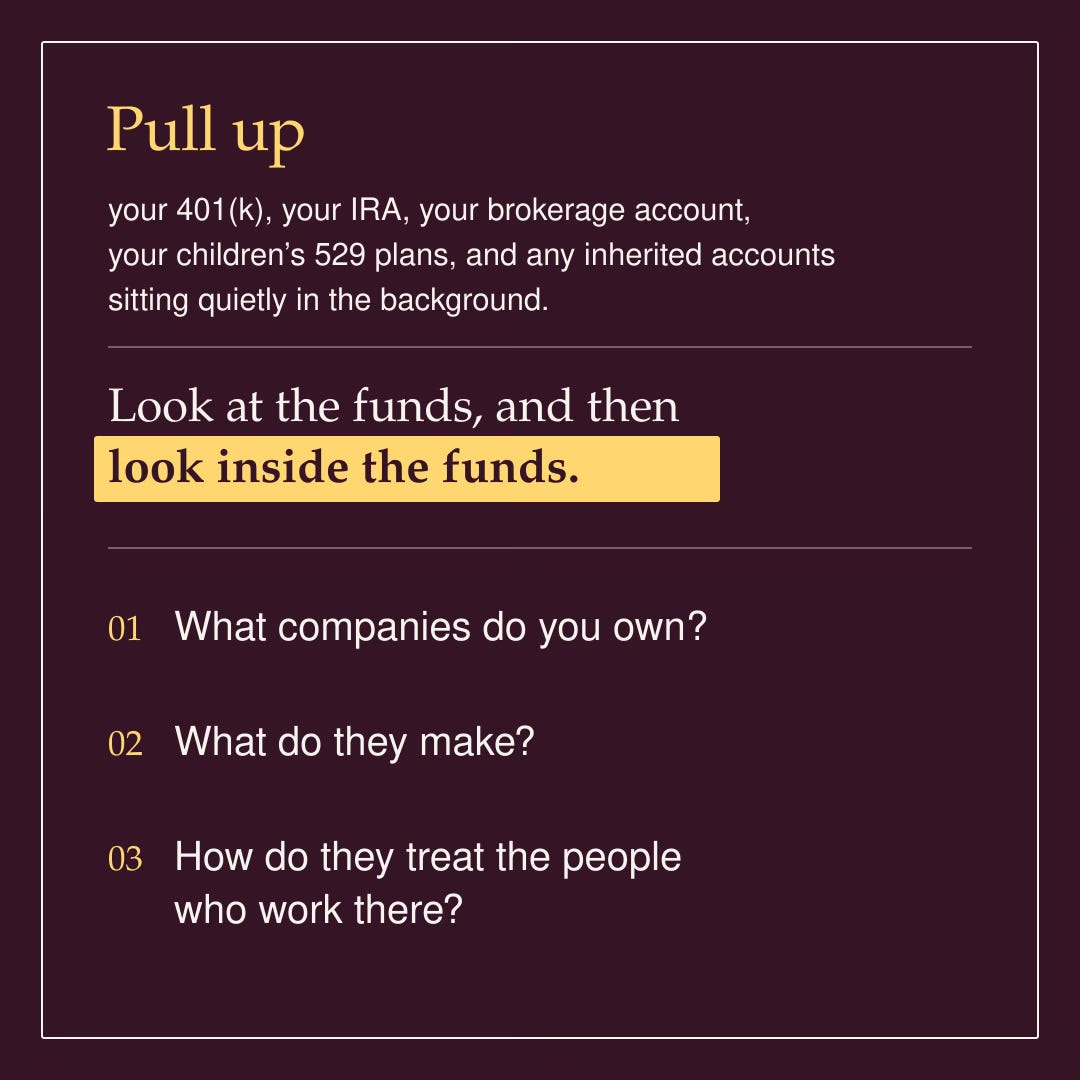
I know this can feel overwhelming. That is part of how money dysmorphia works: it convinces us that not looking is okay because we don’t have enough to worry about anyway, or we’ll think about it when we have more. This is the lie that keeps us disempowered.
Take back your power by looking at what you have. It’s the starting place.
And note that you do not have to fix everything today. In fact, you don’t have to fix anything today. All you have to do is look.
See what you have. Let’s start there. Then, once you see, you can choose. (To make this actually doable for you, I created an AI prompt to help you inventory what you own and look inside your funds, without requiring you to share private financial data. When you join the Financial Liberation Challenge, you get the prompt. It's here.)
You can choose to move some of what you have out of extractive systems.
You can choose to invest in the world you want to see.
You can expand the options on your menu.
But you have to look at what you have.
Stop outsourcing to your guy.
Stop abdicating your leadership.
Start taking full responsibility.
And, together, we can create an entirely new economic reality, one that doesn’t extract, but instead regenerates, and creates the world we want to live in.
• • •
This is where the Great Wealth Transfer becomes much more than a story about who inherits what. Between now and 2048, approximately $124 trillion will transfer between generations. A significant portion will move through families who do not think of themselves as wealthy, families with retirement accounts, homes, businesses, insurance policies, land, and debt. Families like yours.
If you are HENRY, you are not watching this transfer from the outside. We are all inheritors, and we are also the stewards of the future.
The question is not whether the money moves. It is already moving. The question is where it sits now, and whether it moves consciously and intentionally, or whether it flows by default toward the same systems that have been mining you and your family’s time, labor, attention, and resources.
Someone in the family has to open their eyes and ask: What do we actually have? What has it been funding? What do we want it to make possible now?
That someone can be you.
• • •

No posts
Comments
Nothing yet. Say the first thing.
Sign in to join the conversation.