
Are you happy? Is your life meaningful? Most of us intuitively sense that those are not quite the same question. A person can feel happy yet adrift, or deeply purposeful while carrying grief. In this installment, the tenth in my mini-series on the varieties of goodness, I explore the difference between happiness and meaningfulness and what happens when the two pull apart.
Happiness is relatively easy to understand. Happy people tend to experience more pleasant emotions than unpleasant ones and generally feel satisfied with their lives.
Meaningfulness, however, speaks to something deeper. Psychologists George Login and Crystal Park define meaning in life as the extent to which life feels coherent, purposeful, and significant. A meaningful life is one in which you feel that your existence matters.
Both happiness and meaningfulness are dimensions of the good life, so it is not surprising that they are strongly correlated with each other. But how are they different?
Disentangling Happiness from Meaningfulness
One of my favorite psychology studies examined this very question. Researchers Roy Baumeister and his colleagues surveyed a national sample of U.S. adults about how happy and meaningful they perceived their lives to be. They also gathered information about participants’ habits, relationships, emotional experiences, and priorities. They then tested the correlations between both happiness and meaningfulness and these other outcomes, adjusting for the other.
Their findings were fascinating.
Participants who described their lives as easy, healthy, and financially secure tended to report greater happiness, but these factors had little connection to meaningfulness. Happiness, more than meaningfulness, appears tied to having one’s needs and desires fulfilled.
Happy participants also focused more on the present moment. However, people who spent more time reflecting on the past and future reported less happiness but greater meaning in life.
The researchers further discovered that meaningfulness was associated with helping others, while happiness was more closely linked with taking care of oneself.
More intriguingly, people who experienced multiple stressful or negative life events reported less happiness but more meaningfulness. Worriers, too, tended to find more meaning in life despite feeling less happy.
Finally, participants rated the degree to which 37 activities reflected their true selves. 25 of the 37 activities were associated with meaningfulness, while only 2 correlated with happiness.
Alignment With One’s Values
Perhaps the last set of findings suggests that meaningfulness is about living in alignment with one’s deepest values. Meaningful lives are not necessarily comfortable lives. They are authentic lives.
If you want to cultivate more meaning, begin by identifying your core values. Here’re a list of values you could consider. One revealing exercise is to imagine that you knew with certainty you only had twelve months left to live. How would you spend your time? Your answer may reveal what your most cherished values are.
The Four Types of Lives
By combining different levels of happiness and meaningfulness, we can begin to imagine four broad types of lives depicted in the 2 x 2 matrix I developed below.
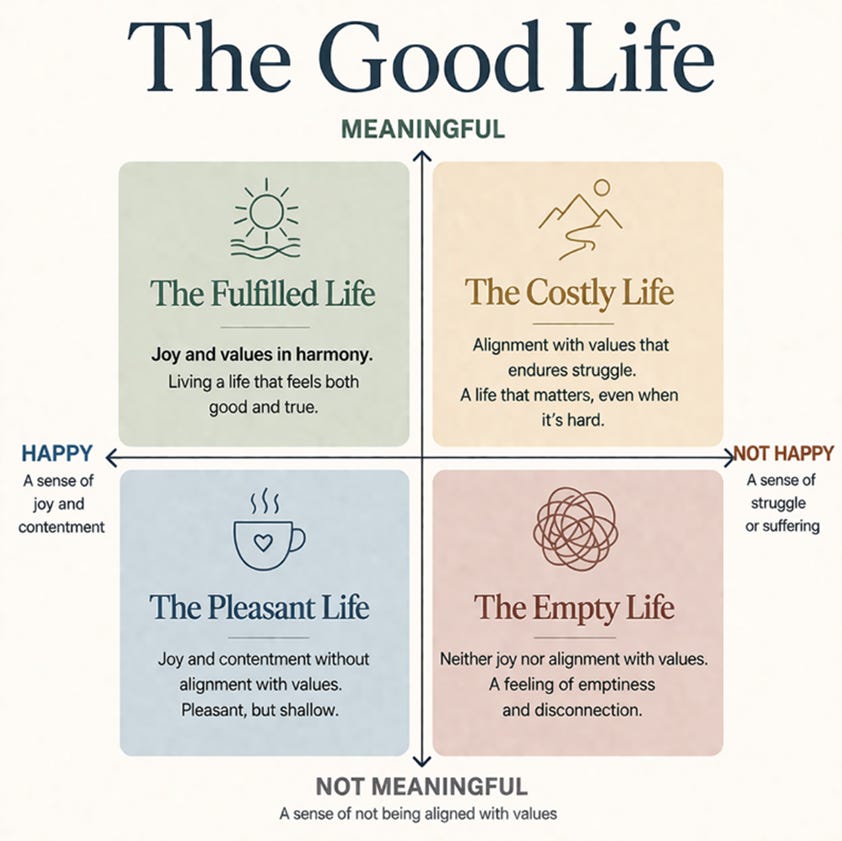
The Fulfilled Life is both happy and meaningful. This is the ideal many people aspire to—a life rich in joy, purpose, and connection.
The Pleasant Life is high in happiness but low in meaningfulness. People who live this type of life are often described as happy-go-lucky, living in the moment, but perhaps slightly self-absorbed.
The Costly Life is high in meaningfulness but low in happiness. This life often involves sacrifice, struggle, or pain in service of something deeply valued.
Finally, the Empty Life lacks both happiness and meaningfulness. It is marked by joylessness, disconnection, and a lack of direction.
Unpacking the Costly Life
I want to home in on the Costly Life because it captures something important that modern conversations about well-being often overlook.
What does it mean to live a life that is meaningful but not necessarily happy? Here’re a few examples:
Choosing to love and extend grace to a difficult family member despite receiving little in return.
Leaving behind a lucrative career to pursue work centered on service, despite lower pay and difficult conditions.
Courageously speaking out against injustice, even when it damages your social standing.
Facing painful truths about yourself, your past, or your loved ones in the pursuit of growth and healing.
Remaining committed to a long-term cause you believe in despite repeated setbacks and little visible success.
These experiences are rarely easy. But if you tell someone committed to the Costly Life that they should simply prioritize pleasure or comfort, they may respond that such a life feels shallow compared to the fulfillment that comes from living out one’s values.
Some may even describe their path as a calling. Something larger than themselves— whether their conscience, God, or love—exerts a gravitational pull on their lives.
To be clear, my point is not that you should always prioritize meaningfulness over happiness. But I hope this discussion helps us to understand better the choices of those who embrace the Costly Life.
Reflections on Gratitude
If your gratitude arises only from pleasant experiences, you may be neglecting some of the most meaningful parts of life, like living courageously, loving deeply, serving others, or committing to a worthy cause.
Once you begin to see meaningfulness as a type of goodness, you may realize that your life contains more reasons for gratitude than you first imagined. And if you identify with the Costly Life, you might be able to better explain to people around you why your life is deeply good even when it includes hardship and struggles.
I’ll end with a personal reflection. Last year, my father was diagnosed with a serious illness, and I flew to Singapore to spend two weeks with him. I spent Christmas Eve sitting beside him in the hospital.
Was I happy? Not really. I cried more during those two weeks than I had in years. But was the experience meaningful? Absolutely. I was exactly where I needed to be. And I’m grateful I could spend time with him.
Animals, like humans, can experience happiness. I’m much less certain they can live a meaningful life.
But to live according to one’s deepest values, to pursue what truly matters, to devote oneself to something larger than one’s comfort or pleasure—that may be one of life’s most distinctly human experiences.
If this article resonated with you, you may also enjoy my Psychology Today blog Gratefully.
No posts
Comments
Nothing yet. Say the first thing.
Sign in to join the conversation.