
Thursday, July 2 2026 marked the 50th anniversary of the Gregg decision.
In 1972, in a case called Furman v. Georgia, the U.S. Supreme Court determined that death penalty statutes were being applied in an arbitrary and discriminatory manner, rendering them unconstitutional under the Eighth and Fourteenth Amendments.
Furman ushered in a period of 1,464 days without executions. This upset a lot of people, especially in Southern states.
Furman was not a neat decision. There were nine(!) separate opinions, and the five justices who formed the majority did not agree on a single explanation for the result.
But several of them identified the same fundamental problem: there were no reliable standards separating the few people sentenced to death from the many people convicted of comparable crimes who were permitted to live. Death sentences were imposed so rarely, unpredictably, and selectively that the process resembled chance more than justice.
Race and poverty were woven into that arbitrariness. As Justice William Douglas put it, the laws were “pregnant with discrimination.”
Justice Potter Stewart compared the death penalty to being struck by lightning. Many people committed crimes for which death was legally available, he observed, but only a capriciously selected handful were condemned to die.
The Fourteenth Amendment gives us the constitutional protections of “equal protection” under the law and prohibits states from depriving any person of life, liberty or property without “due process of law.”
Equal protection doesn’t guarantee that every person will receive an identical outcome, but it does require governments to apply their laws without unjustifiable discrimination.
In Furman, the Court found that states were choosing who lived and who died through a process that was arbitrary, discriminatory, and devoid of consistent standards. It concluded that, as the death penalty was then being administered, it was cruel and unusual punishment.
In Dead Man Walking: Graphic Edition, we ride along on the way to the Louisiana State Penitentiary as attorney Millard Farmer educates Sister Helen Prejean on how the laws work:
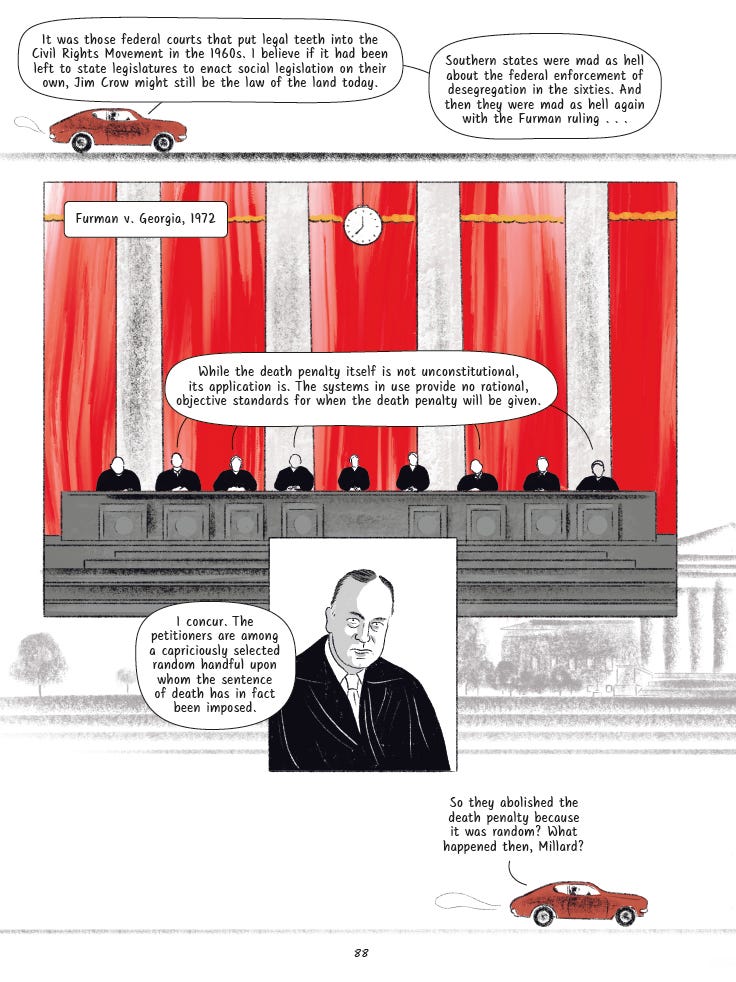
The opposition to Furman was intense. Within four years of the decision, Congress and 35 state legislatures had enacted new death penalty laws.
In the South, where capital punishment had long been intertwined with demands for “law and order,” states’ rights, and resistance to federal interference, the opposition was particularly passionate.
Georgia, Florida and Texas tried to preserve the death penalty by placing limits around the discretion of judges and juries.
Louisiana and North Carolina took a blunter route: they made death mandatory for certain murders, apparently reasoning that if discretion produced arbitrariness, the solution was to eliminate discretion altogether.
The Supreme Court considered these competing approaches together in 1976. In Gregg v. Georgia, it upheld Georgia’s new “guided discretion” system:
guilt and punishment would be decided in separate stages;
a jury could impose death only after finding at least one specified aggravating circumstance;
the defendant could offer mitigating evidence;
and the Georgia Supreme Court would automatically review each death sentence, including whether it was disproportionate to sentences imposed in comparable cases.
The Court accepted Georgia’s promise that these procedures could prevent death sentences from being imposed arbitrarily or capriciously. It also upheld broadly similar laws from Florida and Texas.
But the Court rejected the mandatory statutes adopted by Louisiana and North Carolina. A system that automatically condemned every person convicted of a particular category of murder left no room to consider the circumstances of the crime or the character and history of the defendant.
The message of the five decisions handed down on July 2, 1976 was not simply that the death penalty had returned; it was that states could keep killing provided they constructed a sufficiently elaborate legal apparatus to make the selection of those who would die appear principled rather than arbitrary.
There were only two dissents.
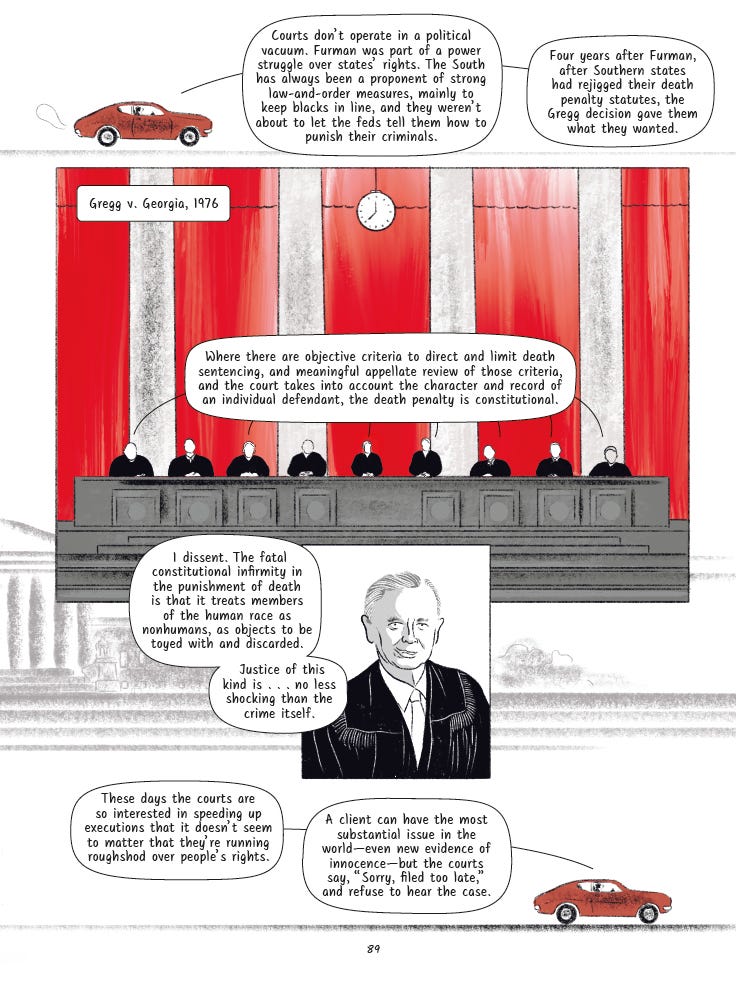
The Gregg decision has not aged well.
Fifty years later, the constitutional machinery designed to make the death penalty consistent and fair has produced something that looks remarkably like the system condemned in Furman.
We live in a country where a handful of states carry out virtually all executions, while a small collection of counties and parishes account for a disproportionate share of new death sentences. In the first half of 2026, every execution took place in just four states, and all but one occurred in the South. Geography has become a lightning rod that determines where death strikes.
Race remains woven through the system. Someone accused of killing a white victim is more likely to be charged capitally, sentenced to death, and executed than someone accused of killing a Black victim. Of all death sentences imposed between 1972 and 2025, 72 percent involved at least one white victim.
And wealth remains perhaps the surest protection of all. You won’t find many on death row who could afford a team of experienced lawyers, investigators and expert witnesses. Death rows across the nation are populated overwhelmingly by people who are poor and depended upon whatever defense the state was prepared to provide.
The elaborate safeguards approved in Gregg were supposed to ensure that death would no longer be imposed arbitrarily or discriminatorily, but the same old capriciousness is still there, gussied up and disguised.
Thanks for reading Graphic Dead Man Walking! Please share it widely.
Comments
Nothing yet. Say the first thing.
Sign in to join the conversation.