

I’ve been making the two-and-a-half hour trip from New Orleans to the Louisiana State Penitentiary at Angola for over two decades. The last part of the drive is along Tunica Trace, a lovely country road that winds through wooded hills before coming to its disconcerting end at the gates of the prison.
After going through security, visitors to Angola board a bus that deposits them at one or another of the many 'camps' within the prison. Death row is my usual destination and because it lies farthest from the gates I get to pass by the men working in the fields of cabbages and okra, corn and cotton.
Encompassing 18,000 acres, Angola is not only a prison, it is also a large agricultural concern. The crops grown there are used to feed the prisoners and staff, to sell on the open market, and to feed livestock that are also sold for profit.
The men who work the crops on the Farm Line are paid between $0.02 and $0.40 per hour. They work year round.
In Louisiana, summer begins in late April and stretches into October, with extreme heat, coupled with high humidity, a common occurrence during June, July, August, and September.
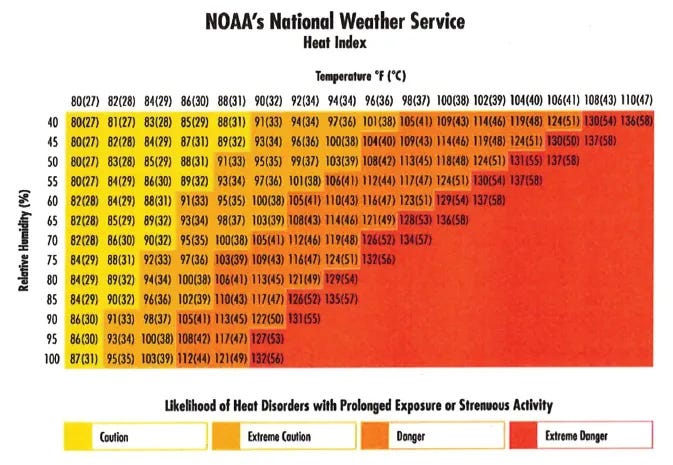
Through the four hottest months, the average heat index is 100°-105° and it regularly tops 110°.
When I first moved to Louisiana, the relentless heat and humidity during the summer gave me a deeper understanding of the life-sapping conditions under which enslaved people toiled. To this day, that breaking toil is a tradition that’s maintained at Angola, where men who work on the Farm Line are kept in the fields until the heat index rises to 113°.
In 2023 a group of men who worked on the Farm Line joined forces with Voice of the Experienced (VOTE), an organization founded and run by formerly incarcerated people and their supporters, to challenge the constitutionality of making people work in such extreme conditions.
In VOTE v. LeBlanc, the plaintiffs argued that Louisiana prison officials were forcing men at Angola to work the Farm Line in dangerous heat, under threat of discipline, without adequate shade, rest, water, protective gear, medical safeguards, or accommodations for medically vulnerable and disabled prisoners.
They argued that the practice amounted to cruel and unusual punishment—a violation of the Eighth Amendment—and discriminated against prisoners whose disabilities or health conditions made the heat especially dangerous.
District court Judge Jackson found that Angola’s policy exposed Farm Line workers to a substantial risk of serious harm, and that prison officials knew of that danger. Before Parker, he wrote, those findings would have supported Eighth Amendment liability.
Jackson admonished the DOC for keeping a policy that allowed manual field labor to continue until the heat index reached 113° Fahrenheit. He found that the National Weather Service classifies a heat index of 103° and over as the danger zone where conditions like heat exhaustion become highly likely and fatal heat stroke becomes a looming possibility.
He wrote that the prison’s refusal to lower that work-stoppage threshold to 103° “creates a substantial risk of serious harm to the health and safety of incarcerated men working on the Farm Line.”
He determined that the prison’s standing measures were wholly inadequate to safely shield workers from severe heat-related medical disorders.
These findings of harm should have led to a win for the men of the Farm Line.
But it was not to be.
Despite finding that the conditions were dangerously unsafe, Judge Jackson wrote that he could not find the state liable for an Eighth Amendment violation because his hand was constrained by a recent en banc decision by the U.S. Fifth Circuit Court of Appeals.
If not for that prior decision, wrote Judge Jackson “the court would have found Defendants liable under the Eighth Amendment for acting with deliberate indifference to the health and safety of incarcerated persons.”
So, what was this decision by the Fifth Circuit that prevented Judge Jackson from granting relief on findings that, to an ordinary person’s eyes, look very much like an Eighth Amendment violation?
The case is Parker v. Hooper, a long-running class-action which, like VOTE v. Leblanc, also dealt with conditions at Angola. The ruling in Parker came in March, 2026, mere months before the Farm Line case.
Before we look at Parker, though, we need first to dive into the PLRA: the Prison Litigation Reform Act of 1996.
There’s an irony that two of the laws that have most limited the rights of imprisoned and condemned people, the PLRA and the Antiterrorism and Effective Death Penalty Act (AEDPA), were both signed into law within weeks of one another by a Democratic president, Bill Clinton.
AEDPA made it harder to challenge unlawful convictions and death sentences, while the PLRA made it harder to challenge unconstitutional prison conditions.
Among other constraints on prisoner-initiated litigation, the PLRA:
required prisoners to exhaust internal grievance procedures before looking to the courts;
required that court-ordered prison reform must be narrowly drawn, extend no further than necessary, and be the least intrusive means to correct the violation;
restricted attorney’s fees in prisoners’ civil-rights cases, which matters because such cases are difficult, time-consuming, and often financially unattractive for lawyers even without extra statutory limits;
imposed filing fees even on prisoners too poor to pay upfront;
and narrowed courts’ power to order prison reform.
The PLRA is a reflection of a belief often touted by the “tough on crime” gang: that the taking away of a person’s liberty is insufficient punishment, and that a certain level of cruelty or, at least, the provision of only the barest minimum of constitutional protections, should be granted to those who have been incarcerated.
The PLRA was sold as a curb on frivolous lawsuits, but it also handed states a crucial weapon in their long campaign against federal oversight of prisons. In the South, where punishment has always been inextricably entangled with its slaveholding history and deep-rooted racism, this was a major win. By making it harder for incarcerated people to reach federal court and harder still to obtain meaningful remedies, the PLRA insulated state prison systems from one of the few institutions capable of forcing constitutional compliance.
Now we jump forward from the passing of the PLRA in 1996 to 2015 when a group of men at Angola launched a class-action suit alleging that the prison's medical care was constitutionally deficient and that it failed to provide proper accommodations for disabled inmates.
Kentrell Parker, who is quadriplegic and whose treatment exemplified the systemic failures of the health care system at the prison, became the face of the litigation.
After winding its way through the courts, in 2021 a district court concluded, after a detailed investigation, that the prison had violated the inmates Eighth Amendment rights due to deliberate indifference regarding severe medical neglect, inadequate staffing, and unconstitutional conditions.
The prison appealed to the United States Court of Appeals for the Fifth Circuit, one of the most conservative courts in the country. That court vacated the district court’s remedial judgement and sent the case back for reconsideration under a stricter view of ongoing deliberate indifference.
The Fifth declared that the lower court’s remedial measures were, in essence, too broad (remember, under the PLRA, any court imposed remedies must be narrowly drawn and extend no further than necessary), and that it had discounted improvements that the prison had already made in response to the legal action to address shortcomings.
I’ve italicized those last words because they underline a crucial gotcha in Parker which scuppered the chances of the Farm Line men in VOTE v. LeBlanc.
In response to the prisoners’ Parker lawsuit, corrections officials had made some improvements to the medical facilities and systems at Angola.
The Fifth decreed that once prison officials make partial improvements, even inadequate ones, the courts may treat those gestures as proof of good faith (rather than as evidence that litigation was necessary to drag the state toward basic decency.)
In other words, the better plaintiffs are at forcing some change, the harder it becomes to win an order requiring enough change.
In response to the Farm Line men’s suit, Angola once again instituted some changes to working conditions and, because of the Parker precedent, the court said remedial measures by prison officials showed “concern and sincerity” thereby defeating a finding of subjective deliberate indifference, even when those measures were inadequate to cure the constitutional problem.
Like a set of legal matryoshka dolls, when you examine VOTE v. LeBlanc inside you find Parker v. Hooper and inside Parker v. Hooper lurks the Prison Litigation Reform Act.
So, the court didn’t say the prison’s actions solved the problem. It said they prevented the court from finding the mental state needed to order relief.
I’ve talked a lot about court rulings, but behind those rulings are human beings, which is why they matter.
Here’s a little about Mr. Kentrell Parker.
He was serving life without parole at Angola. While there, he played in a prison-sponsored football league. During a game he suffered a traumatic spinal-cord injury, leaving him paralyzed from the neck down and dependent on round-the-clock care.
His mother, Janice Parker, said she found him alone in a small, dark, grimy room, allegedly placed there after complaining about his care. (If you read Calvin Duncan’s story in The Jailhouse Lawyer, you’ll learn that this was not an infrequent occurrence when inmates complained of their medical treatment.)
Kentrell’s family reported episodes of neglect, including him lying in his own feces, infections, failure to bathe him, bedsores, inadequate catheter care, and dependence on untrained incarcerated orderlies rather than nurses.
As of the most recent reporting I could find, Kentrell Parker was granted medical release in 2025, but his actual transfer depended on Angola locating a nursing home capable of meeting his needs. I’ve found no confirmed report that such a placement has yet been found.
Comments
Nothing yet. Say the first thing.
Sign in to join the conversation.