
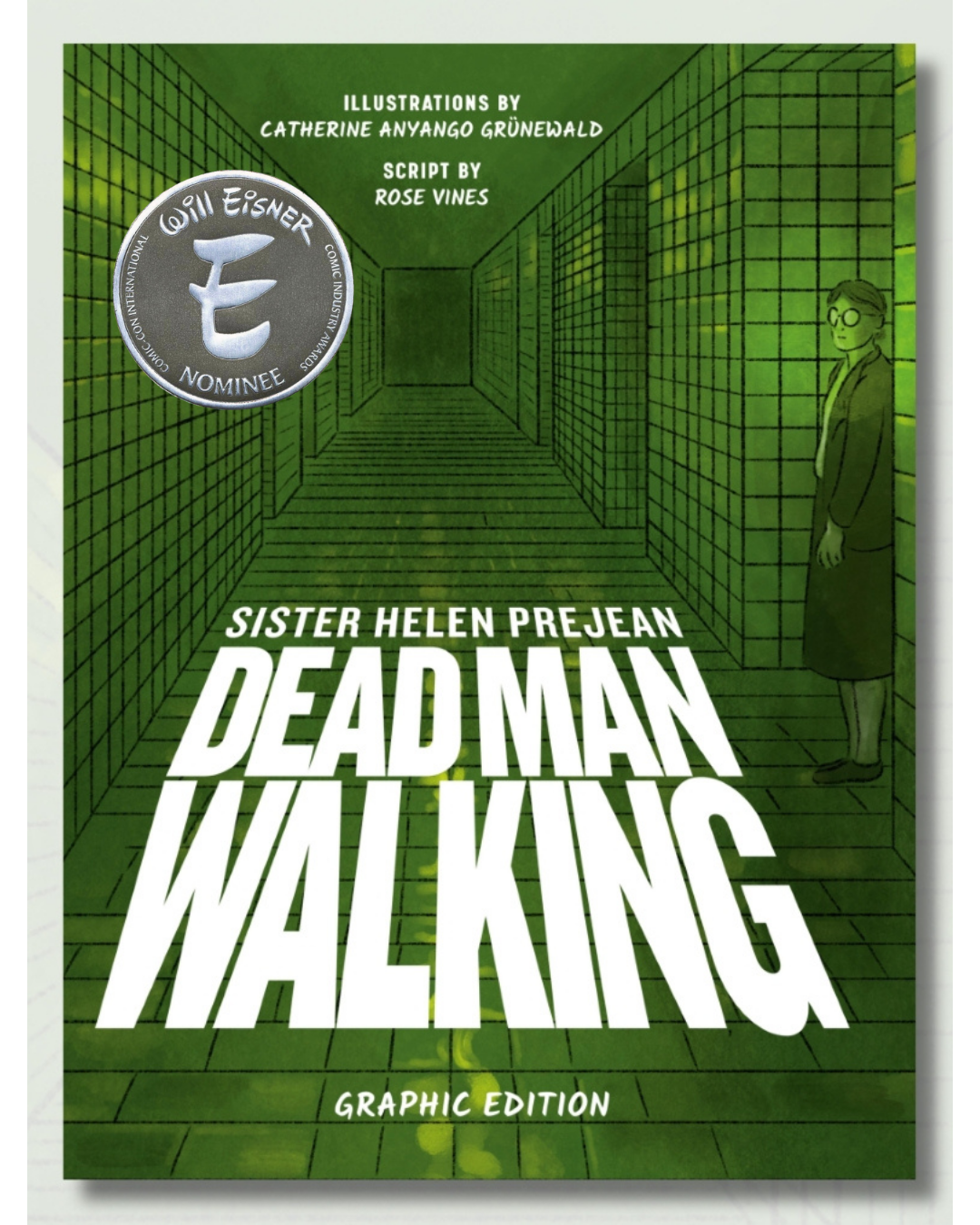
I thought it would be good to give all of us a breather this week and talk about books instead of executions for a change.
Dead Man Walking: Graphic Edition has been nominated for an Eisner Award this year. The Eisners, as I mentioned in May, are the equivalent of the Oscars for comics and graphic books, so this is a huge deal for us.
The Eisner Awards ceremony is being held on the Friday of San Diego Comic-Con (SDCC). Although SDCC is not the largest event of its kind in the world, with its attendance capped at 135,000—the capacity of the San Diego Convention Center, it is the most influential, prestigious, and internationally recognized comics convention.
Unfortunately, illustrator Catherine Anyango Grünewald is unable to wing her way from Stockholm for the event and Sister Helen Prejean has her head down writing a book about Manuel Ortiz, so I’ll be attending solo.
If you aren’t an aficionado of graphic books or comics you might dismiss the form as unserious, but a survey commissioned by the American Library Association finds a different story for readers in the 13-40 age range.
The survey, Gen Z and Millennials: How They Use Public Libraries and Identify Through Media Use, includes these findings:
Given a choice, 59% of Gen Z and millennials would choose the graphic/manga version of a story rather than a text-only book; and
preference for a graphic/manga version instead of a text-only book is higher in Black (69%) and Latinx (73%) communities.
Despite oft-voiced concerns that book reading is in decline, the opposite is true of graphic books. North American estimates put combined comics and graphic novel sales at about US$2.2 billion in 2025, the highest level yet recorded. Graphic book readers are also more likely to prefer printed books to ebooks.
So, to reach younger readers who are our primary target audience for Dead Man Walking, the graphic format is the ideal vehicle.
Our book joins others like Maus, March, Persepolis, Kent State, They Called Us Enemy, Wake, and The Best We Could Do which have demonstrated that there’s a substantial audience for serious, nonfiction graphic books.
Comic-Con features hundreds upon hundreds of panels, anime sessions, autograph sessions, board game rooms, epic cosplay (attendees must tie down their swords so they cannot be drawn!), an independent film festival, a massive exhibits hall, screenings, and limited edition collectibles.
Educational panels make up a surprisingly large component of the convention, with topics such as literacy, history, journalism, diversity, law (attorneys can gain Continuing Legal Education credits by attending), libraries, comics in education, intellectual property, censorship, and preservation.
This snapshot of part of my schedule—alas! I won’t be able to fit them all in—gives you an idea of some of the panels that are available:
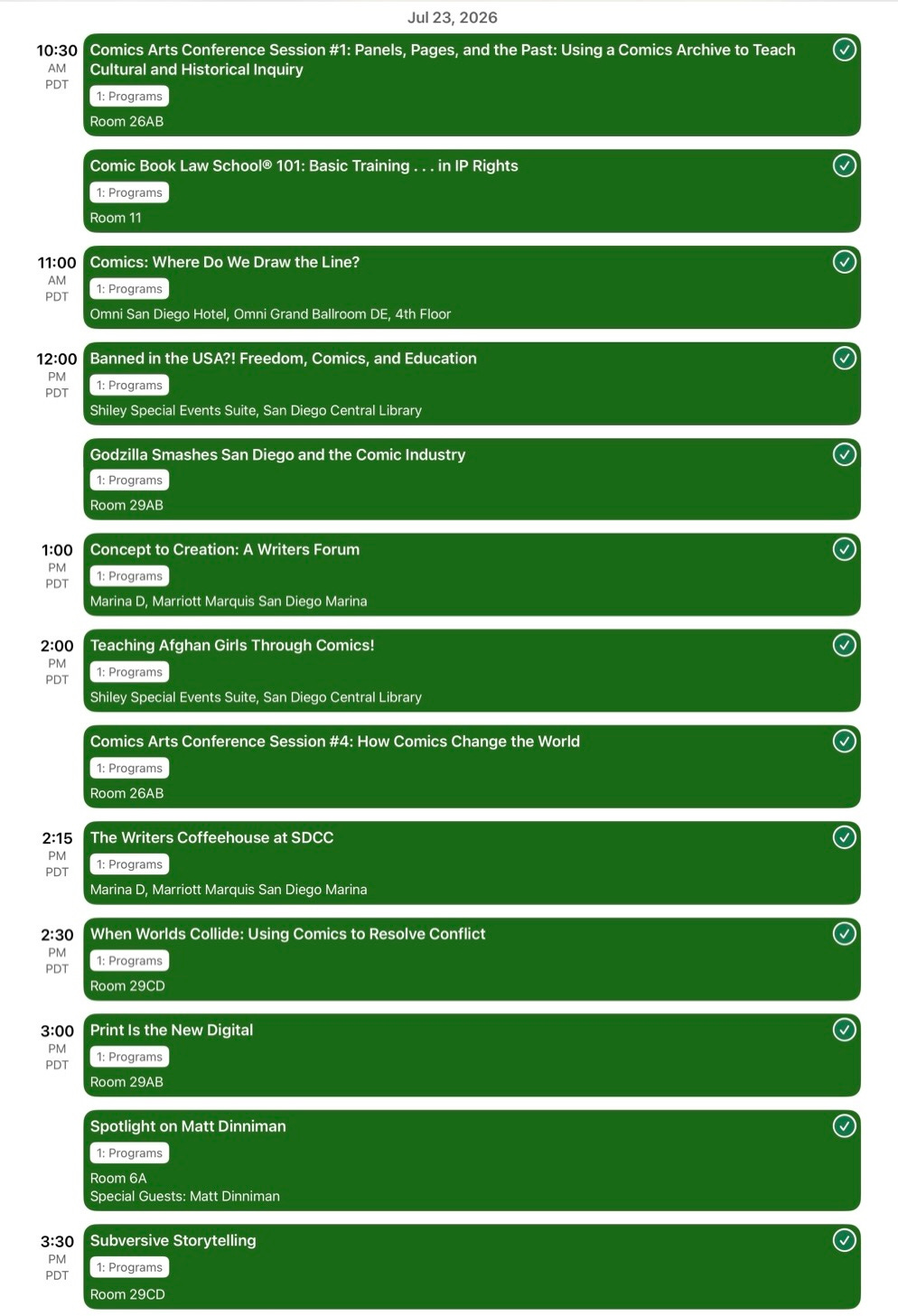
You can see that the theme for my Comic-Con experience, with a couple of diversions, is essentially “how comics can change the world.”
This year’s Eisner Awards include more than 170 nominated works across 32 categories. Dead Man Walking: Graphic Edition has been nominated for Best Adaptation from Another Medium.
Nominated works across all categories are overwhelmingly fiction, with nonfiction works making up around 12% of the nominees. Although a minority, nonfiction is no longer a niche in the awards. It’s an indication of the growing importance of such books.
There are six nominees in the Best Adaptation category this year, which is a change from the past when the judging panel sometimes deemed that the field didn’t merit selecting a winner. For the past eight years, however, there has been keen competition for the award, suggesting that the category has matured considerably.
Past winners include:
2018 – Kindred
2019 – Frankenstein (Junji Ito)
2020 – Snow, Glass, Apples
2021 – Superman Smashes the Klan
2022 – George Orwell’s 1984
2023 – Chivalry
2024 – Watership Down
2025 – The Road
The nominees for this year make for an eclectic selection:
Two fantasy classics (Alanna: The First Adventure and A Wizard of Earthsea)
One of the most famous novels in the English language (Lord of the Flies)
A major contemporary novel about race and policing (Ghost Boys)
A 17th century literary classic (The Compleat Angler)
One of the most influential nonfiction books on the death penalty ever written (Dead Man Walking).
Wish us luck!
Comments
Nothing yet. Say the first thing.
Sign in to join the conversation.