
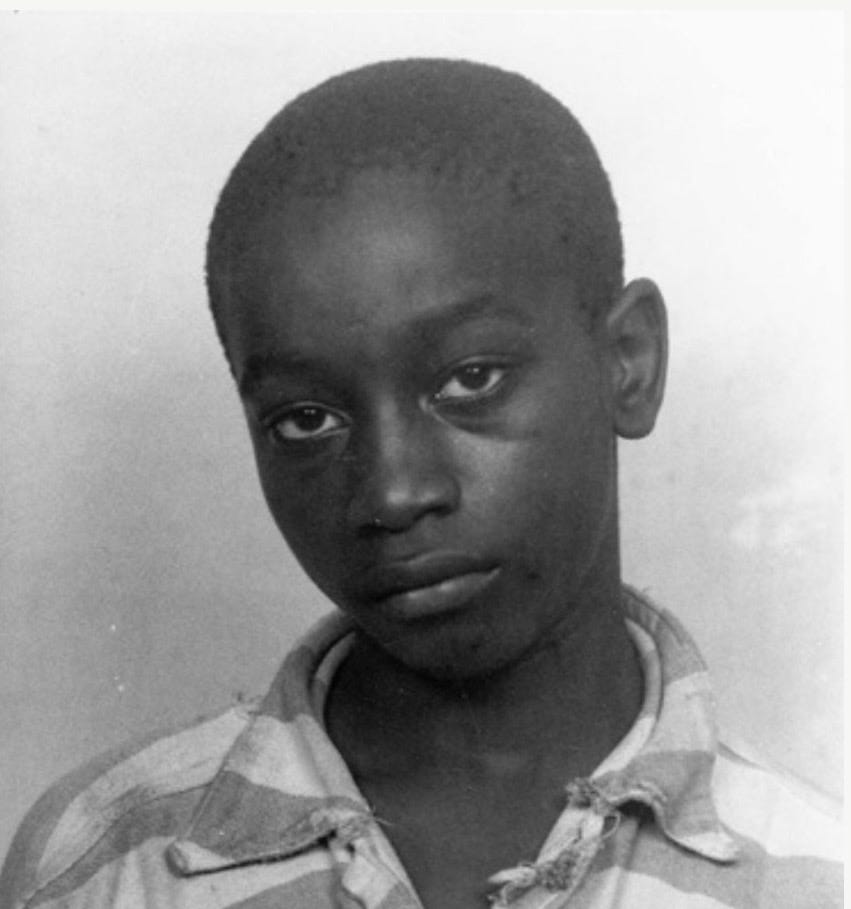
I’ve been thinking a lot about George Stinney this week. Monday marked the 82nd anniversary of his death in South Carolina’s electric chair.
George was 14 years old. Short for his age at just over five feet. Weighed 95 pounds. Black. He was so small that the guards used a Bible as a booster seat in order to fit the leather straps around him as he was placed in the chair. When the electric current was first switched on, the mask that had been placed over his head—to protect the witnesses from what might be a gory sight—slipped off and revealed his burned scalp and the tears that streamed down his face.
I should add that George was almost certainly innocent. At the very least, the trial that sent him to the chair bore no shred of justice, of constitutionality. It could rightly be viewed as one of the most egregious miscarriages of due process in U.S. legal history.
George was charged with the murder of two young white girls, Betty June Binnicker, 11, and Mary Emma Thames, aged seven. The girls’ bodies were found in a ditch, their heads smashed in.
George, who participated alongside his father in the search for the two girls, mentioned to others that he and his sister had seen the girls on the day they were murdered.
In the little town of Alcolu in 1940s South Carolina, that was enough to make him the prime suspect.
Although there was no physical evidence linking George to the crime, he was taken into custody, held for five days without being formally arrested, denied access to a lawyer, separated from his family, and interrogated.
The night that George was taken away in handcuffs, George’s father was sacked from his job and the family, on hearing that a lynch mob was coming, fled the town.
When George’s trial took place, Black people were refused entry to the courthouse, and so George faced alone a white judge, white prosecutor and police, an all-white jury, and an all-white audience. Charles Plowden, his court-appointed attorney (also white) who was running for office and hence beholden to the white voters of the district, put forward a skeletal defense with no cross-examination of witnesses, no mention of the lack of physical evidence, no challenge to an oral “confession” that the police said George had made.
The trial lasted three hours; the jurors deliberated for 10 minutes. Probably just enough time for a bathroom break. George was sentenced to death by electrocution.
Plowden filed no appeal on George’s behalf because, he said, “there was nothing to appeal on.”
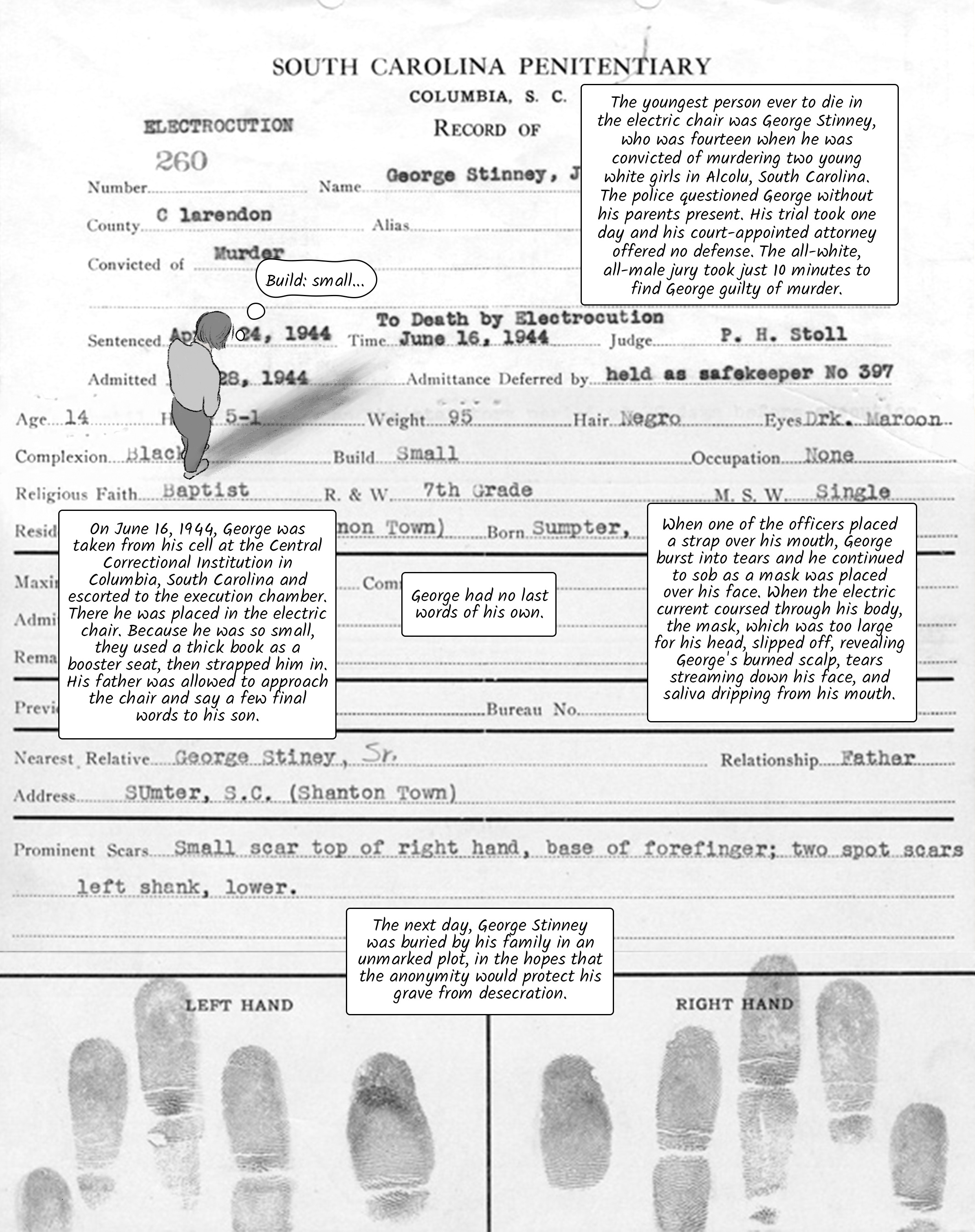
As George’s execution date approached, hundreds of letters poured in from across the country, begging Governor Olin Johnston to show mercy. One telegram read: “CHILD EXECUTION IS ONLY FOR HITLER.” Apparently not in 1940s South Carolina.
Governor Johnston was having none of it. In response to one letter from a constituent, he embellished George’s alleged confession with this:
“It may be interesting for you to know that Stinney killed the smaller girl to rape the larger one. Then he killed the larger girl and raped her dead body. Twenty minutes later he returned and attempted to rape her again, but her body was too cold. All of this he admitted himself.”
The governor happened to be running for the US Senate at the time.
Many people in Alcolu, both Black and white, would have been happy for George Stinney’s story to have been buried with him, but that was not to be.
In 2013, attorney Matt Burgess became interested in George’s case and started investigating. He contacted George’s surviving siblings who, if Plowden had bothered to call them as witnesses, could have testified that it was impossible for George to have killed the two girls because he was with them all day.
It wasn’t much to go on, but as Burgess continued to dig, he unearthed more and more details that cast doubt on George’s guilt, sufficient for members of George’s family to petition for a new trial.
In January 2014, over the course of two days Judge Carmen Mullen, a circuit court judge sitting in Sumter, South Carolina, listened to testimony from three of Stinney’s surviving siblings, a member of the original 1944 search party, and multiple modern forensic experts who challenged the original autopsy and the validity of the alleged confession.
Judge Mullen took almost a year to review the arguments and process the evidence. On December 16th, 2014, she issued an historic ruling vacating George’s conviction.
In her ruling, Judge Mullen said that she was overturning the conviction because the original court failed to grant George a fair trial:
…from time to time we are called to look back to examine our still-recent history and correct injustice where possible. Our common law provides for extraordinary relief, equitable in nature, where great and fundamental injustice has occurred. "A void judgment gains no validity from the passage of time."
Given the particularized circumstances of Stinney's case, I find by a preponderance of the evidence standard, that a violation of the Defendant's procedural due process rights tainted his prosecution. For that reason, the Court hereby grants relief in the form of a writ of coram nobis, "not on the grounds that the judgment against him was wrong on the merits, but that the courts have failed in a capital case to discharge their proper functions with due regard to the constitutional safeguards in the administration of justice,"
A writ of error coram nobis, Latin for “before us” or “in our presence”, is an extraordinarily rare remedy.
The writ is strictly for people who have already completed their sentence or probation. Courts routinely dismiss coram nobis petitions filed by current inmates on the basis that if a petitioner has any other legal avenue available to challenge their detention, they cannot bypass it to use coram nobis. While the writ of habeas corpus is designed for people who are physically detained, coram nobis is designed to cure the lasting "collateral consequences" of a conviction for people who are already free.
To win, a petitioner must prove there was a fundamental error of fact or law unknown at the time of the trial, that it could not have been discovered with due diligence, and that it would have prevented the conviction entirely.
Courts are deeply divided on whether a dead person can even receive a writ of coram nobis. Most jurisdictions rule that the writ dies with the defendant.
Despite the rarity of a writ of coram nobis, in George Stinney’s case Judge Mullen’s ruling reflected that the original trial was marked by a complete collapse of due process. She relied on her inherent equitable power to right a historic wrong.
Wait! Judges have inherent equitable power? What on earth is that?
Inherent equitable power is a court’s fundamental, unwritten authority to deliver fairness and justice when existing statutory laws or formal procedures fail to provide a remedy. Think of it as a judicial safety valve used to correct systemic failures, prevent manifest injustice, or right historic wrongs that standard legal rules cannot fix.
Unlike specific powers granted to judges by legislatures through statutes, inherent powers belong to a court simply by virtue of its existence as an independent branch of government.
Inherent equitable power is:
Derived from Common Law. It originates from the ancient English Court of Chancery, which was created specifically to provide relief when the strict, rigid rules of standard law courts produced unjust outcomes.
Independent of Statutes. A judge doesn’t need a law passed by Congress or a state legislature to trigger this power. They can invoke it to fill gaps in the law.
A last resort only. Courts will only invoke their inherent equitable power when a severe injustice has occurred and the petitioner has absolutely no other legal remedy available.
In using her inherent equitable power to grant a writ of coram nobis for George Stinney, Judge Mullen was asserting the court’s primary, overarching duty to administer true justice and to protect the integrity of the judicial system.
Because George Stinney was deceased, standard appellate and habeas corpus laws no longer applied, and yet to maintain a fraudulent or fundamentally unconstitutional conviction would permanently stain the integrity of the court itself. By invoking inherent equitable power,Judge Mullen could bypass standard procedural roadblocks, reopen the record, and vacate the ancient judgment.
Given the state of criminal justice in the U.S., one would think that there were myriad cases in which judges could and should make use of this superpower.
Yet the very rarity of the power is part of its design. Courts have repeatedly warned that equitable authority cannot become a substitute for ordinary appeals, post-conviction review, or legislative reform.
And so, alas, inherent equitable power is rarely a pathway to justice. Higher courts have ruled that judges can only use it to fill empty spaces in the law where strict adherence to technicalities would cause a shocking, unconscionable miscarriage of justice.
Comments
Nothing yet. Say the first thing.
Sign in to join the conversation.