
I lazed on the beach last week instead of writing. No swimming, alas, due to an unceasing rip caused by the atmospheric squeeze play between two mammoth weather systems. The bonus was pleasant temperatures and no crowds.
While I was absent, something big went down that I want to share.
Alabama has made itself the primary testing ground for the use of nitrogen hypoxia, aka asphyxiation, to execute people.
So far, the state has carried out seven executions using this method. Louisiana, the only other state to use the protocol, has carried out a single execution this way.
Alabama has repeatedly argued that unconsciousness occurs within seconds and death follows within minutes, but that doesn’t jibe with eyewitness reports:
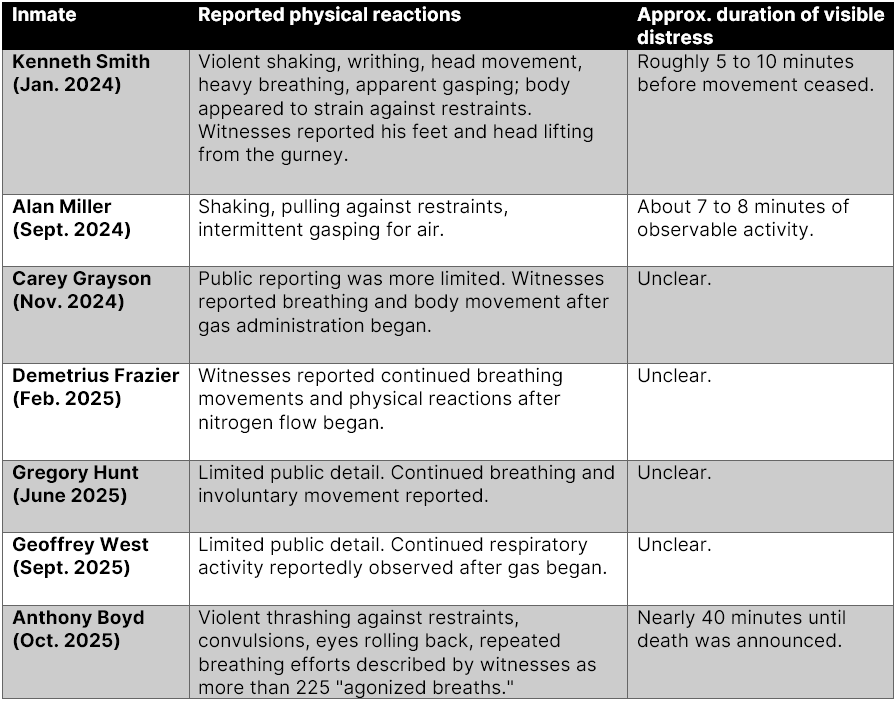
For an execution method which the state proclaims to be almost painless, Alabama goes to great lengths to hide what actually happens.
For example, witnesses are not allowed to monitor what prison staff are doing in the adjoining control room. As a result, reporters cannot independently verify:
when nitrogen flow actually begins;
gas flow rates;
oxygen concentrations;
whether adjustments are made during the execution;
or whether equipment problems occur.
Officials have consistently stated that the executions went “according to plan.” After Kenneth Smith’s execution, for instance, officials said that the execution was “carried out according to protocol” and that the observed movements were “expected consequences of oxygen deprivation” rather than signs of a problem.
A media witness to Mr. Smith’s execution, Lee Hedgepeth, saw it differently:
This was the fifth execution that I’ve witnessed in Alabama, and I have never seen such a violent reaction to an execution.
It seems that the courts have taken notice of the discrepancies between Alabama’s assessment of nitrogen hypoxia executions and the public record that documents the much longer period during which prisoners continued to exhibit breathing movements, shaking, gasping, or other physical activity.
It all started with Jeffrey Lee, who is next in line to face execution in Alabama. In district court before Judge Marks, his lawyers argued that nitrogen hypoxia violated the Eighth Amendment because it caused unnecessary suffering. Judge Emily Marks found against him.
In her judgement, Marks wrote:
“Lee establishes that death by nitrogen hypoxia involves some suffering…”
But then she went on to conclude (emphasis added):
Although this Court held the first bench trial in the entire country examining the constitutionality of nitrogen hypoxia, the Court does not write on a clean slate. The United States Supreme Court “has never invalidated a State’s chosen procedure for carrying out a sentence of death as the infliction of cruel and unusual punishment.” Baze, 553 U.S. at 48. Time and time again, the Supreme Court “tells us that the Eighth Amendment does not guarantee a prisoner a painless death.” See Bucklew, 587 U.S. at 132. While Lee establishes that death by nitrogen hypoxia involves some suffering, he fails to show that the Protocol is cruel and unusual in violation of the Eighth Amendment.
This ruling was not a casual rejection of Lee's claims. It came after a thorough evidentiary trial in which Marks heard experts, reviewed extensive evidence, and concluded that Lee had indeed shown that nitrogen hypoxia would involve suffering. Yet she felt constrained by existing Supreme Court doctrine, particularly the framework established in Baze v. Rees and Bucklew v. Precythe.
In other words, Marks was not saying the evidence proved the method was painless. She was saying that under current Supreme Court precedent, proof of suffering alone is not enough.
“While Lee has shown that executions under the Protocol involve some suffering, on this record he has failed to prove that the Protocol causes more than ‘the necessary suffering involved in any method employed to extinguish life humanely’…
Because Lee has not shown that the Protocol cruelly superadds pain, his claim that the Protocol violates the Eighth Amendment fails as a matter of law.”
Her reasoning was essentially:
The Constitution does not require a painless death.
Every execution method causes some pain.
Supreme Court precedent sets an extremely high bar for proving an execution method is unconstitutional.
Therefore, even though suffering exists, Jeffrey Lee had not met that doctrinal threshold.
Then the case took a remarkable turn.
Lee appealed the decision to the Court of Appeals for the Eleventh Circuit and that court came to a different conclusion. Using Marks’ factual findings, it determined that:
“Alabama’s nitrogen hypoxia protocol presents a ‘substantial risk of serious harm’—severe pain over and above death itself.“
The court explained (emphasis added):
“As intended, the protocol causes death by introducing pure nitrogen gas through a respirator mask until the inmate is declared dead. The district court found that an inmate executed under the protocol suffers one to three minutes of “severe air hunger and corresponding emotional distress, anxiety, physiological stress, and physical discomfort.” Lee, 2026 WL 1493098, at *25. This mental distress, physiological suffering, and physical discomfort, the district court found, will likely take place. There is, in other words, a substantial risk of serious harm. The risk is not conjectural, speculative, or doubtful.”
Although this decision has given Jeffrey Lee a reprieve, it has not removed the danger of execution. On the contrary, as determined by the Supreme Court’s ruling in Glossip v. Gross (2015), because executions are deemed constitutional, a state must therefore have a method of being able to carry out executions.
This means that any person who challenges their execution method must show that there is an available method that is demonstrably less likely to cause extreme suffering. (This is the “bring your own execution method” trap that was set up in the Glossip ruling, a gotcha that must have had Justices Scalia, Alito, and Thomas licking their chops at finally stymying those anti-death-penalty “guerrillas” who had been plaguing them for so long.)
Jeffrey Lee offered the firing squad as an alternative, a protocol not currently in use by Alabama. The 11th Circuit sent the case back to Judge Marks, asking her to adjudicate whether Mr. Lee had satisfied both prongs of the Glossip test: firstly, that the proposed state method was unnecessarily cruel, and secondly, that the state could avail itself of a less painful method. She found that both prongs had been satisfied.
Alabama tried to get the ruling stayed so that it could proceed with the execution regardless. The stay was denied in turn by Judge Marks, by the 11th Circuit, and by the Supreme Court of the United States.
Taking a breath here: the denial of a stay by the Supreme Court is not a ruling on the merits of whether nitrogen hypoxia is constitutional.
However, this is still a result worth celebrating.
When Judge Marks first considered Jeffrey Lee's challenge, she observed that she did not write on a clean slate. Generations of precedent stood in the way. Yet the evidence developed in this case ultimately persuaded a federal court that nitrogen hypoxia violates the Eighth Amendment. The litigation continues, but the slate is no longer quite as spotless for states seeking to defend new methods of execution as humane.
Comments
Nothing yet. Say the first thing.
Sign in to join the conversation.