
The phrase progressive foreign policy has been thrown around frequently over the past week, with many proclaiming its sudden emergence into the mainstream of American politics. This precipitous rise in conversation around this topic is wholeheartedly due to Representative Alexandria Ocasio-Cortez’s dual speeches at the Munich Security Conference. The conference, itself, has served as an annual forum for those connected to Western security and foreign policy issues since 1963, with many of its previous attendees consisting of heads of state, diplomats, businesspeople, and academics. The conference has since its founding essentially become comic con for those with a nerdy love for international policy, and thus, over the years the forum has morphed into a common avenue for Western politicians to stake new claims and goals for their countries.
Representative Ocasio-Cortez during her two moments of conversation presented to thousands of viewers an attempt by an American politician to shift the foundations of US foreign policymaking leftward, something which has been uncommon since the end of World War Two. Her critical and aspiratory lines on international order, economic precarity and authoritarianism, and worker-focused statecraft all detracted from what we’re used to seeing within these kinds of established institutions, and from the Democratic Party writ large. Liberal foreign policymaking, while less erratic than its Cold/Iraq War days, has since the early 2000s continuously rolled into these events singing the same tired tunes of militarism and semi-multilateralism. Obama and Biden, while different regarding Cuba and aspects of trade, fundamentally offered the same kind of liberal interventionism which has been struggling for purpose since the collapse of the USSR. No lessons have been learned, and mistakes have been repeatedly made for all the world to see.
Liberal administrations supported NATO’s bombing of Libya and Saudi Arabia’s decade-long war in Yemen; they continuously backed arm shipments to Israel and helped to further aid the country’s genocide of Gaza; most crucially, they time and time again reaffirmed the stance that America’s hegemonic position had to be maintained through force projection, expanded defense spending, and competition with rising powers.
In its essence, liberalism’s contemporary foreign policy is a weakened vestige, motivated by blinkered goals and ideals which have failed to evolve with our world’s emerging challenges and conditions. It has tirelessly continued to endorse the antiquated mechanisms of regime change, privatization, and selective enforcement of international law, and all without realizing its declining legitimacy. Under Biden, slight changes to this ideological lineage occurred, but not nearly to the degree that was needed to bring forth sustainability.
But AOC’s messaging was far different. It diverged from liberal orthodoxy, not merely rhetorically, but in worldview and political-economic scope. Her narrative was not one of hegemonic defense or fictitious devotion to selective international rules, but instead a pragmatic left vision that recognizes the role of economics, trade, and class in shaping global political power and its myriad misapplications. Fundamentally, it was internationalist, pro-worker, and pro-democracy; it did not shy away from democratic multilateralism, nor did it claim that we are witnessing a departure from a once-great liberal international order. In fact, it argued the opposite and presented our current moment as existing within a “pre-rules-based order” that has yet to congeal.
AOC ‘s message framed our supposed liberal world order, and the ideology attached to its waist, as being practically nonexistent for billions of people, and instead argued that it was war, inequality, and insecurity that were driving instability and shifts of power globally. It was an argument grounded in political economy, viewing foreign policy as being fundamentally connected and downstream to domestic politics and its plethora of crises.
In its essence, progressive foreign policy is meant to convey an orientation toward American statecraft that draws from left-wing goals in domestic policymaking and organizing. It is an ideological bent which recognizes the growing reality of multipolarity and the weaknesses that stem from American hawkishness, but also that American power can still be a force for democratic change if utilized correctly. Fundamentally, it acknowledges that American influence over our global system is not going to suddenly evaporate into thin air, nor should it. Our impact on international markets, diplomacy, and security will still be ever-present in the years to come, and regardless of how we feel about this reality, it is something we have to address and attempt to mitigate. Isolationism is not preferable, nor is America voluntarily choosing to allocate all of its power abroad in the name of based anti-imperialism.
America’s unique position as a hegemon is both a privilege and liability, and it will not disappear overnight despite all our mistakes and quagmires. Subsequent administrations will use our country’s power and influence for their own political purposes, and in order to prevent its worst applications, we must organize around a new form of policymaking which acknowledges this reality and attempts to build something better through international cooperation and labor power.
Our objective here is not on ending American power, but instead on how to utilize it toward left-progressive ends which will buttress democratic legitimacy, ameliorate inequality, and reduce the power of oligarchs and authoritarians. The goal is to build a more stable world, not through intervention or war, but through helping to deliver sustained and equitable growth at the domestic level alongside global incentives which favor democracy, human rights, and the rights of workers.
American power, under this logic, could be used to help reinvigorate and shift institutions like the International Labor Organization or the World Bank toward stronger labor protections and worker-led development. Development, under these conditions, could be used to strengthen unions and working-class movements, ensuring more equitable growth and new centers of political energy within receiving countries. These strategies could also grow to take a more Keynesian approach to finance by setting up capital controls and regulations which help to keep investment local and within industries that are following labor laws.
Cooperation is also key in this regard and could likely bring on European and Pacific allies toward these goals, especially considering American and Europe’s leverage within international trade and finance. Speaking of extensive leverage, existing monetary and fiscal tools could be used to favor green industrial policy, thus helping to weaken authoritarian petrostates and strengthen international cooperation simultaneously. Altogether, through shifts in policymaking and global cooperation, the West’s influences over regulatory and economic standards (think the Brussels and California Effects) could be used to create a slew of global incentives which both help the Global South while offering strong support toward democratic governance.
Regarding trade, an issue where progressives have differed greatly from liberals, America could work with countries and allies to ban social dumping and then supplant current practices with higher income and labor standards. Hell, we could even utilize the power of the government to attack offshore tax havens and work to return tax dollars, not only to ourselves, but to nations all throughout the world. If properly investigated and enforced, an estimated $200 billion in untaxed funds could be returned to developing countries in Asia, Africa, and South America. How’s that for soft power politics?
Critically, as AOC highlighted, we could help buttress international law’s legitimacy by enforcing the rules against both ourselves and allies, thus helping to signal that buy-in to the system carries with it leverage and accountability. Smaller countries would possess new means to challenge regional aggressors; refugees and victims of war would have a robust international outlet to expose crimes and atrocities; and working-class populations globally would finally have mechanisms in place to challenge capital’s immense leverage over development and finance. Of course, not every country or autocracy would be subject to these international rules, but by leading the charge on enforcement and scope, this could indeed be a step in the right direction that helps to incentivize actors toward more democratic and worker-friendly ends.
Overall, AOC’s messaging opened a window into the promises of a left foreign policy driven by opposition to monopoly, authoritarianism, and insecurity. She connected the West’s stagnation and failed technocratic governance to the contemporary rise in populism and illiberalism; she offered a narrative, far from blaming working-class populations, which attempts to build a politics which understands their pain, experiences, and aspirations; crucially, she called on governments to respond, invest, and adapt to economic challenges, and for strengthened global cooperation on issues pertaining to economic equality, class, and cross-border oligarchy.
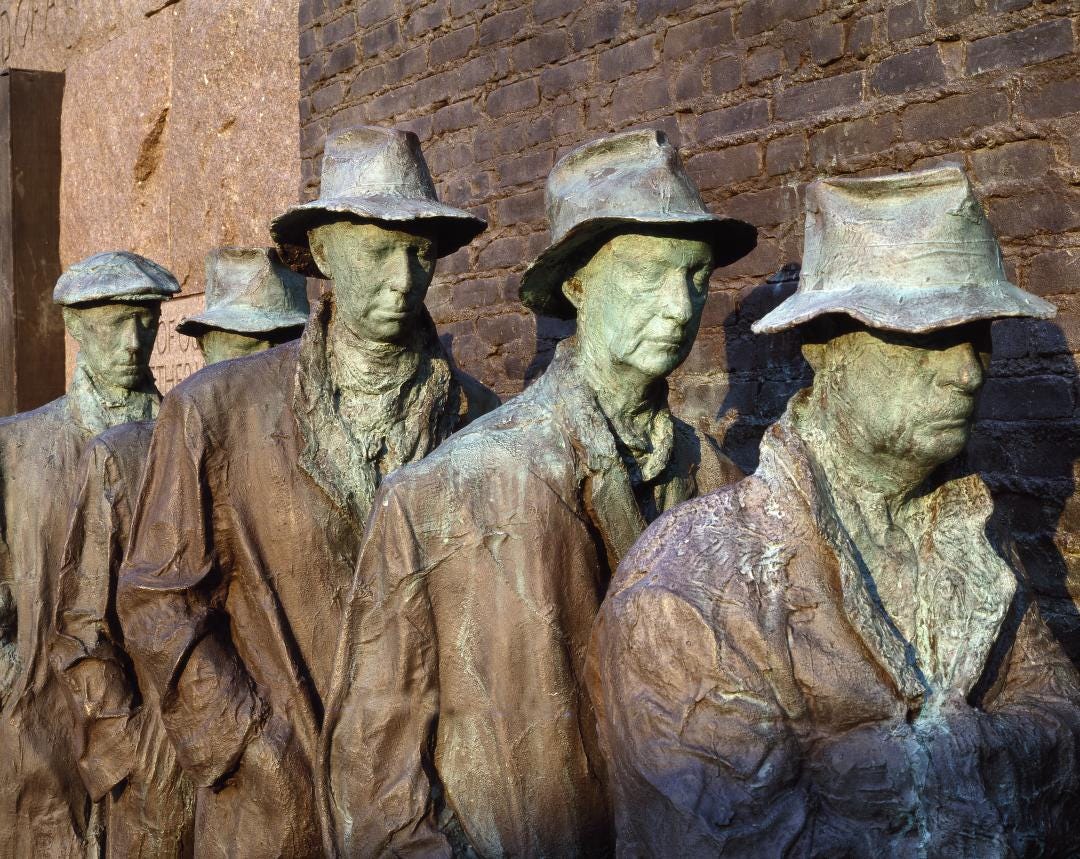
Progressives, differing from liberal interpretations of politics, understand how important economic and political security are in helping to bring about a stable global order. President Franklin Delano Roosevelt, near the end of World War Two, famously argued that the New Deal and its benefits needed to be delivered globally in order to prevent radicalism and violence. Lessons had to be learned from World War One, the Great Depression, and the rise of fascism, and these lessons needed to rely, not only on expertise, but on labor power and democratic energy. Economic collapse had begot inequality, resentment, and vicious ethnonationalism, and in order to impede these forces, governments needed to spend and plan. Corporate power had to be lowered, unions needed to be empowered, and domestic economies had to be regulated to ensure that investment and growth were sustainable, local, and fair.
Contemporary progressives see a world today which is eerily similar to that of the Depression era. Inequality has skyrocketed, wars are more common, democratic backsliding is gaining steam, and all the while, imperial powers are eschewing democratic rights in favor of oligarchy and violence. Russia and its oligarchic elite are attempting to reassert their imperial claims over Eastern Europe and parts of central Asia; the United States’ gang of cronies are again using their country’s military and economic might to intervene in South America, the Arctic, and Asia; and an emerging China is increasingly shifting toward a totalitarian form of state capitalism which limits democratic rights and the ability of workers to exert labor power. All three of these powers are weakening the global working class, and none are showing any signs of eschewing bellicosity in favor of worker-led development or regional peace.
Progressive foreign policy follows what FDR offered almost one-hundred years ago. Domestic progressivism needs to be replicated globally, and this replication must be centered around the core tenets of democracy, labor power, and cooperation. Workers must be protected, authoritarian oligarchies must be weakened, and standards of living must rise and begin to match what is needed to live a good and decent life. Governments must recognize the errors of past neoliberal orthodoxy and attempt to chart new paths which change, not only domestic distribution, but also their orientation toward what global democracy and economics should look like in the 21st century.
In a world of growing crises and insecurity, progressives are offering a solution grounded in democratic laborism. AOC conveyed this in Munich, FDR conveyed this in 1945, and future generations will be tasked with fighting for these goals as our new world comes into being. A better world is possible and worth fighting for, and progressives are offering a path forward, not only for America, but for workers and laborers everywhere.
No posts
Comments
Nothing yet. Say the first thing.
Sign in to join the conversation.