
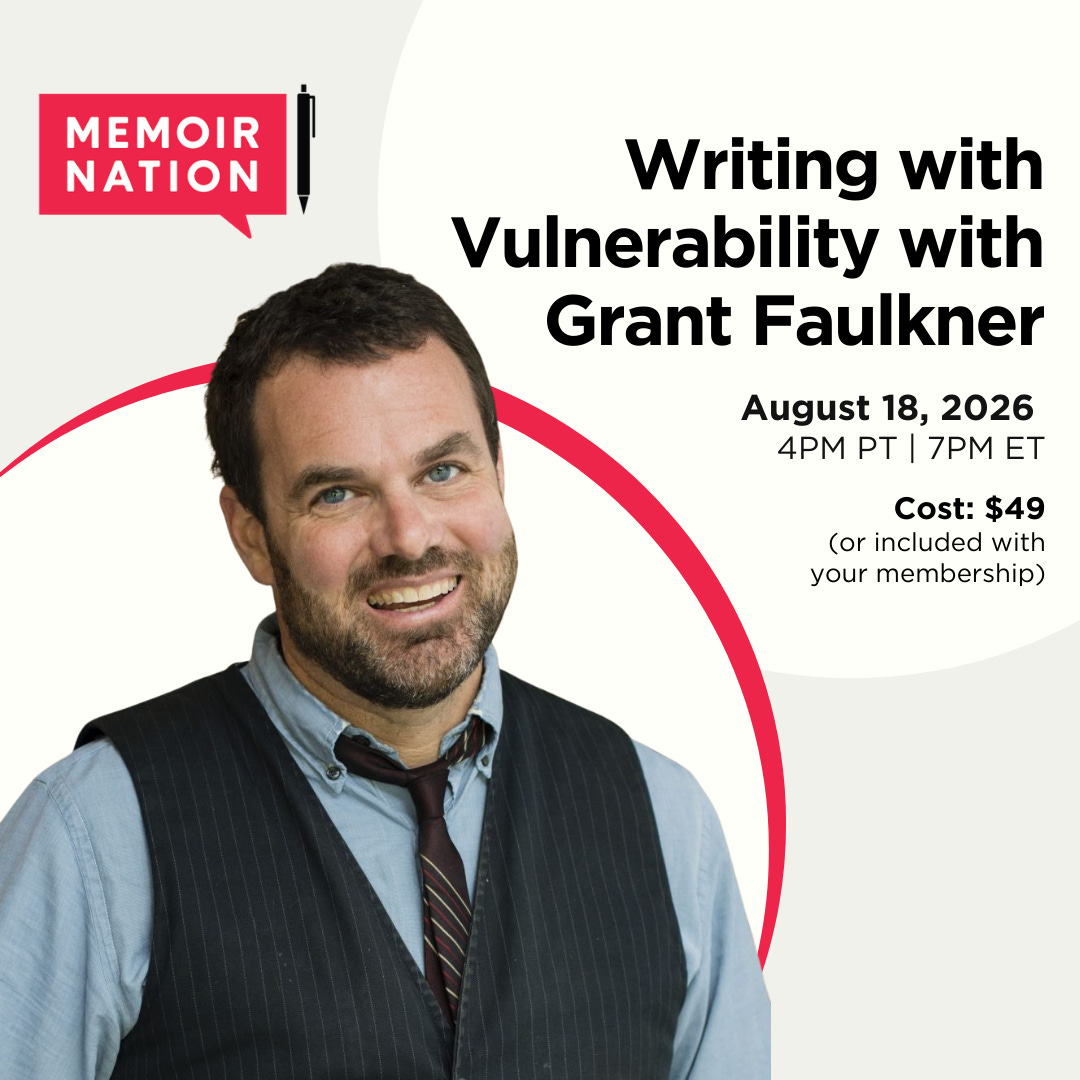
I’m teaching a class with Memoir Nation this Tuesday on Writing with Vulnerability. I think it is the crucial topic for any writer.
Riveting dialogue, piercing details, a suspenseful plot all go into the construction of a good book—but I’d argue that the ability to be vulnerable on the page is more important that any craft element.
That’s because being vulnerable is what connects us beyond all else.
Pause to think about a person who you open yourself to without fear of judgement, with the expectation of love and acceptance. Pause to think about how you can only know someone deeply if they allow their wounds, their foibles, their silly dreams, their awkward lunges, to be seen.
We all want to be loved, to belong. But to be truly loved, to truly belong, is to open yourself, which is a risk because opening ourselves makes us vulnerable to what can feel like all of the rocks and arrows the universe might sling at us. And the worst rock or arrow might take the form of banishment. Which is the ultimate human fear.
When I look at my class title, Writing with Vulnerability, I worry that the takeaway might be misunderstood. I worry that students might feel that you can just flip the switch of vulnerability on and off—that the class will provide all of the answers to being vulnerable.
But being vulnerable is actually a lifelong practice. Each vulnerability is its own unique story. Each vulnerability must be treated differently, expressed differently. You can’t just wake up and run a marathon. You have to practice running, practice knowing your limits and strengths, practice knowing the course (aka the page), practice feeling both the pain and the joy of the endeavor.
You have to come to the page every day with the intention of being open. You have notice when you’re holding back—notice when fear takes over. You have to coach yourself to “write like no one is looking” and remind yourself that writing the truth will not only set you free, it will set the reader free.
I recently published an excerpt from my memoir about my lifetime of suicidal ideation in Jessy Easton’s series, On Writing the Hard Thing.
I was anxious the night before it was published. I’d barely told anyone in my life about this side of myself. And when I posted it on Facebook, to a possible readership of 5,000 friends, family, and contacts from 61 years, I wondered if my story would come across as “trauma porn,” or overly self-involved—or if people would pile on with too much sympathy or 1-800 numbers or recommendations of therapy (of which I wanted none of—I just wanted to tell my story).
But when I shared my piece, I felt a rush of connection. So many people left comments about their own mental sufferings, or the suffering of people dear to them, and instead of feeling banished, I felt the strength and warmth of deepening bonds, the embrace of belonging. People came out with their own stories. People thanked me.
At its heart, vulnerability is about trusting others. When we’re afraid of things, we tend to project worst-case scenarios. The reader becomes a cold and menacing critic in our minds, ready to judge, ready to crucify.
For many years, I didn’t show anyone my stories. I had a master’s degree in creative writing, so I possessed all the hardened calluses that workshopping stories builds. Still, I wrote in a solitude protected with ever-thickening barricades.
I suppose somewhere within myself I believed my stories weren’t good enough—or feared that others’ reactions would prove they weren’t good enough. Perhaps I worried about being exposed as a creative charlatan, a dilettante, a fool.
One definition of shame is that we feel weak and inadequate in a realm where we think we’re supposed to be strong and competent.
I sent stories to literary journals because only anonymous editors would read them—and their reactions didn’t matter as much to me. Even when a story of mine was published, I rarely gave it to friends and family, and I declined invitations to read in public. I like to write about the underbelly of life, the sordid moments and unspoken desires that lace through people’s consciousness, and I suppose I feared that people would make judgments of me based on such stories.
Since I grew up in a small town, where lives were constantly under scrutiny, such a fear was embedded within me and had surely become magnified over the years.
But then one day I randomly started sharing pieces with a friend at work. It was an enlivening experience to suddenly have a reader. The simple act of giving a story to another and hearing her reactions made me realize how the closures of solitude had made me into a stingy writer, and how the act of writing changed when I did so with the idea of touching the person who would read it.
After all, the urge to be a writer is a generous act at its core: we want to share our story with others, to give them a world that will open doors to insights and flights of the imagination.
The only way to achieve that is through an openness of spirit that can feel dangerous. A good story occurs when an author travels, or even plummets, into the depths of vulnerability and genuinely opens his or her soul in search of truths that otherwise go untold. My favorite stories are the ones where I feel as if I’m in an intimate conversation with the author.
Telling such a story, however, is among the most challenging things a writer can do. Brené Brown, a research professor at the University of Houston who studies shame and vulnerability, said that one-third of the people she interviewed could recall a “creativity scar,” a specific incident when their creations were disregarded or disdained.
I think that figure is low. My guess is that everyone has a creativity scar of some sort. And the way that most people heal their scar is to close up. A stoic show of invulnerability can feel stronger than the weakness of openness.
To be vulnerable is not weakness, though. Quite the opposite. To tell your story in your way, to confront difficult truths and risk putting your story out there, takes courage. Such courage is challenging, of course. It requires overcoming the fear of shame—the feeling that we’re flawed, unworthy—and shame can be a noisy beast. It screams, “You’re not good enough!” in a myriad of ways to writers.
I suppose such unspoken thoughts were why I didn’t share my stories for so many years. But I had to ask myself, why did I become a writer in the first place?
I made a list. And here’s what I discovered was on it: I wanted to put words to the shadowy corners of people’s souls, to understand the desperate lunges people take to give life meaning. I wanted to explore the enigmatic paradoxes of being, how desire can conflict with belief, how yearning can lead to danger. Life is so mysterious, nuanced, ineffable—equally disturbing as it is beautiful—so I decided it was my duty as a writer to be brave enough to risk ridicule in order to bring my truths to light.
Why write a sanitized version of life? I decided that what is most important to me must be spoken, no matter if I’m belittled for it, because only in such acts do we connect and understand each other.
Art is fundamentally an act of exposure. An artist opens the closets, dares to go into the dark basements, and rummages through the attics of our souls. Each sentence, each paragraph, each story holds its own particular demand of bravery.
By being vulnerable on the page, you won’t find shame—you’ll find enlivening connection. People will appreciate your moxie and your generosity. They’ll applaud you for telling their story, the one they can’t tell themselves.
I hope you’ll continue this conversation with me in my class this Tuesday.
Make a list of personal stories you hesitate to write. They can be the dramatic “too dangerous to write” stories, or they can be about smaller, more private things that we feel shame or embarrassment in revealing.
Make a list of your favorite works of art and what vulnerability the artist explored or risked. Or, go beyond that, and think of art that owed their entire existence to vulnerability—like Kiese Laymon’s Heavy or Lidia Yuknavitch’s The Chronology of Water.
Try writing one of those personal stories you’re shirking from. Write it just to write it, just to experience the words on the page, without any aspirations, without any expectation of showing another. See how it feels.
Parts of this were excerpted from Pep Talks for Writers.

“There is no intimacy without vulnerability. There is no courage without vulnerability. Courage requires the willingness to lean into uncertainty, risk, and emotional exposure.”
—Brené Brown
Thanks for reading Intimations: A Writer's Discourse! This post is public so feel free to share it.
Comments
Nothing yet. Say the first thing.
Sign in to join the conversation.