
I have a love affair with crows.
They give me great comfort when I see them on my walks. They watch me so attentively, so curiously. I try to speak with them because I feel like crows always have something they want to say to me. Something like the story of the world.
This is why I decided to make this my year of studying crows, and to see what I could learn from them.
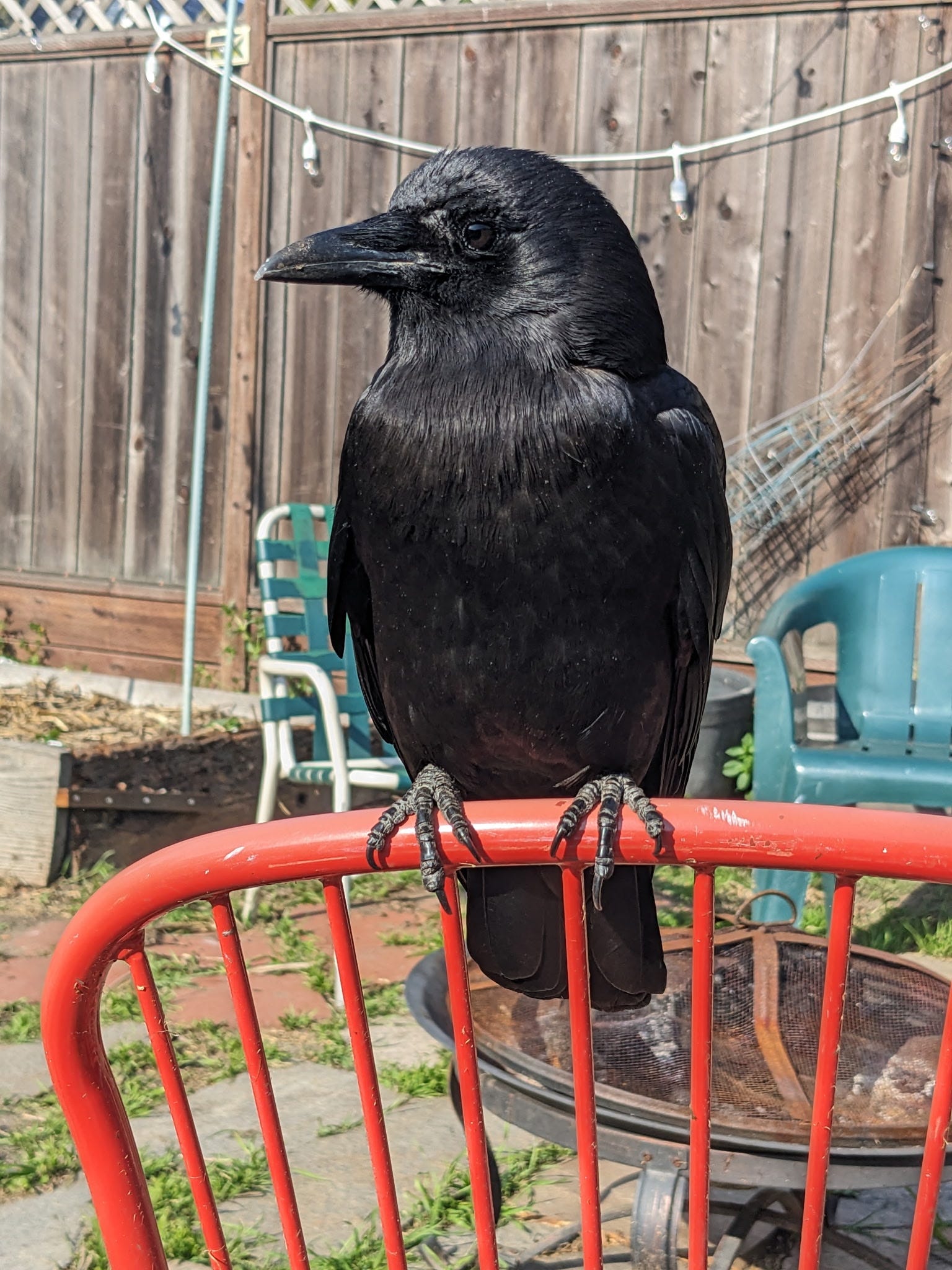
Crow story no. 1: My hair stylist, the wonderful artist and gusto-filled human being Bobby Jean, has a crow friend, Carl (in the photo above), who has been visiting her since the beginning of the pandemic.
They met under unfortunate circumstances. Bobby had to quit her full-time stylist job due to a shoulder impingement, so she was home most of the time. That’s when she noticed Carl, who was even more mangled than her. He was ill with Avian Pox, and she watched as he was “very noisily cast out from his local murder.”
She found him hiding in her tree after dodging multiple attacks. “The murder looked to be trying to murder him,” she said. Perhaps because they knew that his Pox was contagious. He was covered in lesions and warts and looked like he would die soon, so she set food and water out for him. The other crows knew Bobby from her dog walks, so they decided to give him space, and he made Bobby’s yard his home, healing to become the handsome devil he is in the photo above.
Now, each morning, Carl greets Bobby with a bow of his head and she bows back. His lesions have faded, but he has a scar over his left eye that had “once resembled an elephant seal’s saggy snout,” said Bobby. “This is how I tell him apart from his mate Coocoo.”
Be sure to read Bobby’s story about bathing with crows below.
Crow story no. 2: I also know a woman in my neighborhood who befriended a couple of crows. She carries a bag of unshelled peanuts and feeds them every day, and they follow her while she walks. She calls them Lancelot and Guinevere.
She told me that Lancelot and Guinevere sometimes leave small objects on her doorstep—a button, some tin foil. It’s Lewis Hyde’s “gift theory” in action: what is given freely returns, transformed into something the giver could not have predicted.
Some say that crows are the cockroaches of birds—tough, hardy, ugly creatures that are likely to survive any apocalypse. Their feathers seem soaked in coal. Their chainsaw squalls are the opposite of any song bird’s melody. But I find they are wonderful life guides, well above cockroaches on the evolutionary life ladder, and maybe above us.
I think the crow is quite striking, even handsome, in its noir cloak. Its beak curved so formidably, as if it’s an obsidian hook. And then there are its intense, penetrating eyes, so full of thoughts and stories. The crow seems to say, “You must reckon with me. Oh, yes, you must reckon with me and all that I will tell you.”
In Greek mythology, the crow was originally white and served as Apollo’s messenger. But when the crow brought Apollo the news that his lover Coronis had been unfaithful, Apollo was so enraged at the crow for being the bearer of bad news that he scorched the crow’s feathers black.
This is often the fate of a writer: we serve the truth with our words, but our truths can be unappreciated, or, worse, we’re punished for speaking them.
I think Apollo’s treatment has made the crow wary. Crows are known for their grudges. Studies have shown that crows recognize individual human faces and remember who has wronged them—sometimes for years, passing the information to their offspring.
When a crow holds a grudge against you, they will scold and maybe even dive bomb at you. I know this isn’t an admirable trait, but I admire crows for the stubbornness of their chagrin. Perhaps memory is tied to morality. Perhaps a crow doesn’t let go of what it has witnessed not out of bitterness, but out of self-protection.
When I think of crows, I think of them carrying a pain. A pain that forms intelligence, though, and the crow is among the most intelligent of creatures. Crows are one of the few species that make and use tools, fashioning hooks from wire, dropping nuts on crosswalks so cars will crack them, using sticks to probe bark for insects.
Plus, crows play.
To solve any problem, you have to play with it. Delight and rigor are not opposites. The crow knows this.
But as playful as a crow might be, they don’t run (or fly) from the tough stuff. When a crow dies, other crows will congregate around the body. Researchers believe this is a form of investigation: the living crows want to learn something about the death. They want to understand how and why their companion died. They know tragedy.
Crows, like artists, are attracted to liminal spaces. In almost every mythological tradition, the crow is associated with transitions and thresholds. In many Pacific Northwest Indigenous traditions, Raven (often interchangeable with Crow) stole light and gave it to the world. The story varies by nation but the essential story is the same: the world was dark, Raven tricked the keeper of light into releasing it, and now we can see.
The trickster doesn’t ask permission to bring light into the world. It takes the light and gives it away. It’s a creative, transgressive act. And there’s a lesson here:
You have to steal fire from those who hoard it for themselves. You have to be defiant to give the world the light of your story. To make sure the light reaches all.
Crows have a language. How could they not?
Individual crows can be identified from their calls alone. Young crows learn regional dialects. Different calls mean different things. They try to find the exact word, the exact image, the exact form, rather than relying on the generic signal that everyone already knows.
Like a writer who strains to find the right word, the right phrase, and is never quite satisfied.
Part of my affinity with the crow is how it is communal and solitary simultaneously. Crows roost together in enormous numbers, but they also love their independence and prefer to scout alone.
Like an artist. The crow knows when to flock and when to fly solo.
I want to take my study of the crow deeper now. I’m going to buy my own bag of unshelled peanuts. I’ll see if I can make a new crow friend, because the other thing about crows: they’re loyal to the very end.

How did Bobby Jean get the photo of Carl above?
“One of my favorite moments is when it was hot out and I was taking a bath in my outdoor semi-hidden tub. The crows acted alarmed by this weird new thing I was doing. They bathe in their water, why shouldn’t I?
“I began to sing and Carl came and perched on the funky wooden chair I used as a table. Two feet from me he bowed, cocked his head and listened while the others stayed their distance, watching. I kept singing and Carl puffed his feathers and stayed with me the whole bath, reacting to my odd note changes that I did to see what he liked or what made him tilt his head in that funny way he does. It was a beautiful moment.”
—Bobby Jean Larranaga
“I saw a crow building a nest, I was watching him very carefully, I was kind of stalking him and he was aware of it. And you know what they do when they become aware of someone stalking them when they build a nest, which is a very vulnerable place to be? They build a decoy nest. It’s just for you.”
—Tom Waits
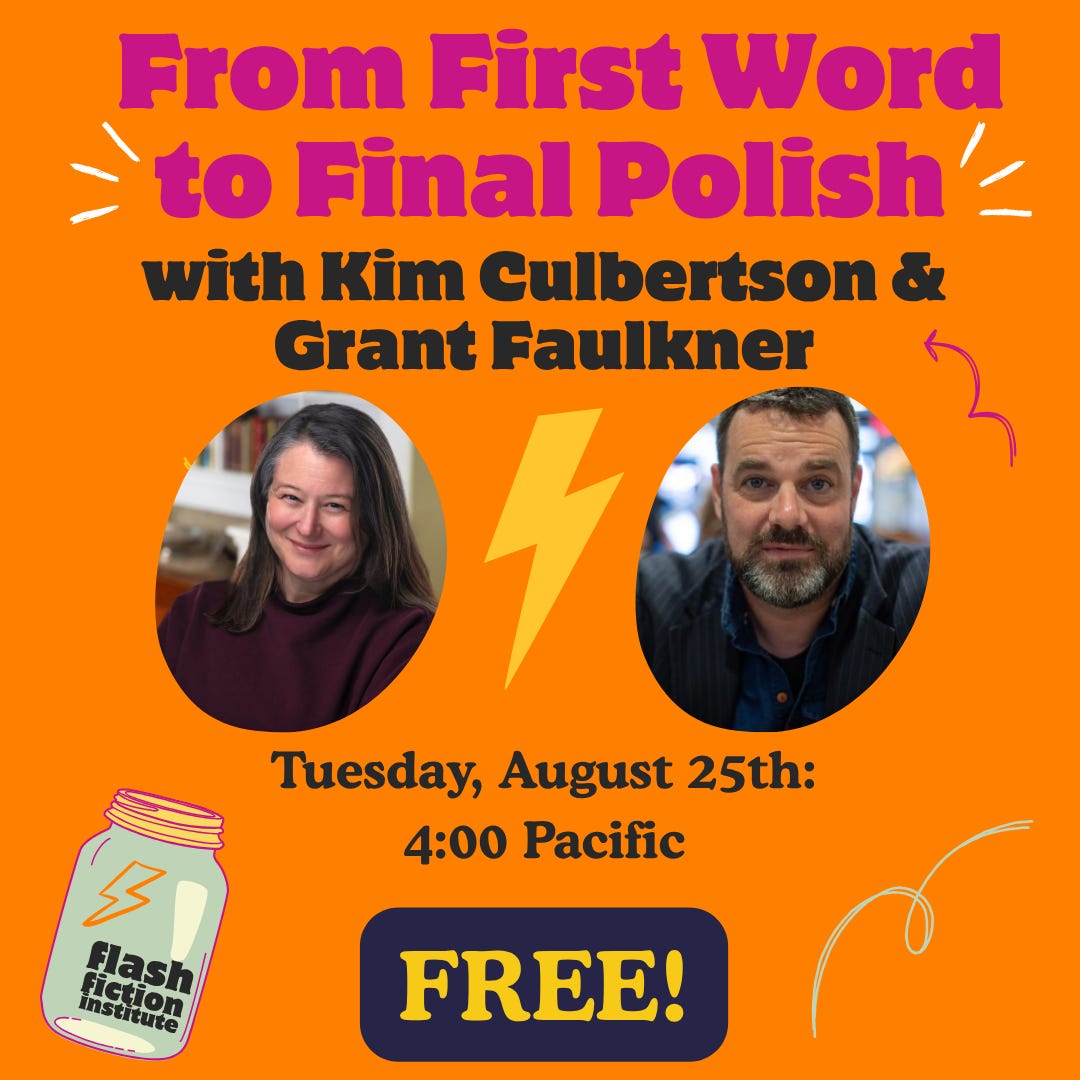
Kim Culbertson and I are hosting a flashy class on flash revision with the Flash Fiction Institute
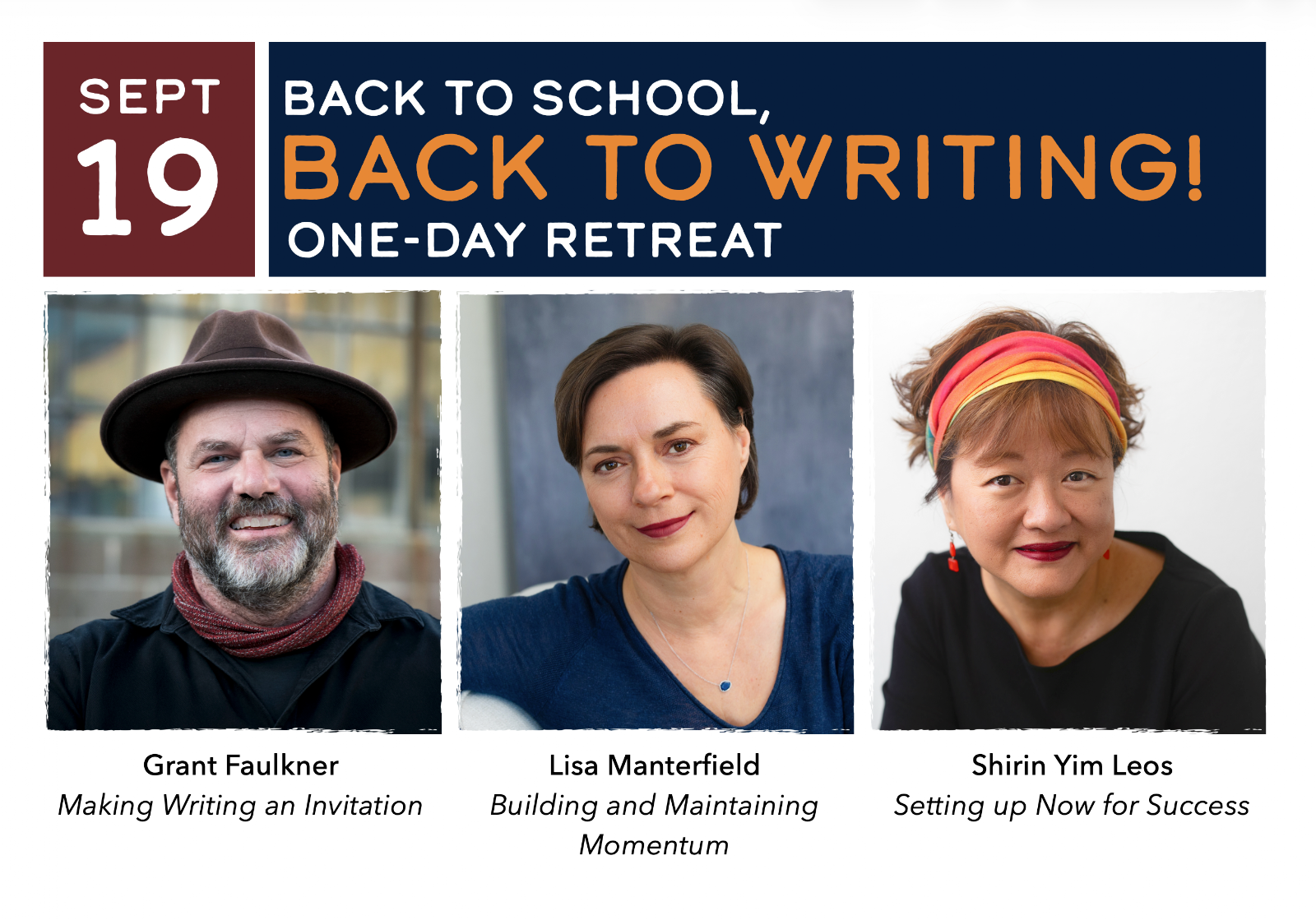
Join us for a fun and energizing one-day retreat to kick off your writing with the school year. I will start us off with a fun and generative workshop, Making Writing an Invitation.
Lisa Manterfield, award-winning author of five novels and seven books of non-fiction, and a book coach who has guided many writers to “The End,” will show you how to maintain your productivity over the long haul with her workshop, Building and Maintaining Momentum.
And, Shirin Yim Leos, writing retreat leader and developmental editor whose debut novel, Of Wind and Dust, was sold at auction to the Dial Press in a Publishers Weekly Deal of the Week, will round off our day with some useful tips on Setting Up Now for Success.
This retreat is limited to twelve participants and seats are assigned on a first-come, first-served basis. You can view the full itinerary here. And you can go here to register.
Thanks for reading Intimations: A Writer's Discourse! This post is public so feel free to share it.
Comments
Nothing yet. Say the first thing.
Sign in to join the conversation.