
I wonder how a painter brushes the first brush of a painting.
I wonder how a musician strikes the first chord.
I’m thinking about this because when I write a sentence, I don’t think too much about it. I don’t decide if it’s going to be long or short, winding or blunt, bursting with adjectives or crisp and spare. The sentence just happens. I have a mood and a muse in my head. And somehow the mood and the muse guide the words, shape the contours, make the world.
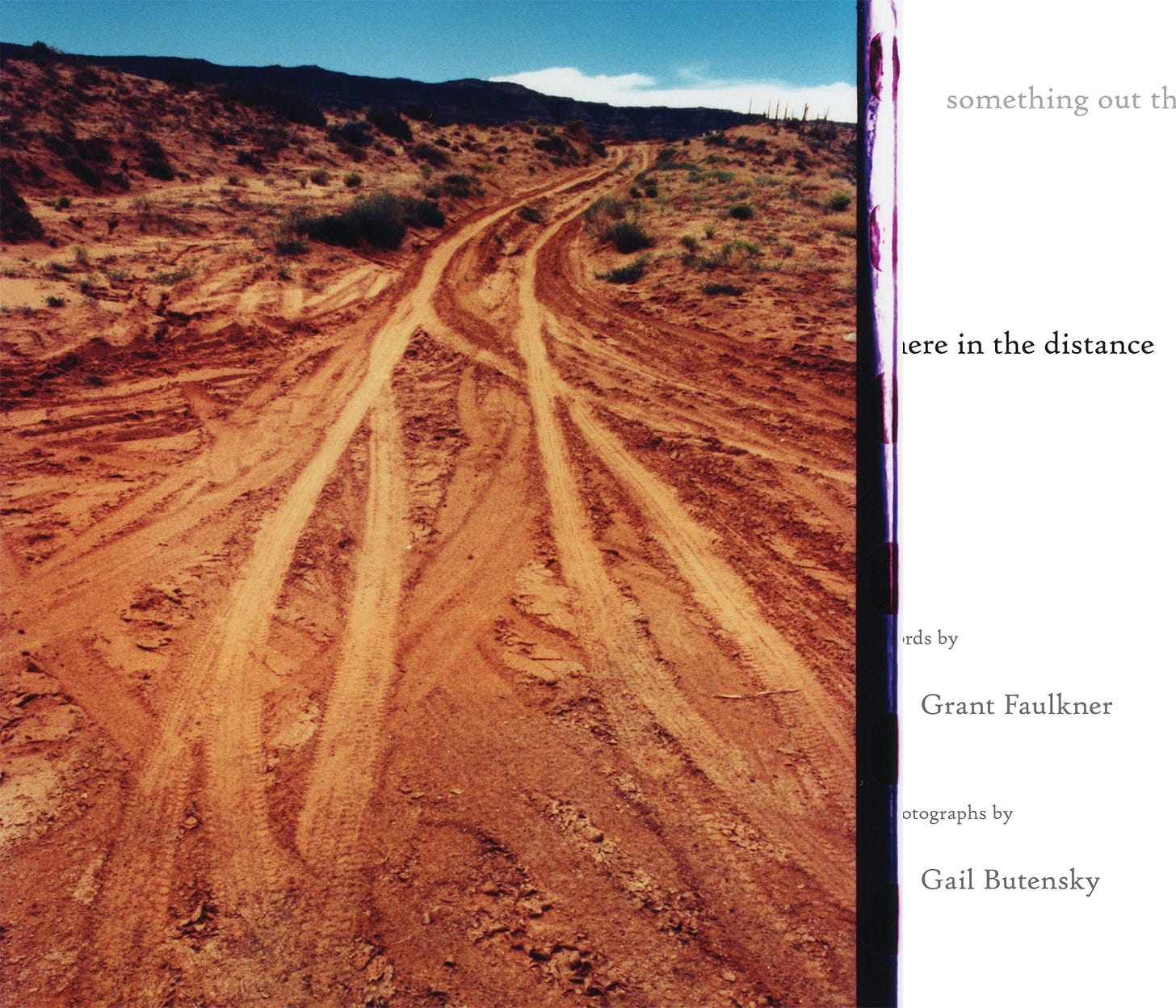
This is on my mind because the great writer Nina Schuyler blew my mind with an analysis of a sentence from my book, something out there in the distance, in a recent issue of her edifying and inspiring Substack, Stunning Sentences.
In her Substack, she analyzes a stunning sentence from a published work each week and shows what the author is doing so you can write stunning sentences of your own. She also wrote a book, How to Write Stunning Sentences.
Here’s my sentence, spoken by the character Jonny, that she analyzed:
“You’ve just got to keep moving, looking for the next circus, dancing the next dance—because you can’t die when you’re laughing, you can’t die when you’re spinning around. Or that was Dawn’s theory.”
Here is an excerpt of her very erudite analysis:
Faulkner’s long sentence renders a feeling of anxiety, as one participial phrase piles up after the other, as if the sentence itself is trying to run from death by continuing to add more.
Faulkner opens with a base clause: “You just got to keep moving.” There’s a colloquial tone from the low register language, “just got,” and the hint of a cliché. This makes sense because the sentence is paraphrasing Dawn and her theory.
What follows the base clause expands what “moving” means. And now we’re in a cumulative sentence, with the base clause elaborated upon by accumulating details. It’s a type of sentence that has a paradoxical movement—moving forward through specificity and backward because it refers to the base clause. It makes the reader stay still for a moment.
A few years ago, a person at a reading for my book, The Art of Brevity, asked me, “What unit of writing are you most focused on in the art of brevity, whether it’s word choice, the sentence, the paragraph, or something larger, like a scene or chapter?”
My answer didn’t take much thought: it’s the sentence.
I love the sentence because, as Gertrude Stein posits in her quote,“A sentence has wishes as they decide,” sentences are each their own unique being. A sentence can have sweep and circumference, a swing and a lilt. A sentence can be a fillip or a thud, a tickle or a trickle, a brush or a scratch. A sentence can prick or punch or flow or stop. A sentence can be carried by a cadence or a gust of emotion. It can march in a parade or slink into the background. The words of a sentence can pop and flop, slither and dither, hurtle and chortle.
Sentences are like people. Some sentences revel in their opulence—they live for the show, fulsome and rococo—while others bristle at any unneeded adornment. And then some sentences seem to know nothing more than their function, as if they’re a garbage disposal or a toaster.
The writer and editor of The SmokeStack, Christopher Allen, opens his flash-writing workshops with the question, “Which sentence in a flash-length narrative is the most important?” Some students say the first sentence. Some students say the last sentence. Then he tells them it’s a trick question. “It’s every sentence because flash-length narratives don’t allow for spinning wheels and throwaway sentences,” he says.
That’s true. The parts that go into making a short are more noticeable because brevity accentuates them. The shorter the story, the more work a sentence has to do. A sentence must be able to cast shadows through the most careful word choice, create mood with the rhythm and juxtaposition of its words, paint brushstrokes of nuance, and capture the microscopic even as it weaves its way into a string quartet of other sentences.
Sometimes a single sentence can be a story unto itself, but those sentences can take on a variety of characteristics, lengths, contours, and rhythms to form the story.
The prime example of the practitioner of a “sentence story” is Lydia Davis. Here, for example, is one of Davis’s better-known but least-voluminous works, “A Double Negative”:
“At a certain point in her life, she realizes it is not so much that she wants to have a child as that she does not want not to have a child, or not to have had a child.”
The question: is such a sliver of a thought a story?
To some it might resemble a single somewhat awkward line drawn on a canvas, or an elongated note played on a slide trombone. There is no setting. No characters with names or ages or any kind of detail. And yet there’s a conflict, the choice of whether to have a child, and the contrast between wanting to have a child versus the realization that she doesn’t want “not to have had a child,” and that conflict is pursued over a period of time that reveals a state of mind, implies actions, and yet still holds questions.
There’s a finality in her decision, and yet it’s unstable enough that you have to wonder whether she’s truly committed. It’s a muddled sentence, using the double negative to maximum existential and dramatic effect, so muddled that it requires rereading to truly get its meaning.
And then, as a reader, you’re stuck in the double negative, which by definition can never be quite a positive, so you’re left in an odd suspension. The character’s resolution seems unstable, and the resolution requires rethinking.
The language of the sentence is the character of the story, for the narrative is a thought.
While Davis’s sentence stories tend to be short and pithy, a sentence story can be winding and rambunctious and breathy as well. Ted McLoof ’s story “Space, Whether, and Why” is told in a single sentence of 1,394 words.
The story is not only an achievement of word count but of storytelling. There is nothing extraneous or gorged about McLoof ’s story. Every word and comma feels necessary. In fact, I didn’t even realize it was a single sentence until after reading it, and then I traced back through it looking for a period, but there wasn’t one.
McLoof said the story is about a lack of space, a momentum that takes over a couple’s relationship with such force that they never get to examine their relationship properly. “Each event piggybacks on the last one, and they never get the benefit of perspective, and that dooms them. I wanted the reader to have that same feeling of breathlessness, of an inability to pause even for the length of a period to reflect, because that’s a distance my characters weren’t allowed.”
Sentences, no matter whether they’re long or short, are units of composition, and how they are used in a story affects how they are experienced in an architectural way, with the space in the room allowing different types of drama.
A writer uses words like dabs of color. A word is a solid, something firm and palpable. A good writer listens for the peal of the vowels and the sibilance of consonants, identifying the acoustical zones of a sentence and tuning or mistuning the sounds as needed. The acoustics of a sentence play into a paragraph, into the white spaces on the page, into the air itself.
Parts of this were excerpted from The Art of Brevity.

“A sentence is born into this world neither good nor bad, and that to establish its character is a question of the subtlest possible adjustments, a process of intuition to which exaggeration and force are fatal.”
—Rachel Cusk, Outline
I’m teaming up with Freewrite and the Flash Fiction Institute to bring you what at least one person is calling “the fastest, most adrenaline-pumping writing event of the year”: The Freewrite 500. Here is how it works:
🎟️ Fill out the form to secure your spot. It’s totally free. (You must register to participate.)
📖 Join me for a free mini flash fiction lesson at 1 p.m. ET on Thursday, August 13.
⏱️ At the lesson, I’ll announce the prompt for the competition and jump into a community writing sprint to get the creative juices flowing.
📝 You’ll have the weekend to finish and submit your 500-word storybased on the prompt by end of day on Monday, August 17.

Thanks for reading Intimations: A Writer's Discourse! This post is public so feel free to share it.
Comments
Nothing yet. Say the first thing.
Sign in to join the conversation.