
Dear friend,
I love an online rabbit hole. Wikipedia is delightful. The Middle English Dictionary is even better.
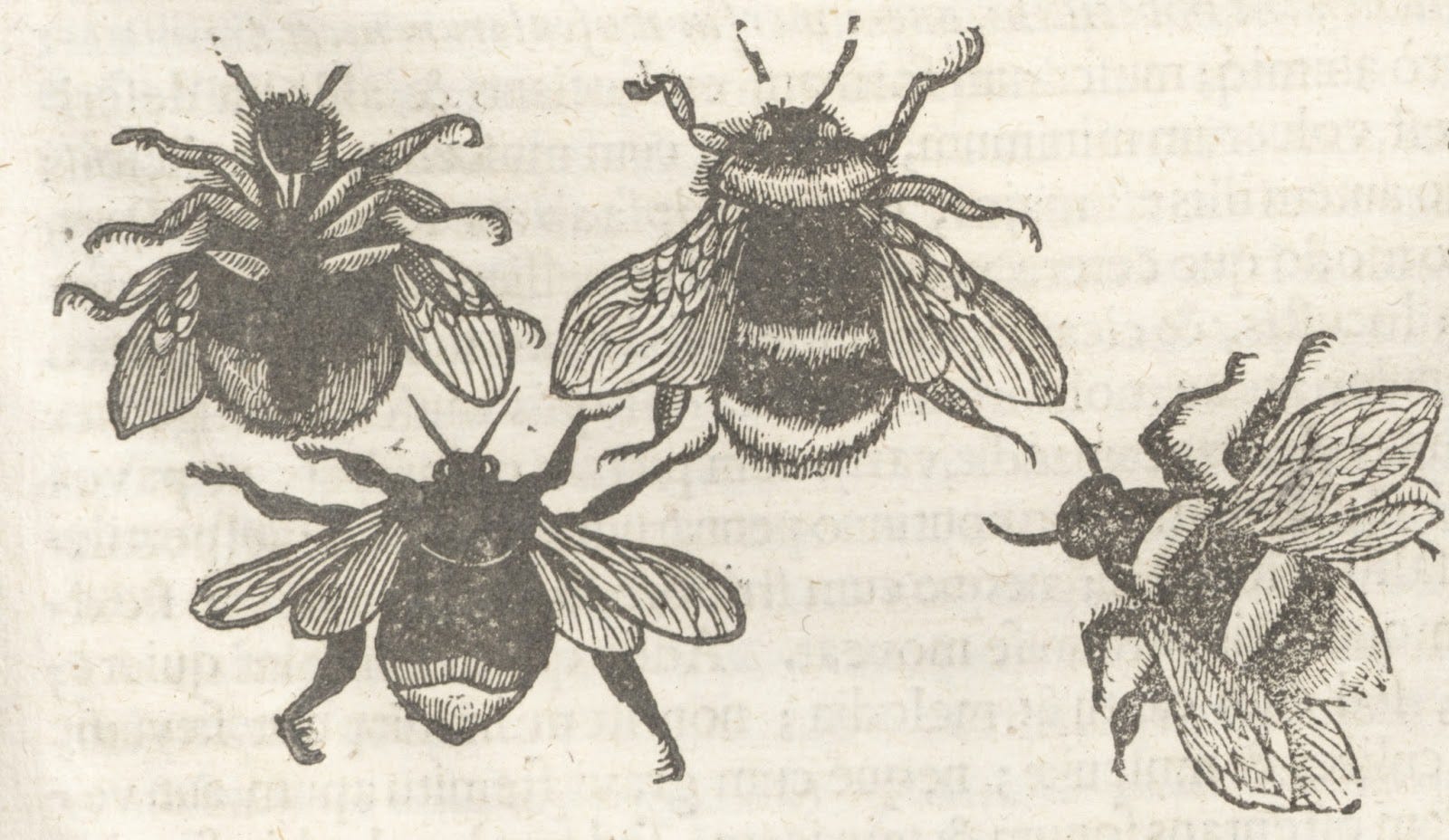
A few weeks ago I shared about a gem I found while looking up swear words in Middle English (what, you don’t think that’s a respectable scholarly activity?!). Swear words are so contextual. Many of the words originally for bodily functions were simply that: bodily functions that given their meaning, eventually took on a broader and bawdier usage. My personal favorite cuss quote was from within the massive thirteenth-century encyclopedia by Bartholomeus Anglicanus, on the bee (Middle English translation by John Trevisa, modern translation mine):
“Þis beest [bee] is ful clene more þan oþir beestes and þerfore sche schitiþ fleynge and nouȝt in hire hyue.
This beast is very clean, more than other beasts, and therefore she shitteth flying and not in her hive.”1
This was a scholarly encyclopedia meant for medieval knowledge! Bartholomeus was a Franciscan scholar. John Trevisa was a Cornish theologian and translator (who likely translated the Bible into Cornish!). So when you see the bees flying around your garden, you can quote this hilarious line to yourself, approved by theologians and scholars alike.
On a more serious note, this all began because I’ve been looking up words for a new project I’m working on. One word that I was looking up usages for was “homely,” that Middle English word for homey, simple, and intimate.2 One iteration of this word has been on repeat in my head for weeks, from Osbern Bokenham’s Lives of the Saints. This fifteenth-century Augustinian friar adapted pieces of the very famous Legenda Aurea into Middle English. He wrote of the lives of holy women in a sort of imitation of Geoffrey Chaucer’s Legends of Good Women. The funny thing about this line is that I have no idea which saint it is referring to, I haven’t had the time to dig up a copy, but both line and idea kind of overcome me (translation mine):
The studye of holy preyere was to hyre homly and frendeful and quotydyanly famuliar.
The practice of holy prayer was to her homey and friendful and quotidianly familiar.3
I was first arrested by the style of the sentence. The first two adjectives, homly and frendful, strike my modern ear as unpretentious and very English. Then we unexpectedly careen off the Latinate cliff into “quotidianly familiar.” To me, that aspect feels classically Middle English, a phase of the language where English and Latinate words are only beginning to get cozy in the melting pot of common use.
In American English today, we do not use homely except as a synonym for ugly or crude (the Brits still use it for homey) and we never use frendful, which strikes me as a shame. What a wonderful word that sounds exactly like what it means, turning the volume up on “friendly” to describe something filled with the qualities of an intimate friend. And while we still use quotidian, mundane, ordinary, daily, to use it as an adverb is rather surprising too. This trio is a set of words that are variations on the same theme. In effect: for this woman, prayer and its labors and practices and efforts are something deeply in the bones, so normal, so welcomingly part of mundane, non-emergent life—and loved in that utterly ordinary way.
To quote a formative movie of my youth, Napoleon Dynamite, “I want that.” I want to move like that through prayer.
This month, my family lost a deeply beloved woman, my aunt. For a season in my life, my family lived down the street from her, my uncle, and my cousins. We had a front row seat to the beauty and cleverness and faithfulness of this woman. She had cancer and this last year of her earthly life was a flood of brutal bodily suffering. This sentence has been in my mind so much because it described her. She was a connoisseur of loving God and people in the ordinary, the humorous, the ridiculous, the quotidian. As the head of her conference of the Society of St. Vincent de Paul (and one time president of her district!), she cared for the needy, under-served, and impoverished people of Phoenix, Arizona in the name of Jesus for many years. She was funny, deep, joyful, courageous, a well of peace. And she did all this rooted in a faith that was frendful, homly, quotidianly familiar.
She would have liked the word “frendful,” and she would have liked that the bee cleanly “shitteth” while flying, too. Pray for us, dear Aunt!
And because I love her: here’s a link to give to the Ss. Simon and Jude conference of the Society of St. Vincent de Paul in her honor and the honor of your own dear departed ones, to feed, clothe, and serve the needy and poor of Phoenix. Or give to your local conference if there’s one near you! Feel no pressure or obligation, but it would delight me to know that people who never even knew her magical self are giving in her honor.
It’s disorienting to live in the highs and lows of life. This has been a month of grief and fog and also a month of some exciting news writing-wise. My recent book, Ask of Old Paths, won the Dallas Willard Book of the Year for 2026, an award bestowed by the Martin Institute at Westmont College! I’m so honored to have any kind of association with the late and brilliant Dallas Willard. Californians, stay tuned—I’ll be headed to Santa Barbara to give a couple of lectures and accept this award in February.
I have some big and fun news on the horizon… perhaps you’ve wondered what’s next in the project world for me post-Ask of Old Paths? More details forthcoming…
Various podcast interviews for the fall.
I’ll be in Dallas at Dallas Baptist University lecturing on September 10th. Then, Berry College in mid-October.
Coming up this September: I’ll be leading a workshop on Julian of Norwich and attention at an incredible weekend retreat outside of San Diego with some other brilliant speakers. Check it out.
Nonfiction: Evelyn Underhill is my comfort food.
Fiction: The Emma M. Lion series. Delightful. But I would not call it historical fiction, it’s more like fun fantasy.
Medieval/Medieval-adjacent: a secret (!)
Article: Many treasures for you today. Mathew Lyons at the Broken Compass wrote a lovely essay on exploring an ancient church in Essex. Plough has a wonderful, nuanced issue out on America’s 250. I particularly appreciated this haunting piece from a man whose company bid on a detention center in Texas and this piece from a genealogist on searching for her enslaved ancestors.
A little blessing from the beautiful collection of the Carmina Gadelica, Scottish Gaelic prayers translated in the nineteenth century into English by Alexander Carmichael. This mountainous one appeals to me as a Coloradan. Bless you all—
Text within this block will maintain its original spacing when published
May God make safe to you each steep,
May God make open to you each pass,
May God make clear to you each road,
And may He take you in the clasp of His own two hands.
Peace for your July,
Grace
P.S. Medievalish is free, and I’d be delighted if you shared it with a friend!
Bartholomaeus’s De Proprietatibus Rerum, John de Trevisa’s translation, 144a/b add ms 27944.
The Middle English savvy among you may be able to guess, from this word, what author I’ve been closely working on for something new! Just a little hint :)
Bokenham’s Lives of the Saints 139.23 (v.2:p.387).
No posts
Comments
Nothing yet. Say the first thing.
Sign in to join the conversation.