
Dear friend,
Have you ever thought about what kinds of drama Shakespeare and Marlowe grew up on, before the great and wonderful Renaissance of Early Modern English drama?
Religious plays make up the bulk of the drama that survives from the Middle Ages. There were also “secular” dramas (scare quotes, because to call anything secular in the Middle Ages is basically anachronistic), but they were far less popular than the miracle, morality, and mystery plays which became so dominant in the fourteenth, fifteenth, and sixteenth centuries. Morality plays, highly popular, included Everyman or The Castle of Perseverance, which dramatized personifications of vices, virtues, even abstractions like Death or Sin. Miracle plays depicted saints’ lives or miracle tales often related to interventions from the Virgin Mary. But mystery plays are what we are exploring today.1 And don’t you love the very name of mystery play?
Mystery plays broadly covered the whole arc of creation, from the very beginnings of Genesis and the creation of Adam and Eve, to Judgment Day. They were based off scripture, but often included apocryphal elements, especially for humor. For instance, the Second Shepherds’ Play from Wakefield was ostensibly about the Nativity, but included a farcical satire of the Nativity narrative alongside it of a sheep stolen by an evil couple and three bumbling shepherds who rescue it. These same shepherds eventually go to the real birth of Christ, but stay in the same comic vein, praising Mary and God, but also cooing at the baby and giving him a ball (so he can play tennis!).
Different scriptural stories were divided into separate plays, but often all performed on the same day or series of days. Popular mystery plays included the Creation of Adam and Eve, Cain and Abel, Noah’s Flood, the Nativity, and long, step-by-step depictions of the Crucifixion, Harrowing of Hell, and Resurrection. These particular moments of scripture seem to have been chosen for their typological importance to medieval people. Reading the Bible typologically—that is, understanding the Hebrew Scriptures as a prefiguring of the Greek New Testament, and figures like Moses as foreshadowing and revealing Christ, or Mary as the fulfilled Eve—was ubiquitous in the Middle Ages. The plays reflected this mode of reading.
In places like York, Coventry, Chester, and Wakefield, these cycles of plays were performed on or close to holy days. Other than the obvious thematic connections, this is because these plays originated from the liturgy itself. Holy day liturgical processions and little shows of scriptural tales were expanded, bit by bit, into these full days of drama. By the later Middle Ages, the cycles had become especially associated with the feast of Corpus Christi (the modern version of this medieval feast was just last week!), the summer feast day celebrating the Eucharist as the true Body of Jesus. They may have also been performed around Pentecost or Midsummer.
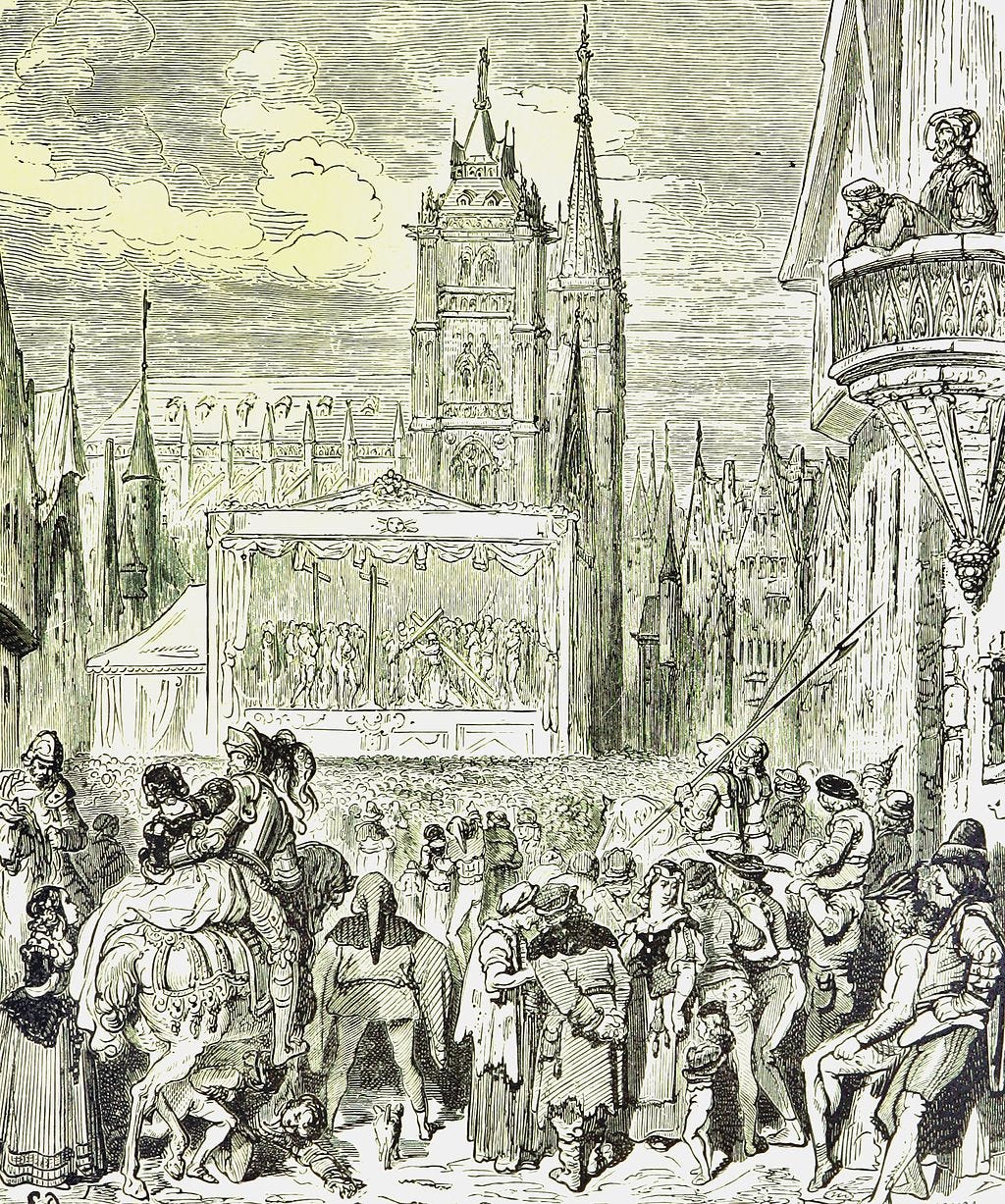
The material, written by a group of different, anonymous playwrights and heavily expanded and revised over the years, is sometimes hilarious and sometimes poignant. The York Crucifixion play is particularly jarring and powerful. Christ only speaks twice. The rest of the play entails the conversation of four soldiers, arguing, commenting on his body, stretching it, moving it, cussing, lifting the cross, complaining of their heavy work. In it we catch the heaviness and reality of Christ’s suffering and dying body, and ultimately, the banality of evil that Hannah Arendt would write about so many years later.
However, the York Cycle and its fellow mystery plays become real magic in their whole context. Keep in mind: this was really before the age of professional actors, and the plays were put on by amateurs, within their own communities. You might recall this from Jesus through Medieval Eyes: each play was staged and acted by a different guild, a group of tradespeople or artisans. Very often these guilds were loosely connected to the themes of their story. So in York, Creation was put on by the tanners, appropriate given the creation of skins, the shipwrights did Noah’s Ark (duh), and Crucifixion by the makers of nails and pins alongside painters. These plays took place on large wagons that circulated around town.
As a medieval resident of York, you were watching scripture coming to life in the bodies of your neighbors, right in front of you in your city streets. Your enemies and friends and fishmonger and butcher were playing Jesus and Judas, Moses and Mary. The plays not only reenacted scripture and apocryphal side stories, they were doing something very theological—you, and I, are the Body of Christ, quite literally. This is why they were so appropriate for the great feast of Corpus Christi. On this day that celebrates the real Presence in the Eucharist, we also see the whole arc of salvation, Christ himself, re-enacted in the very bodies of normal neighbors.
The plays died out in the sixteenth century. Staging the life of Christ became deeply controversial in the iconoclasm of the Reformation. Anything associated with the visual depiction of Christ’s body smelled suspicious to the most radical reformers. But these plays are occasionally revived in England, especially York, to this day.
Medieval drama still influences us today in less tangible but incredibly meaningful ways. William Shakespeare, who may have watched the mystery plays at Coventry, was deeply formed by the conventions, staging and humor of medieval drama. The most obvious example comes in Hamlet’s instructions to the players in Hamlet, and his famous phrase, “out-Herods Herod,” in reference to the wildly wicked and over-the-top Herod portrayed in the mystery plays. But their DNA is everywhere in Shakespeare’s plays, in their liturgically-inflected dumb shows, especially in Shakepeare’s heady, wonderfully medieval mix of earthiness and holiness.
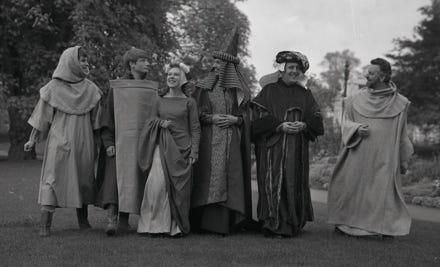
Summer reading is here. Might I suggest some of these plays? They can be a fascinating glimpse into medieval versions of scripture, complete with play and seriousness. If you’d like to read a well-curated selection of different mystery plays in a version with modernized spelling and useful little introductions, I recommend A.C. Cawley’s well-beloved and at this point quite aged version from Everyman, which is wonderfully cheap! If you’d like the full collection of the York plays in original Middle English, you can online or if you’re like me and always want to read on paper, the TEAMS edition, edited by Clifford Davidson, is excellent.
Happy summer reading!
Laying low for summer. Going to go back to serious writing & thinking soon. There may be some special news on the horizon :)
I discussed a mutual favorite, The Importance of Being Earnest, with Wesley Walker on his podcast, The Classical Mind.
Coming up this September: I’ll be leading a workshop on Julian of Norwich and attention at an incredible weekend retreat outside of San Diego with some other brilliant speakers. Check it out. I’ll also be in Dallas and Rome, Georgia!
Nonfiction: More Evelyn Underhill.
Fiction: Finally read Emma M. Lion after many recommendations. Very fun!
Medieval/Medieval-adjacent: still good old Walter Hilton
Article: This wonderful piece on AI & writing from the New York Review of Books (if you don’t have a subscription but have a library membership, pull it up through the Libby app, which is how I read it… it’s worth it!)
Here is a beautiful old Irish prayer that I love. Wikipedia has different arguments for its source: some say that it was written by Fr. Michael Sheehan of Waterford in 1916, some Fr. Michael Meehan, longtime nineteenth-century parish priest in County Clare, and some still that it is older than either. Whatever its source, I find it full of comfort. Here, I use the translation by Eamon Duffy in his The Heart in Pilgrimage: A Prayerbook for Catholic Christians.
Text within this block will maintain its original spacing when published
Christ's is the seed,
And Christ's the crop.
In God's own barn
May we be gathered up.
Christ's is the sea,
And Christ's the fish:
In God's own net
May we be caught.
From youth to age
And from age to death,
Your two arms, O Christ,
Be round us still.
From death to the end,
Not an end, but new birth,
In Paradise of the blessed
May we find rest.
Amen.
Peace for your June,
Grace
P.S. Medievalish is free, and I’d be delighted if you shared it with a friend!
This post first came out two years ago, for paid subscribers, before I shut down paid subscriptions.
No posts
Comments
Nothing yet. Say the first thing.
Sign in to join the conversation.