
Dear friend,
Well, I have a thrilling announcement for you this month that some of you may have already seen on Notes… I just signed a contract for my next book! A translation and accompanying set of interpretive essays on my FAVORITE MEDIEVAL WRITER, Julian of Norwich!!! Is there enough exclamation points to express my delight?
On a night in May of 1373, a woman thought she was dying. She was thirty and a half years old. To encourage her at this apparent end of her earthly pilgrimage, the priest held out the wooden crucifix, Jesus nailed to the cross, over her deathbed for comfort and against fear. Racked in death-pains, she gazed. And to her shock, the carved Christ began to actively bleed. What was wood became flesh; what was painted became wet and lively and horrible. What she saw and heard over the next day would occupy that woman the rest of her life.
Julian of Norwich’s story was strange, and yet familiar in those fourteenth-century days when it was expected that time and the timeless, body and spirit intersected and infused one another with jarring, sudden meaning. Julian recovered from her illness, but the experience never left her. Julian would write about the experience in the immediate aftermath, then, decades later, write again, with deeper detail and greater interpretive power. The Showings, as these writings are called, and the second, revised, longer text in particular, are works of profound theology and prose. She is subtle, brilliant, and to top it off, the first known woman writer in English. But Julian methodically stripped away personal details, references to herself, her name, her place. Her writings did not widely circulate in the Middle Ages. Today we know nearly nothing of her life and are left only with some scattered wills, and one account of meeting from a fellow early woman writer, Margery Kempe. This lack of historical record has not stopped The Showings from becoming a favorite of countless readers over the last one hundred years.
First, I will give you a translation of the Long Text of The Showings. This is my first public tackle at a translation of this length, and I’m thrilled and totally nervous.
Then, the interpretive chapters take up what we do possess: the marvelous, bizarre, astounding words and questions that the hidden anchorite interrogates, turns upside down, delights in, and ultimately gives to us, her readers. Each chapter of this interpretive portion highlights one of Julian’s ancient words, in that charming, crotchety grandparent of modern English called Middle English, to guide readers into the deeper contexts social, spiritual, theological, or just plain interesting, of Julian’s visionary experience.
Julian herself did not write to inform. Julian wrote to form her reader, to habituate her reader into this “lesson of love,” as she calls her showings. She asks the same questions we ourselves still reach for with yearning words: How can I love? What should I love? What’s the point of all this suffering? What is real? What lasts? These are questions not answered by a yes or a no. These are questions whose answers require being formed by the pursuit of their meaning. These are questions whose relevance has never been more pressing. And I can’t wait to be formed and think with her as she considers these questions.
This is a massive project that will take me and my publisher a number of years. So you won’t hear about it for a while—just know that busily behind the scenes, I’m seeking out the anchorite from Norwich and sitting at her feet.
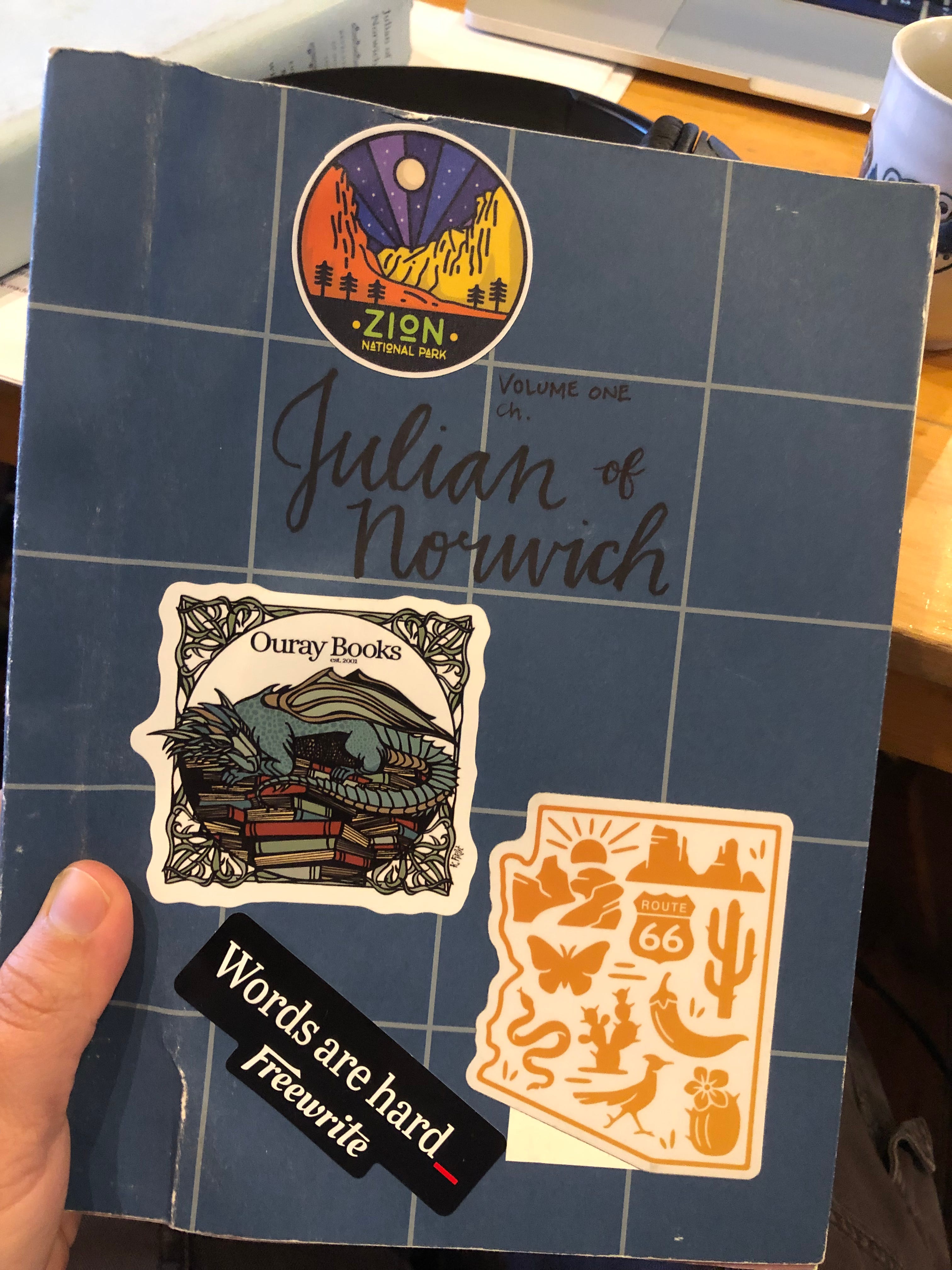
I mean, all the above.
Various podcast interviews for the fall.
I’ll be in Dallas at Dallas Baptist University lecturing on September 10th. Then, Berry College in mid-October.
Coming up this September: I’ll be leading a workshop on Julian of Norwich and attention at an incredible weekend retreat outside of San Diego with some other brilliant speakers. Check it out.
Nonfiction: The Splendid and the Vile. I adore Erik Larson. Who doesn’t love a detailed saga of Churchill trying to persuade America into joining WWII?
Fiction: Marie Benedict’s Daughter of Egypt, on Lord Carnarvon’s daughter and her role in discovering the tomb of Tutankhamen, intertwined with the story of Hatshepsut. Beach read fun.
Medieval/Medieval-adjacent: Who else but Lady Julian?
Article: While I absolutely disagree with Emily Wilson’s takedown of Christopher Nolan’s Odyssey in the LRB, it sure was a hoot to read and judge accordingly.
This is an excerpt from a prayer, one of the earliest Christian prayers outside of canonical scripture, from Clement of Rome’s letter to the Corinthians. Clement was the fourth Pope/Bishop of Rome and this prayer likely dates to the last three decades of the first century. Translation taken from ccel.org.
[Grant unto us, Lord,] that we may set our hope on Thy Name which is the primal source of all creation, and open the eyes of our hearts, that we may know Thee, who alone abidest Highest in the lofty, Holy in the holy; who layest low in the insolence of the proud, who settest the lowly on high, and bringest the lofty low; who makest rich and makest poor; who killest and makest alive; who alone art the Benefactor of spirits and the God of all flesh; who lookest into the abysses, who scanest the works of man; the Succor of them that are in peril, the Savior of them that are in despair; The Creator and Overseer of every spirit; who multipliest the nations upon earth, and hast chosen out from all men those that love Thee through Jesus Christ, Thy beloved Son, through whom Thou didst instruct us, didst sanctify us, didst honor us.
We beseech Thee, Lord and Master, to be our help and succor. Save those among us who are in tribulation; have mercy on the lowly; lift up the fallen; show Thyself unto the needy; heal the ungodly; convert the wanderers of Thy people; feed the hungry; release our prisoners; raise up the weak; comfort the fainthearted. Let all the Gentiles know that Thou art the God alone, and Jesus Christ is Thy Son, and we are Thy people and the sheep of Thy pasture.
…Amen.
Peace for your August,
Grace
P.S. Medievalish is free, and I’d be delighted if you shared it with a friend!
No posts
Comments
Nothing yet. Say the first thing.
Sign in to join the conversation.