
Note: These are my personal views only and do not constitute investment advice. See full disclaimer below.
Audio embedded below:
0:00
-29:37

Last year I heard a story about a UK bulk annuity deal. A pension scheme was running a competitive process for a £2bn buy-in. Two insurers had made it to the final round. The winning bid was 30bps cheaper. The losing bidder was told, in the polite language these things get communicated in, that if they could find a way to sharpen their pencil they were back in the game.
The pricing team went away and came back the next morning. They had not changed their funding cost, their longevity assumptions, or their expense base. They had asked their Bermuda reinsurer to take an extra 10% of the deal under a Funded Reinsurance treaty. The capital release flowed through the pricing model, the new business strain (the upfront capital cost of writing the deal) dropped, and the bid came down. They won.
That trade, repeated dozens of times across the bulk purchase annuity (BPA) market over the past three years, is what the regulator has just repriced into uneconomic territory.

This is good news for the listed UK life sector, in my view. The PRA has stripped out the cheap capital lever that drove the BPA price war. From here I expect more pricing discipline, less competition at the margin, and over time the prospect of higher margins on the business being written. The companies most exposed face a strategic choice rather than a write-down, and the companies that held discipline have been vindicated. The rest of this article walks through the evidence behind that view.

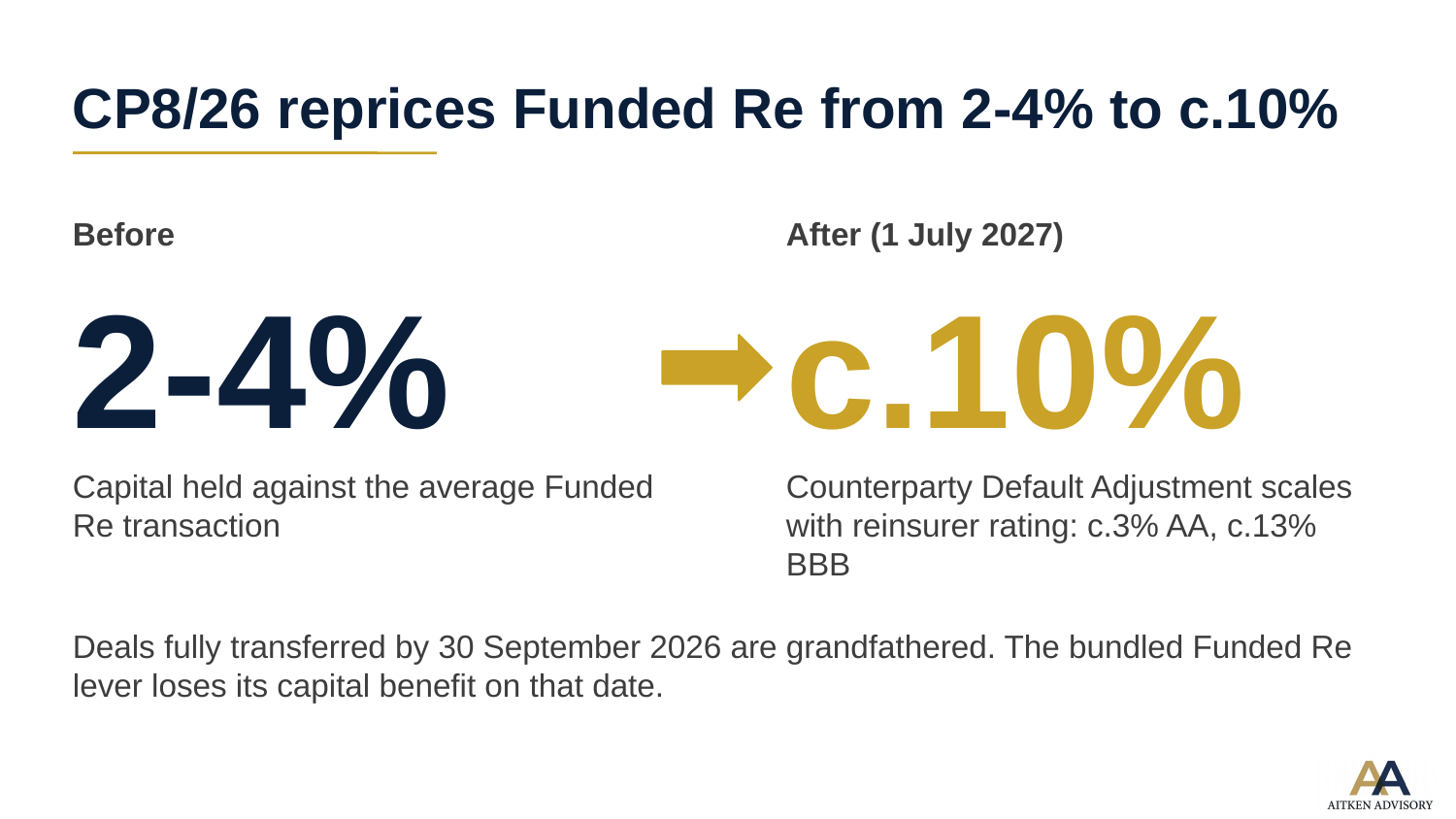
On Wednesday 29 April 2026 the PRA, the UK insurance regulator, published Consultation Paper CP8/26. The proposals raise the capital held against the average Funded Reinsurance transaction from 2 to 4% of liabilities to around 10%, narrowing but not eliminating the gap to the 11 to 15% capital charge that economically similar direct exposures attract under Solvency UK, the rulebook that governs UK insurer capital. The mechanism is the Counterparty Default Adjustment (CDA), the haircut a UK insurer must apply to the value of a reinsurance asset to reflect the risk that the reinsurer fails to pay. Under the new rules the CDA scales with the reinsurer’s credit rating and the strength of its collateral arrangements: c.3% for a strongly-collateralised AA counterparty notched up to AAA, c.13% for a BBB with weak collateral and no notching, with the average current counterparty landing at c.7%. New rules apply from 1 July 2027, with deals fully transferred by 30 September 2026 grandfathered.
I had a ringside view. I presented at the Westminster and City Annual Bulk Annuities Conference on Tuesday 28 April, the day before the PRA’s announcement, and listened to Gareth Truran’s speech the following morning.
To put scale on the structure: roughly half of all UK PRT (pension risk transfer) volume ever written has been written in the past five years. The Funded Re structure scaled alongside that demand boom. Funded Re premiums reached approximately £6.5bn in 2025 according to the PRA, and Funded Re assets now represent c.8% of UK insurer invested assets.
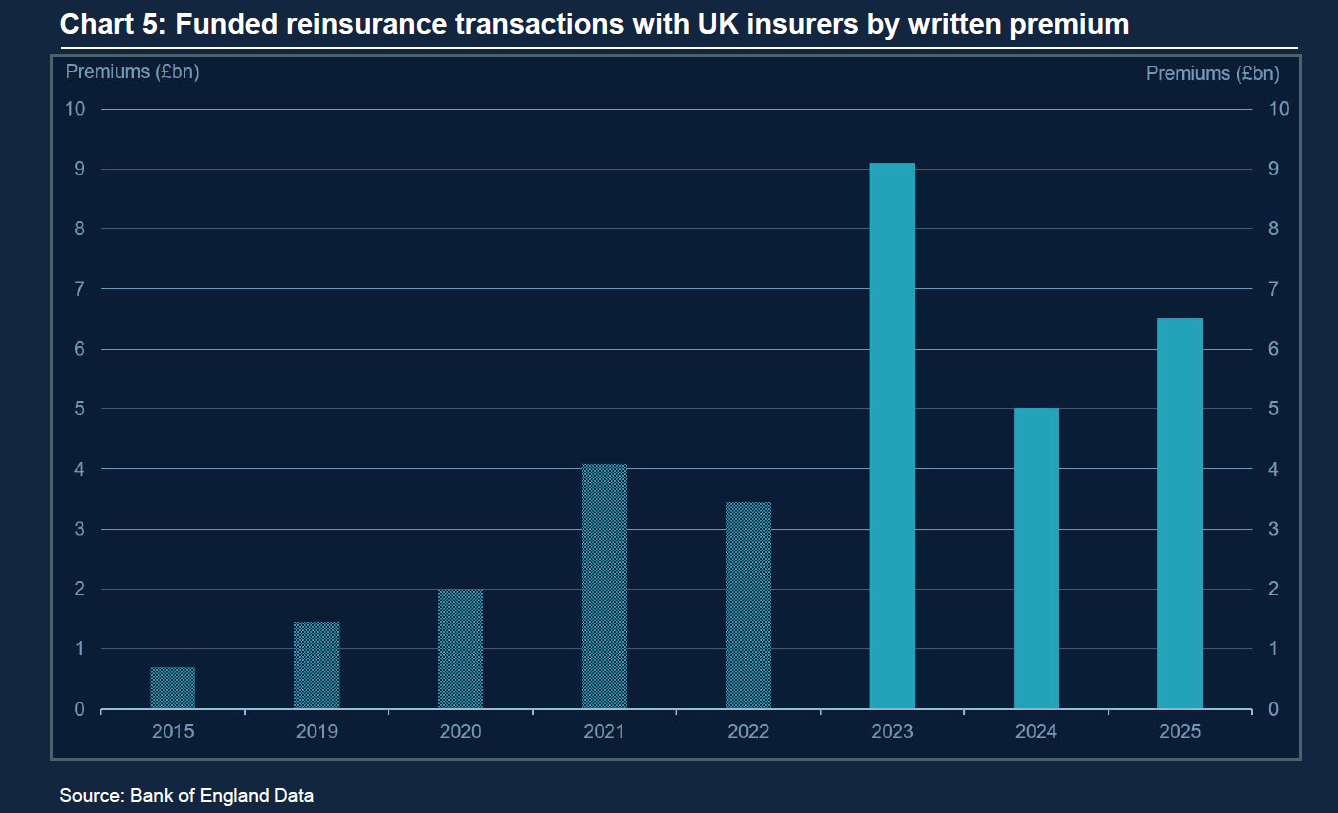
Aggregate Funded Re share is unlikely to exceed 10% in any given year. The current footprint is modest in aggregate. What worried the regulator was the trajectory and the concentration of those assets in a handful of Bermuda counterparties.
I have written before about Funded Reinsurance, most recently in this post The Case for Keeping Risk Onshore. The view I took then was that Funded Re was transferring value offshore in pursuit of volume, that UK life insurer balance sheets had never been stronger, and that the market would be healthier if the regulator reined the structure in. CP8/26 takes the market in that direction. The question now is what listed UK life insurers should do with the result.
The PRA has been signalling this for two years. The sequence runs through SS5/24 in July 2024, the Dear CEO letter in July 2024 (the first formal warning shot to insurers using the structure), the PRA response to those insurers in April 2025, Vicky White’s September 2025 speech, and the autumn 2025 industry roundtables alongside the LIST 2025 stress test results in November. Vicky White’s September speech was the most explicit:
The PRA is forming the view that its principles-based approach to addressing Funded Re by setting supervisory expectations may be insufficient to address certain risks associated with the structure.
Vicky White, PRA Director for Prudential Policy, “Funded realignment: balancing innovation and risk”, Bank of America Annual Financials CEO Conference, 18 September 2025
The January 2026 Dear CEO letter named Q2 2026 as the publication date. CP8/26 arrived on schedule on 29 April 2026. The genuine news in the document is what the PRA chose not to do. The September 2025 speech floated unbundling, separating the funding component from the longevity swap and capitalising each separately. That approach would have been materially harsher than what CP8/26 actually proposes. The PRA cited industry feedback and, more importantly, the operational complexity of unbundling, the modelling and assumption-setting required, and dropped it. That is the only material softening in the document, and in my view it is a rare concession from a regulator that does not usually concede. The industry should not overlook it.
A definition first, because the term one of the many pieces of jargon that litter the UK life insurance sector. Funded Reinsurance is a deal where a UK insurer hands the longevity risk and the assets backing a bulk annuity to a typically Bermuda-based reinsurer in exchange for a stream of payments matched to the pension liabilities. The reinsurer holds the assets and earns the spread; the UK insurer keeps the policyholder relationship and frees up capital. The structure is legal, disclosed, and has been in widespread use, with volumes accelerating sharply from 2021 onwards.
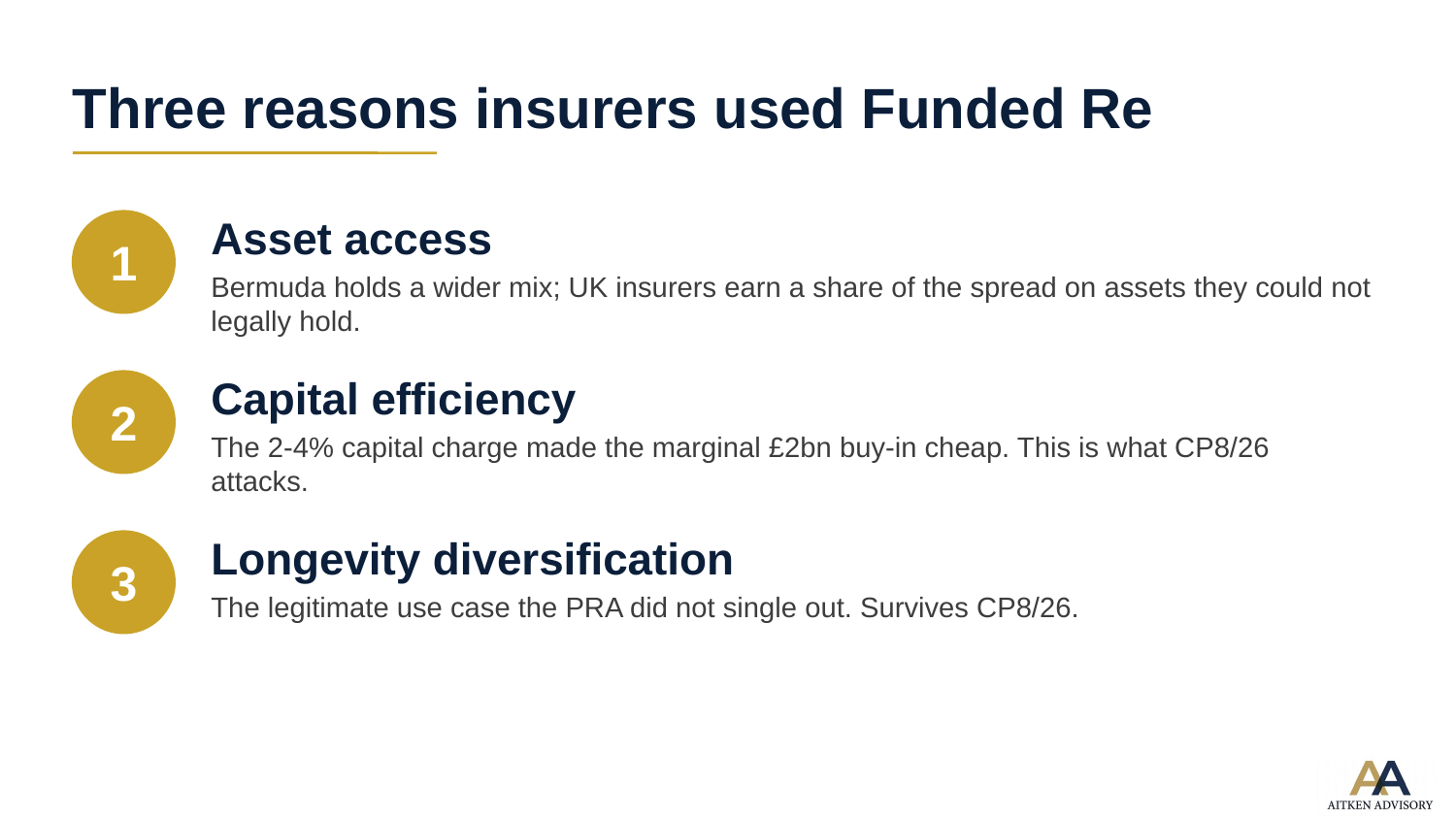
Three things drove its adoption.
The first is asset access. A UK life insurer running a Matching Adjustment portfolio (a Solvency UK mechanism that lets the insurer book extra yield on long-dated illiquid assets, provided the assets are eligible and the cashflows match the liabilities) is constrained on what it can hold. The rules favour bonds with predictable cash flows over private credit, structured assets and esoteric origination. A Bermuda reinsurer faces fewer such constraints and can hold a wider mix. Ceding the liability via Funded Re lets the UK insurer earn a share of the spread on assets it could not legally or efficiently hold itself. That is a genuine economic benefit, not a regulatory dodge. The PRA acknowledged this rationale in its consultation but is uneasy about it, because Funded Re becomes a transmission channel for private credit risk into the UK sector. The driver is legitimate; the underlying assets are what the regulator is watching.
I believe there may be an unspoken political layer here too. The UK Government has made no secret of its agenda to keep insurer assets on UK soil, channelling long-term capital into UK infrastructure, productive assets and the wider real economy. Funded Re sends those assets the other way, to Bermuda. The PRA is independent, and I would not suggest the UK Government can direct it on a specific consultation. Even so, the political backdrop is hard to ignore, and in my view it is a contributing factor in why the PRA has chosen to act now rather than rely solely on the supervisory tools it already has.
The second is capital efficiency on the marginal deal. A £2bn buy-in retained on the domestic balance sheet ties up capital for decades. The same deal partially ceded releases capital that can be redeployed against the next opportunity. In a market writing £40bn to £50bn of annual demand, that recycling of capital is the difference between writing two jumbo deals a year and writing four. This is the driver the PRA explicitly called regulatory arbitrage, and the one CP8/26 is aimed at. The 2 to 4% capital charge that made the trade economic is the gap CP8/26 closes.
The third is longevity diversification. A reinsurer holding longevity exposure across multiple cedants and geographies can offer the cession at a price the insurer cannot match on its own balance sheet. The PRA did not single longevity diversification out as problematic. It is the legitimate use case that survives CP8/26.
Funded Reinsurance served a purpose, and some version of it will continue. The asset access rationale is weakening fast, in my view, as listed insurers build their own private credit origination capability, often via tie-ups with private capital partners. L&G’s 2025 strategic origination partnership with Blackstone is the most visible example; M&G has been building in-house origination through M&G Investments for years. The takeover route has now joined this trend: Brookfield’s completed acquisition of Just Group and Athora’s completed acquisition of PIC bring private capital with deep origination capability directly inside two of the larger BPA writers. When your own asset manager (or new private capital owner) can originate the spread directly, you do not need to route through Bermuda to access it. The capital efficiency rationale is exactly what CP8/26 attacks. The longevity diversification rationale survives, but in my view it does not require the bundled financing structure that the PRA has just made expensive.
Some version of Funded Re will continue, but the bundled financing version is what CP8/26 attacks.
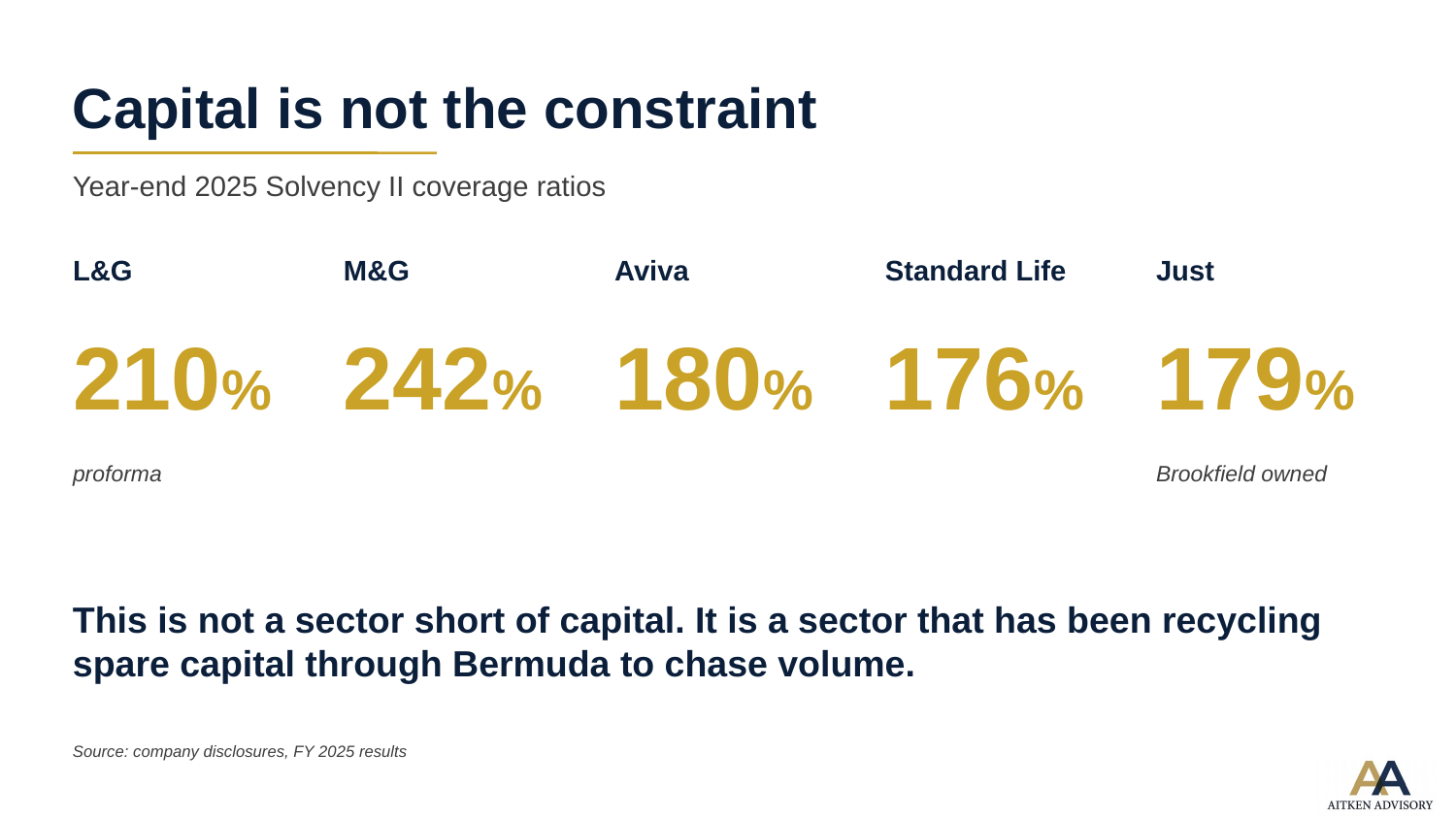
UK life insurer balance sheets have never been stronger, and the public market has refused to credit it. End-2025 Solvency II coverage ratios across the listed names look like this: L&G 210% proforma, M&G 242%, Aviva 180%, Standard Life 176%, and Just 179% (Just is now part of Brookfield following completion of the deal in April 2026). UK life insurers have active capital return programmes: L&G’s £1.2bn share buyback (the largest in its history) and Aviva’s resumed buyback at £350m. This is not a sector short of capital, in my view. It is a sector that has been recycling spare capital through Bermuda to chase volume.
On paper, CP8/26 differentiates by reinsurer credit quality and the strength of collateral arrangements, with stronger collateral earning additional notches. The CDA scales from c.3% for a strongly-collateralised AA counterparty to c.13% for a BBB with weak collateral, and stronger cedants absorb the change more easily. In practice, in my view, the differentiation barely bites at the listed end of the market. Solvency II ratios are strong across the listed names, well above the threshold at which capital becomes a binding constraint. The relative penalty falls hardest on the smaller end of the market and on insurers paired with lower-rated Bermuda counterparties.
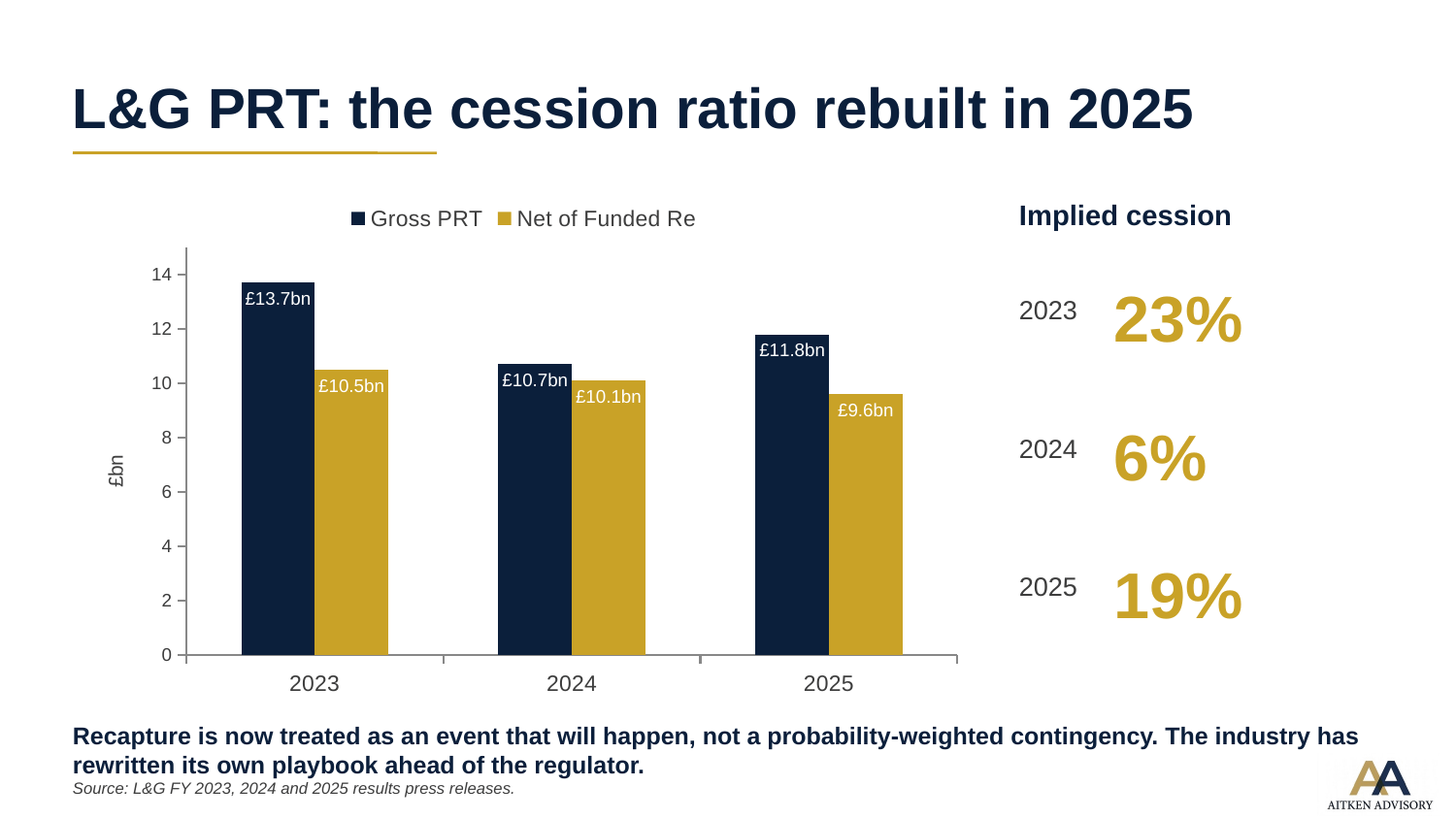
The headline cession ratios are noisy: a dip to 6% in 2024 and a rebuild to 19% in 2025. The underlying underwriting framework has changed. Recapture is now treated as an event that will happen, not as a probability-weighted contingency. The industry has rewritten its own playbook ahead of the regulator. CP8/26 is being published into a market that has already moved.
The aggregate capital cost of CP8/26 is small. The PRA’s own estimate of the additional industry capital required is around £700m per year, against UK BPA writer aggregate Solvency II own funds of approximately £80bn. That is less than 1% of the sector’s aggregate own funds.
LIST 2025 (Life Insurance Stress Test) was the PRA’s first full public stress test of UK life insurers, with results published in November 2025. The core scenario was severe: interest rates fell 150bp, equities 30%, BBB credit spreads widened 270bp, property values fell 30%, with a Funded Re recapture overlay layered on top. All participating firms remained above 100% of their regulatory capital requirement throughout. My view on the LIST 2025 results is here for the sector as a whole and here for the individual companies.
The Funded Re overlay added a 10pp aggregate solvency hit, driven mainly by higher capital requirements on recapture rather than by collateral impairment. Insurers absorbed the impact comfortably. In my view the exercise gave the PRA the empirical cover it wanted for CP8/26.
On pricing, the picture is the inverse. PRA data describes BPA pricing as having reached historically low levels in 2025. The Funded Re lever was the primary mechanism, in my view. The compression in 2025 new business margins is visible in the Funded Re-heavy writers and absent in those that have not used the structure.
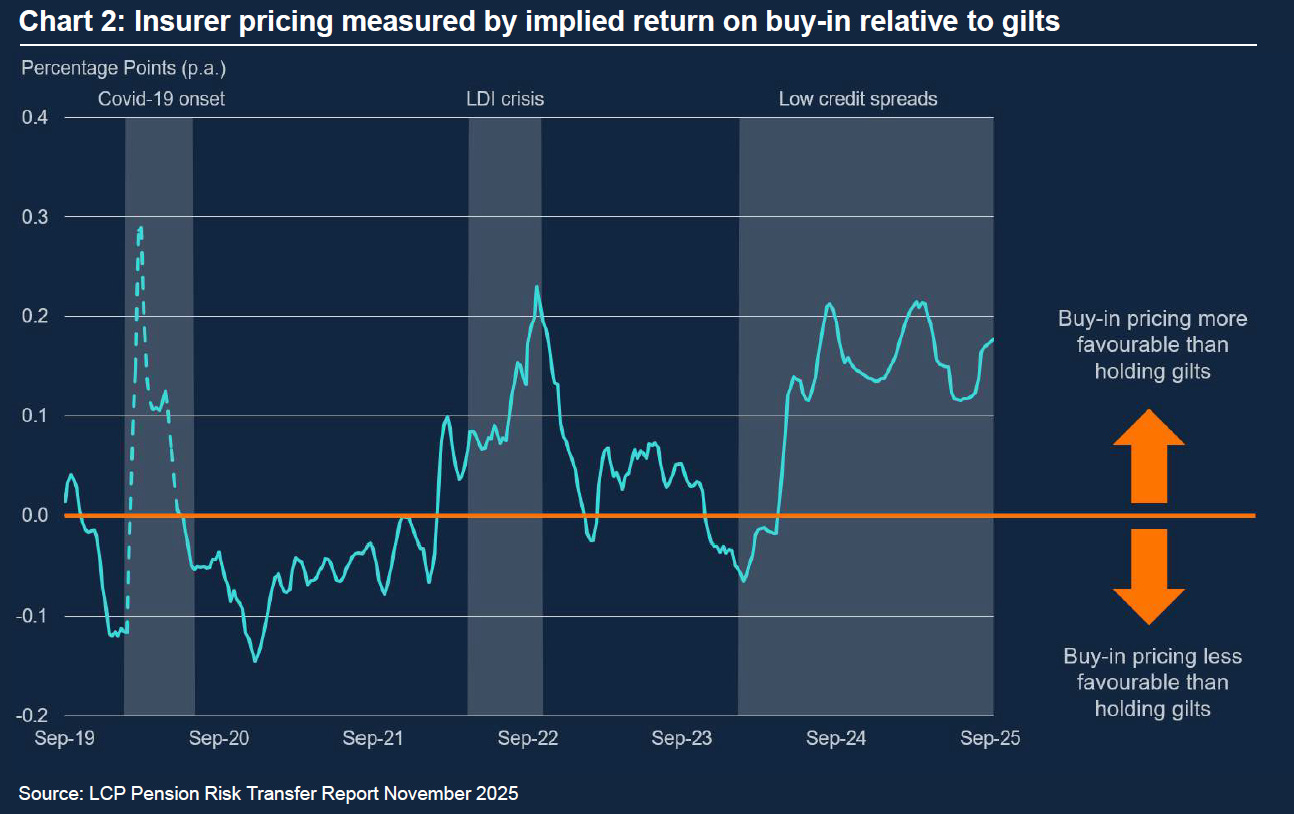
Volumes will plateau while value rises, in my view. That is certainly not the bear case that some others have pushed.
The PRA repeatedly frames Funded Re as “regulatory arbitrage”. I think that framing is unfair on insurers.
The PRA itself shaped the demanding Solvency UK regime, alongside HM Treasury. The longevity capital charge, the Matching Adjustment rules, the internal capital model approval process all came through the PRA’s own rulebook. A rational management team facing that regime, plus shareholder demand for double-digit returns, plus a record pipeline of BPA demand, will find the cheapest compliant way to write the business. That is what Funded Re was. Bermuda is a Solvency II equivalent jurisdiction, meaning the EU and UK accept its insurance regime as broadly comparable. The Bermuda regulator is credible, the structures were transparent, the disclosures were public. Insurers were not hiding anything.
Now the PRA says that response was arbitrage and has to stop. The same regulator that defined the demanding rules is now penalising insurers for finding the lowest-cost way to comply with them. I have some sympathy with management teams on the receiving end of that argument.
A key point from the PRA is that the global regulatory community has reached the same conclusion at the same time. The IAIS (the international body for insurance supervisors), the Dutch National Bank, the US National Association of Insurance Commissioners, Japan’s FSA and the Bermuda regulator have all moved in the same direction over the past 18 months. The arbitrage was always going to be temporary. Business models built around an expiring regulatory differential were always going to be revalued. Even so, for several years the insurers were following the rules as written, and the rules just changed.
One caveat on the global alignment story. The alignment is directional, not synchronised in calibration. Overseas regulators are moving more slowly than the UK, and the direction of travel is more positive abroad. Capital and reinsurance portfolios can pivot internationally. In my view the UK may end up tighter than its peers for a period before the rest catch up.
PIC (a cedant in the Funded Re context rather than a reinsurer) and Pacific Life Re (one of the principal Bermuda-based reinsurers in the market) made the industry rebuttal at the same Westminster and City conference. I attended the session and listened to both speak shortly after the PRA. Three substantive points are worth engaging with.
The first is economic equivalence. The industry argues that Funded Re is not the same as a collateralised loan, because of the embedded longevity swap, the early recapture rights, and the matching cashflow profile. The 11 to 15% comparator on which the PRA’s repricing rests therefore overstates the equivalence and overstates the gap.
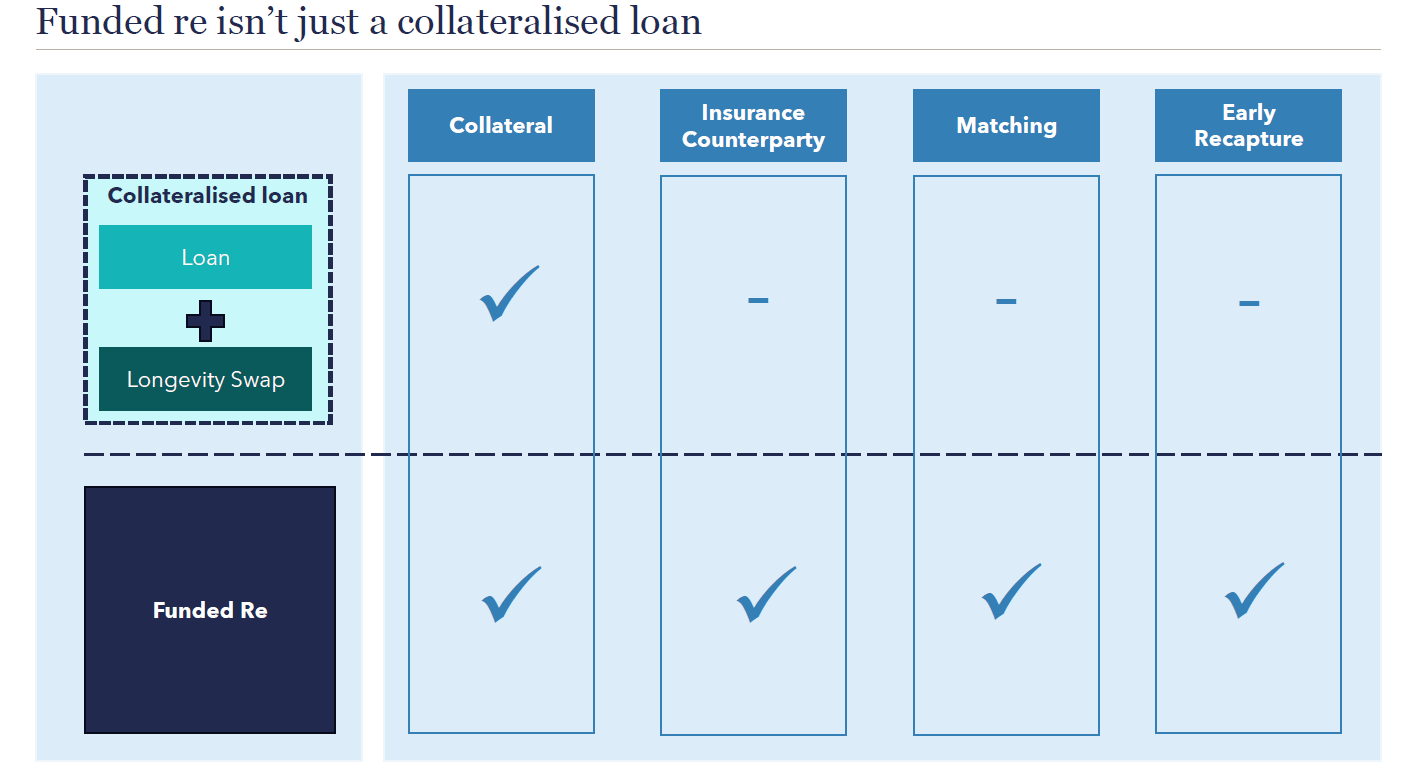
Source: Pacific Life Re / PIC.
The second is the balance sheet point. The Bermuda reinsurer holds asset and longevity risk capital under its own regime; the UK cedant holds counterparty risk capital under Solvency UK. The system already holds capital against the underlying risks. The PRA adjustment, on this view, risks double-counting unless the reinsurer’s own capital position is properly factored in.
The third is the existing toolkit argument. The PRA’s 2024 supervisory statement (SS5/24) already gives it a four-tier limits framework: aggregate counterparty limits, correlated counterparty limits, individual reinsurer limits and contract-level limits, combined with stress assumptions that already model instant default, worst permissible collateral, no management actions, and no recovery on shortfall. The case is that systemic risk is already capped through those instruments without changing the headline capital number.
All three arguments carry weight. The first two rest on the structural distinction between Funded Re and a pure collateralised loan, and the embedded longevity swap and recapture rights are real features rather than rhetorical decoration. The third is the strongest, in my view, and it is the one the PRA has been most sensitive to. SS5/24 was the first attempt to use supervisory tools alone. The PRA judged that approach insufficient, and the LIST 2025 results gave it the empirical cover it wanted to go further.
The clearest signal in the PRA’s announcement, and the one most analysts have under-weighted, is that CP8/26 is not just a capital recalibration. Gareth Truran, the PRA’s Executive Director of Insurance Supervision, was explicit in his Westminster speech announcing the proposals:
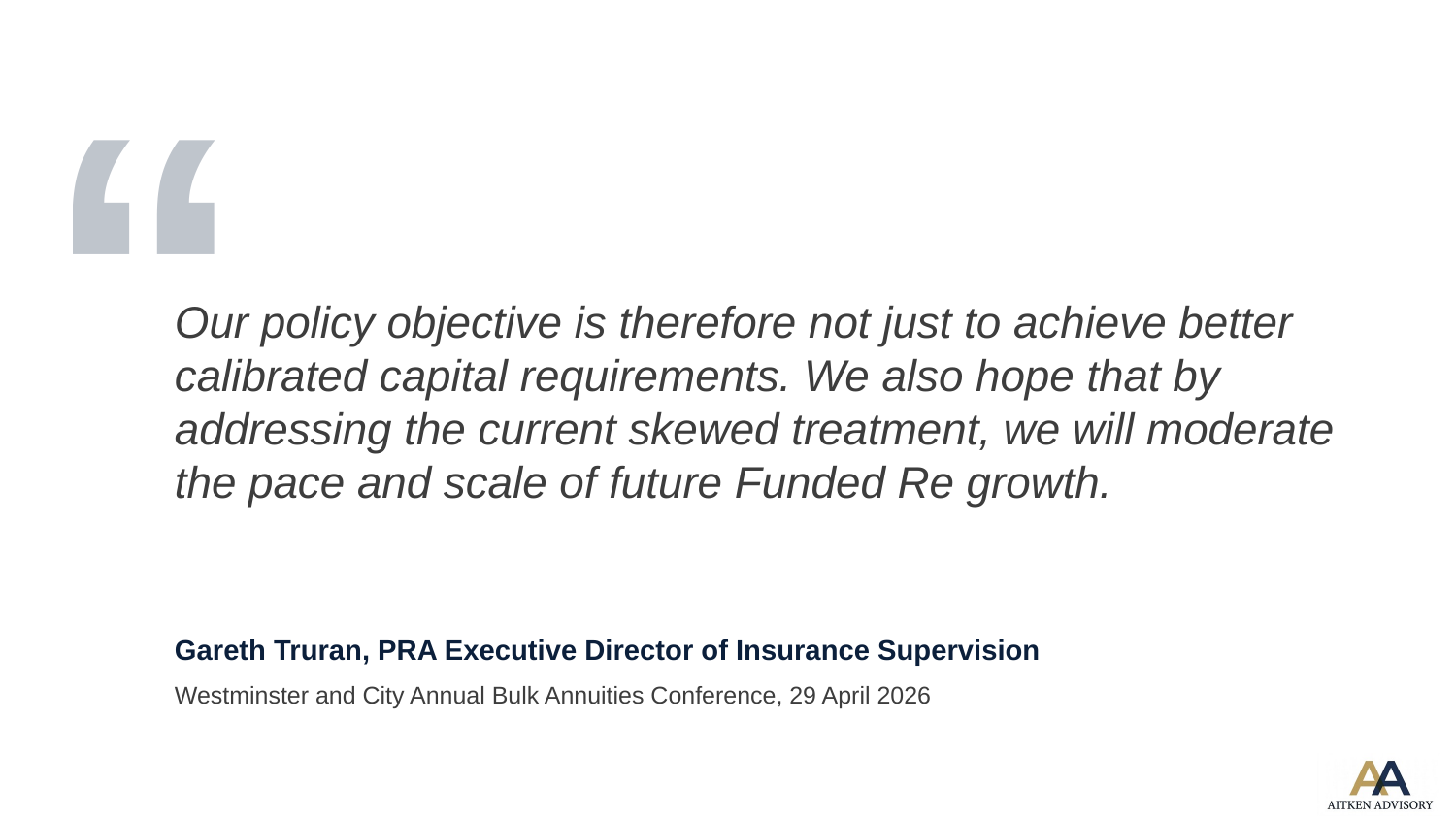
The PRA wants to slow the growth of the structure, not just price it more accurately. Truran framed Funded Re as “a channel through which broader shocks in global private credit markets could also affect the UK sector”. The macroprudential concern that no individual insurer can manage is the risk of simultaneous recapture events across the market. Capital alone, in his words, “doesn’t mitigate some of these broader risks”. The PRA reserved the right to “keep this under review and consider further actions to safeguard resilience if needed”. In my view, if industry volumes do not slow, more may be coming.
In my view, CP8/26 does not create winners and losers; it removes a distortion. For three years the BPA market subsidised volume by exporting margin to Bermuda. That subsidy is being withdrawn. The listed insurers who held discipline look smarter today than they did six months ago, and the ones who used Funded Re heavily face a strategic choice rather than a loss.
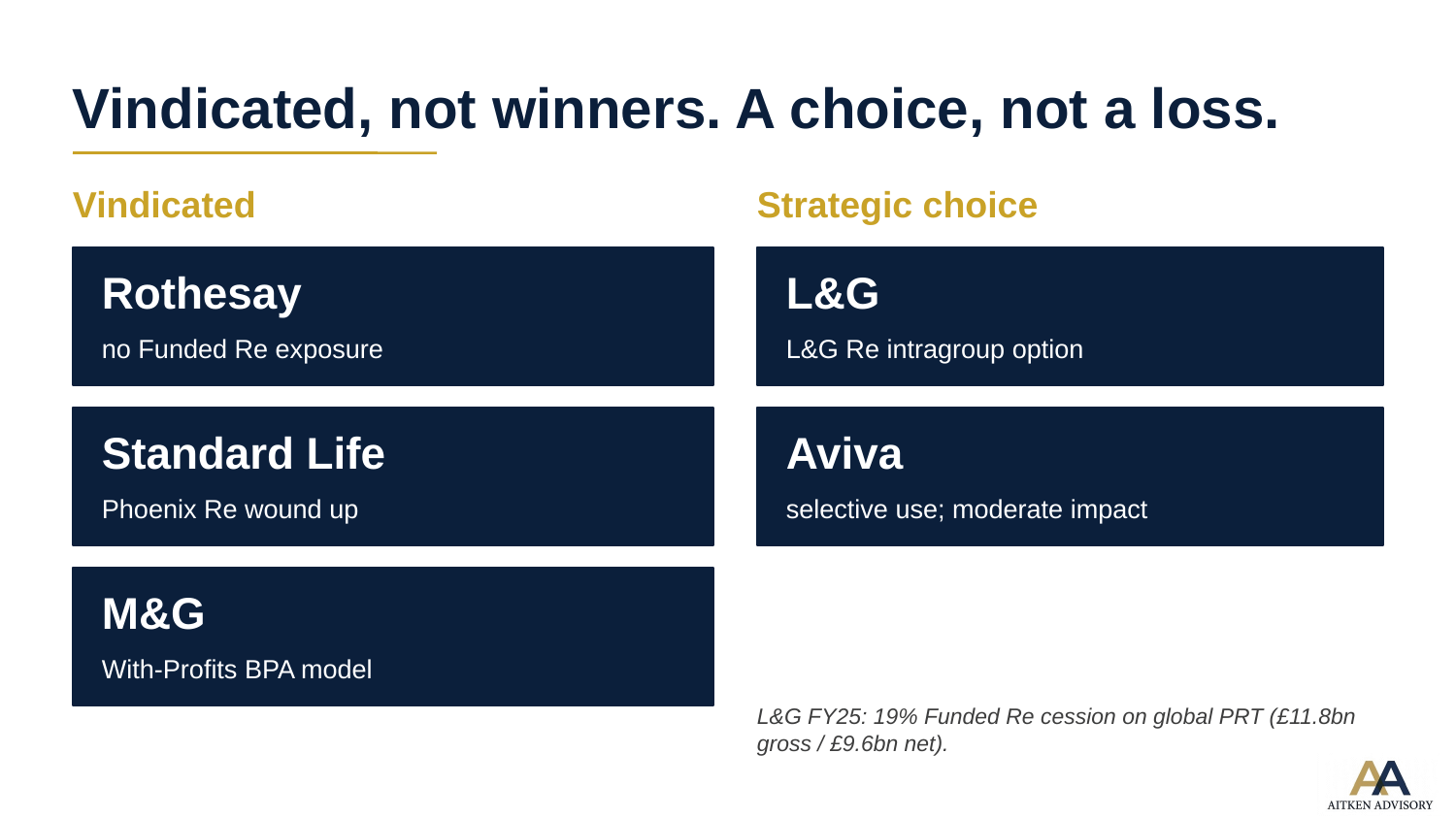
Rothesay has no Funded Re exposure and is not benefitting from a policy gift; it is running the model the rest of the sector is now being forced toward. Standard Life had already pivoted. Phoenix Re Limited, the group’s Bermuda vehicle, is being wound up or sold. M&G’s With-Profits BPA proposition, which shares risk with the corporate sponsor instead of using offshore reinsurance, sidesteps the issue entirely.
From what is disclosed, L&G is the most exposed listed name. Global PRT net of Funded Re was £9.6bn in 2025 against £11.8bn gross, implying 19% cession (source: L&G FY 2025 results press release, March 2026). L&G Re, the group’s in-house Bermuda reinsurer, gives them the option to rebuild the structure intragroup. Aviva has been a more selective Funded Re user; the impact is moderate and within their existing strategic range.
CP8/26 carves out intragroup quota share arrangements from the headline capital uplift, provided the reinsurer holds a mirror portfolio of MA-eligible assets matching the ceded liabilities, the cedant retains a meaningful share of the risk and “skin in the game” in asset selection, the deal generates no day-one profit, and the structure does not lift surplus at group level. The detailed criteria will sit in a new defined term, “intra-group quota share funded reinsurance”, in the PRA Rulebook Glossary.
The bundled Funded Re lever loses its capital benefit on 30 September 2026. My view is the price war it built ends with it. The question is what replaces it.
Listed UK life insurers face a strategic choice. They can stand up captive intragroup reinsurance capacity in the L&G Re mould; they can absorb the new CDA on third-party deals; or they can step back from the Funded Re-dependent end of the market.
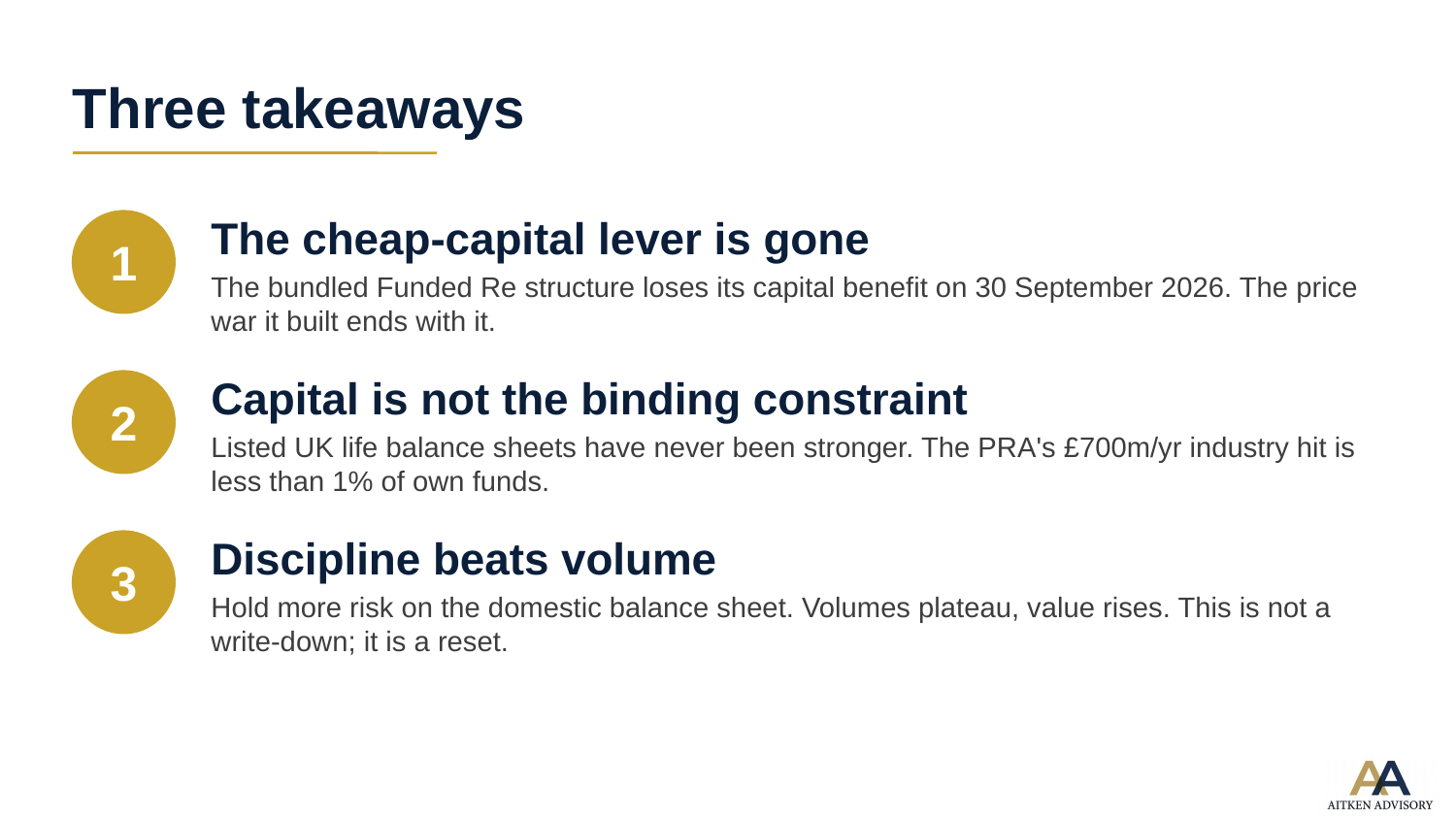
My view, unchanged from my piece written in October 2025, is that the right answer is to hold more risk on the domestic balance sheet. Capital strength is abundant. The marginal £2bn buy-in won at sub-3% margin via offshore reinsurance was always lower-quality business than a £1bn buy-in retained at 4% margin on domestic capital. CP8/26 makes the price discipline question unavoidable. The PRA has signalled it intends to slow Funded Re growth, not just reprice it. The listed insurers that read the signal will use the moment to compound long-duration value rather than chase volumes.
The next test comes around the September 2026 deadline. How the listed insurers respond, and how the PRA responds to their response, will tell us whether the discipline holds. My view is that it will. The structural cheap-capital lever has gone, the global regulatory community is moving the same way, and management teams have already started to reset their underwriting frameworks. From here, in my view, the path is towards a more disciplined sector, less marginal competition, and over time better margins on the business that is actually written.
Want a deeper dive on UK life insurers, annuity balance sheets, and why markets often misprice them in stress? That is the core theme of my book, Breaking Down the Insurance Black Box.
Gordon Aitken runs Aitken Advisory, providing strategic advice on UK and European life insurers and pension funds. I work with investors, insurers and advisers on transactions, capital strategy and market positioning. If you would like to discuss a potential engagement, click the button below to email me.
Disclaimer
The content of this publication reflects my personal views only and is provided for information purposes. It does not constitute investment advice or investment research, and I am not acting in the capacity of an investment adviser. I own shares in some of the companies mentioned. Readers should carry out their own analysis or seek professional advice before making any financial decisions.
If you found this post helpful, feel free to share it with colleagues or subscribe for future updates on UK life insurers and pension funds
No posts
Comments
Nothing yet. Say the first thing.
Sign in to join the conversation.