
Note: These are my personal views only and do not constitute investment advice. See full disclaimer below.
Audio embedded below:
0:00
-34:04

In September 1999, I was at Barclays Global Investors (BGI) when the news ticker carried the announcement that NatWest had agreed to pay £10.75bn for Legal & General, 210p per share. Lloyds TSB had agreed to buy Scottish Widows three months earlier, but Widows was a mutual being demutualised as part of the deal. The NatWest bid would have been the first takeover of a listed UK life insurer by a UK clearing bank. I recall the Embedded value at the time was around £1 per share, so NatWest’s offer at 210p valued L&G at 2.1x EV, a similar multiple to what Lloyds was paying for Widows.
The databox below is from my own CSFB research note on L&G dated 2 July 2001. By year-end 2000, embedded value per share had crept up to 126p.
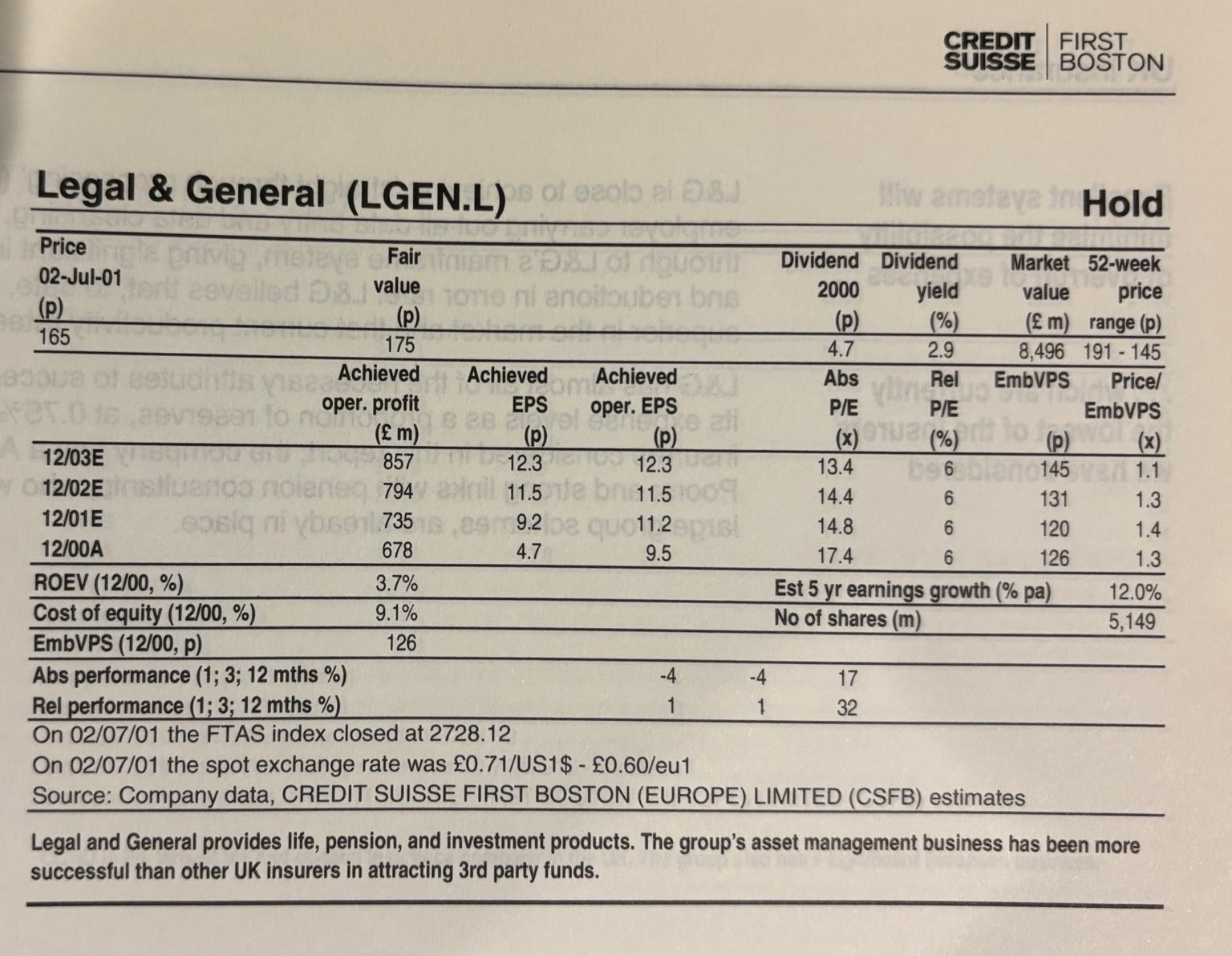
BGI was a big index shop (in the UK L&G was the other at the time). I however worked in the active equities team, which was quant. Our model liked value stocks, and screened on classical accounting metrics: book value, earnings and dividend yield. L&G did not screen well. The screen captured only the published net assets on the balance sheet, and ignored the in-force value of the life book, which is the present value of profits emerging over decades from policies already written, and which is the larger half of any life insurer’s embedded value. I spent the rest of the day explaining to colleagues why the right way to value L&G was through embedded value rather than book, and why NatWest’s 2.1x multiple was not the obviously stupid number it looked on the value screen.
The deal itself did not survive the autumn. Bank of Scotland launched a hostile counter-bid for NatWest within weeks, RBS came over the top at £21bn, and by February 2000 NatWest had accepted the RBS offer. The L&G deal was dead, and the question of how to value a UK life insurer went back into the box for the better part of a quarter of a century.
27 years later, the FT's "Will L&G be the City's next domino to fall?" lands on 14 May. The paper reported that several US private capital firms are drawing up plans to bid, with one source telling it "people are spending real money on this now". The CEO told the FT there are "no discussions or anything else going on", but the shares were marked up 6.2% on the day all the same.
Is L&G back in play? The potential buyer this time is the asset manager chasing inflows, not the clearing bank chasing distribution. The embedded value problem I was explaining to my colleagues in 1999, in muted form, has never gone away.
The most important shift since 1999 is the direction of ownership, not the size of the bulk purchase annuity (BPA) market or the rise of private capital as an asset class.
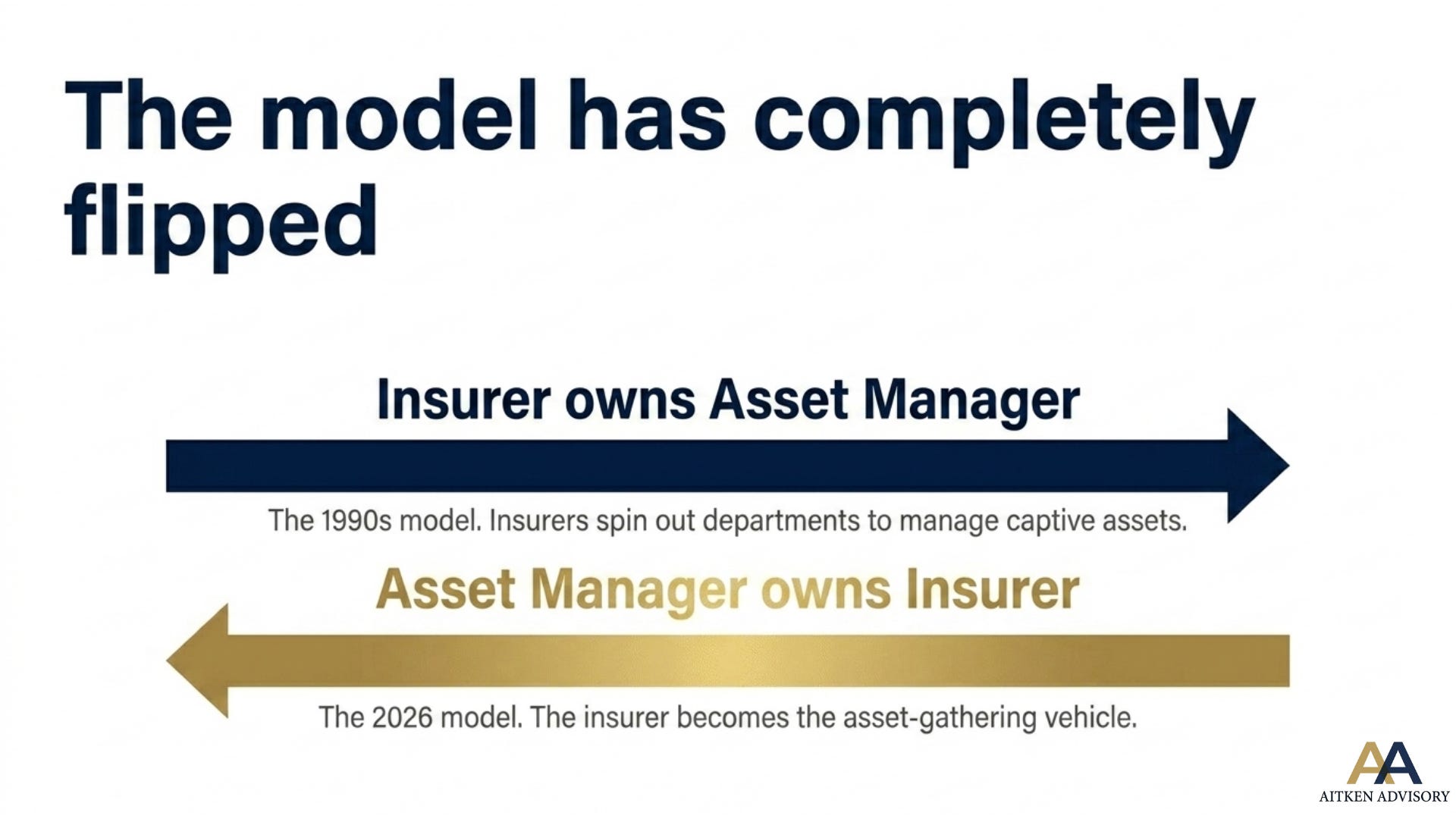
The old model was that insurers owned asset managers. These businesses started life in the 1990s as departments inside the insurer. They were then spun out into separate subsidiaries, primarily to manage the captive assets of the parent. The skill set transferred reasonably well into a wider market, so they all tried to attract third-party institutional money, with varying degrees of success. In active management, the insurance-owned asset manager was broadly looked down upon by the wider institutional market. L&G was the exception. Indeed I’d indicated at the bottom of the databox shown above that its asset management business was already more successful than other UK insurers at attracting third-party funds.
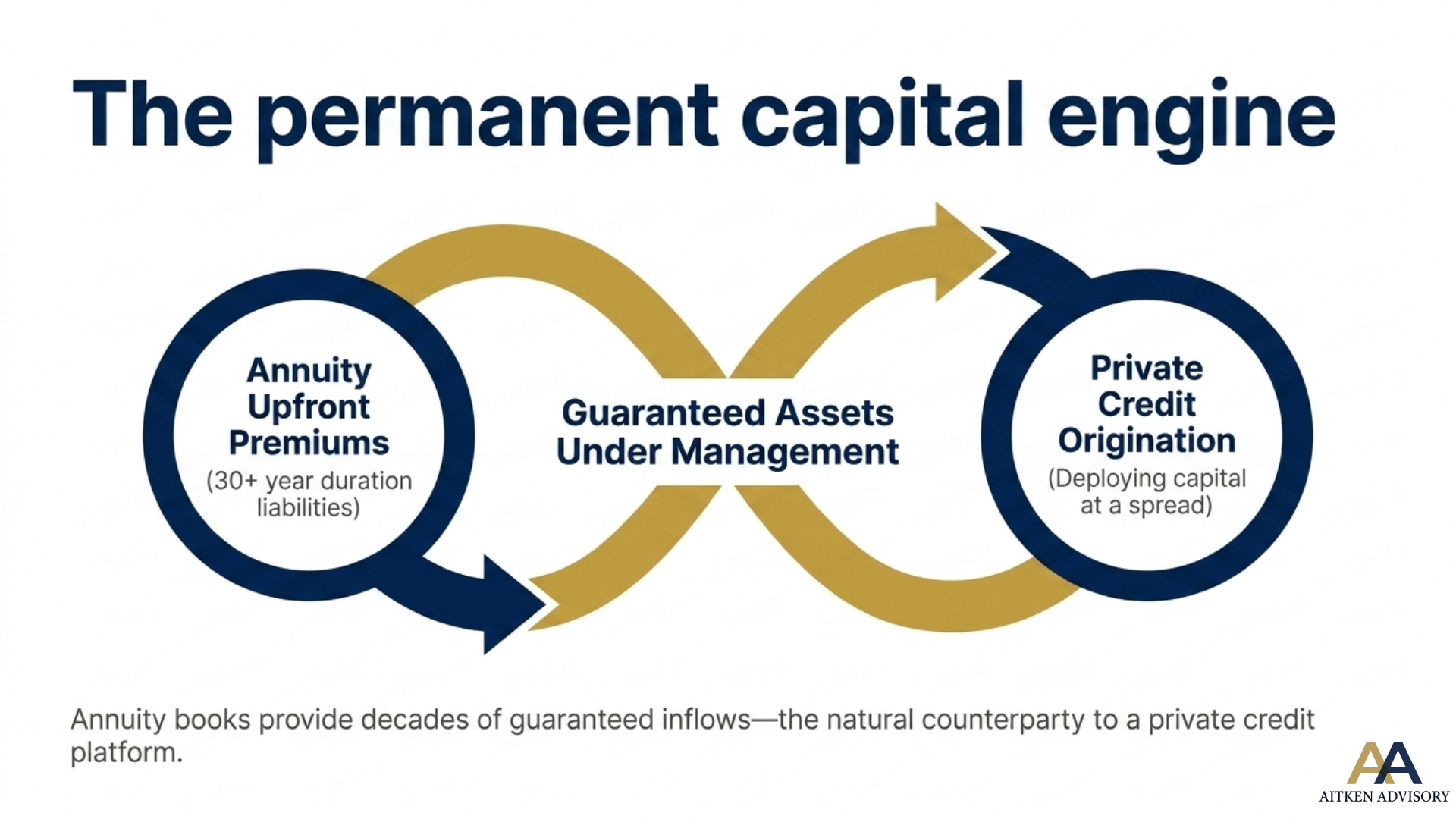
The new model is that asset managers want to own insurers, because annuity liabilities are net inflows at attractive margins for decades. An annuity book pays out gradually over 30-plus years, and in the meantime the upfront premium is invested. For an asset manager, that is decades of guaranteed assets under management to deploy at a spread above the liabilities. Annuity books are the natural counterparty to a private credit origination platform that needs reliable long-duration capital to deploy.
Apollo did this trade with Athene from 2009 to 2022. KKR followed with Global Atlantic from 2020 to 2024. Athora completed the £5.7bn acquisition of PIC on 27 March 2026. Brookfield completed the £2.4bn acquisition of Just Group on 1 April 2026. Both UK deals closed inside five days of each other, less than seven weeks ago. In each case the asset manager is the senior partner and the insurer is the asset-gathering vehicle.
In the past 18 months, six of the most sophisticated long-duration capital allocators in the world (Apollo, Athora, Brookfield, KKR, Blackstone, CVC) have tabled bids, are reported to have done so, or have agreements covering UK or European spread / BPA assets. With the exception of Hargreaves Lansdown, none of them is bidding for UK defined contribution platforms. Hargreaves is a retail / direct-to-consumer DC platform, not workplace pensions, so the read-across to L&G's workplace DC book is limited anyway. A CVC-led consortium (with Nordic Capital and Platinum Ivy) took Hargreaves private at c.£5.4bn / £11.40 per share, a private equity buyout play rather than a spread/BPA franchise build. The other five names are exclusively focused on the annuity-and-credit machine.

L&G is the largest predominantly life insurer in this universe, with a £14bn market cap. The group has three divisions, and the 2025 IFRS operating profit split is 58% Institutional Retirement (£1,168m, £11.8bn of pension risk transfer (PRT) sales at 1.6% capital strain, meaning the proportion of the deal value the insurer has to set aside as regulatory capital), 20% Asset Management (£402m, £1.2trn of assets under management, £75bn of private markets), 22% Retail (£447m, £114bn of workplace assets under administration).
As far as I can see five structures are in play.
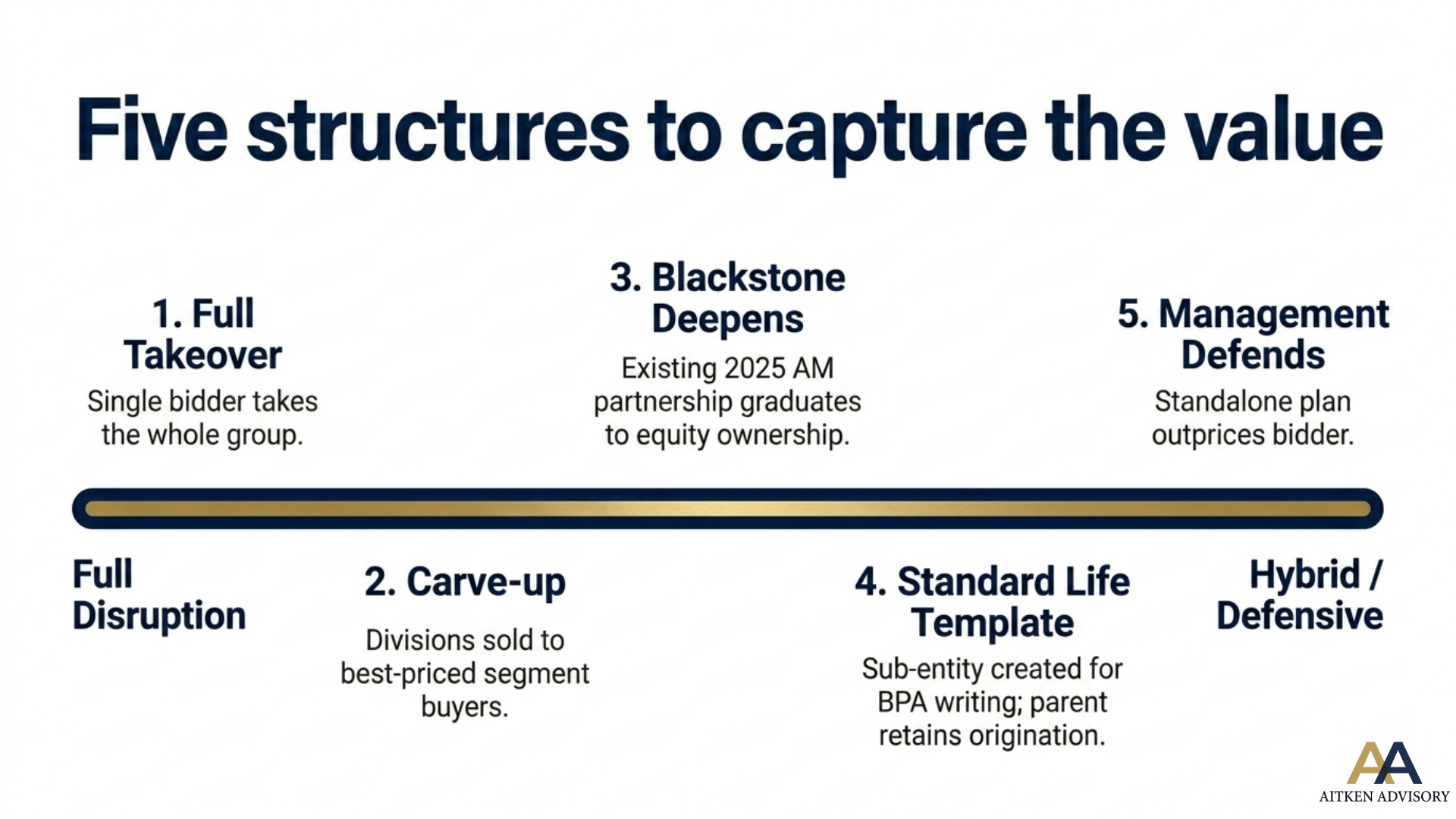
1. Full takeover. A single bidder takes the whole group, with the PRA, FCA, Treasury and Bank of England all in the room.
2. Carve-up. The three divisions are sold separately to the best-priced buyer in each segment. Note that these units can stand alone. This has already been proven by PIC, Rothesay and Just, all of which built successful UK BPA franchises without an in-house asset manager attached.
3. Blackstone deepens. The existing July 2025 asset management partnership, under which L&G directs up to 10% of new annuity flows to Blackstone-originated investment-grade private credit, graduates into equity ownership, following the Apollo/Athene template.
4. The Standard Life template. The FT has reported that Standard Life may be bringing CVC and Prudential Financial into a new BPA-writing sub-entity inside its regulated insurer (see my Substack piece Is Standard Life about to trade 20% IRRs for a re-rating?); L&G could do something similar, with the listed parent retaining origination and asset management fees on a much bigger pool.
5. Management defends. The board uses its standalone plan and existing defence team to ask shareholders to back the listed company at a higher price than the bidder offers.
On the carve-up route specifically, 47% of LGIM’s AUM is indexed, and the index side is responsible for the group’s net outflow position as DB schemes close and de-risk. The abrdn-style risk of active underperformance applies on the 53% active side, but the dominant structural drag on LGIM AUM is the closing DB book, not a return-cycle problem.
In the event of a bid, I see a simpler way to triangulate the take-out price than a divisional sum-of-the-parts: the forward dividend yield. L&G yields 8.6% on 2027 consensus DPS of 22.67p at Friday’s 264.8p close. I believe it is reasonable to compress that to 5%, broadly where Allianz trades, still a great yield for a balance sheet as strong as L&G's, with full asset-liability matching and a strong new business pipeline, and the implied share price moves to c.453p, a 71% premium to today.
Just Group is the relevant listed precedent. Brookfield paid 220p in cash, a 75% premium to the undisturbed share price, and the deal was waved through, in large part because shareholders had endured years of being valued well below break-up. In my view Brookfield got a decent price and Just shareholders got a decent exit. Both can be true at once when the public-market discount has built up for that long. The yield compression case and the Just precedent converge in the same range.
Political and systemic. L&G is one of five UK insurers on the resolution-planning list published by the Financial Stability Board, the international body that coordinates national financial regulators on behalf of the G20. The FSB is explicit that the list is not a systemic-importance list: "an insurer is not considered systemically important by virtue of being included", but it is the closest formal proxy for the UK life groups the Bank of England and Treasury would care most about in a takeover. The FSB has been chaired since 1 July 2025 by Andrew Bailey, Governor of the Bank of England. The other four UK names on the list are Aviva, Bupa Finance, Standard Life plc and M&G.
PIC and Just are not on this list. The FSB list cleaves the listed UK life groups subject to formal resolution planning from the BPA pure-plays that are not. PIC and Just, both pure BPA plays, have now been taken out by overseas private capital. If L&G follows, the UK's contribution to the FSB list collapses from 5 to 4, and ownership of the resolution-listed end of the UK life book becomes a matter for government and the Bank of England.
Regulatory. The PRA published consultation paper CP8/26 on funded reinsurance on 29 April 2026, effective for new business from 1 October 2026 (see my Substack article The regulator doesn’t do favours, this time it did). L&G is a big user of Funded re, so this is an obvious moment to reassess. I expect business will come back onto the balance sheet and will use more capital. Analytically that is fine, but shareholders may not see it that way. UK life sector shareholders have continuously pushed for higher and higher solvency over the years, which I have disagreed with, but that is what every conversation I have had with them confirms.
Defensive. Given recent M&A in the BPA space, L&G’s Board will have been prepared for a Thursday-morning headline like the FT’s.
A full L&G bid would reprice the rest of the sector overnight. A Blackstone or Standard Life-template structure validates the BPA franchise at the implied transaction multiple.
None of this is unhelpful for public market investors. Professional buyers with detailed knowledge of the underlying economics are telling the market there is value here. That should be read as a signal that UK life insurance has been mispriced for years, not as a threat. In each scenario, the listed sector re-rates as a group. The public-market discount that drives L&G’s 8.6% yield weighs on Aviva, Standard Life and M&G in equal measure.
I asked on LinkedIn this week who readers thought captures the value over the next phase of the bulk annuity market. The comment thread split between Apollo, Brookfield, and the more uncomfortable view from one actuarial reader that there will soon be no UK life insurance company left standing.
What I think is that all five structures above remain live: a full takeover by private capital, a clean carve-up that sells the three divisions to the best-priced buyer in each, a deepening of the existing Blackstone partnership into equity ownership on the Apollo/Athene template, a Standard Life-template hybrid that keeps L&G listed but transfers the upside to a sponsor, or a successful management defence.
The one that lands depends on whether the PRA and the government decide to act before the next domino falls. If they do not, the model has already flipped. The remaining question is one of timing, not direction.
Gordon Aitken runs Aitken Advisory, providing strategic advice on UK and European life insurers and pension funds. I work with investors, insurers and advisers on transactions, capital strategy and market positioning. If you would like to discuss a potential engagement, click the button below to email me.
Want a deeper dive on UK life insurers, annuity balance sheets, and why markets often misprice them in stress? That is the core theme of my book, Breaking Down the Insurance Black Box.
Disclaimer
The content of this publication reflects my personal views only and is provided for information purposes. It does not constitute investment advice or investment research, and I am not acting in the capacity of an investment adviser. I own shares in some of the companies mentioned. Readers should carry out their own analysis or seek professional advice before making any financial decisions.
If you found this post helpful, feel free to share it with colleagues or subscribe for future updates on UK life insurers and pension funds
No posts
Comments
Nothing yet. Say the first thing.
Sign in to join the conversation.