
Note: These are my personal views only and do not constitute investment advice. See full disclaimer below.
Audio embedded below.
0:00
-11:39
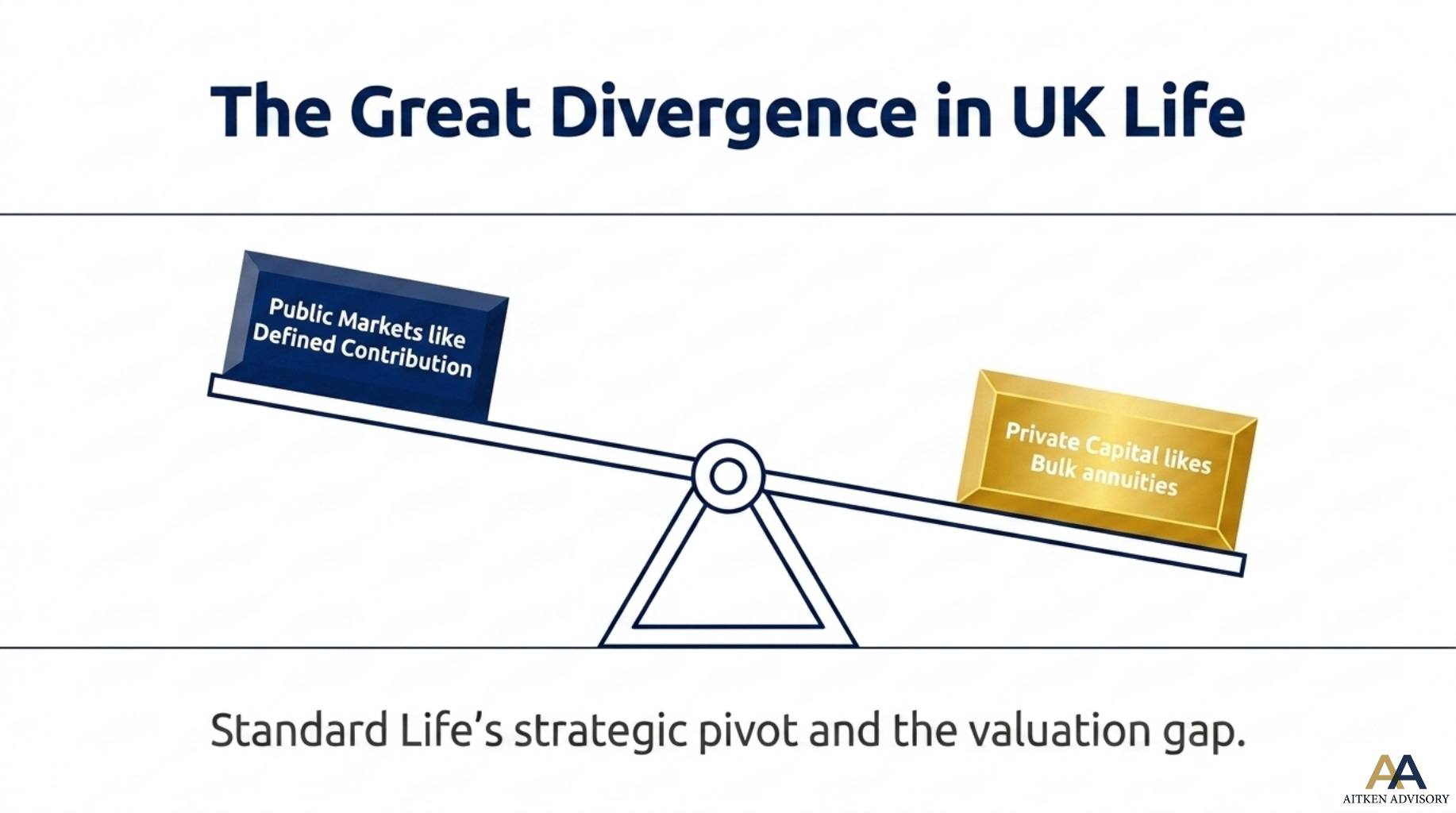
About 10 years ago I sat down with an analyst at one of the big UK fund managers to walk him through a listed UK life insurer’s bulk annuity book. He understood the upside. He could see that matching meant very little could go wrong. He had two problems. He doubted he could explain the asset to his portfolio managers as well as I had explained it to him, and he knew the PMs were on a clock. If sentiment did not soften in the next few months, they would pull the plug. He wanted to know when it would soften. I could not tell him it would change any time that year.
In the end he bought the insurer’s subordinated debt himself, personally. He understood the asset and was prepared to back it with his own money. For the equity book he proposed a wealth manager, and his PMs bought it. The same person, looking at the same insurer, valued the BPA cash flows enough to own the debt and judged the listed equity wrapper unsellable to his own colleagues.
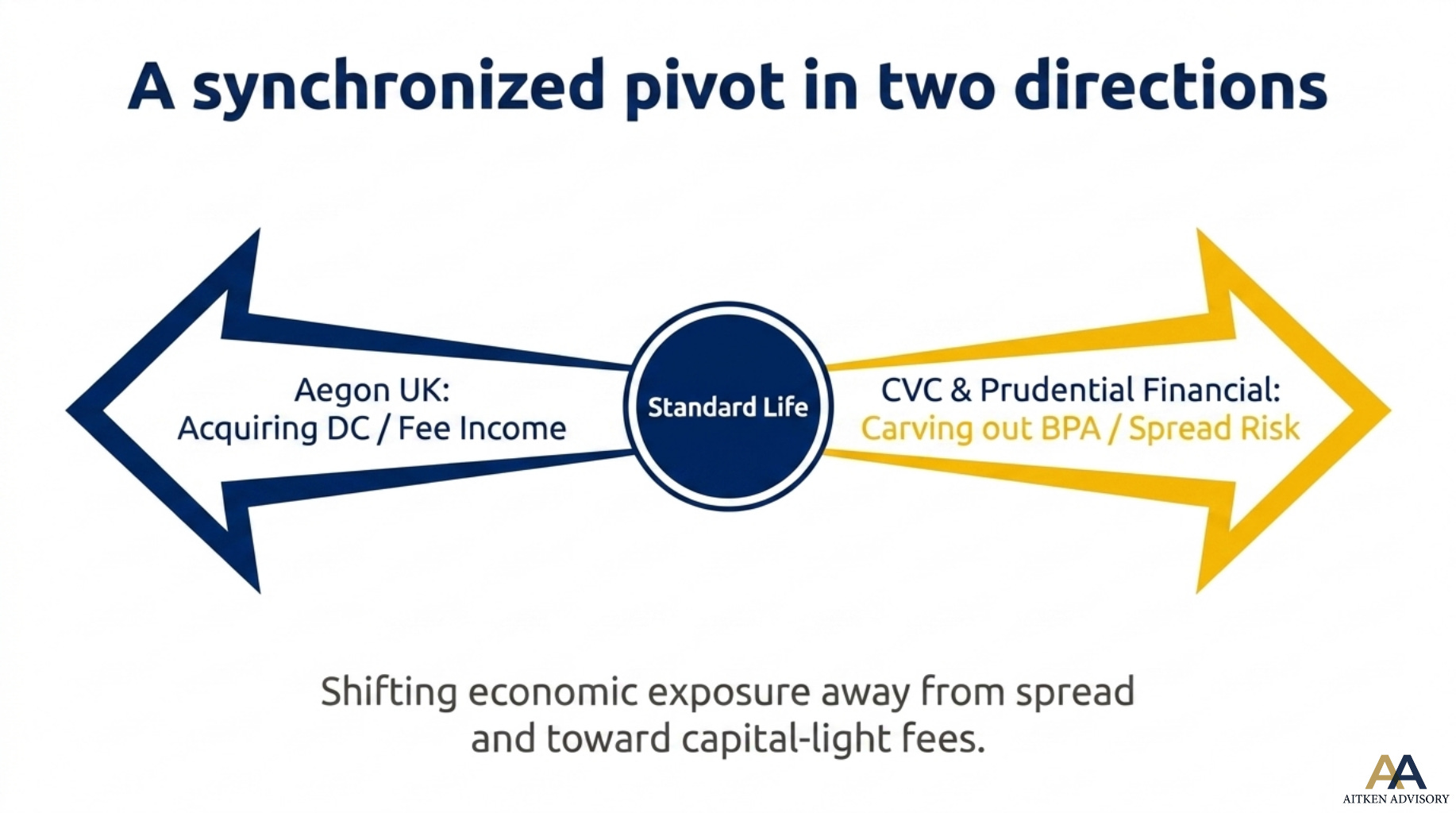
A decade later, Standard Life has reached the same conclusion at the corporate level, and is doing both things at once. The FT reported on 22 April 2026 that a consortium led by CVC and Prudential Financial has emerged as the frontrunner in Standard Life’s process to bring third-party capital into its UK bulk annuity (BPA) business, the market in which insurers take on defined benefit (DB) pension scheme liabilities from corporate sponsors in return for an upfront premium. The reported deal would commit more than £1bn of equity to a newly created Standard Life subsidiary, drip-fed in over time as new pension scheme deals are written. It pairs with the £2bn acquisition of Aegon UK announced a week earlier on 15 April 2026, which almost doubles the listed entity’s DC platform.
Standard Life is doing what its shareholders want. The bigger question, and the one that runs through this piece, is whether its shareholders want the right things. In the near term the deal is likely good for the share price. Over the long-term I do not think it is good for earnings.
This piece builds on my 14 April note on private capital moving into UK bulk annuities and my 15 April note on the Aegon UK acquisition. The two threads converge here.
The process has been in train for over a year. CEO Andy Briggs flagged the direction of travel publicly at the 2024 full year results in March 2025, telling analysts the company was exploring ways to partner with third-party capital using its origination capability in the market, and that funded reinsurance had become “a more challenging focus because of the evolving regulatory position”. In October 2025, Bloomberg reported the formal process, codenamed Project Ocean and run by Fenchurch Advisory, with initial bidders Blackstone, KKR and Sixth Street. By late 2025, BlackRock and Goldman Sachs Asset Management had also joined (source: FT). The April 2026 FT report has CVC and Prudential Financial in pole position. The rebrand from Phoenix Group to Standard Life completed on 2 March 2026.
The choice of partner is itself a signal. CVC brings the capital. Prudential Financial brings the operating platform, as the largest pension risk transfer writer in the United States, with over $110bn of transactions completed since 2012 and seven of the ten largest US deals to its name. The losing bidders, BlackRock and Goldman Sachs in particular, would have the same financial power but brought less insurance balance sheet expertise. Standard Life has chosen actuarial knowledge alongside the capital, not just the capital.
Most of the recent private capital moves into UK bulk annuities have been outright acquisitions. Athora, the Apollo-backed European reinsurer, completed its £5.7bn acquisition of Pension Insurance Corporation (PIC) on 27 March 2026. Brookfield, the Canadian alternative asset manager, completed its £2.4bn acquisition of Just on 1 April 2026 at 220p per share, a 75% premium to the undisturbed share price. L&G’s tie-up with Blackstone, announced on 10 July 2025, is structurally different again. It is a $20bn private credit asset-management mandate over five years, sitting on the asset side of L&G’s balance sheet rather than the equity side, with the listed entity unchanged.
The Standard Life CVC structure is not like any of those. The listed entity stays public, and the regulated UK life insurance subsidiary, SLAL (Standard Life Assurance Limited, the group’s regulated UK life insurer), stays whole. Inside SLAL a new sub-entity is created specifically to write new BPA business, with the consortium taking an equity stake (by some accounts a majority) and the capital drip-fed alongside new business rather than handed over upfront.
The closest precedent I can think of is Apollo’s ACRA sidecar at Athene, where third-party investors fund the new business strain on annuity deals and take a corresponding share of the spread economics. If the Standard Life structure follows that template, the consortium takes the bulk of the capital strain and spread, while Standard Life keeps origination and asset management fees on a much bigger pool.

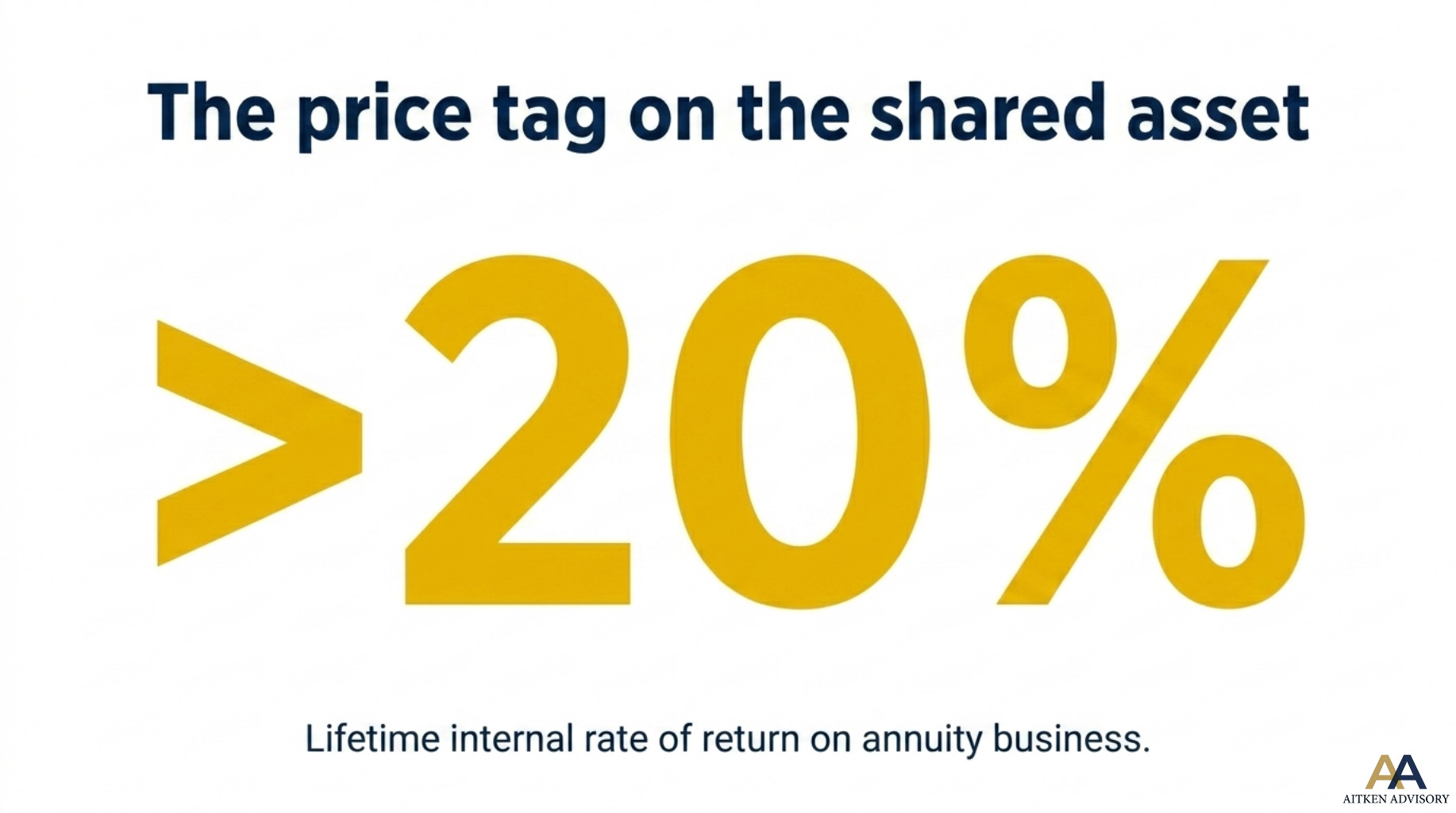
Standard Life’s 2025 results, published in March 2026 under the new name, give the cleanest picture of what the deal is for. Standard Life wrote £3.9bn of pension risk transfer (PRT) volumes in 2025, down from £5.1bn in 2024. Total annuities capital strain was £162m for the year, down from £206m in 2024. The largest deal was £1.9bn, the biggest the company has ever written. The slides accompanying the 2025 results disclosed lifetime IRRs of more than 20% on Standard Life’s annuity book, which includes both bulk purchase annuities and individual annuities.
Two things stand out. Management has been running below their own strain budget. The implied capacity is around £200m a year. They actually used £162m. This may be due to increased competition in the PRT market which we witnessed last year but also is consistent with selective pricing at the high end, and it is consistent with Standard Life being capital-constrained at the top of the market. It cannot always be at the table for £5bn-£10bn jumbos against PIC, L&G and Rothesay because it cannot fund the strain. The CVC and Prudential capital line is precisely what removes that constraint. The new vehicle is the way Standard Life writes multiple jumbos a year rather than one.
The bigger story is a lifetime IRR of more than 20%. Public market investors do not value it at anything close to that. They discount it heavily, I expect almost by half, for the asset risk, longevity risk, regulatory risk and the sheer complexity of a 30-year liability. That gap between the disclosed return and the credit equity investors are willing to give it is the gap private capital is buying into. CVC and Prudential Financial are being invited into a business at a return the public market refuses to credit. The economic question for the listed shareholder comes down to whether the asset management fees and minority spread share, on a much bigger pool, exceed what the company would have made writing a smaller pool with 100% of the economics.
The proposed CVC deal does not sit in isolation. On 15 April 2026 Standard Life announced it is also buying Aegon UK for £2bn, due to complete by end-2026. The consideration is £750m cash plus shares giving Aegon a 15.3% stake in Standard Life. The deal adds £160bn of assets under administration and 3.8m customers. The combined group will rank second in the UK workplace pensions platform market and first in UK pensions and savings. Management is selling the deal as capital-light fee income: £160m of additional operating cash generation a year, £190m of additional operating profit, and £800m of total net synergy value.
Read the two deals together and the strategic shape is unmistakable. The Aegon UK deal pushes the listed entity toward defined contribution (DC) and capital-light fees. The CVC deal carves the spread book out into a partly-owned subsidiary. The economic mix of the listed Standard Life is shifting away from the BPA spread and toward DC platform economics.
The market reaction to the Aegon deal has been positive. Standard Life rose from 713.8p at close on 14 April 2026 just before the Aegon UK announcement to 776.4p on close on 21 April 2026, a rise of 8.8%. The listed market likes the DC tilt.
The reason is partly a function of who is buying the shares, and it is the same problem the buy-side analyst I sat with a decade ago could not solve. The Standard Life investor base, in common with the broader UK life sector, draws heavily from generalist asset managers. The “AUA x margin x persistency” profitability model they apply to DC is a model they recognise well as it is the model of the business they themselves run. They live inside it every day. That is why DC platform pensions, wealth managers and platforms are intuitive for those fund managers. A bulk annuity book is not.
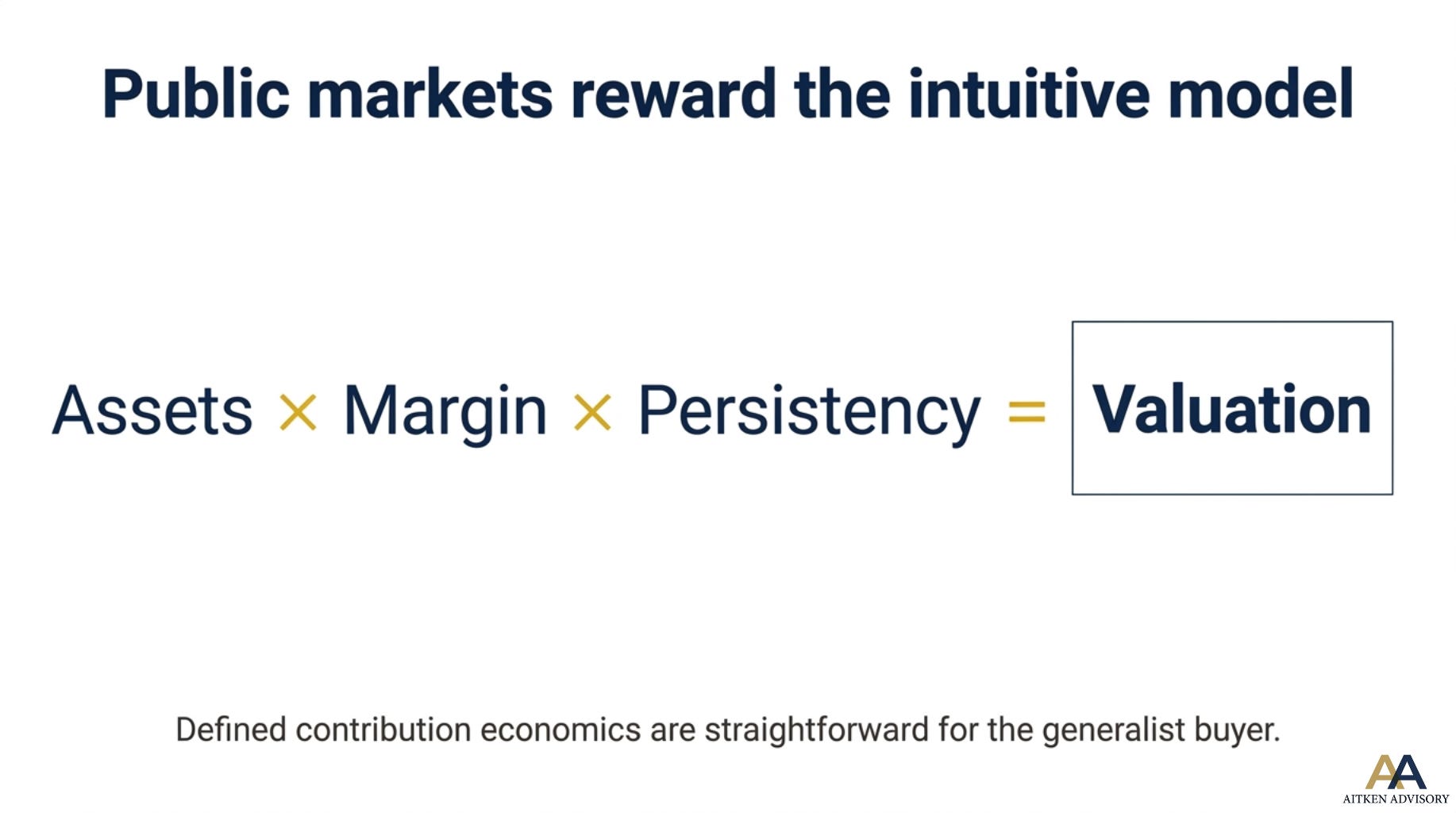
The DB / BPA model is the opposite. It demands real work to understand: Solvency II capital generation, the matching adjustment, contractual service margin, longevity tables, embedded value, lifetime IRRs on new business. The cohort of investors fluent in that vocabulary is small and shrinking. The share prices of Just Group prior to the Brookfield takeover or L&G demonstrate that public market investors do not reward the spread model. Management’s working assumption, entirely defensible over a 3-5 year horizon, is that the market will not start to reward it any time soon.
Read in that light, the Aegon UK plus CVC strategy is a rational response to the listed market’s actual preferences. Tilt the company toward what the listed market understands and rewards. Hand the bit it does not understand to people who do. That is exactly what Standard Life is doing.
The listed entity rebranded as Standard Life on 2 March 2026 carries the DNA of two predecessor companies, and the two deals announced in April fit each predecessor’s identity neatly.
The original Standard Life, the company that demutualised in 2006, was an explicitly capital-light pitch. I wrote the investment case as IR director at the time, and the story to public market investors was fee-based asset management economics, SIPP and wrap distribution, and DC platform growth. Spread risk was not part of the equity case. The Aegon UK deal, with £160bn of additional AUA, 3.8m new customers and £160m of additional operating cash generation, is the listed Standard Life reverting to that original brand on a much larger scale.
The original Phoenix, which acquired Standard Life Assurance in 2018 and gave the combined group its closed-book backbone, was a UK consolidator. The model was conservative hedging, predictable cash generation, and very little new business strain. My feeling from chatting to shareholders is that the BPA push of the past three years sat slightly awkwardly with that identity, asking the company to take more spread risk, more new business strain, and more asset side credit risk than the consolidator brand had been built around. The CVC structure resolves that tension. The company gets scale in BPA, books origination and asset management fees on a much bigger pool, and parks the new business strain and most of the credit risk in a separately-capitalised vehicle.
Read together, the two deals are the listed entity reverting to type on both halves of its inheritance at once. That is rational from management’s risk-tolerance lens. It is not the same as saying it is value-creating from the listed shareholder’s economic-exposure lens. Whether the deal is sensible for the equity holder depends entirely on terms that have not been disclosed. The 20%-plus lifetime IRR Standard Life is currently making on annuity business is the benchmark against which any new partnership has to be judged.
If I consider what will impact earnings over the long-term, several things make me wary, even allowing for management's near-term reasonable response to the actual investor base.
The first is the revealed preference of private capital. Apollo, Athora, Brookfield, KKR, Blackstone, CVC, Sixth Street, BlackRock and Goldman have all run processes for, or completed acquisitions of, UK and European spread / BPA assets in the last 18 months. Not one of them is buying UK DC platforms. Nobody is bidding for SJP, or Quilter. The most sophisticated long-duration capital allocators in the world have looked at the same UK savings market and made a clear choice. The choice is spread, not DC. That is a near-perfect natural experiment on which model is the better business to be in for a buyer that does the work.

The second is the valuation evidence. Looking across the comparable peers as of April 2026, the wealth mangers/platforms trade on forecast P/Es of 13-17x and dividend yields of 3-5%. Standard Life trades on a forecast dividend yield of around 7.7% while the other PRT writers yield 7-9%. The DC platforms do trade at a premium to spread insurers in the listed market. Private capital, however, is paying very different prices for the same BPA assets. Athora paid £5.7bn for PIC and Brookfield paid £2.4bn for Just at a 75% premium to the undisturbed share price. Those are valuations the listed market consistently refuses to give Standard Life, L&G, M&G and Aviva for the same asset class. The same cash flows look like a bargain to private capital and a value trap to public markets.
The third is the historical pattern of insurers exiting spread at the wrong time. The US variable annuity story is the cleanest. I remember Voya, Hartford via Talcott Resolution, MetLife via Brighthouse, and Corebridge all offloaded legacy VA books, mostly to private capital-backed vehicles. Public listed players would not touch any of it. The feared tail risks did not show up at the modelled severity, and the private buyers compounded those books at very attractive economics for a decade. The current case is unusual in that there is no crisis driving Standard Life's exit. The mechanism is the same. There is a real risk that 2026 is to UK BPA what 2009 onwards was to US variable annuities.
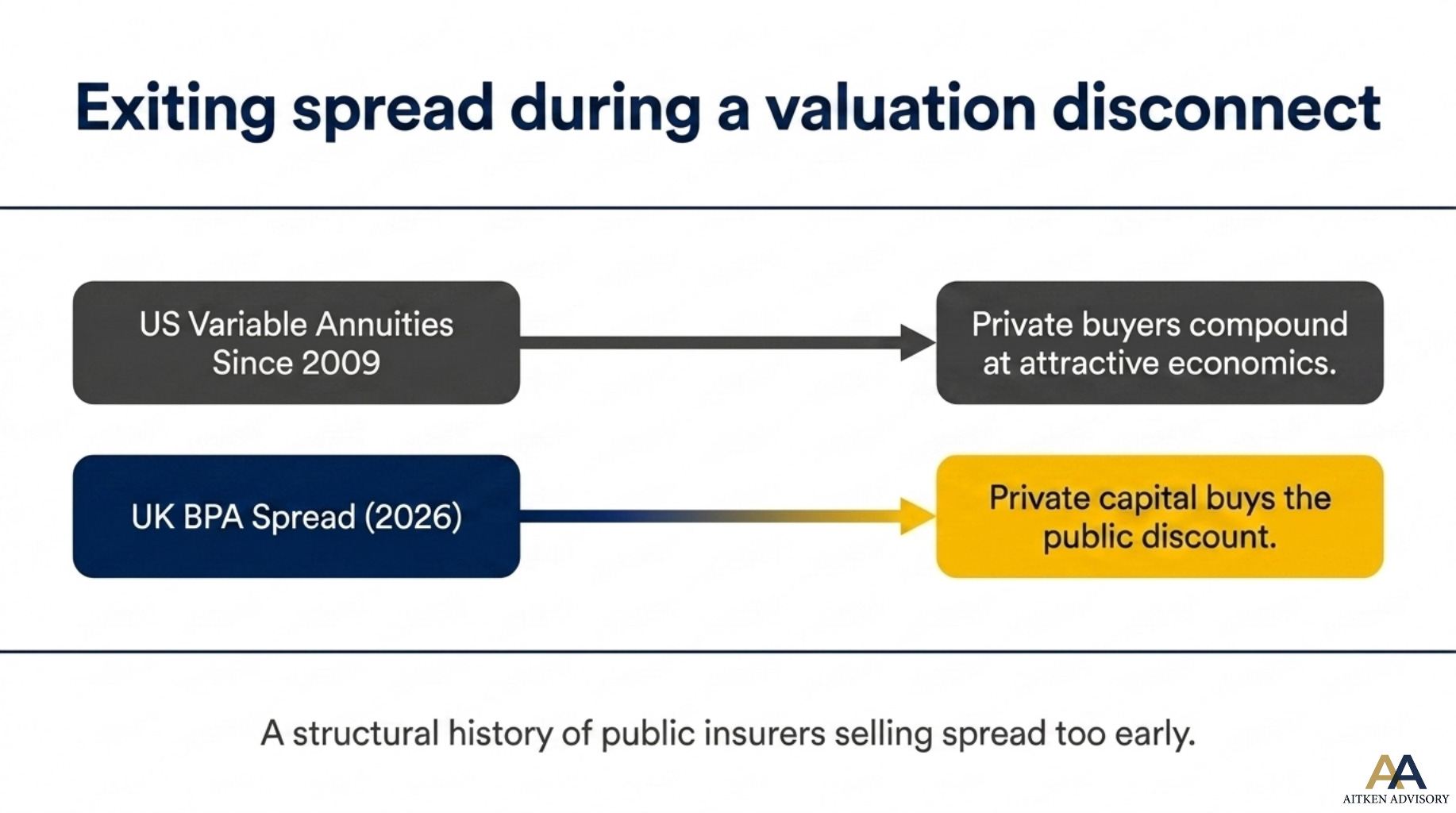
The CVC deal would be the third major UK BPA transaction this year. PIC went to Athora at £5.7bn. Just went to Brookfield at £2.4bn. Standard Life is now letting CVC and Prudential Financial in at the new business margin in return for £1bn-plus of fresh equity. Five of the most sophisticated long-duration capital allocators in the world have looked at the UK BPA market and concluded it is worth real money.
The listed sector’s response to that signal has been to move closer to what the listed market does reward. Standard Life’s response to the valuation gap is to move its centre of gravity away from the bit private capital is paying up for, and to grow the bit private capital is not interested in. To me, that is striking, and it is the right move only if you believe the listed market never closes the gap. Management appears to believe exactly that, which I have a lot of sympathy for. The gap hasn’t closed in the past 5 years, so why should it close in the next 5?
For a listed shareholder who shares that view, the deal is fine. The dividend yield, the buybacks and the disclosed Aegon UK synergies should compensate over a 3-5 year horizon. For a listed shareholder who thinks the gap will close and has a longer-term time horizon, the deal is a quiet form of corporate concession that the listed market will be the wrong place to own UK BPA economics for the foreseeable future. Both views are understandable.

There are scenarios in which I am wrong.
The CVC deal could come at terms that are clearly value-creating for retained shareholders: an asset management fee structure that scales with the pool, a minority equity slice of new business at favourable terms, and a strain reduction that frees capital for buybacks. The terms have not been disclosed. Until they are, this is an analytical inference, not a confirmed P&L impact.
The DC business could be more profitable than I credit. Aegon UK does come with cost synergies and a network effect Standard Life can scale. My scepticism is from years of margin pressure and years of continuous technology spend on these platforms.
The PRA published its funded reinsurance consultation on 29 April 2026. I was at the Westminster and City conference and heard the PRA make the case in person. As proposed, the changes would take capital held against the average funded reinsurance trade from 2-4% of annuity liabilities to around 10%, and would apply to all new business from 1 October 2026. What this does to BPA spread economics is genuinely uncertain. It depends on how UK insurers reduce or restructure their use of funded reinsurance, how the offshore reinsurance counterparties respond, and how the consultation itself lands after industry feedback. The PRA has set out a direction of travel; the market response is not yet visible. Selling a slice of the listed BPA economics against a regulatory backdrop none of us can yet read is hard to defend on the merits.

If the FT report lands as described, Standard Life will have written one of the most interesting pieces of insurance corporate engineering in the listed sector that I can remember. The deal is consistent with the company’s lower-risk DNA. It scales the BPA franchise without taking the marginal balance sheet pain. It pairs with the Aegon UK deal to rebalance the listed entity toward DC fee income, which is what the share price has rewarded so far.
If I take the longer-term view, after both deals are complete, the listed shareholder owns a smaller slice of the better business and a larger slice of the worse one. The five-year listed investor with a DC mental model can rationally clap. The longer-horizon investor who believes UK BPA is the most attractive insurance business model in the world, and that the listed market discount on it is mispricing rather than truth, has just watched a piece of that business move out of the listed wrapper, into a partly-owned vehicle, on terms that have not been disclosed and on a timeline they did not control.
Standard Life is doing what its actual investor base wants. The bigger question, and the one I keep coming back to, is whether its actual investor base wants the right things. History on insurers exiting spread at the wrong time, and the revealed preference of private capital that is right now buying every UK BPA franchise that becomes available, both suggest the answer might be no.
Want a deeper dive on UK life insurers, annuity balance sheets, and why markets often misprice them in stress? That is the core theme of my book, Breaking Down the Insurance Black Box.
Gordon Aitken runs Aitken Advisory, providing strategic advice on UK and European life insurers and pension funds. I work with investors, insurers and advisers on transactions, capital strategy and market positioning. If you would like to discuss a potential engagement, please get in touch.
Disclaimer
The content of this publication reflects my personal views only and is provided for information purposes. It does not constitute investment advice or investment research, and I am not acting in the capacity of an investment adviser. I own shares in some of the companies mentioned. Readers should carry out their own analysis or seek professional advice before making any financial decisions.
If you found this post helpful, feel free to share it with colleagues or subscribe for future updates on UK life insurers and pension funds
.
No posts
Comments
Nothing yet. Say the first thing.
Sign in to join the conversation.