
Note: These are my personal views only and do not constitute investment advice. See full disclaimer below.
Audio summary embedded below:
0:00
-8:40

In late 2007 I was Investor Relations (IR) Director at Standard Life, sitting in our brokers’ offices at UBS, hosting a call with the sell-side analysts. We had just put out an RNS, the London Stock Exchange’s regulatory news service, announcing that we were going for Resolution, Clive Cowdery’s first closed-life consolidator, with an offer worth just under 720p a share that Resolution’s board had agreed to recommend.
My team had been up most of the night getting it over the line. Partway through the analyst Q&A, one of the analysts came on the line to say that Hugh Osmond’s Pearl had bought enough shares in the market to take its stake above 25%. The room went flat. A UK scheme of arrangement needs 75% support, so once a single holder sits above 25% the scheme cannot pass. Exhausted and demotivated, we carried on through the motions of the call, but everyone on it knew the deal was dead. Pearl took Resolution the following year.
The Resolution episode taught me the lesson that runs through the rest of this story. Public markets debate insurance complexity. Professional buyers buy cashflows.
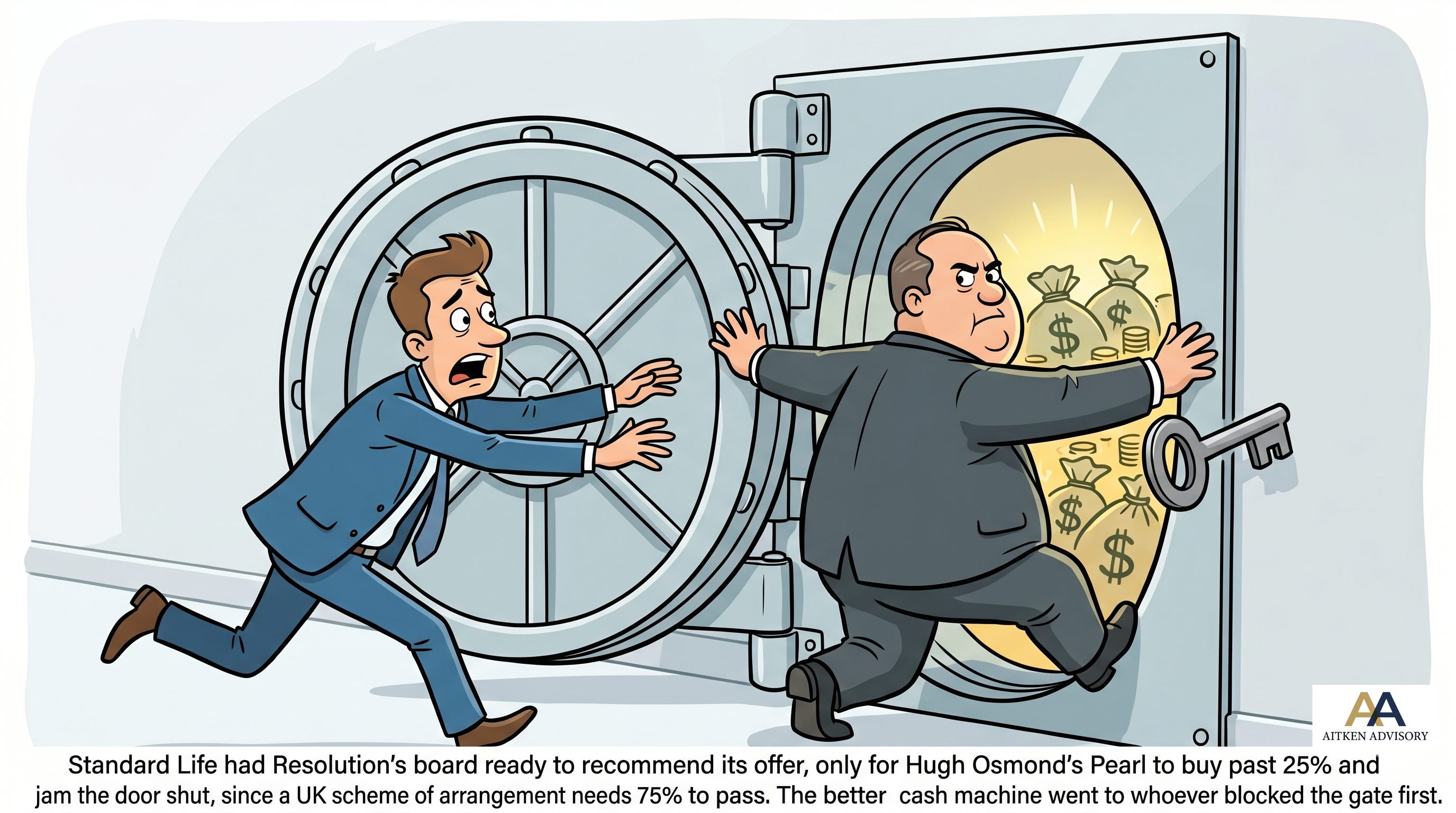
I have thought about that morning a good deal recently, because the thing that beat us was not a better strategic vision. Osmond simply went and bought the cash machine before we could. That, in the end, is the whole story of who has owned UK life insurers across my career: the asset barely changes, but the type of buyer who wants it, and the reason they want it, changes about every fifteen years. Right now, in my view, it is changing again.
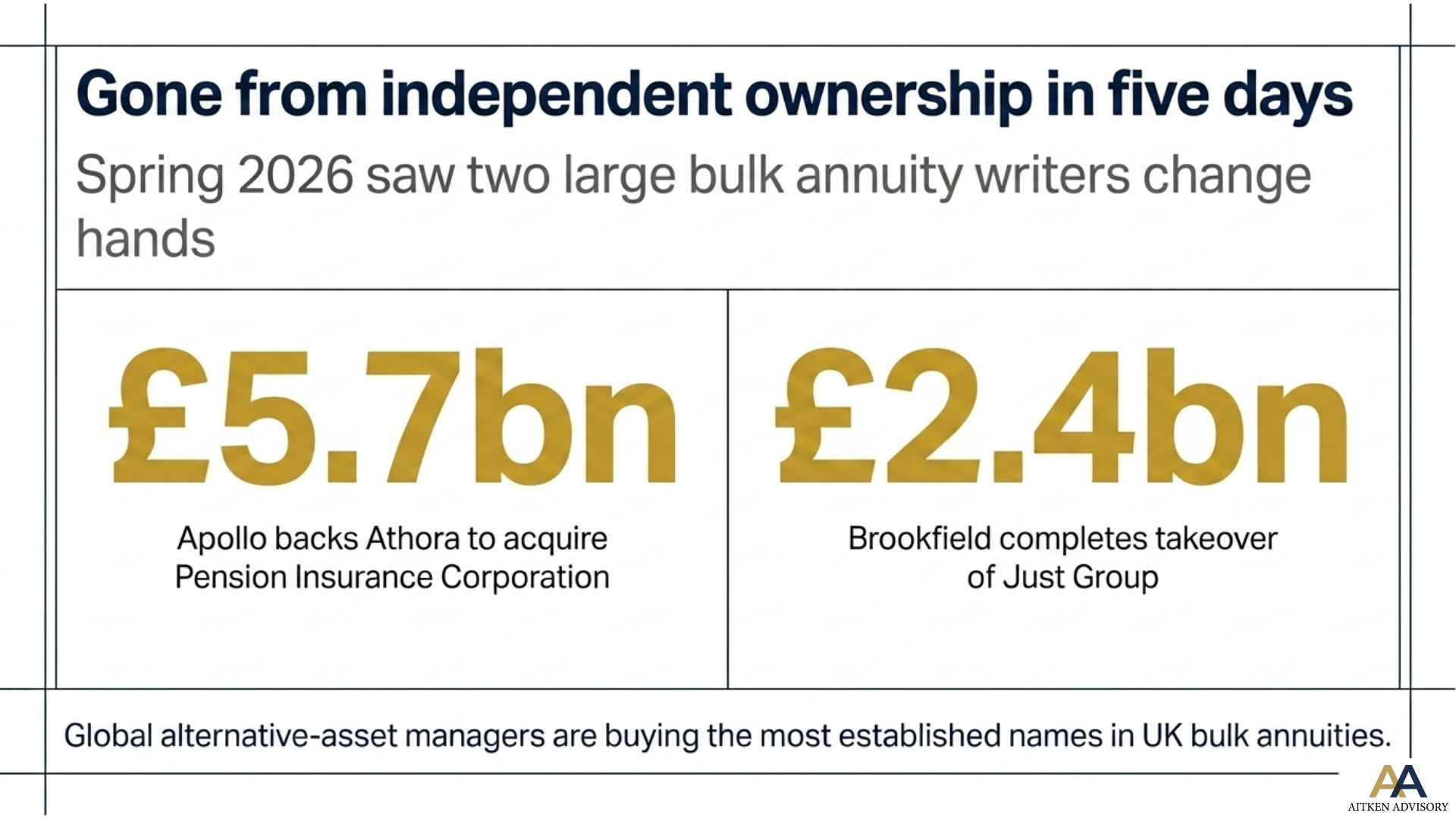
Two significant UK life insurance acquisitions completed within five days of each other this spring. On 27 March 2026, Athora, backed by Apollo, completed its £5.7bn acquisition of Pension Insurance Corporation. On 1 April 2026, Brookfield completed its £2.4bn takeover of Just Group. Two of the most established names in UK bulk annuities, the business of taking defined-benefit pension liabilities off company balance sheets, gone from independent ownership inside a week, both bought by global alternative-asset managers most pension trustees had barely heard of a decade ago.
I have written before about why these UK life companies turned themselves from sprawling conglomerates into specialists, and about whether L&G itself is back in play 27 years after NatWest first bid for it. This piece asks a different question. Forget what management teams decided these businesses should be. Look instead at who has repeatedly turned up wanting to own them, and why. You do not get buyers at all unless the stocks are attractively priced, and over my career they have been priced attractively rather often. What has changed is the type of buyer, and what each has wanted, as the products UK life companies write have shifted. I have separated out five eras. In each one the buyer wanted something completely different from the same underlying asset.
For most of the twentieth century the question of who owned a UK life insurer had a dull answer: the policyholders did. The great names, Standard Life, Scottish Widows, Norwich Union, Equitable Life, were mutuals, owned by their members and with no share price to answer to. That model built the industry, and then in the space of about five years it was largely competed out of existence.
The puzzle is why it happened when the equity market was strong rather than weak. The answer is that strength was the cause, not distress. These funds ran very long equity positions through the 1990s, and a roaring market made them stronger and stronger, swelling the with-profits funds (pooled funds where policyholders shared the investment returns) and the inherited estates, the surplus built up inside them over decades. That created two incentives at once. Members wanted to bank the gains, and demutualisation crystallised the surplus into windfalls. Boards, meanwhile, wanted listed equity as acquisition currency, capital they could raise and shares they could spend on deals. Norwich Union is the one I remember most clearly: it demutualised in 1997 and within three years had merged with CGU to create CGNU, later Aviva, a newly listed mutual promptly turning buyer.
The UK life sector went through a major demutualisation wave for 10 years from the early 1990s. Scottish Mutual went to Abbey National, Provident Mutual to General Accident, Clerical Medical to Halifax and Scottish Amicable to Prudential. Norwich Union, and Friends Provident chose the stock market route, while National Provident Institution went to AMP and Scottish Widows went to Lloyds TSB.
The buyers were other UK insurers, overseas insurers and banks, and what they were buying was not just life insurance earnings. They were buying distribution, scale and strategic optionality: millions of policyholders, trusted brands, adviser relationships and large with-profits balance sheets built under a pre-Solvency II regime that gave management teams more room for manoeuvre than today’s capital framework. The core asset was the customer base. The investment thesis was that ownership of that customer base could be converted into broader savings, pensions and investment flows.
Standard Life, where I was IR Director, is the exception that proves the rule. It demutualised later, in 2006, and for the opposite reason. It had run the same long equity position into the downturn, the market turned, and the 2004 realistic-balance-sheet regime, which forced insurers to value their guarantees at market prices, exposed the strain. By the time it floated it needed the capital, rather than choosing to bank a windfall from a position of strength. Same mechanism, opposite starting point.
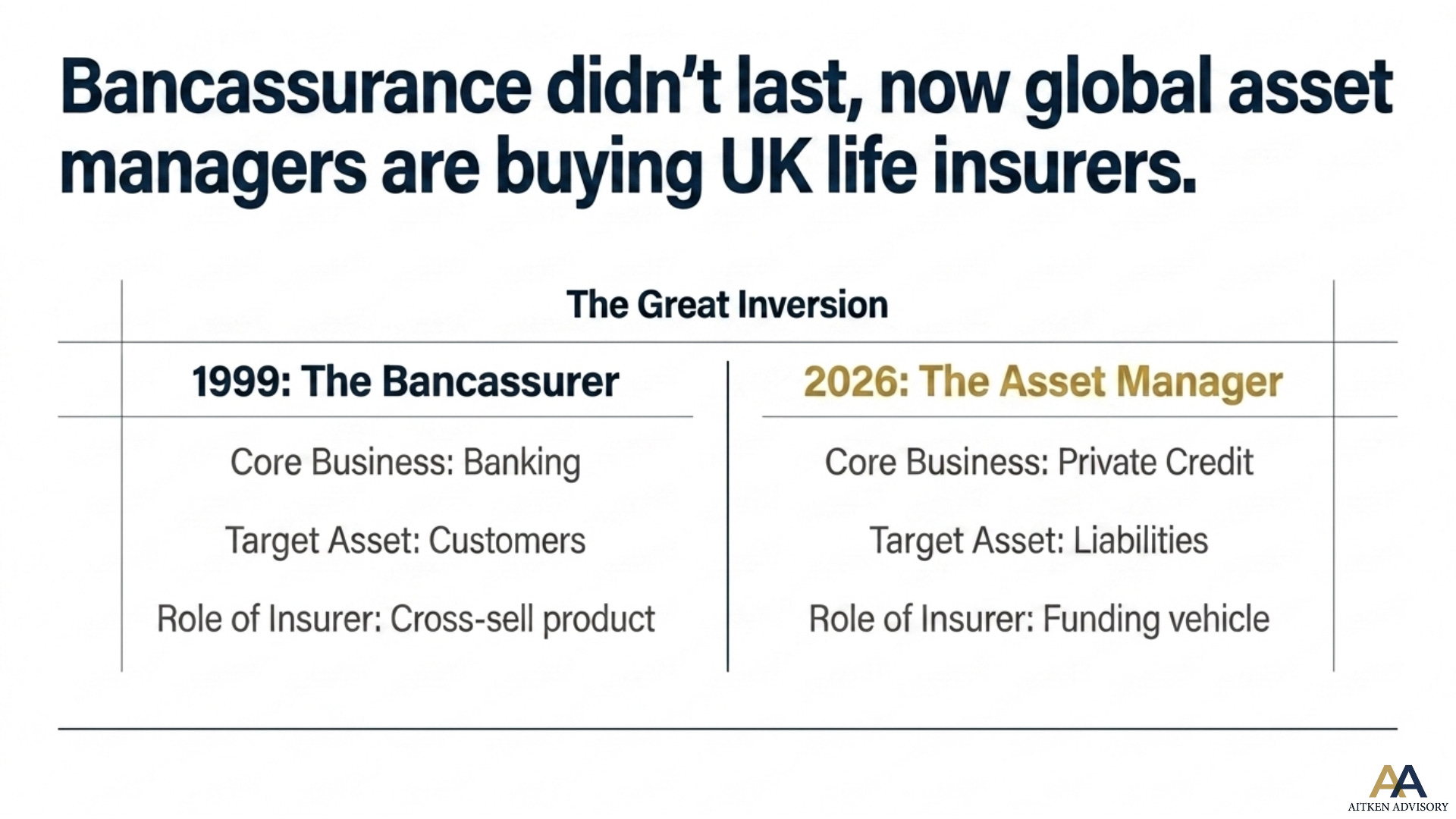
The high-water mark of the distribution thesis was the clearing bank that decided it should own a life insurer outright and cross-sell to its branch customers. NatWest’s agreed £10.75bn bid for L&G in 1999, at 210p a share, would have been the first takeover of a listed UK life insurer by a British clearing bank. Lloyds TSB had already taken Scottish Widows. The logic was that a bank with millions of current-account holders could shift pensions and protection through the same network.
It did not really work, and the banks worked out why fairly quickly. They did not need to own an insurer, with all the capital and balance-sheet risk that involved, to earn from selling insurance to their customers. They could simply strike a distribution agreement and take a commission, leaving the manufacturing and the risk with someone else. I recall L&G’s long-running tie-up with Barclays was exactly that, a commission arrangement rather than ownership. As for the cross-sell that justified the premium prices, I have heard management teams talk it up for at least 25 years, and it has never genuinely materialised. The 1999 buyer wanted the customers. Nobody serious is bidding for UK life today to cross-sell current accounts.
Running alongside the banks, a different buyer turned up through the 1990s and 2000s: the big Continental insurer that decided the UK was a growth market worth owning. Aegon, the Dutch group, took a 40% stake in Scottish Equitable in 1994 and moved to full ownership by 1998, building a UK platform of several million customers. AXA of France assembled a substantial UK life and pensions business. Zurich owned Allied Dunbar, Eagle Star and Threadneedle. The Swiss came too, though Swiss Re’s ReAssure, built from Zurich’s book, L&G’s with-profits and others, was really a closed-book consolidation play rather than a growth bet.
What unites them is how the story ended. Within a decade or two most concluded the UK was mature and low-growth next to Asia and the US, and retreated. Aegon sold its annuity book to Rothesay and L&G and its protection book to Royal London, and in 2026 agreed to sell the rest of its UK business, the old Scottish Equitable, to Standard Life for £2bn, as it concentrated on the US under the Transamerica name. AXA sold its UK life arm to Resolution for around £2.75bn, a French strategic handing the asset straight to the consolidator. Swiss Re sold ReAssure to Phoenix. The European buyer came for growth and left when the growth thesis broke, and in leaving they fed the very consolidators who made up the next era.
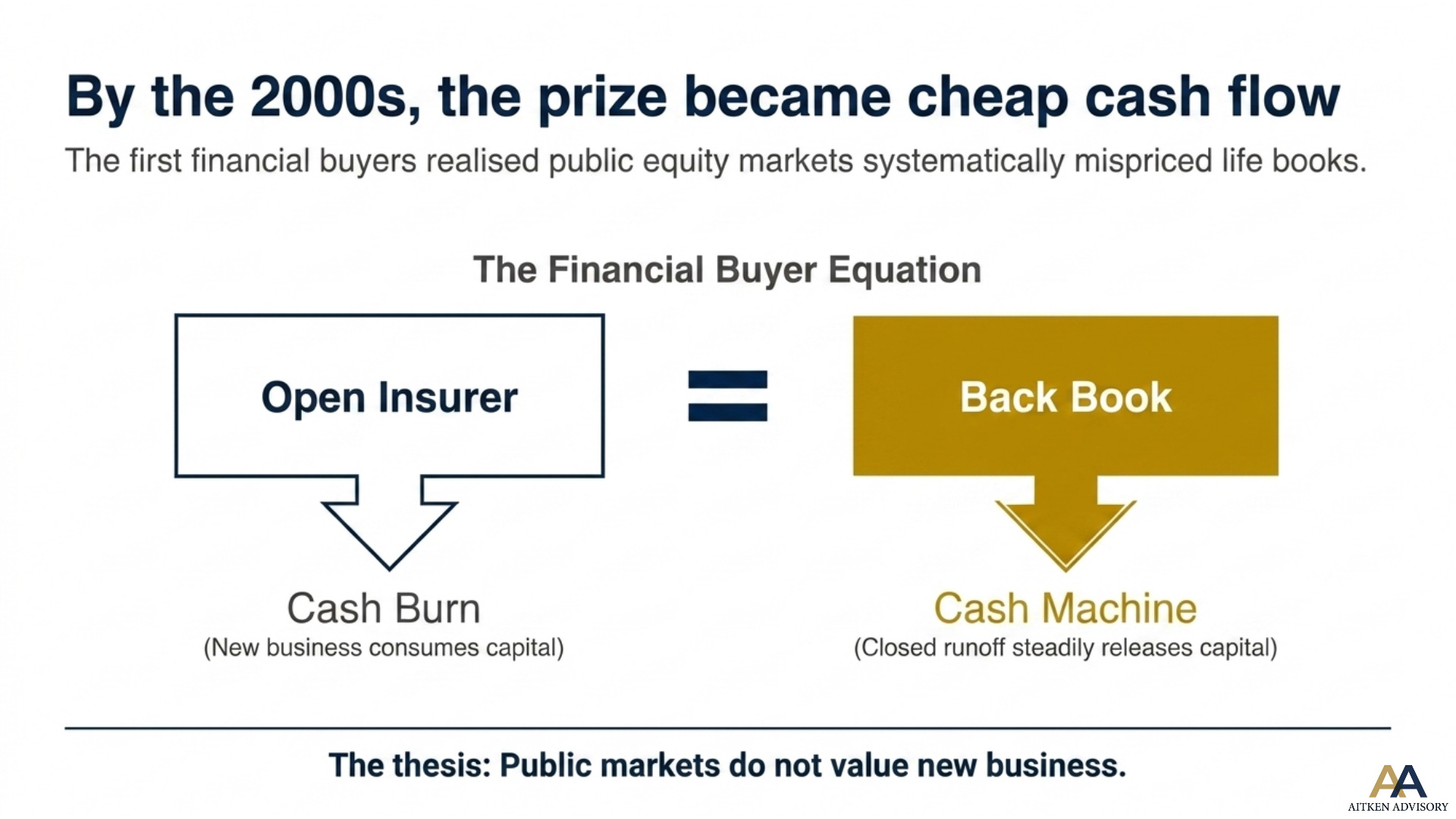
The next buyer was not strategic at all. It was financial, and it arrived with a genuinely original insight. Clive Cowdery’s argument, when he launched Resolution in 2003, was that equity markets systematically misunderstood life insurance. He felt they disliked new business, because writing it consumed capital upfront and took years to pay back, which made open insurers look permanently hungry for cash. What the market undervalued was the back book: the closed block of existing policies that writes no new business and instead releases capital steadily as it runs off. New business burns cash; the back book generates it. If the market would sell you that run-off at a discount, you bought it.
Resolution rolled up the closed books of Royal & SunAlliance, Swiss Life, Britannic and Abbey National Life, buying the Royal & SunAlliance book at around 70% of embedded value, the present value of the future profits expected from the existing book. It was then bought, in 2008, by Pearl, the same Pearl and the same Hugh Osmond that I mentioned above had outflanked us at Standard Life. The deal I had lost on that analyst call was the foundation of what became Phoenix, the FTSE 100 consolidator, with Chesnara running a smaller version of the identical idea. What incumbents dismissed as non-core drag, the consolidators correctly saw as cash-rich businesses the market was underpricing. This is the conceptual ancestor of everything happening now: the realisation that a life book is a financial asset to be acquired at a discount, not a franchise to be operated for its brand.

I crossed paths with the same template again years later, on the other side of the table. By then I headed European Insurance Research at RBC, acting as broker to Friends Life when it was sold to Aviva in 2015. Friends Life was Cowdery’s second consolidator, the vehicle he had assembled out of Friends Provident, AXA’s UK life operations and Bupa’s protection arm after selling the first Resolution to Pearl. Having been outmanoeuvred by him at Standard Life, I was now helping to deliver his second creation into the hands of a listed composite, an insurer writing both life and general business. The cash machine had simply changed owners again.
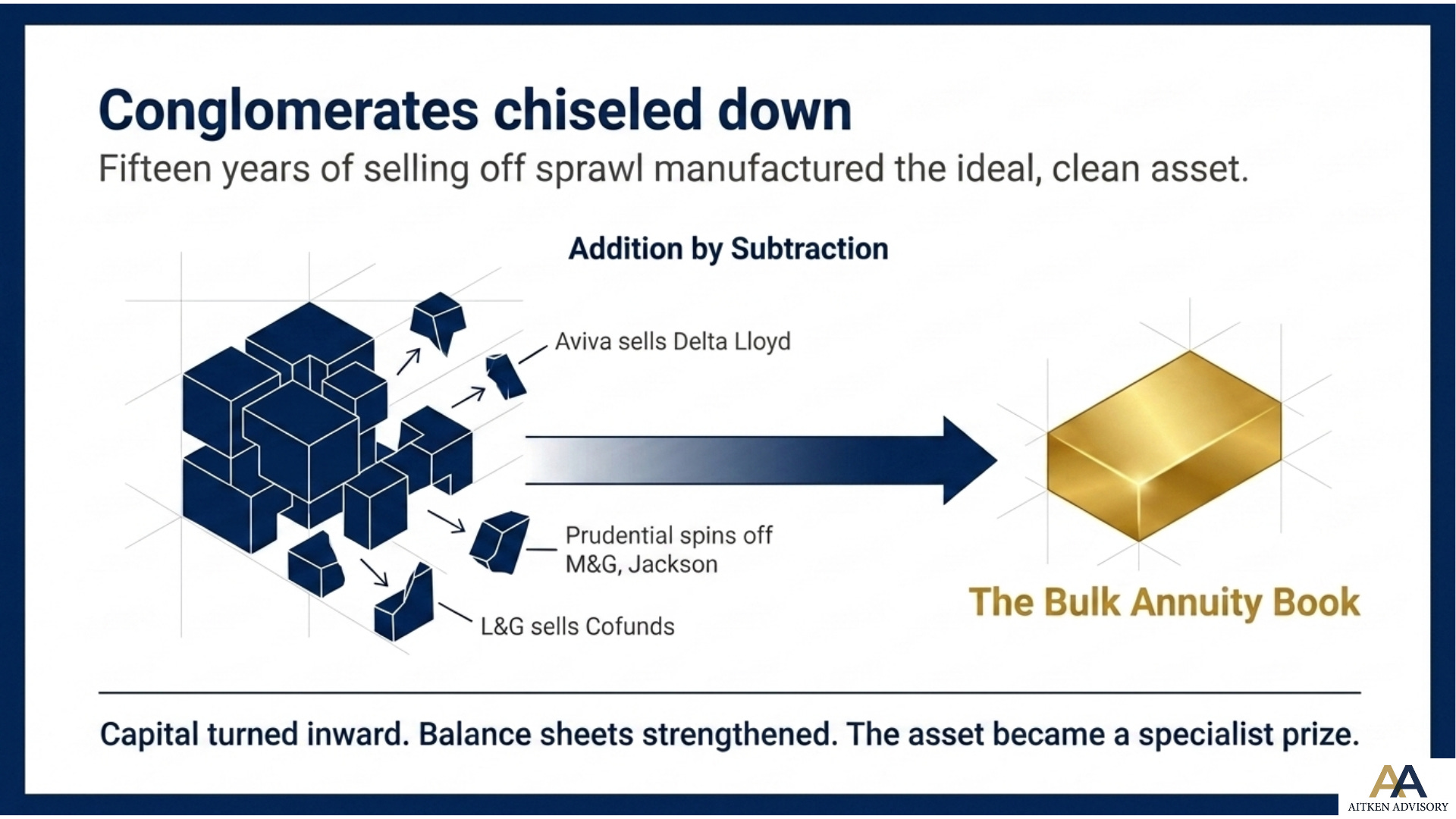
Then the direction of travel reversed, and stayed reversed for fifteen years. Having spent two decades buying everything, the listed insurers spent 2010 to 2025 selling. Aviva offloaded the RAC, exited the US and Delta Lloyd, and under Amanda Blanc from 2020 sold a string of overseas businesses, France, Italy, Spain, Poland, Singapore and more, to refocus on the UK, Ireland and Canada. Prudential demerged M&G in 2019 and spun off Jackson in 2021 to become an Asia pure-play. L&G sold general insurance and Cofunds. Standard Life sold its bank, its healthcare arm and its Canadian business, merged with Aberdeen, then sold its insurance arm to Phoenix and eventually the Standard Life name itself, which is why the consolidator completed its own rebrand to Standard Life in March 2026.
This was less an era of buyers than of sellers, but it matters because of what it left behind. Instead of buying, the survivors turned spare capital inward, paying down debt and returning cash, and their balance sheets got stronger and stronger across the period. By 2025 the UK had a handful of focused, simplified, well-capitalised survivors, L&G, Aviva, Phoenix and M&G, each doing a recognisable thing rather than everything at once. It also confirmed which part of the old conglomerate was the real prize. When the Pru sold £12bn of annuities to Rothesay in 2018, it signalled that the annuity book was a specialist asset best owned by people who could price long-duration credit. The annuity book, once a sideline within a diversified insurer, had become the asset specialists most wanted to own. The break-up era, in other words, manufactured exactly the cheap-but-strong businesses the next buyer would come looking for.
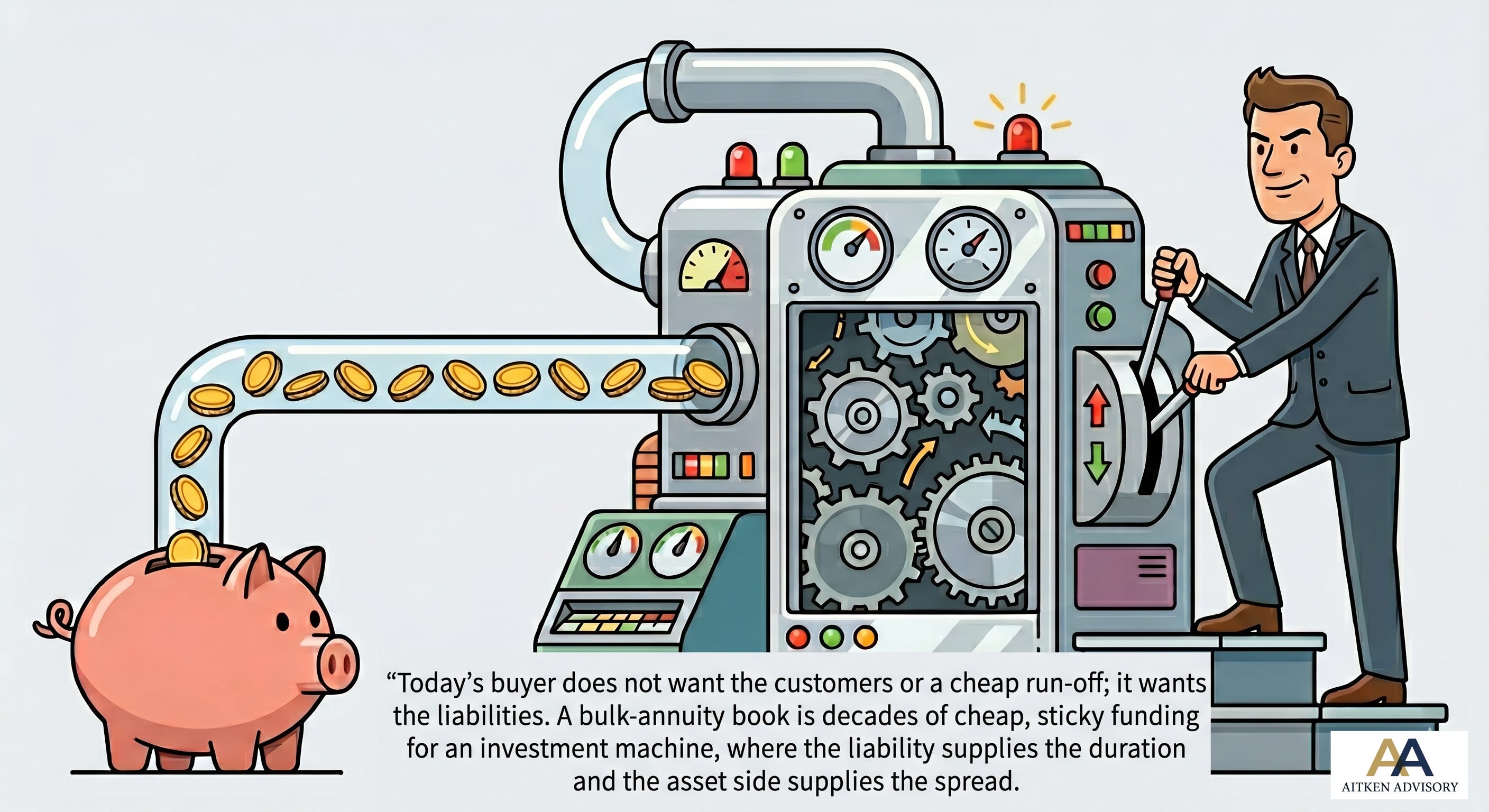
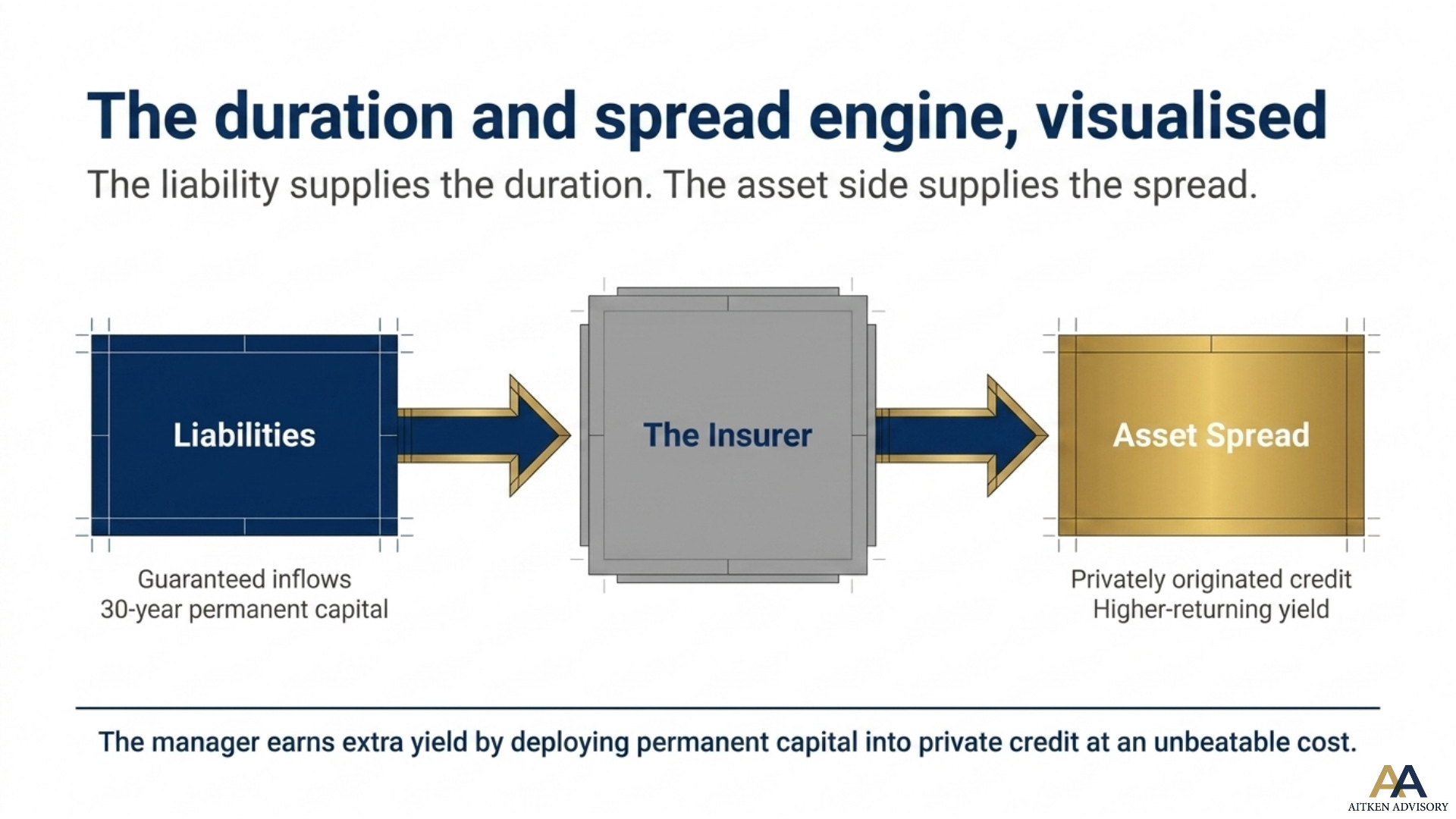
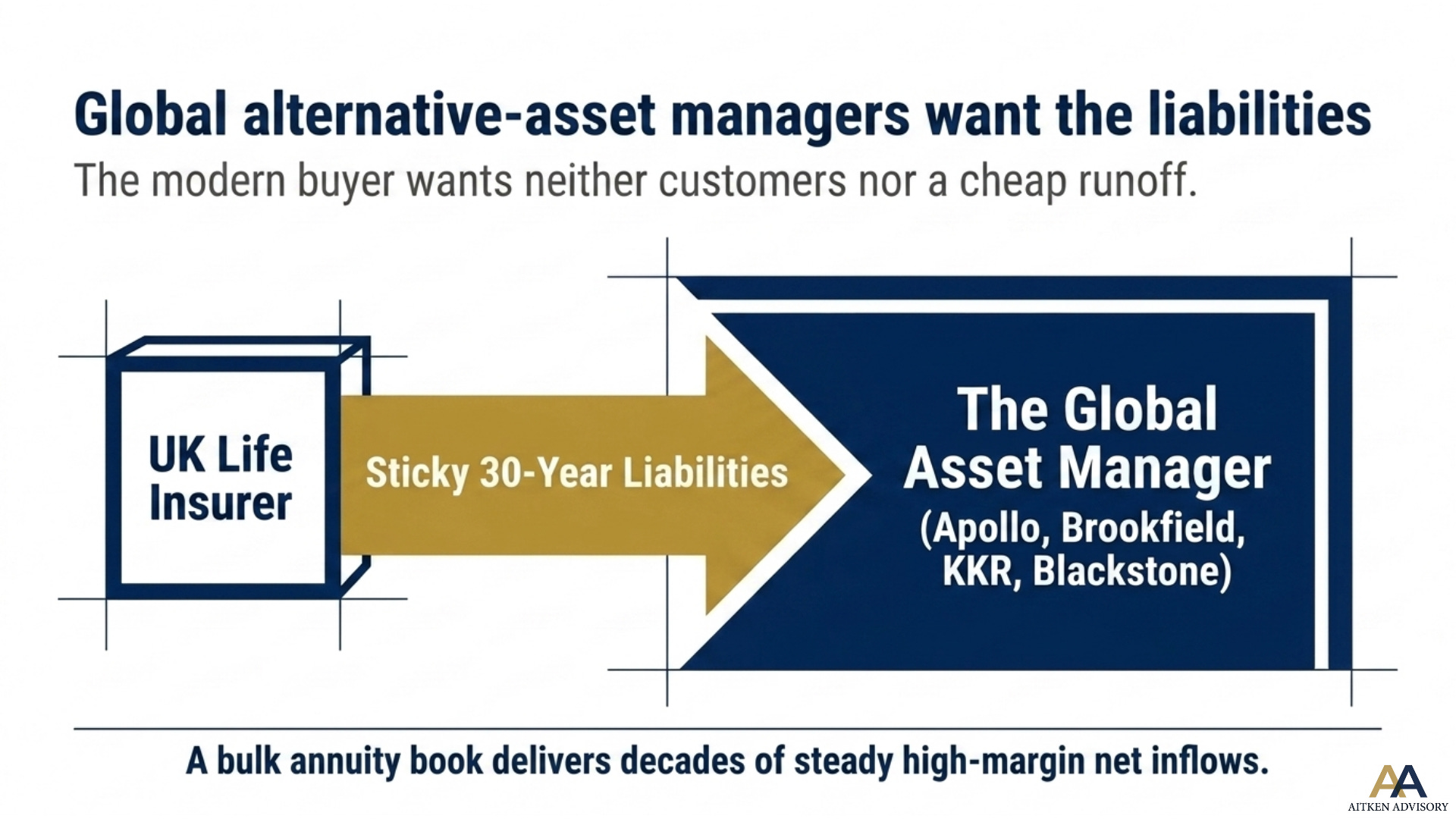
Which brings us to today’s buyer, and I believe to the single most important shift in the whole thirty-year story. The current acquirer is the global alternative-asset manager, and what it wants from a life insurer is neither the customers nor a cut-price run-off. It wants the liabilities, and it wants them for two reasons that work together. A bulk-annuity book delivers decades of guaranteed inflows, sticky, long-dated money that will not run off for 20 or 30 years and more, which is about the most valuable form of permanent, low-cost capital a manager can hold. It also lets the manager earn extra yield on the asset side, deploying that money into higher-returning, privately originated credit rather than plain gilts and corporate bonds. The liability supplies the duration; the asset side supplies the spread.
In the past eighteen months Apollo (through Athora), Brookfield, KKR (which built Global Atlantic between 2020 and 2024), Blackstone and CVC have all bid for, agreed, or been reported exploring UK or European annuity and spread assets. Athora’s completed purchase of PIC handed it a £54.8bn asset portfolio, around 45% of the enlarged group, and Athora intends to relocate its headquarters from Bermuda to the UK by late 2027. Brookfield acquired Just Group. The defining feature of every one of these deals is the same: the asset manager is the senior partner and the insurer is the asset-gathering vehicle.
This is very different to 1999. The bancassurer wanted a life insurer because of the customers attached to it. The alternative-asset manager wants one because the annuity book funds an investment machine for decades at a cost the manager can beat on the asset side. PIC’s liabilities give Apollo something to deploy its origination against. The insurance is almost incidental to the investment case; it is the funding leg. Understand that one shift and you understand why the buyer changed, and why I do not believe it will change back any time soon.
For L&G, Aviva, Standard Life and M&G, the arrival of private capital is not a threat to be feared so much as a re-rating catalyst hiding in plain sight, in my view. Three things follow:
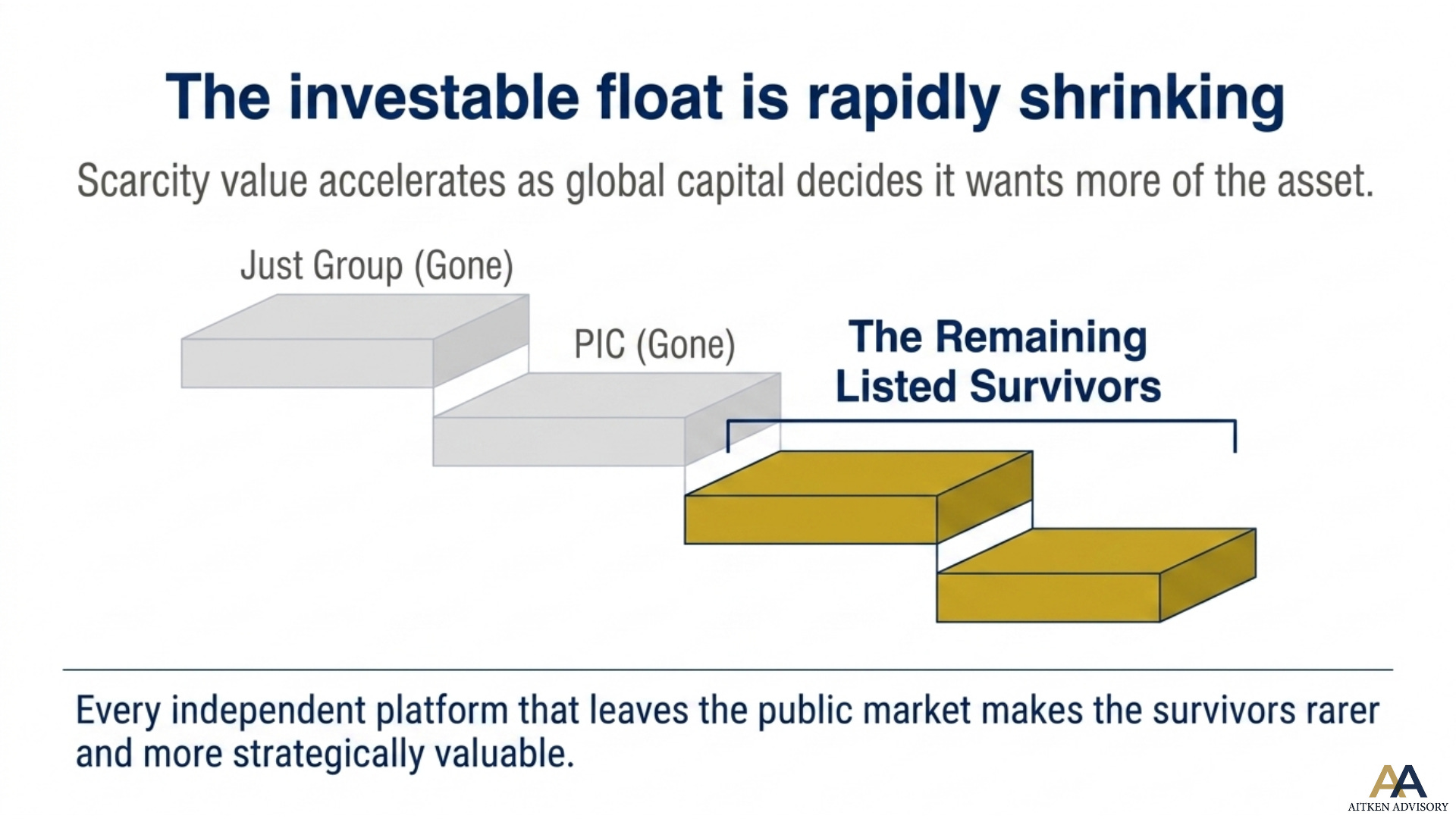
Scarcity value. Every PIC and every Just that leaves public markets makes the remaining listed bulk-annuity writers rarer and more strategically valuable. I do believe the investable float of UK life is shrinking just as global capital decides it wants more of the asset.
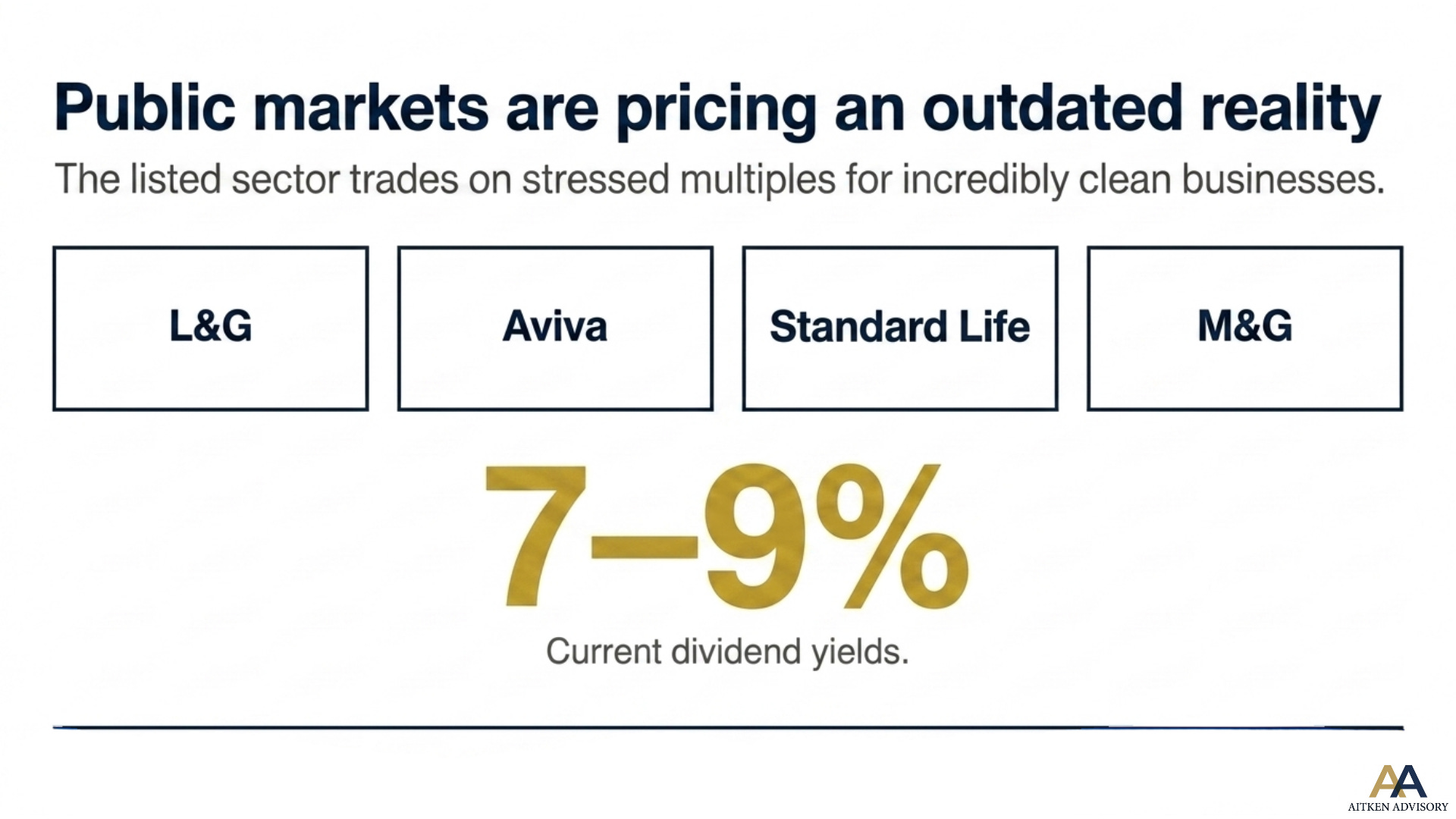
A demonstrated valuation floor. Private buyers are now proving in hard cash what these books are worth: PIC at £5.7bn, Just at £2.4bn. I argued in August that the listed sector was trading on distressed-era multiples, 7-9% dividend yields, 7-11x forward earnings and low price-to-book multiples, that bore no relation to how clean and predictable these businesses had become. The private bids are the market finally putting a number on that gap. When a listed peer trades below the price a disciplined private buyer will pay in cash, that is an arbitrage the private buyers can see too, and I expect them to keep acting on it.
The bid is structural, not opportunistic. The FT talking about L&G as a target is not a one-off rumour but the same wave of global long-duration capital that has already taken PIC and Just, now looking at the largest remaining independent UK annuity and asset-management platform.
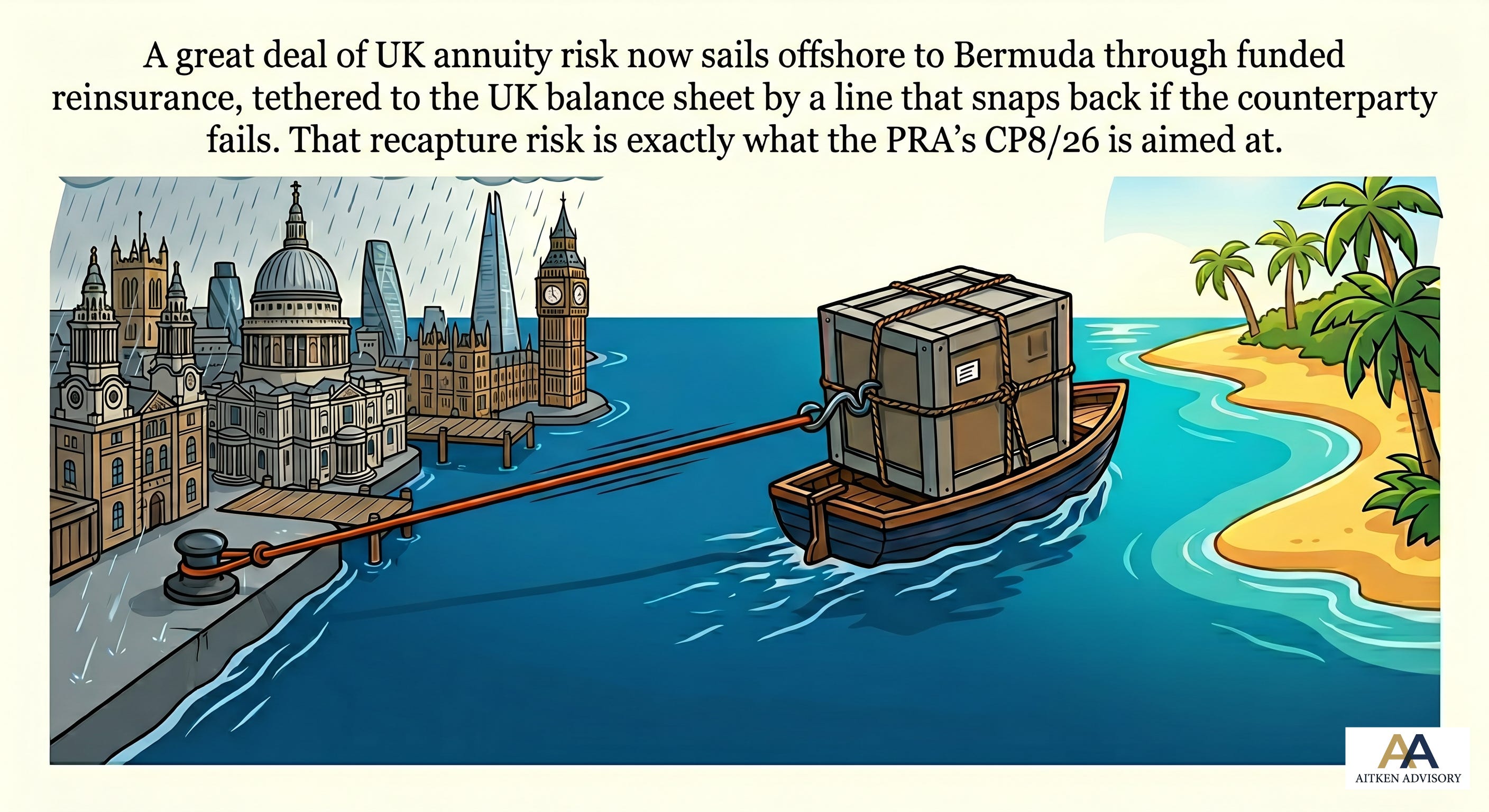
The newest owners do bring a newer risk, though it is not really about who holds the shares. It is about where the risk ends up sitting. A great deal of UK annuity risk is now ceded offshore, typically to Bermuda, through funded reinsurance, where an insurer hands both the assets and the liabilities of an annuity book to a reinsurer, and that is what the Prudential Regulation Authority (PRA) consultation, CP8/26 published on 29 April 2026, is aimed at. The ownership question is related, since the offshore reinsurer is often connected to the same global group, but the supervisory concern is the cross-border transfer itself: conflicts of interest, asset concentration and the risk of a reinsurance recapture landing back on the UK balance sheet if the offshore counterparty fails.
My own view, from years of watching the regulator operate at close quarters, is that the PRA is highly engaged and well-informed, not the informationally disadvantaged party it is sometimes painted as. The mechanics that worry the headline writers, the matching adjustment (the Solvency II rule that lets annuity writers book the extra yield on the assets backing their liabilities), collateral arrangements and recapture triggers, are considerably more resilient than the coverage implies.
I have been on the wrong end of this once already. In 2007 I watched a professional buyer pay up for a cashflow that the public market valued too cheaply, and that the firm I worked for had very nearly secured itself. That is the pattern running through all five eras: the public market has never quite believed what these businesses are worth, and someone with a longer horizon and a sharper pencil has repeatedly been willing to prove it wrong in cash. Banks did it, the Europeans did it, the consolidators did it, and the world’s largest asset managers are doing it now, and I expect they will keep doing it. PIC at £5.7bn and Just at £2.4bn are simply the latest proof.

The listed survivors that remain, L&G, Aviva, Standard Life and M&G, still trade on 7-9% dividend yields and low price-to-book ratios, valuations that say the public market continues not to believe it. I argued as much in August, and for years before that at RBC: the listed sector has been trading on stressed multiples that bear no relation to how strong, clean and predictable these businesses have become. I believe the public market is still mispricing these businesses, and that the private bids will keep proving it.
The professional buyers believe it, which is exactly why they keep turning up. My longstanding view is that the stocks are attractively priced, and being attractively priced is precisely what puts them in play. After thirty years of watching the professional buyer be proved right, I would think hard before betting against them this time either.
Gordon Aitken runs Aitken Advisory, providing strategic advice on UK and European life insurers and pension funds. I work with investors, insurers and advisers on transactions, capital strategy and market positioning. If you would like to discuss a potential engagement, click the button below to email me.
Want a deeper dive on UK life insurers, annuity balance sheets, and why markets often misprice them in stress? That is the core theme of my book, Breaking Down the Insurance Black Box.
Disclaimer
The content of this publication reflects my personal views only and is provided for information purposes. It does not constitute investment advice or investment research, and I am not acting in the capacity of an investment adviser. I own shares in some of the companies mentioned. Readers should carry out their own analysis or seek professional advice before making any financial decisions.
If you found this post helpful, feel free to share it with colleagues or subscribe for future updates on UK life insurers and pension funds
No posts
Comments
Nothing yet. Say the first thing.
Sign in to join the conversation.