
One of those weeks full of news croutons: plenty to chew on, nothing quite substantial enough to focus on in particular and leave you fully satisfied. So I thought I’d try something I’ve been meaning to do for some time: a weekend notebook post, pulling together the different strands of the week. If it’s a format you like, let me know in the comments and I can do it more often (or not).
⸻
Why is America trying to send one of its most distinguished doctors to prison?
Little better encapsulates the disintegration of American political institutions than the spectacle of Tony Fauci, the former head of the CDC, being dragged before a Senate committee stacked with Republican senators, determined to trip the octogenarian former official into perjury or contempt of Congress. Consequently, he pleaded the Fifth to every question, including such probing enquiries as to the day of the week and the colour of his tie.
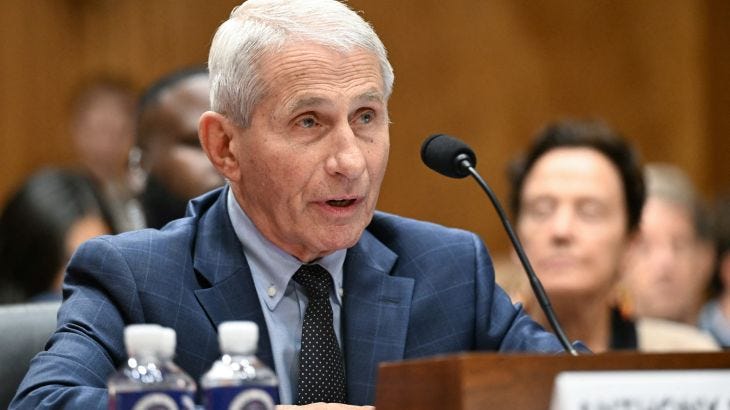
Rand Paul, Fauci’s long-time bête noire and a doctor himself, has led the charge against the ageing physician, at times apparently obsessed. As part of his efforts, he has—by means which remain unclear—obtained and published 1,100 pages of Fauci’s diaries from the pandemic period.
These diaries are embarrassing. They contain a rolodex of celebrity contacts (“Barbara [Streisand] called me on my cell phone today and she asked me questions about her booster shot. It is always good to hear from her”). They paint a picture of a man enjoying his newfound fame a little too much at a time of national trauma. This has angered some, including ordinary Americans. But there is no smoking gun, certainly nothing to vindicate the wildest ideas promulgated by the most fevered minds in the Republican Party—for example, that he funnelled money to the coronavirus research lab in Wuhan to develop Covid-19. Fauci was far more likely to be found accepting bouquets of flowers from Julia Roberts than taking backhanders from the CCP.
But ultimately none of this is really about Fauci at all. He wasn’t put on trial for virology; he was put on trial for technocracy, or at least as a representative of technocracy. The way Fauci has been treated is an embodiment of American political failure, on every side.
The left’s mistake was to treat scientific expertise as infallible; the right’s was to treat scientific fallibility as proof of conspiracy. Even after legitimate questions about Covid emerged, including over the costs of lockdowns, on the liberal institutionalist left it became almost verboten to articulate them, for fear of feeding conspiracy. On the fevered radical right, meanwhile, to accept scientific good faith at all became a sign of feeble credulity. This logic led inevitably, to the absurd spectacle of Robert F. Kennedy Jr—a vaccine sceptic and AIDS denialist—being handed responsibility for American public health.
In other words, Fauci became the vessel into which America poured all its anxieties about power, expertise and trust. The left forgot that experts can be wrong and, even when they are right, that it is the realm of politics to balance harms: people were entitled to be angry that schools were closed and loved ones denied the chance to say goodbye, gradient of the curve or not. The right, meanwhile, forgot that experts can still be necessary—and that expertise is not malevolent by design. Fauci was less the cause of America’s divisions than their avatar: a scientist turned stand-in for a country that no longer knows whether to fear expertise or trust it. And which won’t likely decide, any time soon.
⸻
Andy Burnham continues to do something which almost unerringly eluded his predecessor: command the political conversation. His approval ratings now surpass anything Keir Starmer achieved, too. Meanwhile, Nigel Farage has gone from the most popular party leader in the country to the least popular in less than a year, just as he has absented himself from traditional broadcast news through the foolish kamikaze by-election he called in his own constituency.
It’s hard to know whether Burnham is making politics look easy or whether Starmer merely made it look impossible, but the result is the same. It turns out that a political leader with something to say—and the ability to say it—can make a real difference. Who knew?
Burnham’s social-care speech on Wednesday was a neat encapsulation of his politics. and skill. He had a deeply arresting line: that social care in England is as unjust as American healthcare. He’s right.
There was another American echo in the speech when he said he was willing to “spend whatever political capital I have” to fix the system, and that he “wouldn’t forgive” himself if he didn’t try. These were unconscious echoes of exactly what Barack Obama said about his attempt to reform American healthcare in 2009 and 2010.
But in the manner of his delivery, it wasn’t Obama whom Burnham reminded me of: it was Joe Biden. Both men are deep believers in the importance of emotion in politics, of emotional connection with voters, of being seen to feel their pain. For Biden, at his best, it was a potent political skill, a complement to his more professorial boss. There hasn’t been a British prime minister since Blair so comfortable with the politics of feeling. For Burnham, it may yet prove his greatest political asset.
⸻
That doesn’t mean he’s right about everything. His education proposals this week worry me.
The end of the Blairite higher-education era, the Daily Telegraph roared. Burnham is the latest politician to intone gravely that we must treat academic and technical qualifications equally. True enough. He is also merely the latest in a long line of politicians, Conservative and Labour alike, to suggest that too many young people are going to university.
There can be no doubt that Britain has a worsening NEET problem and too many degrees that fail to provide value for money. But this obsession with there being “too many graduates” is a peculiarly British preoccupation. No one in America thinks too many people go to college; it is still considered a universal aspiration and an ever more important one, as the knowledge economy deepens.
Instead, almost nobody in Britain seems willing to say something that is self-evidently true: the expansion of British higher education has been an enormous success and a tremendous social, political and economic force for good. Those who argue to the contrary are often graduates themselves, whose own degrees were paid for and who would almost certainly send their own children to university come what may.
The problem is not that higher education has failed as an engine of social mobility. It is that, for too long, it has been treated as the only engine. The curriculum is not the problem which is driving our NEET malaise; the weakness of local economies is. Any Labour administration should therefore tread very carefully before dismantling any part of the comprehensive educational settlement created by the Labour governments of the 1960s. Burnham’s proposals also misunderstand the multi-layered nature of the modern university, which in many cases is as likely to offer vocational courses as strictly academic ones.
In any case, let’s stop the obsession with STEM subjects and “practical” training. There is already too much snobbery in the assumption that working-class students are somehow less interested in the arts and humanities. And we’ve never needed those graduates more. In an age in which we are already outsourcing so much of our critical thinking to machines, and in which none of us can be entirely sure of the truth of what we see, where the world’s complexity is ever deepening, subjects like philosophy, history, political science, linguistics, classics and literature have rarely been more important. I’m sure our English graduate prime minister might agree.
⸻
Maybe these weren’t croutons after all. Proper bread rolls, in the end.
No posts
Comments
Nothing yet. Say the first thing.
Sign in to join the conversation.