
One of the laziest and most banal assumptions in British politics today is that Britain has become ungovernable. That there is, somehow, a crisis of politics- that the political/media system has become addicted to the “doomscrolling” of prime ministers- that Andy Burnham’s ascension, first to parliament and then the premiership, is proof positive of our slow conversion to 1980s Italy, with worse weather and more boring sex.
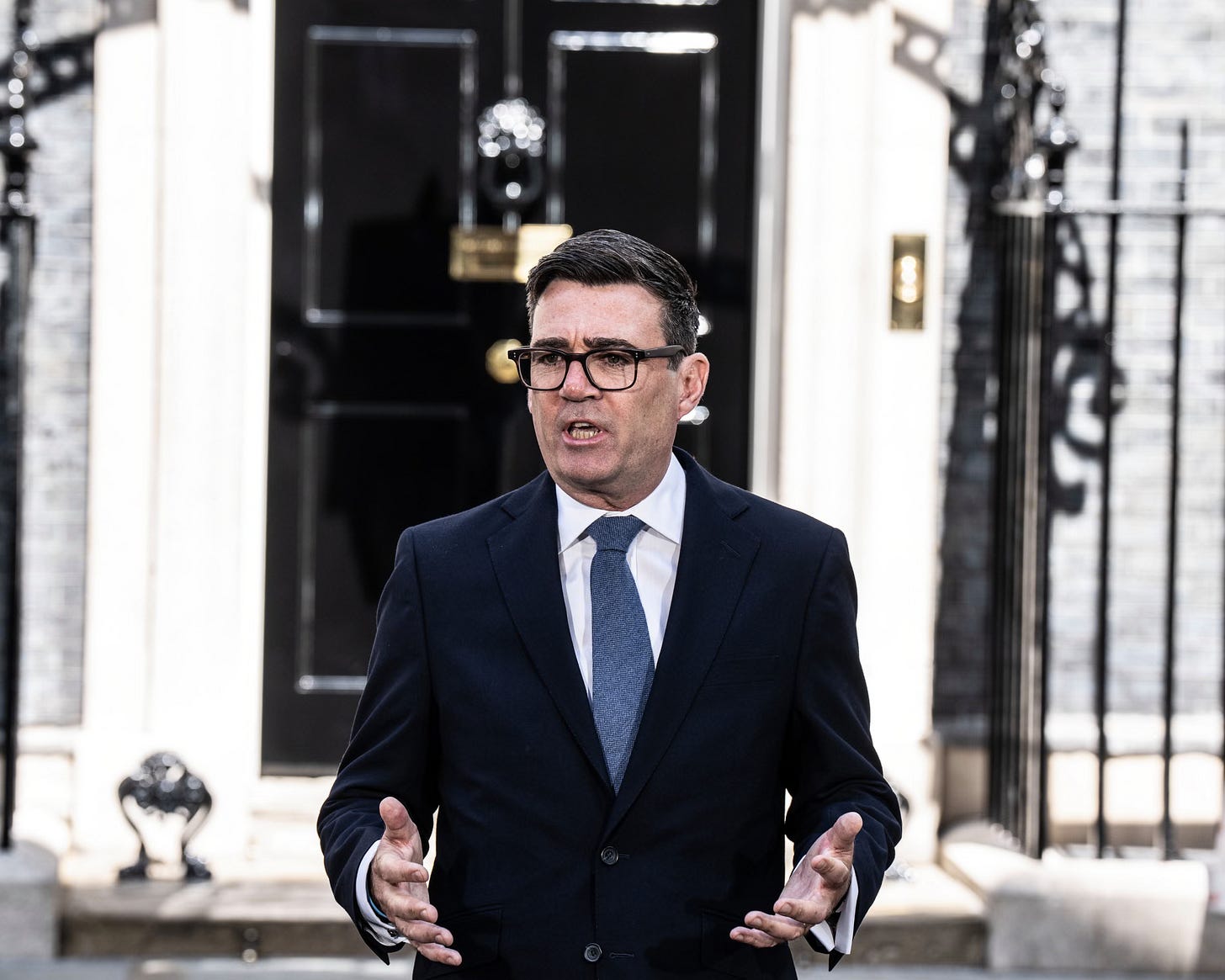
Burnham himself acknowledged the churn shortly after becoming prime minister today, saying he was “acutely aware” that he was the seventh person to be walking down the No 10 gauntlet in ten years. There are structural factors which have undoubtedly made governing harder and which make the ungovernability thesis superficially attractive. Some touch every Western polity: principally the end of the peace dividend and rise of Great Power politics, and likewise media fragmentation, the rise of big tech and post 2008 stagnation. Some are peculiarly British, the on-going Brexit realigment, collapsing party identification and their replacement with Leave/Remain cultural tribes making party coalitions more malleable and unstable. Similarly there has been a media/political addiction to drama, which at the edges has made British political instability worse.
Governing then has doubtless become harder- but it has happened at precisely the moment the quality of our political leadership has collapsed. Those who believe that there is something structurally wrong with British politics must answer the question: which of the sextuplet of premiers would we have saved from the chop? Cameron had to go, his authority was completely extinguished after the referendum result. May botched an election and never recovered. Should Truss or Johnson have stayed in office, despite their complete moral and political implosion? Sunak’s services were dispensed with by the electorate. Starmer was ill-suited to the job- not actually enjoying anything about politics. There’s just as strong an argument to say the problems of British politics are deeply contingent on the political decisions of the recent politicians which have led it. Consider an alternative universe where May chose to wait until 2019 to call an election, with an “oven ready” Brexit deal, as Johnson could go to the country with: she might still be prime minister now. If one decision could set in place a chain of events, and prime ministers, which lead us to this moment, that isn’t terribly structural.
Indeed, I would argue that the political system is doing precisely what it should do: dispatch poor prime ministers with ease and speed. Thankfully we are not burdened with a presidential system, which locks weak, incompetent, nefarious or corrupt leaders in place for set term limits. Rather, the problem is that we replace duff leaders with another. When was the last time we had a prime minister with a genuinely programmatic set of beliefs and plan to execute them? The fact that the best answer is some two decades ago, tells us much about our recent problems.
That is not to say that there aren’t problems with the British state- which has been hollowed out- at a time when expectations from the electorate for what it might deliver are high. But it is to say that our system, in principle, should be more than well placed to match it. We have no real constitutional impediments, no separation of powers- the Commons is sovereign, everything- politically speaking- is up for grabs, so long as a majority can be reached. The problem has not purely been external constraint, it has been that the internal political means has not been found to will the ends, which ultimately comes down to the quality of political leadership.
The big unanswered question at the heart of the Burnham government then is whether he, unlike his immediate predecessors, can summon that leadership: whether he has a genuine theory of the state and political change, a Labour programme, rather than a reiteration of airy Labour values. In this, what was striking about Burnham’s words and tone outside Downing St, was not so much the break with Keir Starmer, but the similarities. Think back to 2024- Starmer shared, almost exactly, the Burnham diagnosis. He agreed that Britain required fundamental change, that it was broken, in almost every direction. He also said that Britain needed stability, that he wanted a politics which trod less heavily on our lives.
The difference was that Starmer had no real plan to actually realise these things, beyond his being prime minister. Labour must hope that Burnham has far deeper political reserves than that. But if he can drive substantial change, it will advert to other tensions at the heart of the new government. His signature theory of the state is that we are too centralised. True enough. But this is a prime minister who stood at No 10 and did not spare expectation. He is promising to turn the page on what he says has been a 40 year political and economic neoliberal settlement. He is promising reindustrialisation and growth in every post code. He is promising to transform the education system, to end rough sleeping- to affect a 10 year plan of national renewal. At this moment of rising expectation- of Labour’s last chance- is the answer to that to give power away, even to your political opponents, just at the moment he will be held accountable to affect the change? What if the cities, or regions or nations have a different agenda? And what if that agenda leads to profound inequalities? Viewed through this lens, it is no surprise that Labour, historically, viewed devolution with suspicion and eyed the merits of a strong central state. Burnham’s will to devolve will be tested early- because he wants the most activist state for decades while simultaneously weakening the centre that would have to deliver it.
And even if he can overcome that paradox, there’s a greater one still. Burnham says he wants transformational political and economic change. Fair enough- it is needed. But he must do so within the stifling confines of the 2024 Labour manifesto- which deliberately, ming vase aloft, promised little. As time goes on, he will strain ever harder on that leash. The way to overcome it, is to cut the cord. Eventually he faces a choice: govern timidly under another man's mandate or seek one of his own. If he is serious about the scale of change he describes, to prove that Britain is far from ungovernable. that choice is unlikely to remain theoretical for long.
No posts
Comments
Nothing yet. Say the first thing.
Sign in to join the conversation.