
We are in the era of the by-election as political bludgeon. Labour, spectacularly, used a by-election in Makerfield to affect a frame-by-frame coup against its own prime minister. Nigel Farage now hopes to use one to create his own political absolution over his financial conduct.
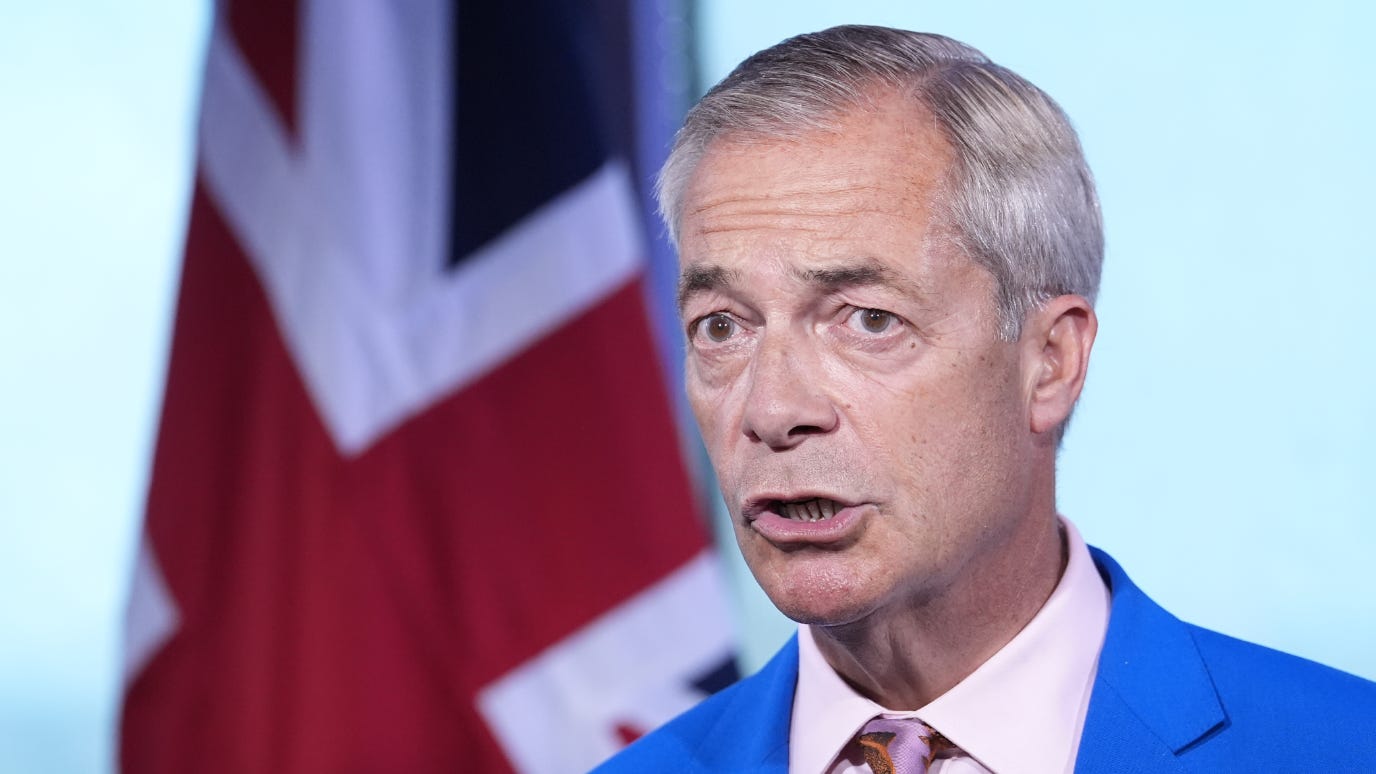
Why has he done it? As ever, with Farage, one need only look to the United States and the MAGA court. The 2024 presidential election turned the American electorate into a de facto jury. It absolved Donald Trump, in the eyes of his supporters, of his crimes. Farage will hope that the Clacton by-election does the same. As he said in his announcement, “this will be a people versus the establishment election.” Plus ça change.
There are several problems with this strategy, beyond its repetitiveness. The first is that by-elections are inherently unpredictable. There are broadly three types of self-imposed by-election. One where the electorate understands the theory of the case and gives the endorsement you ask for (Makerfield, 2026). One where the issue is quite abstract but the electorate endorses it with a shrug of the shoulders, and, as a result, little changes (David Davis and Haltemprice and Howden, 2008). And a third, where the electorate actively rejects the premise and the contest becomes about something else entirely. Worse where a different sort of candidate stands and upends everything.
The danger for Farage is that even if it is option A, little is solved in a practical sense. Clacton may endorse him again, but the second they do, the parliamentary authorities will resume their investigations. This may prompt the absurdity of a second by-election. Some of the energy may be drained from the story if Clacton returns him, and some reporters will inevitably be distracted. But the most dogged will interpret this potentially rash act as a clear signal that the story has much further to run, and will keep pressing. It is hard, even for a politician of Farage’s skill, to call a by-election over a specific question and then say you intend to answer no questions about it.
Which means there is something deeper happening. This is a move born of weakness, coated in the Faragiste insolence of strength. As I wrote over a year ago, Reform—without deep political roots—is a party that requires constant forward momentum to sustain itself. In a five-year Parliament, they have peaked far too early. The media is already tiring of their success. It is now looking for cracks. There is also a new shiny kid in town, talking (authentically) about taking on Westminster: Andy Burnham. Farage, too, appears to be losing the battle for the hearts of some of the traditionally Tory-supporting newspapers, which seem to be yearning for a Conservative revival under Badenoch. It is notable that quite a few of these financial stories have appeared in the Murdoch press, which until recently was flirting with the idea of a Farage premiership. Restore too is waiting in the wings, as is Jenrick from within. Farage will hope that this by-election will make the papers look at him anew, will keep the attention just as Burnham moves into No 10- but it is just as likely they tire all the quicker. If that does happen, the broadcasters will follow suit.
You can never underestimate Farage. He is canny. He has some of the sharpest political instincts of any British politician of the last 30 years and has become one of the most influential. But this is a man who, doused in not inconsiderable self-pity and self-regard, is increasingly giving in to his worst, rather than his best, political instincts. This is a bold move, but I wonder if it marks the opening of a long denouement in British politics, rather than the beginning of a march towards the premiership or anything like it. In which case, we may still have that Reform leadership contest sooner rather than later—which, without his magic adhesive binding them together, would threaten to descend into a new edition of Fifty Shades of Hard Right. Farage hopes Clacton will acquit him. But political juries are unlike legal ones. Their verdicts are rarely final. Sometimes they simply mark the beginning of a much longer trial- one, I’m still not convinced Farage truly wishes to fight.
No posts
Comments
Nothing yet. Say the first thing.
Sign in to join the conversation.