The macro is mixed. Short-term real yields support Gold, while rising long-term yields are working against it.
Week Type:RANGE Dealer hedging keeps pulling price back toward max pain into Friday. Moves may pick up after that.
Position Size: HALF Payrolls is the first real catalyst. Until then, preserve capital and trade selectively.
The Fed left rates unchanged at 3.50% to 3.75% on Wednesday with three officials pushing for a quarter-point hike.
But that’s not the strange part.
Before the meeting, futures markets put the chance of a July hike at about 1 in 3. If the Fed stayed on hold, traders saw roughly an 81% chance of a hike in September.
Warsh then delivered hawkish comments - doubled down on keeping inflation under control and gave markets little reason to expect an easier Fed. September hike odds fell to ~57% right after that.
When the three dissenters, Hammack, Kashkari, and Logan published separate explanations for their hawkish votes later on Friday, September hike odds climbed back to roughly 65% to 67%.
The market seemed to believe the three regional bank presidents more than the the Fed chair.
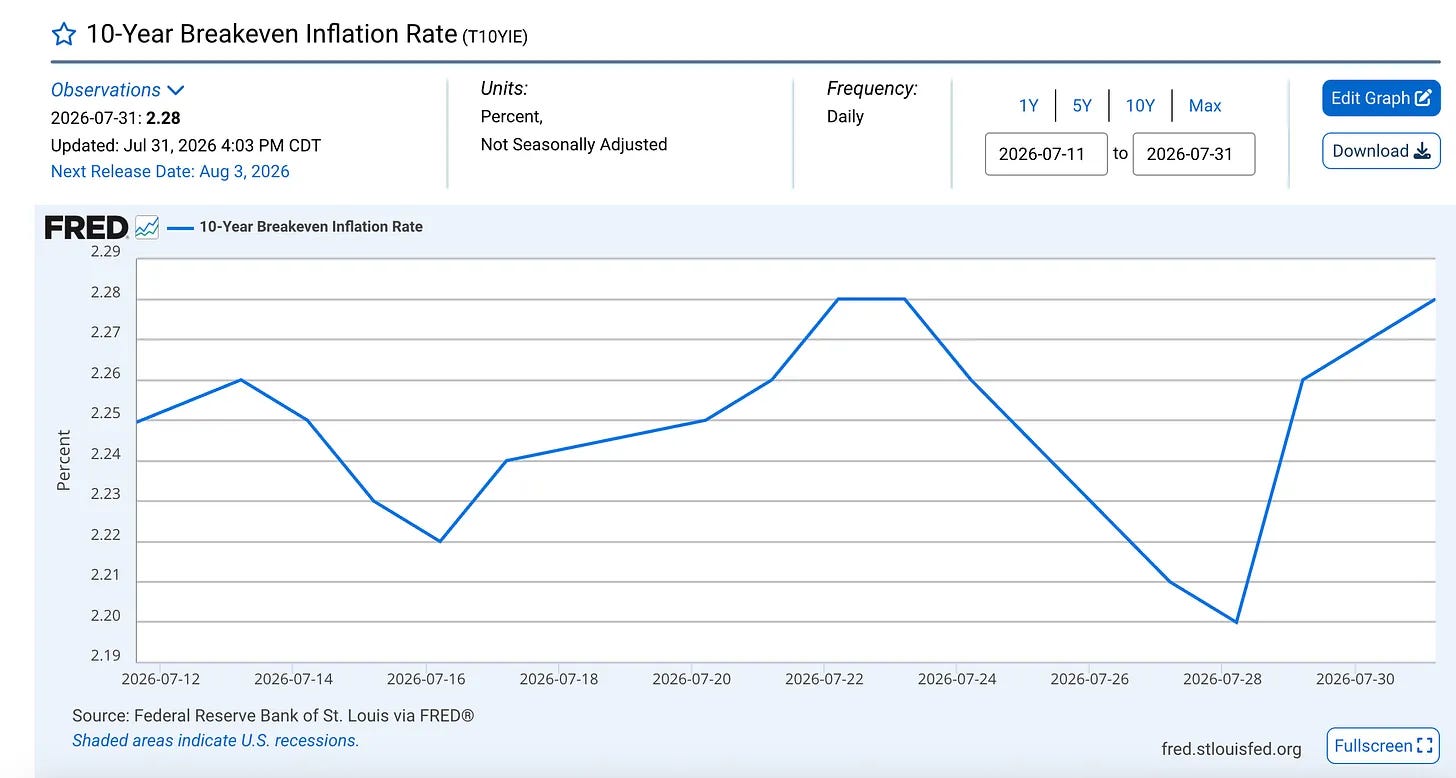
The 10-year breakeven hit a monthly low of 2.20% on Tuesday. By Friday, it had climbed to 2.28%.
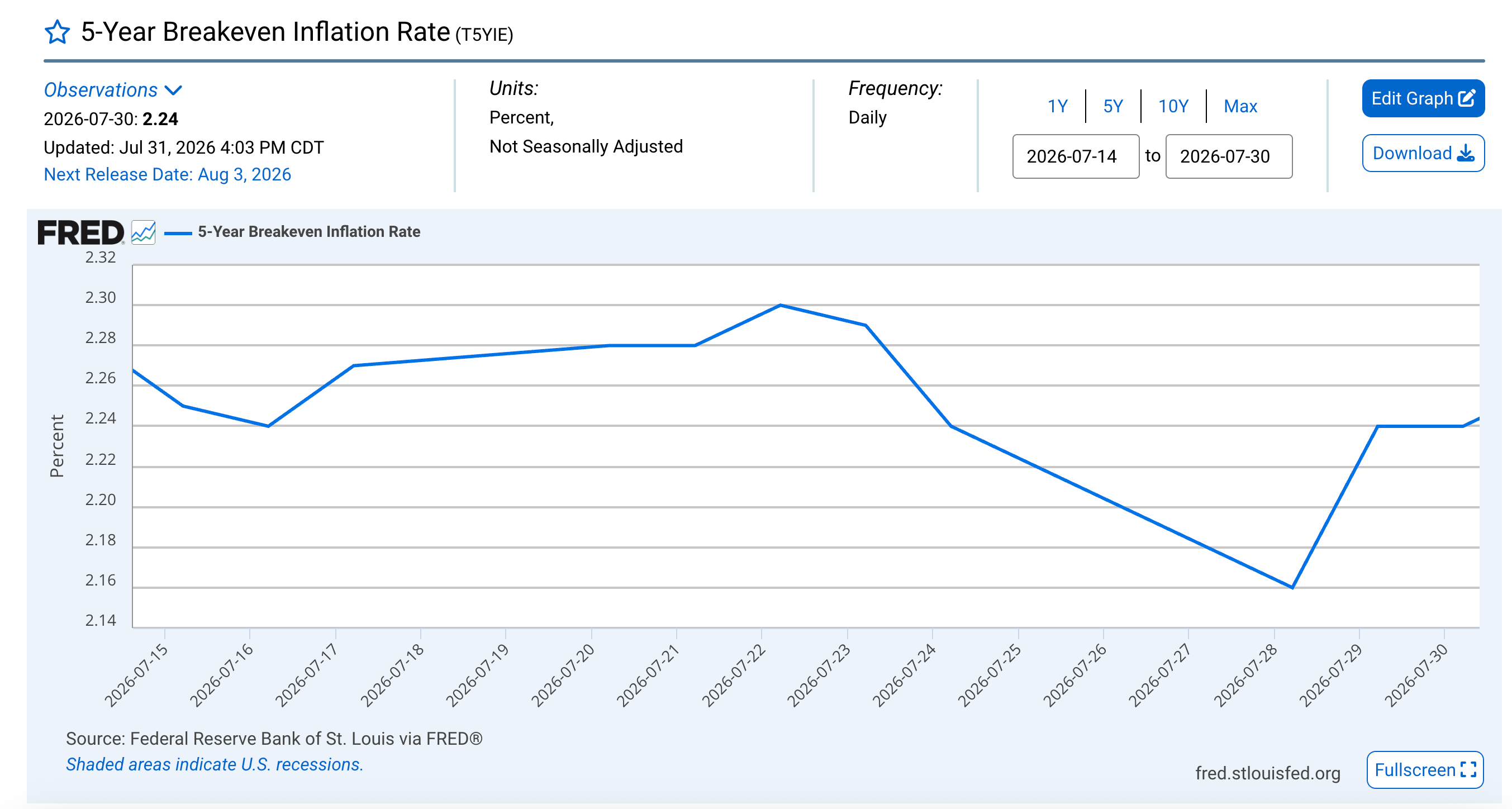
The 5-year moved even more, rising from 2.16% to 2.26%. Most of that jump happened right after the Fed meeting.
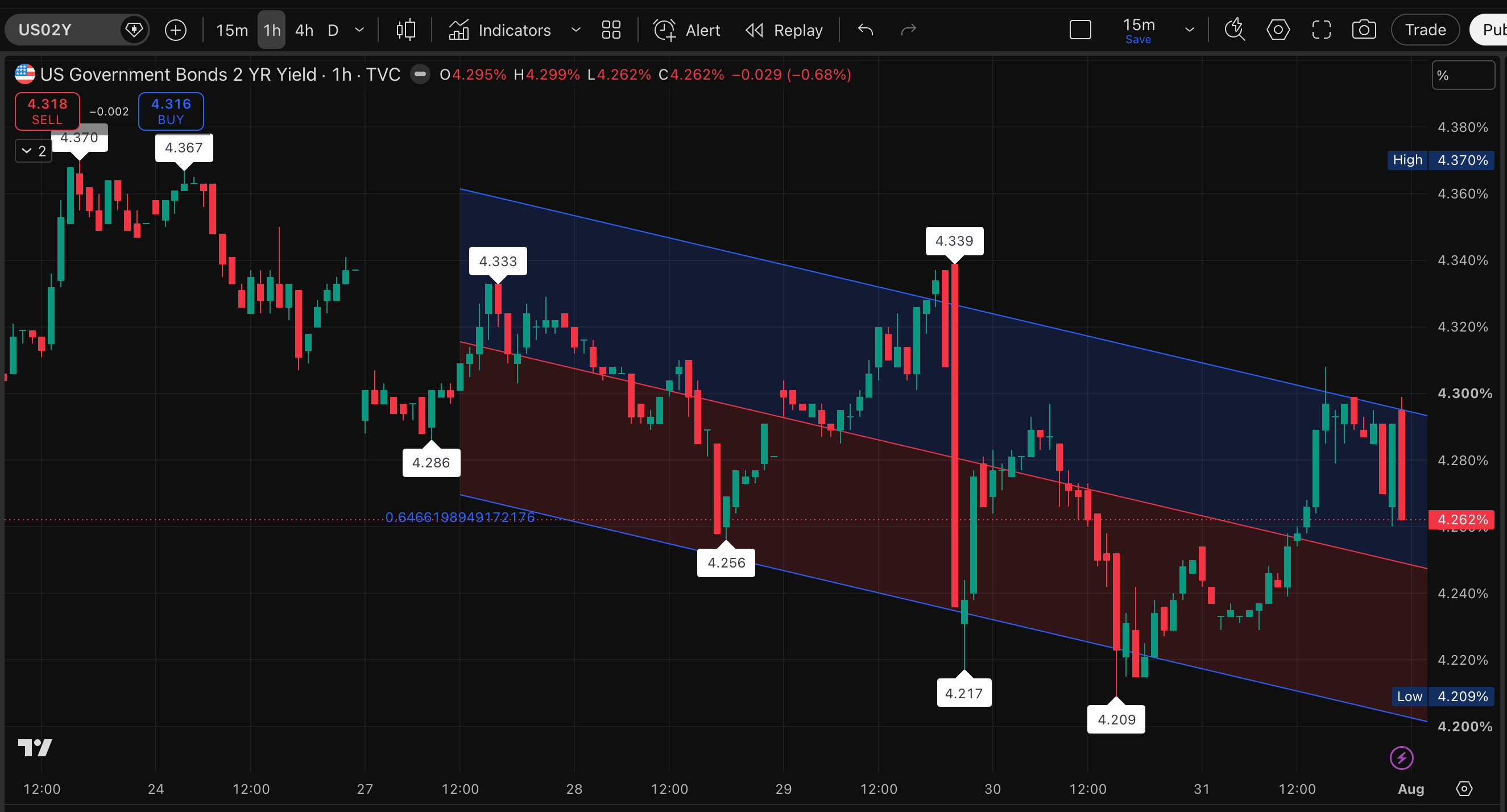
At the same time, the two-year Treasury yield moved the other way - it fell from about 4.34% before the decision to ~4.26% by the end of the week.
This unusual combination of a little more inflation and a little less tightening lowers the real yield. Over just three days, that cost dropped by roughly 20 basis points. For context, one basis point is one hundredth of a percentage point.
This is an interesting development. Because for months, the Fed has been able to tighten financial conditions just by talkingtough.
Talking costs nothing. Raising rates eventually invite the question of when the cycle ends.
This week, though, the talking tactic stopped working. Warsh delivered some of his toughest inflation comments yet, and instead of pushing markets toward higher rate expectations, traders moved the other way.
Some rates strategists said the main reason the talking didn’t do it's job this time was because Warsh named a problem, yet offered no strategy for solving it beyond asking to be trusted.
Alberto Musalem of the St Louis Fed also went out of his way to deny that the Fed is outsourcing policy to markets, saying Congress gave the responsibility for price stability to the FOMC and not to markets. People generally don't deny an accusation until they think someone might believe it.
Warsh was asked how he thinks about policy.
He said that when the labour market is roughly in equilibrium and underlying inflation is moving higher, a central banker is more likely to tighten.
And when the labour market is roughly in equilibrium and underlying inflation is falling, a central banker is more likely to loosen policy.
He finished by saying, "That's my reaction function."
In his view, the labour market is more or less in equilibrium, so one of those conditions is already in place. The next morning, the inflation data moved the second condition a little closer. Core PCE edged down from 3.4% to 3.3%. On a monthly basis it slowed to 0.1% after running at 0.3% in May.
For Gold, the important change is that the market now has a roadmap. The bullish case has never depended on the Fed cutting rates next month. It mostly depends on investors gradually deciding that the next move after this pause is more likely to be down than up.
Until this week, Warsh hadn’t really described when to expect cuts. But if core PCE stays soft through August and September while energy prices settle down, don’t be surprised if traders start quoting his own reaction function back to him.
The Bank of England published new forecasts on Thursday showing inflation climbing to 3.2% later this year and staying above its 2% target until early 2028. Those forecasts assume the BoE raises rates once late this year and again in 2027.
Most economists surveyed by Reuters don’t think either hike will happen.
Governor Andrew Bailey tried to explain the gap. He said markets are pricing the possibility of another hike because of the risk that the Iran war escalates, not because investors think the Bank needs tighter policy to deal with domestic inflation.
A similar moment played out in Japan.
Kazuo Ueda said he would make sure the Bank of Japan does not fall behind the curve. It's the kind of reassurance you give after people start wondering whether you're already behind.
On paper, this should have been a good week for Gold.
Real yields fell. Markets became less convinced the Fed could keep talking tough without eventually disappointing investors. Yet Gold opened the week ~$4,090 and finished closer to $4,045.
There are three reasonable explanations of what happened.
The first is that traders care more about long-term interest rates than short-term ones right now.
The 30-year Treasury yield climbed above 5.20% on Wednesday, its highest level since 2007, and kept rising into Friday. If investors are taking their cues from the long end of the curve, falling short-term real yields simply don't matter as much.
The second is that the market still thinks another rate hike is coming.
After Friday’s interviews with the Fed dissenters, September hike odds climbed back to roughly 65-67%.
Christopher Waller and Lisa Cook both voted to leave rates unchanged this week. Both also said they'd support another hike if inflation doesn't improve soon.
JPMorgan reached a similar conclusion after the meeting. The bank now predicts the next rate hike in December 2026, bringing its forecast forward from the second half of 2027.
If markets stop reacting to hawkish speeches, the Fed may eventually decide that speeches aren’t enough. The obvious alternative is action.
The third explanation is positioning.
Going into the meeting, traders were unusually split. About one-third expected a July rate hike, which Deutsche Bank called the most uncertain Fed decision since late 2018.
When the market is positioned that evenly, prices often take a while to settle. Hedges need to be unwound, and the first move after the event isn’t always the lasting one.
My guess is that the long end of the Treasury market is doing most of the work here. That’s where the evidence looks strongest, and it’s also the part of the market Gold has tracked most closely in recent weeks.
So that’s where we’ll look next.
This is where the free report ends...
You now know what’s moving Gold. The paid report is about what to do with that information.
Inside this week’s plan:
Every support and resistance zone on my chart
5 setup ideas with exact entries, stops, and profit targets I’m using
My capital protection plan with exact alerts when to reduce/cut my position
The interactive Trade Board: input the current price and it shows you which setups are live and which need extra confirmation.
One trade won’t make your year. A process you can repeat every week just might.
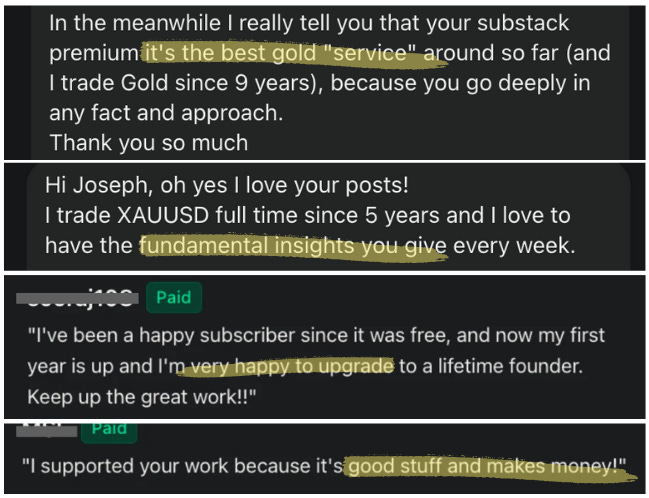
When you join premium, you also get:
My proprietary ‘Gold Spotter’ tradingView warning system: Imagine knowing 3–5 days before everyone else when Gold is about to reverse. This leading custom-built tool does just that.
Proprietary SAGE - a rule-based indicator designed to put you in high probability buy setups and keep you away from bad ones.
Mid-week level updates on Telegram - Markets change. Levels shift. When they do, you’ll know immediately.
This isn’t for everyone. I want traders who are serious about making money and feeding their families, just like me.
If that’s you, it’s time to stop guessing and start trading with a plan.



Comments
Nothing yet. Say the first thing.
Sign in to join the conversation.