
Hi! In an effort to provide more for paying subscribers, I’m going to aim for a monthly capsule review post moving forward. To that end I’ve written a few new pieces on recent readings and republished and expanded some otherwise unavailable early review blurbs.
This is one for the “I read this because of James Tussing” file. A penetrating and compelling examination of the role of religion in the formerly Latin west and secularization via a historical and phenomenological lens. Charles Taylor [who wrote the introduction to the (apparently not up to the snuff of the original French) English translation I read] clearly got quite a bit from Gauchet for his lengthy (and somewhat better known to me) 2007 study A Secular Age. I often felt while reading The Disenchantment that I was missing a bit of context for what Gauchet was saying, an impression confirmed by James afterwards.
The first part claims that if we look beyond the still existing Churches and the abiding faith, we will see that the religious has reached the end of its life in the modern world. The second part claims that the modern Western world’s radical originality lies wholly in its reincorporation, into the very heart of human relationships and activities, of the sacral ele-ment, which previously shaped this world from outside. Religion’s demise is not to be ascertained by declining belief, but by the extent of the human-social universe’s restructuring. Though this restructuring originated within religion, it escaped from and reversed its original religious orientation, and this reversal of the age-old organizing influence of the religious will be the book’s main focus.
The book investigates what beneath the Weber-citing title might more properly considered as a structural transition occurring within the Christian west from the time of the reformation on, although Gauchet, following a number of modern thinkers sees something like secularism as implied in Christianity from the beginning.
This short review was written for a now-defunct thought digest early in this blog’s existence and predates both a more substantial engagement with the canon of continental philosophy and my formal conversion to Christianity. As such there are some things that I would write differently and others that I might not write at all. It has been lightly edited but otherwise is presented as is.
The sex-negative radical feminist Andrea Dworkin has been somewhat of a bogeywoman for subsequent generations of feminist, enjoying a posthumous reputation as a kind of world-loathing, anti-sex gnostic who would rather Christian theocrats call the shots than have one (1) red-blooded straight man enjoy the blue light of a pornographic film. I plan on reading a selection of her major works, beginning with this one, published in 1974. I found it a brisk and heavy-hitting read, presenting some views that are I suspect correct and others I have some reservations about in an atmosphere of dour radicalism that one at times almost wants to mock until one remembers that things really were that bad when Dworkin was writing.
Rape is, in fact, simple straightforward heterosexual behavior in a male dominated society. It offends us when it does, which is rarely, only because it is male-female relations without sham-without the mystifying romance of the couple, without the civility of the money exchange. It happens in the home as well as on the streets. It is not a function of capitalism-it is a function of sexism.
This passage in particular struck me as not only in a sense true, but expressing an idea I’ve often had with regard to incels and PUA’s. These men perceive only the animal logic of the sexual transaction, extrapolating it into systems of economics or pseudoscience without any of the validating romance or mystique that we more well adjusted citizens use to sleep at night. I’ve always appreciated that about Dworkin, that willingness to acknowledge evil and the rottenness in the world and our relations in it, and I think she’s quite right that if one sees it, one really should do something to oppose it.
That said, there really isn’t much air to breathe in the book (again, I can’t be too harsh, things were that bad when it was written) and her theory of art is not mine. This is a common problem I have with a lot of mainstream second wave feminism, this view that art has no independent existence, is only ever propaganda justifying and reinforcing the dominant. Much of the early part of the book is about fairytales, which Dworkin thinks (probably with some grounds to do so) condition men and women’s expectations of the other gender and their place in the world. She seems overall to have a fairly low anthropology (in a psychic rather than metaphysical sense) viewing us seemingly as biological machines programmed by culture.
Take any aspect of behavior and one can find the source of the programmed response in the cultural structure. Western man’s obsessive concern with metaphysical and political freedom is almost laughable in this context.
Perhaps she’s right, but reading that I couldn’t help thinking to myself: “someone needs to read some Dostoevsky and Nietzsche” Dworkin would probably retort that those were men, and fair enough. She advocates for androgyny, which one may be for, but seems to see it as inextricably linked to an de-anthropocentric recognition of the human as just another animal, the human/nature binary being in her view nothing more than a greater instantiation of the male/female binary. She touches on some popular late 20th century ideas: namely that a more idyllic, balanced era of human history had been violently replaced by the squalid domination of patriarchal civilization at some point in the distant past. It was an interesting if somewhat dated and at times simplistic read, I may write more about it at a later date.
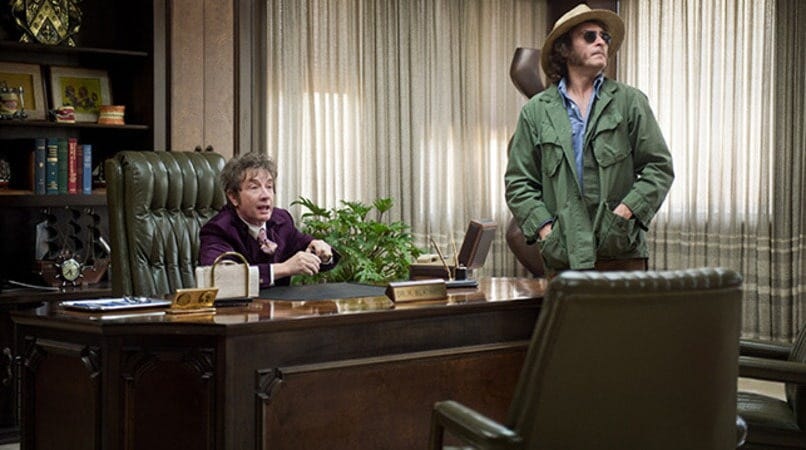
Paul Thomas Anderson’s first adaptation of a Thomas Pynchon novel is about as seamless a translation into the silver screen as one could possibly hope for.1 Inherent Vice trims the fat of the novel by quite a bit, and still winds up a bit indulgently stoned-seeming. Joanna Newsom’s narration as Madame Sortilège is a genuinely inspired touch that restores something like a feminine counterpoint to what is otherwise (as is true of most Pynchon) a very masculine story. Anderson teases out the minor-key quietism that flows through some of Pynchon’s late works, and which (I have still not seen OBAA) it sounds like he did not bring to his Vineland adaptation.
Comments
Nothing yet. Say the first thing.
Sign in to join the conversation.