
Then the Lord God said, “Behold, the man has become like one of us, knowing good and evil; and now, lest he put forth his hand and take also of the tree of life, and eat, and live for ever”— therefore the Lord God sent him forth from the garden of Eden, to till the ground from which he was taken. He drove out the man; and at the east of the garden of Eden he placed the cherubim, and a flaming sword which turned every way, to guard the way to the tree of life.1
In the original Hebrew, so I am told, it’s a just so story-how did the human get his brains, why childbirth hurts, why there is enmity between men and women, why we die. The cosmic morality play came later, with the deepening of what Karl Jaspers called the “axial age.” Hints of it wafted in with Platonism in the Hellenistic period, accumulating like sediment on the pages of the Septuagint, and perhaps wafted out back into into pagan Platonism later on, though that’s a topic for another day. The thinkers have always been troubled by the details. What does “like us” mean? Why does the creation happen twice? Why does God seem to have a body in a few passages? And on and on.
When I first began writing on this platform I did a great deal of blogging about posters on twitter and discourse that annoyed me, as though real life was my twitter feed. In particular, there was a kind of secular acknowledgment of sin that felt at once catastrophizing and unnecessarily letting the poster off the hook. There was a kind of moral neoteny at play here, or so I felt at the time, a way of denying oneself agency that felt fundamentally dishonest.
Once I wrote about this sort of thing with reference to the works of Grant Morrison, describing it as a way of remaining “helpless before the world,” but I didn’t really explain what exactly that meant or why I thought this tendency emerged. To the best of my abilities, I’ll try now. To be helpless before the world is to be clean of sin, to be clean of ever having to know or care that even if only on the most infinitesimal level within your own life you will cause someone to suffer. The late modern westerner is burdened by the vestiges of a middle class Judeo-Christian morality: she may no longer believe in the wrath of the Lord, but she does believe in sin, and sin is woven deeply into the fabric of the world, into our souls or our psyches, take your pick. Too deeply for anyone who imagines themselves good to enjoy life for a moment knowing the bonds of suffering and evil that bind together every link of the chain.
In my darker moments I sometimes think this is why online culture so loves “head empty” posting and the idea of bimbos and himbos. If you’re too stupid to breathe, you’re also too stupid to do harm, too stupid to be complicit in the way that all of us are complicit in the suffering of others, in sin. This is not, as IDW types sometimes claim, a leftist Gnosis, a line connecting Valentinus with Vladimir Lenin and through him to Bernie Sanders, but rather something like a late-modern anti-gnosis, an inability to deal with the terrible knowledge of suffering, of the sin beneath the surface of the world. I suspect this was one of the essential functions of orthodox religion in the west, and especially of Christianity. The death and resurrection of Christ frees the believer from sin, both theirs by will and that which they are born into as an incarnated being sharing in the original sin of Adam, which is in part exactly that incontrovertible fact of causing another human or humans to suffer.
The next day he saw Jesus coming toward him, and said, “Behold, the Lamb of God, who takes away the sin of the world!2
But we mostly don’t believe in that anymore. Often we aren’t so sure that we could even if we wanted to. Still, some fundamental emptiness remains. We make stabs at a crude pantheism, talk about “the universe” and maybe pick an esoteric version of Catholicism to adhere to as a kind of joke, an extended pose to strike about how America needs a Francisco Franco while you rail a line of ketamine in NYC, but all too often we don’t really believe, unless in some deep-down unconscious way. Which is a problem, because sin and our awareness of it hasn’t left us. We still cause others to suffer in our day to day lives, and are complicit in a certain amount of it just by existing, but there seems so often to be for us in our fleshy prisons and silicon tablets no Lamb of God to wash away our sins, no alien Lord to liberate the particles of light imprisoned within the fabric of our being, and so we remain down here with our hot takes and our righteousness, scrubbing and scrubbing, trying to get clean.
Such was my heart, O God, such was my heart. You had pity on it when it was at the bottom of the abyss. Now let my heart tell you what it was seeking there in that I became evil for no reason.” I had no motive for my wickedness except wickedness itself. It was foul, and I loved it. I loved the self-destruction, I loved my fall, not the object for which I had fallen but my fall itself. My depraved soul leaped down from your firmament to ruin.! I was seeking not to gain anything by shameful means, but shame for its own sake.3

He also told this parable to some who trusted in themselves that they were righteous and despised others: “Two men went up into the temple to pray, one a Pharisee and the other a tax collector. The Pharisee stood and prayed thus with himself, ‘God, I thank thee that I am not like other men, extortioners, unjust, adulterers, or even like this tax collector. I fast twice a week, I give tithes of all that I get.’ But the tax collector, standing far off, would not even lift up his eyes to heaven, but beat his breast, saying, ‘God, be merciful to me a sinner!’ I tell you, this man went down to his house justified rather than the other; for every one who exalts himself will be humbled, but he who humbles himself will be exalted.4”
Reader, I am not pointing all of this out to make you feel badly. I wrote the three paragraphs above nearly three years ago, while I was still working out how to process the experiences that I had lived through in the preceding. There is much in them that I would write differently today. Among other things, these days I do my best to be more mindful of the log in my own eye.
Five years ago during an otherwise unremarkable day at the job I held at the time I had an experience of the risen Christ. In a state of utter despair I called out to Him and He was there, not as an apparition, as the radiant firstborn of the dead as on the less-cited closed panel of Mattias Grunwald’s Isenheim Altarpiece, but the indwelling spirit of Whom Paul wrote to the Galatians.5
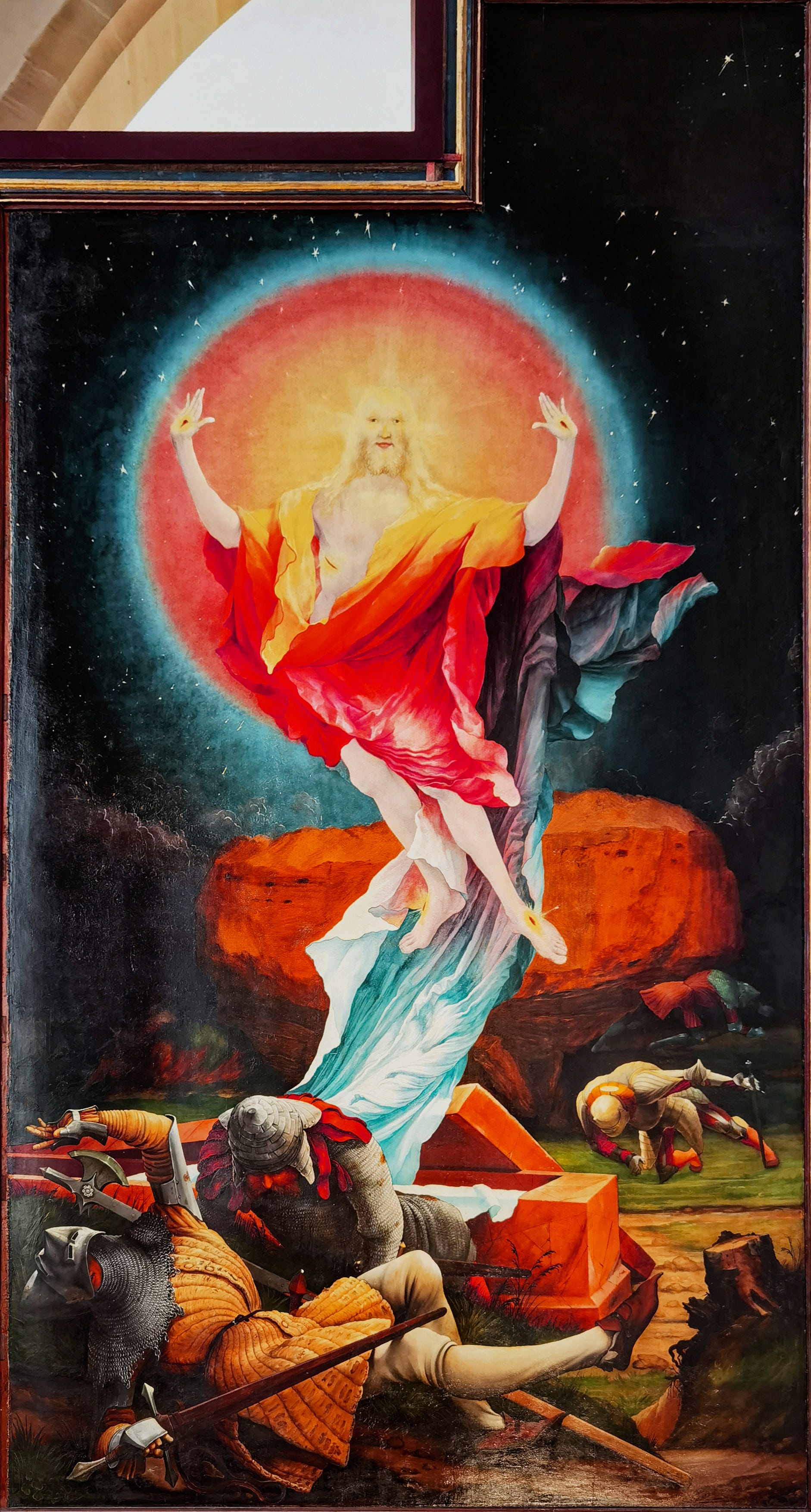
Pehaps this will read to you as merely a platitude, but I promise that as much as I have ever known anything I know that He was there, and that He loved me when I was unable to find anything of value in myself. There is none who is too far gone, none for whom the doors will not open if your heart is opened. I understand the feeling that you are excluded from the great procession, I have felt it too. If you repent, if you open yourself to him He is there waiting for you. When he entered the earthly Jerusalem in the last week of his life He told His disciples “and I, when I am lifted up from the earth, will draw all men to myself.6” Do not think dear ones, that He was not speaking of you also.
Genesis 3:22-24 Revised Standard Version
Saint Augustine Bishop of Hippo, Confessions; A New Translation by Henry Chadwick, trans. Henry Chadwick (New York, NY: Oxford University Press, 1992), 29.
I have been crucified with Christ; it is no longer I who live, but Christ who lives in me; and the life I now live in the flesh I live by faith in the Son of God, who loved me and gave himself for me.
Galatians 2:20, RSV
No posts
Comments
Nothing yet. Say the first thing.
Sign in to join the conversation.