

July was a month of violent rotation: oil ran towards $100 and then broke below $80 as the Iran de-escalation held, more than a trillion dollars came off chip stocks worldwide, and Korea, our largest emerging-market exposure (12% of the fund), had its worst month since the global financial crisis before staging the largest one-day rise in its history on the final trading day.
Our UCITS fund fell approximately 1.8% in EUR terms, against a broadly flat MSCI ACWI.
What we bled through this month, is already on its way to recovery as the first few days of August show a full recovery, but it hurt more than it should have.
Our AI hardware and electrification holdings, thirty-nine positions wearing half a dozen different sector labels across four continents, fell 14% on average and cost the book roughly 390 basis points.
The rest of our book did its job.
The energy and tanker holdings (refining and midstream) added around 230 basis points, with Suncor up 24% and Cenovus up 21% within two weeks of our refining essay making exactly that case.
The defence names we added into June’s ceasefire selloff repaid us within a month: Indra rose 18%, Leonardo 17%, and the basket contributed close to 90 basis points. Microsoft alone added over 100.
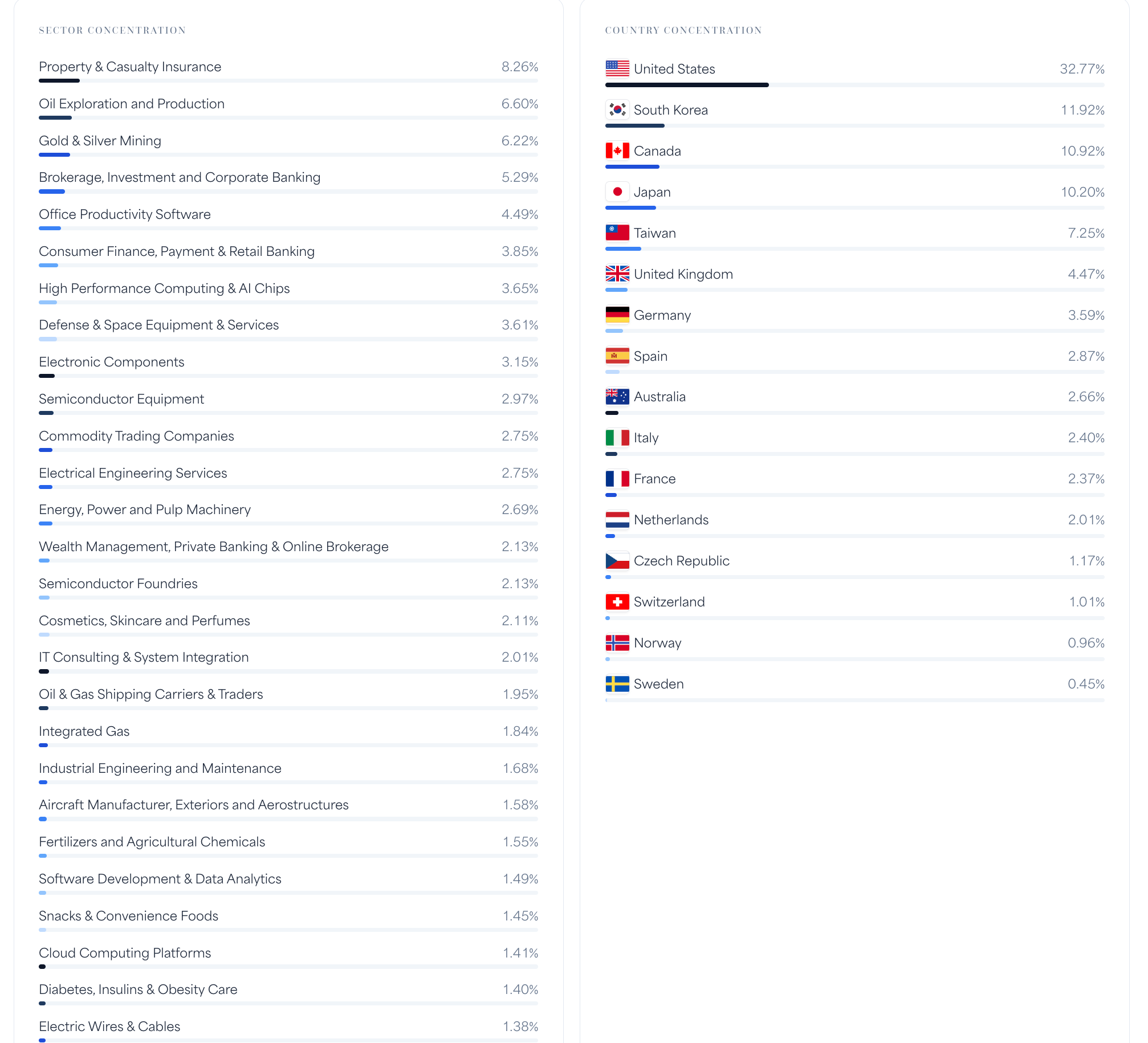
July also exposed a limit in our own portfolio construction.
Our equal-weight discipline diversifies us by name, and in most months that is enough.
It did not prevent us from crowding into a single trade this time: thirty-nine of those positions, spread across chipmakers, cable makers, transformer builders, cooling specialists and electricity producers, were in practice one bet on AI infrastructure, and in July they fell together.
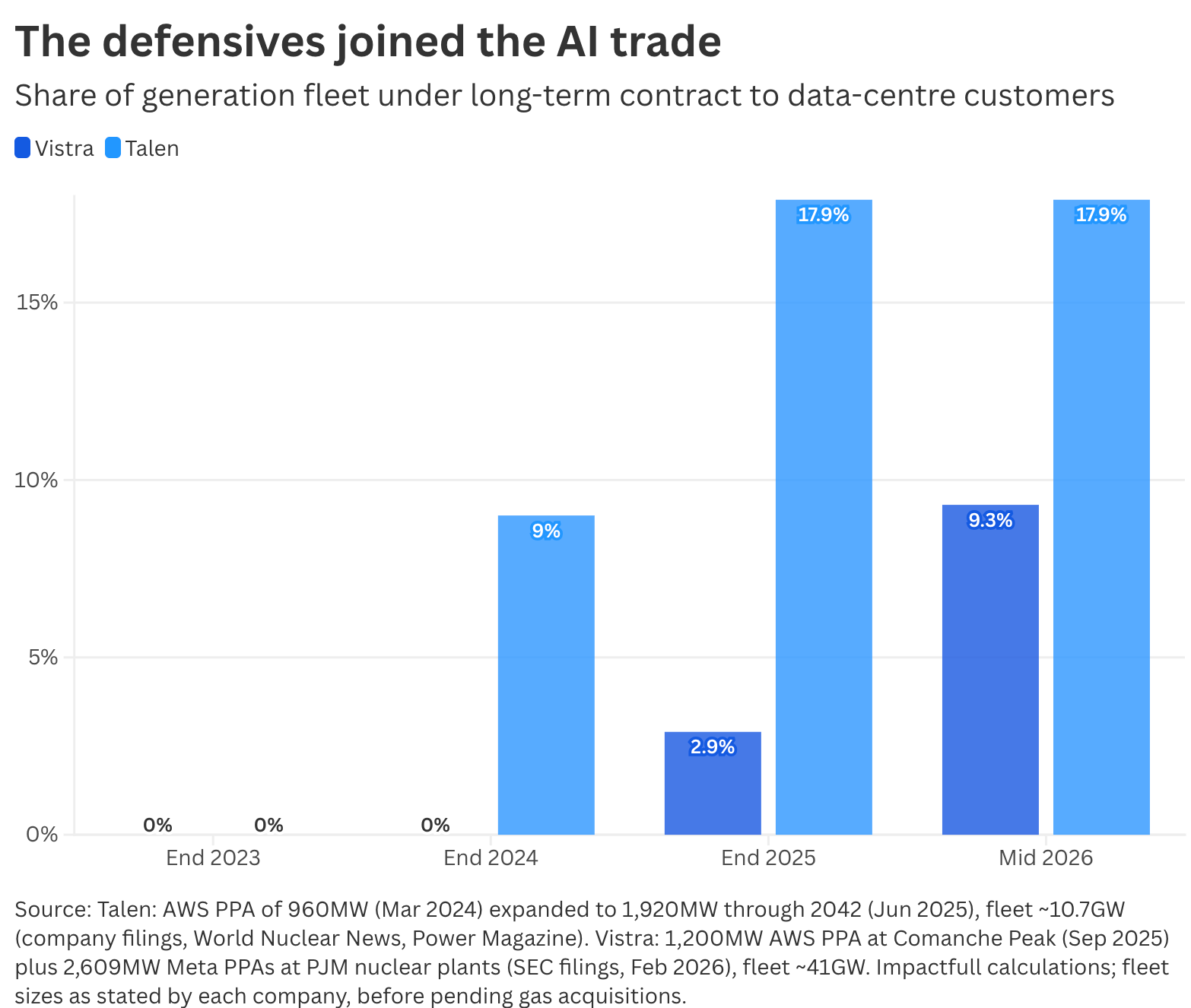
For example, Vistra and Talen are American electricity producers, normally one of the most defensive things a portfolio can own, but both now sell a growing share of their output to datacenters, and the market repriced them as part of the AI trade: they fell 7% and 14% in a month when defensive utilities should have offered us stability.
We are contemplating portfolio construction improvements to further limit this concentration risk, capping exposure at the level of the basket rather than only the name, and we will detail them in a future update once they are settled.
In the meantime, we thank you for your trust, and we hope that the current environment (lower energy prices, less leverage in Asia, a lower dollar) will be conducive of future returns for your fund.
Back to the Weekly.
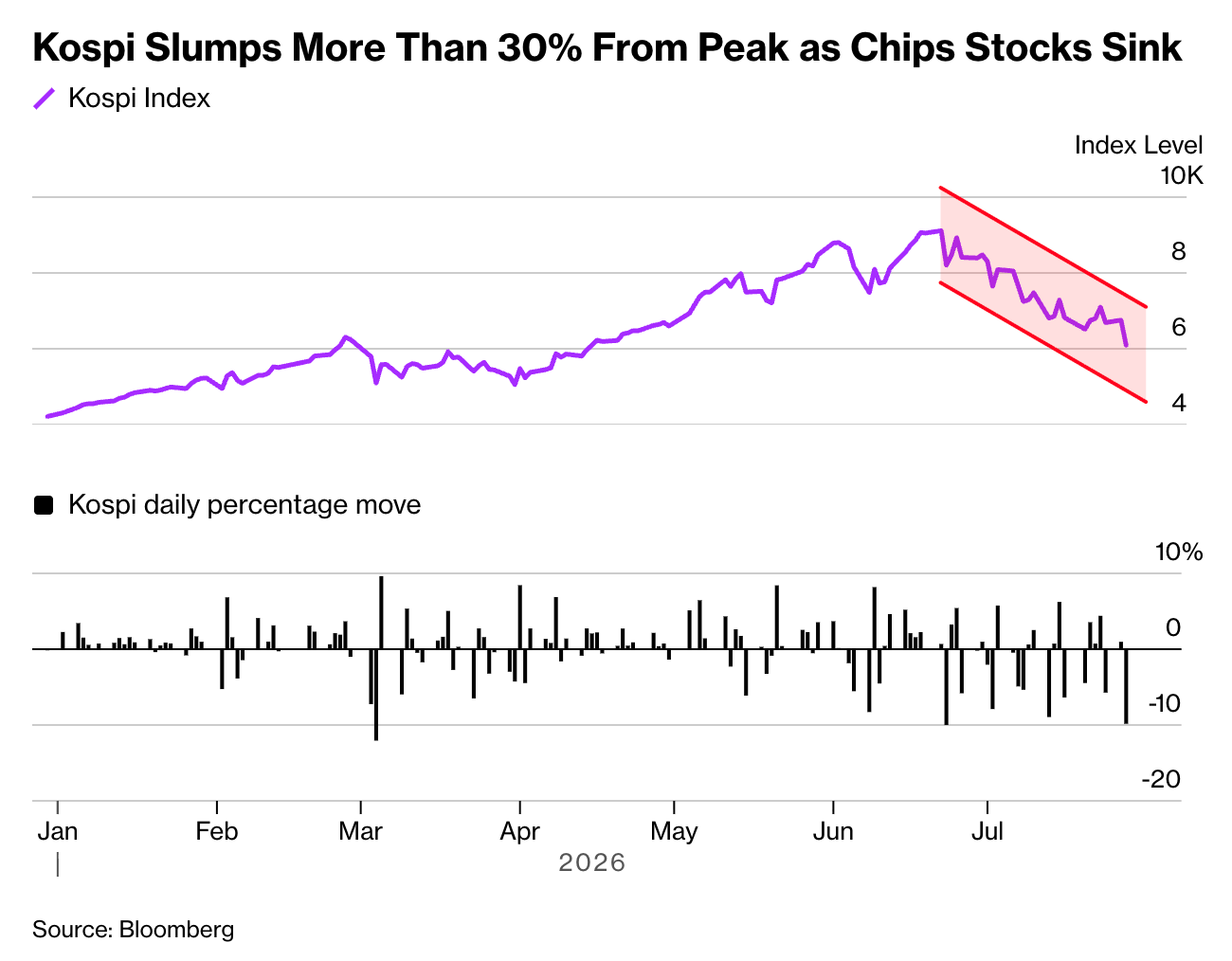
On Tuesday 28 July the Korean stock market fell 10.84%, the fourth worst day in its history. Samsung Electronics dropped 14.4%, its worst session since October 2008, and SK Hynix lost 14.7%. Of the 917 companies on the main index, only 36 finished higher at the end of the day.
Two companies are to blame for that. The others fell because they happened to be listed in the same index, pulled down by a market that no longer distinguishes between a chip maker and a sunscreen maker.
Today, there are two Koreas trading under the same KOSPI index. This edition is about everything but Samsung and SK Hynix.
In this edition of Impactfull Weekly, we look at what made the KOSPI break loose and whether there’s anything in the wreckage that was sold for no reason. Spoiler alert: some stocks got hit despite being in their best form.
For the first half of 2026, Korea was the best performing major market in the world. The index started January at 4,309, more than doubled by the beginning of June, crossed 9,000 for the first time on 18 June and closed at a record 9,114.55 four days later.
Very little of that rise had anything to do with Korea as a whole.
It was mostly Samsung Electronics and SK Hynix, riding the boom in the high-bandwidth memory that feeds AI data centres, who grew until the two of them accounted for roughly half of the index’s entire value, up from about a quarter a year earlier.
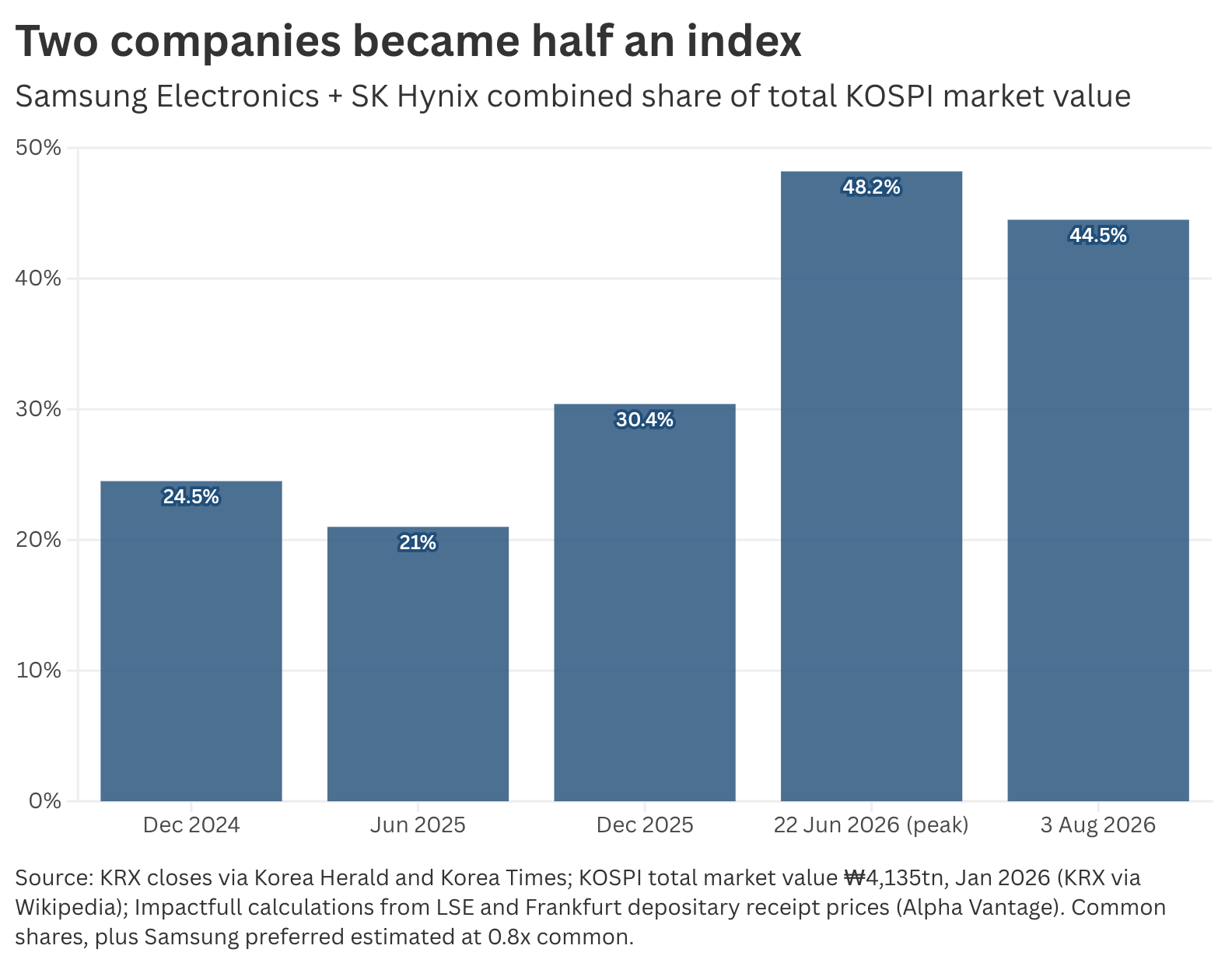
Retail investors provided the fuel to this fire. Many of them bought into Samsung & SK Hynix with significant amounts of leverage, meaning that a 7% rise meant they pocketed 14% but if it went down 7% they lost 14% of their investment.
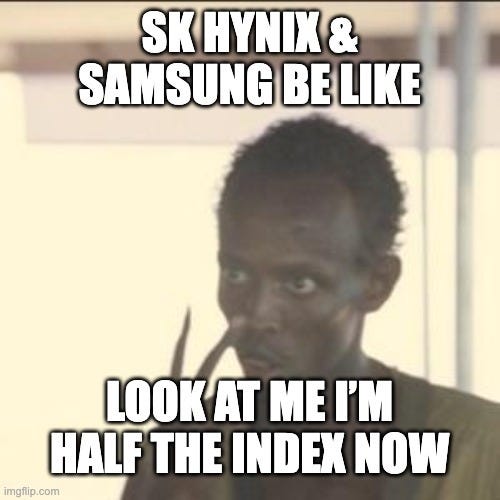
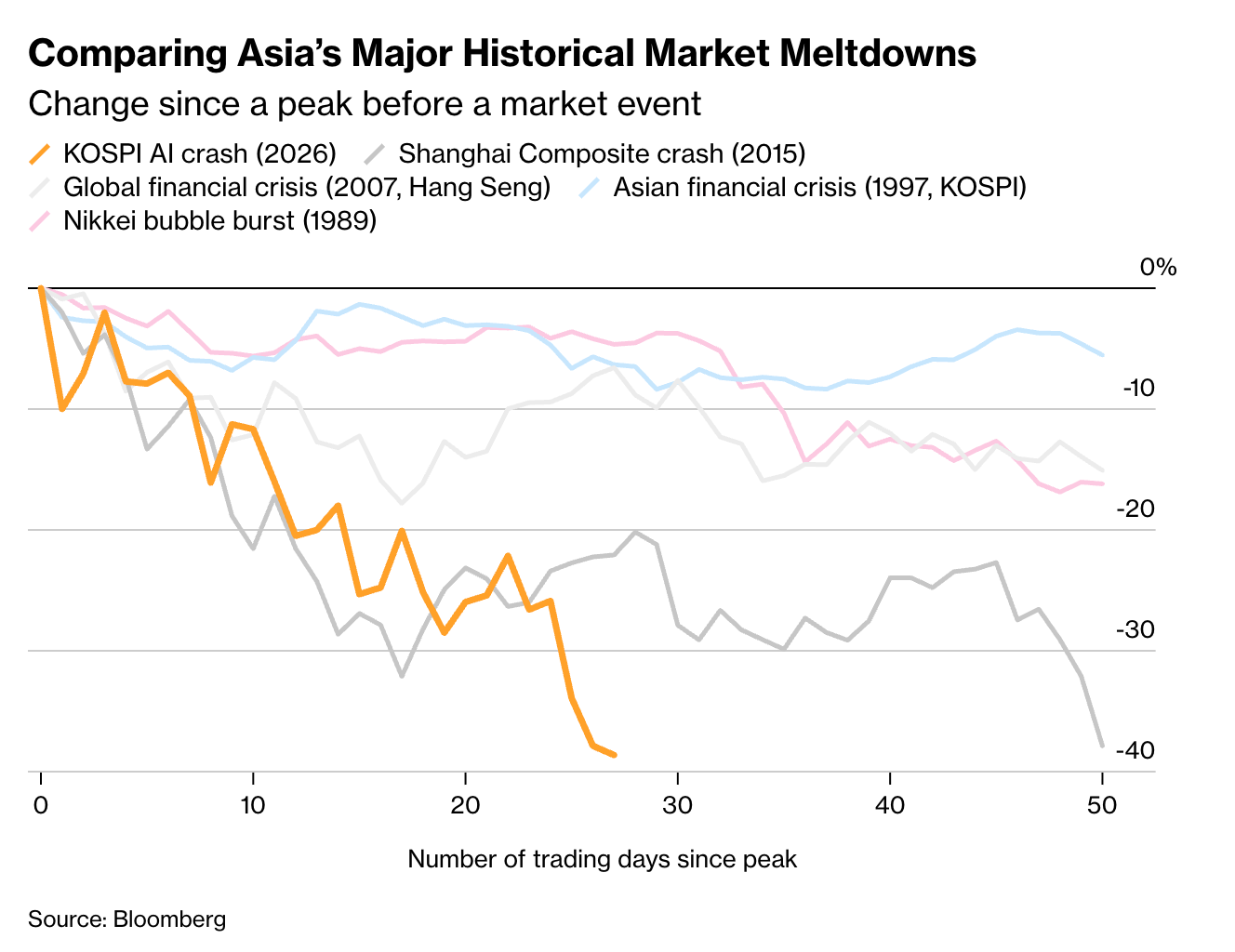
You can guess what happened when the Korean stock market dropped by 40% in total, over the past 3 weeks. By late June the exchange had already triggered close to 30 temporary trading pauses and five full market halts in 2026, more than in the whole of 2008.
Earlier this year, in Impactfull Weekly #30, we argued that memory is a cyclical industry that’s pretending to be a decade-long infrastructure story, and we spoke about the cracks we thought would end this current boom: a wave of new factories, and the arrival of Chinese competitors with state capital behind them. Both have since come true.
Such a spectacular bull run rarely ends for just one simple reason. This one absorbed three different catalysts in a matter of five weeks, each relying on borrowed money.
On 23 June, MSCI, the index compiler whose classifications steer trillions of automatic, index-tracking money, kept Korea in its emerging markets bucket and declined even to open a formal review for promotion to developed status.

MSCI decides, in effect, which league each market plays in, and promotion comes with guaranteed buying, much as a club promoted to the Premier League is guaranteed television money before it touches the football.
A lot of foreign money had bought Korea in advance of that promotion.
We had made the case for the Korean market reform last year with the Value-Up program and more, but this decision from MSCI, who is notoriously strict on the availability of foreign currency markets abroad to promote liquidity, has pushed a realistic Developed Markets promotion by about two years at the earliest.
This led to the KOSPI shedding 10% the day of the MSCI announcement.
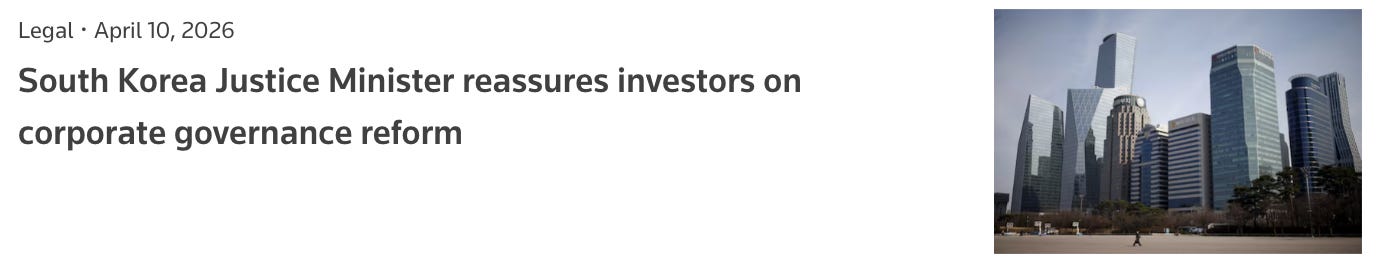
But a silver lining is that reforms are continuing, as we saw amendments to the Commercial Act that makes the company directors legally accountable to all shareholders, not just the controlling families (Chaebols).
Global AI stocks spent all of July in an anxiety-driven drawdown that began in the run-up to June earnings season, when investors turned nervous about the two groups holding the whole trade up: the major AI capex spenders, and the memory beneficiaries like Micron that feed them.
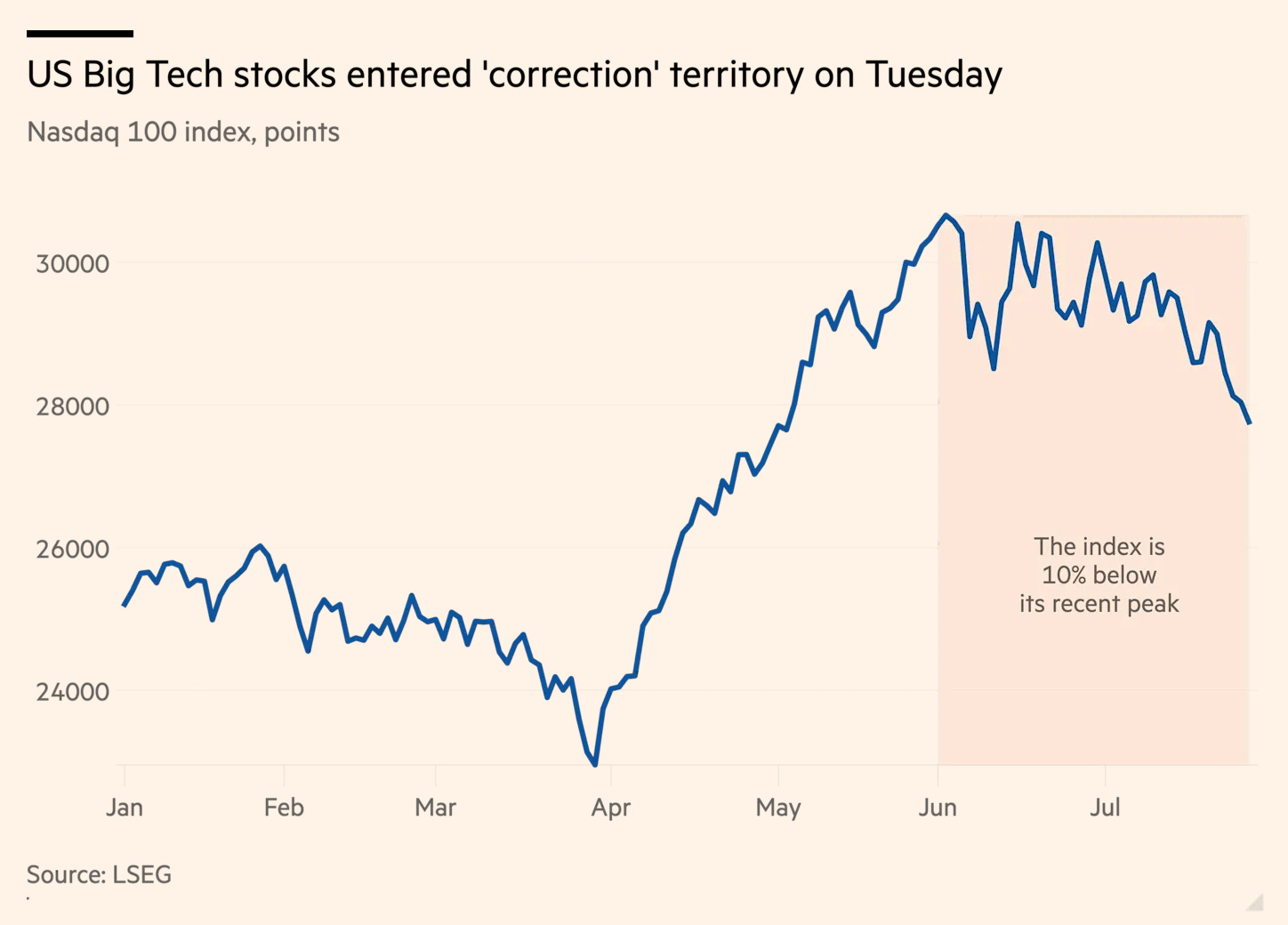
Two triggers turned the nerves into selling.
First, Meta moved to sell spare AI computing capacity it had built, and a customer with too much capacity is a customer who slows its buying.
Second, as the major AI capex spenders reported results, their construction budgets were combed for any hint of a plateau, and each earnings call set off another round of selling in US and Korean memory stocks.
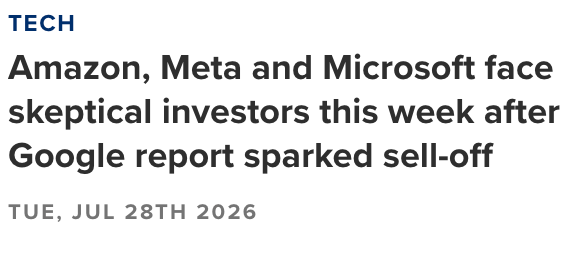
The strange part was the contrast with the memory businesses themselves.
SK Hynix reported its memory sold out through 2027. Samsung reported the best quarterly results in its history. The market sold both because they weren’t convinced about how long the spending could keep growing.
Then came the second shock. CXMT, the main Chinese challenger to SK Hynix, Samsung Electronics and Micron, listed on the Shanghai Stock Exchange, and the prospect of a state-backed rival with fresh public capital set off another round of drawdowns in the memory players, this time violent enough to trigger a circuit breaker and a trading halt on the KOSPI.
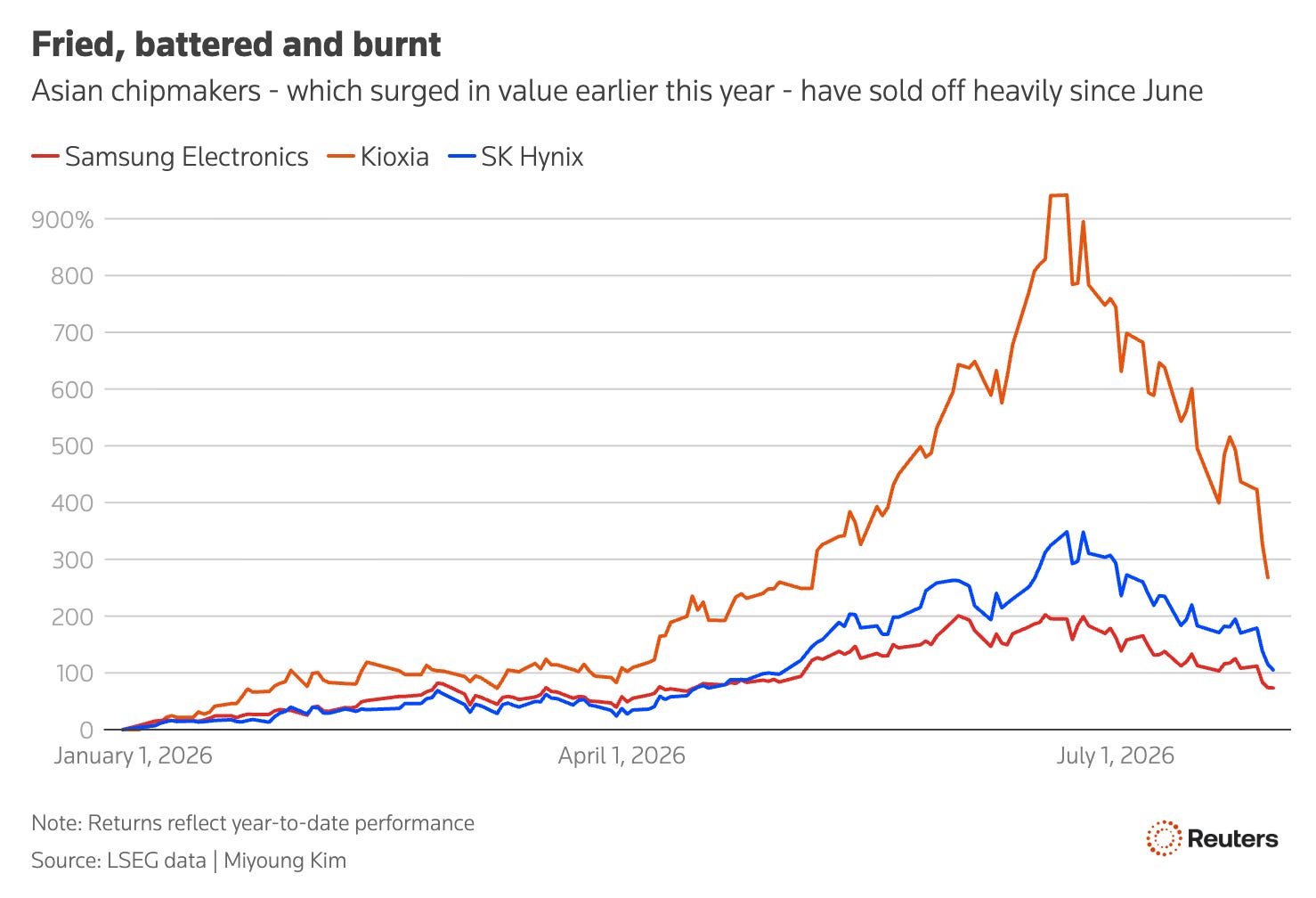
Neither of the first two catalysts, on their own, explain a 38% crash.
The other culprit here was the undoing of leveraged trades done by thousands of retail investors due to the existence of single-stock leveraged ETFs who only saw “number go up” and piled on to these vehicles without thinking about what would happen when the number stopped going up.
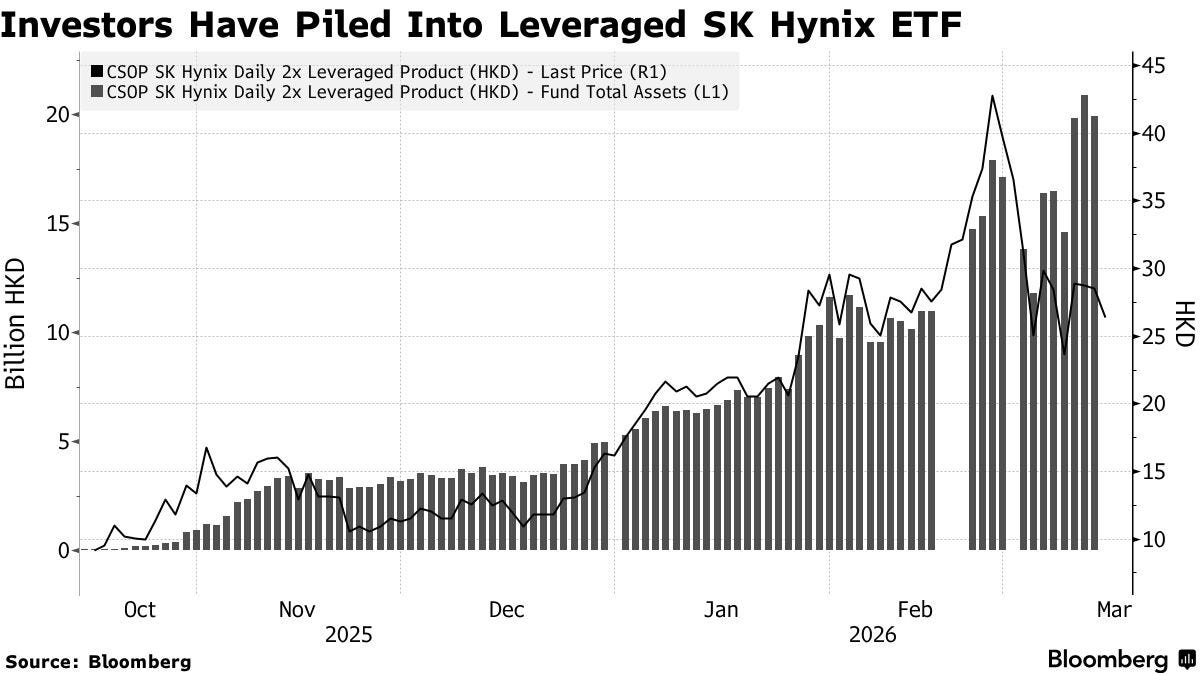
When the spending scare hit the two giants, every holder of doubled exposure took twice the loss. Brokers demanded cash, holders sold to raise it, the selling pushed prices lower, and lower prices brought more demands for cash.
The leveraged ETF around SK Hynix lost about 80% from its June peak.
Today, the most fragile, highly leveraged retail traders have been entirely flushed out, costing retail investors an estimated $39 billion in realized losses, but the baseline level of retail leverage remains structurally higher than it was in 2024.
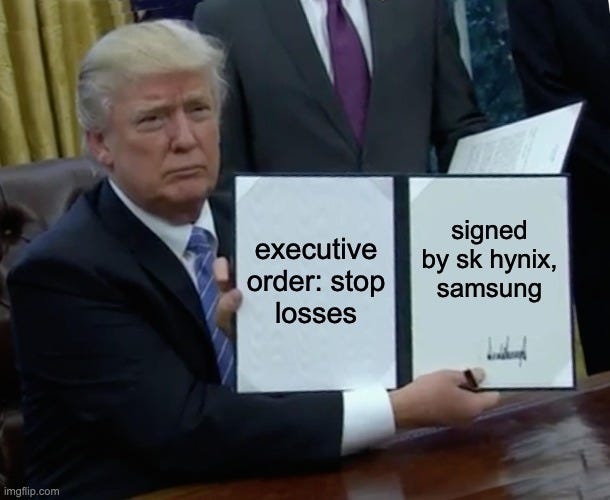
On 28 and 29 July the selling grew violent enough to trigger full circuit breakers on consecutive days, the first time that has happened in the market’s history, and the Korean financial regulator is now proposing emergency powers to cut these products from 2x leverage to 1.5x or 1x.
Which stocks fell, and how far, was decided not by how much each company earned that quarter, but by who held it and with how much borrowed money. Forced sellers do not choose what they sell.
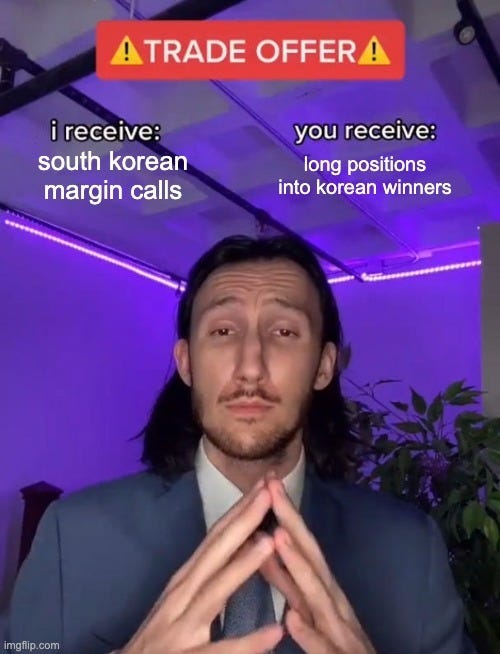
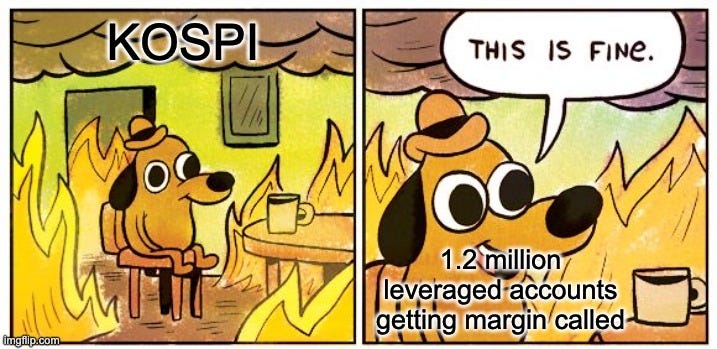
By the middle of July, more than 1.2 million leveraged retail accounts had received margin calls, and an estimated 320,000 to 360,000 had already been forcibly liquidated before the two worst days arrived.
A liquidation on that scale does not differentiate between the position that caused the loss and the positions sitting next to it, which is how a crash that began in two chip companies spread to industries reporting record results.
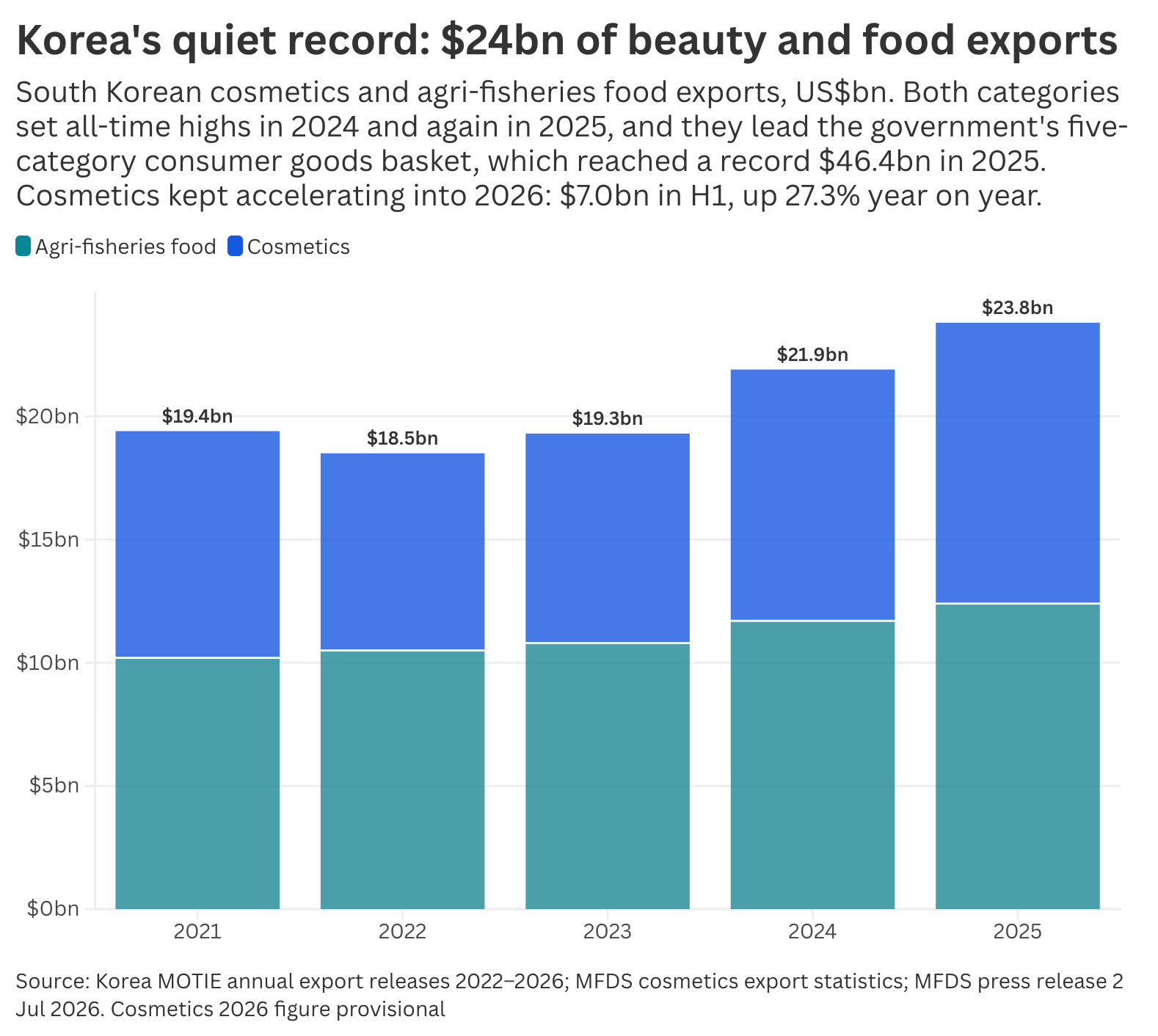
Korean cosmetics exports set an all-time monthly record of $1.34 billion in June, 42.5% higher than a year earlier, and the listed beauty names had risen a modest 18% on average in the first half against the index’s 100%, so they carried none of the froth that was now being wrung out of the market. They got sold anyway.
The carmakers took the same hit, with Hyundai and Kia losing between 4% and 5.5% on the first crash day alone. The shipbuilders went down carrying order books that stretched years into the future with Hanwha Ocean itself having a backlog of $33.7 billion dollars, and the defence names and the banks followed, the same banks the market reform trade had spent 2025 patiently re-rating.
On 31 July, individual investors sold a record $5.7 billion of shares in a single session while foreign & institutional investors at the same time bought a record $5.8 billion worth of shares. Is this a sign of the bottom?
It depends which Korea you mean.
The first Korea is the KOSPI, which today means two chip companies at half the weight, late into a boom and bust cycle we described, with all the leverage that powered the rally now being drained out of it by the regulator.
On headline numbers it looks cheap, with the KOSPI trading at 7-8x, but if you remove Samsung and SK Hynix, the remaining companies trade closer to 12x, which means “Korea is cheap” is mostly just reflecting the concentration in memory chips.
The second Korea has to be bought name by name, on its own earnings.
The honest way to sort the names is by their distance from the leverage unwind blast, with one further test applied to each: how much of the fall was the stock’s own excess coming out vs. the damage done by the index. A company can be a genuine victim of forced selling and still have deserved part of its fall.
Stay invested, cautiously.
Disclaimer: Thoughts are my own and for informational purposes only. Not investment advice. Does not represent the views or strategies of Impactfull Partners. Not an offer to buy or sell securities or UCITS funds. May hold positions in mentioned assets. Do your own research.
No posts
Comments
Nothing yet. Say the first thing.
Sign in to join the conversation.