

This Impactfull Weekly was co-authored with Maxence Visseau from Arkevium Research, a macroeconomic research firm, and Impactfull Partners. Not investment advice.
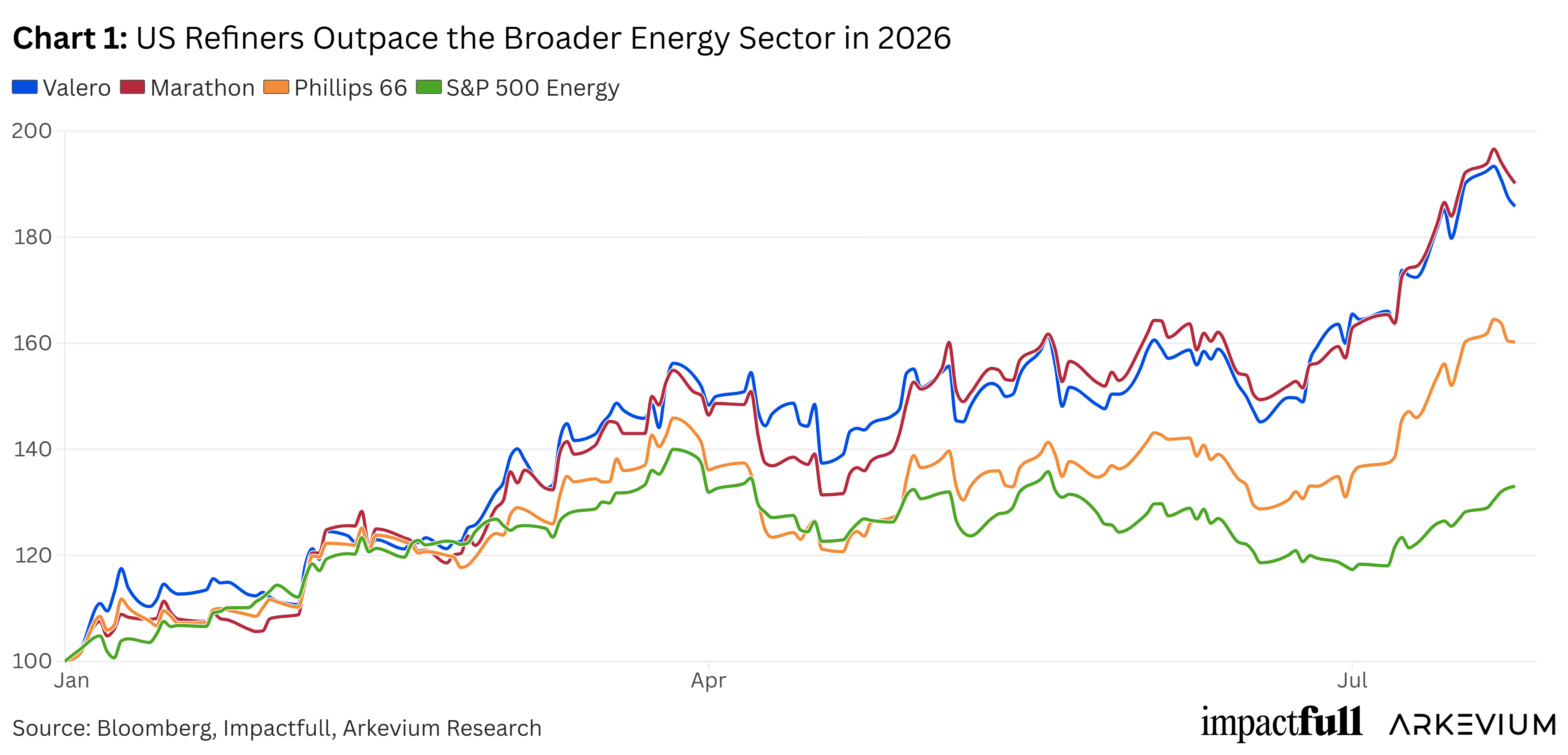
Refining has been the best performing corner of the energy complex this year. Valero and Marathon have nearly doubled since January. Phillips 66 has trailed its peers but still delivered roughly twice the return of the broad energy index. On the other hand, the S&P 500 Energy sector has managed a fraction of that. Dispersion this wide inside a single GICS sector is unusual.
A refiner’s economics are captured by the crack spread. The standard 3-2-1 measure compares the cost of three barrels of crude against the revenue from the two barrels of gasoline and one barrel of diesel made from them. In mid-July the US 3-2-1 margin came within a whisker of $70, the highest level ever recorded and close to triple where it sat before the Iran war began in late February. Brent-based margins have followed the same path with a lag.
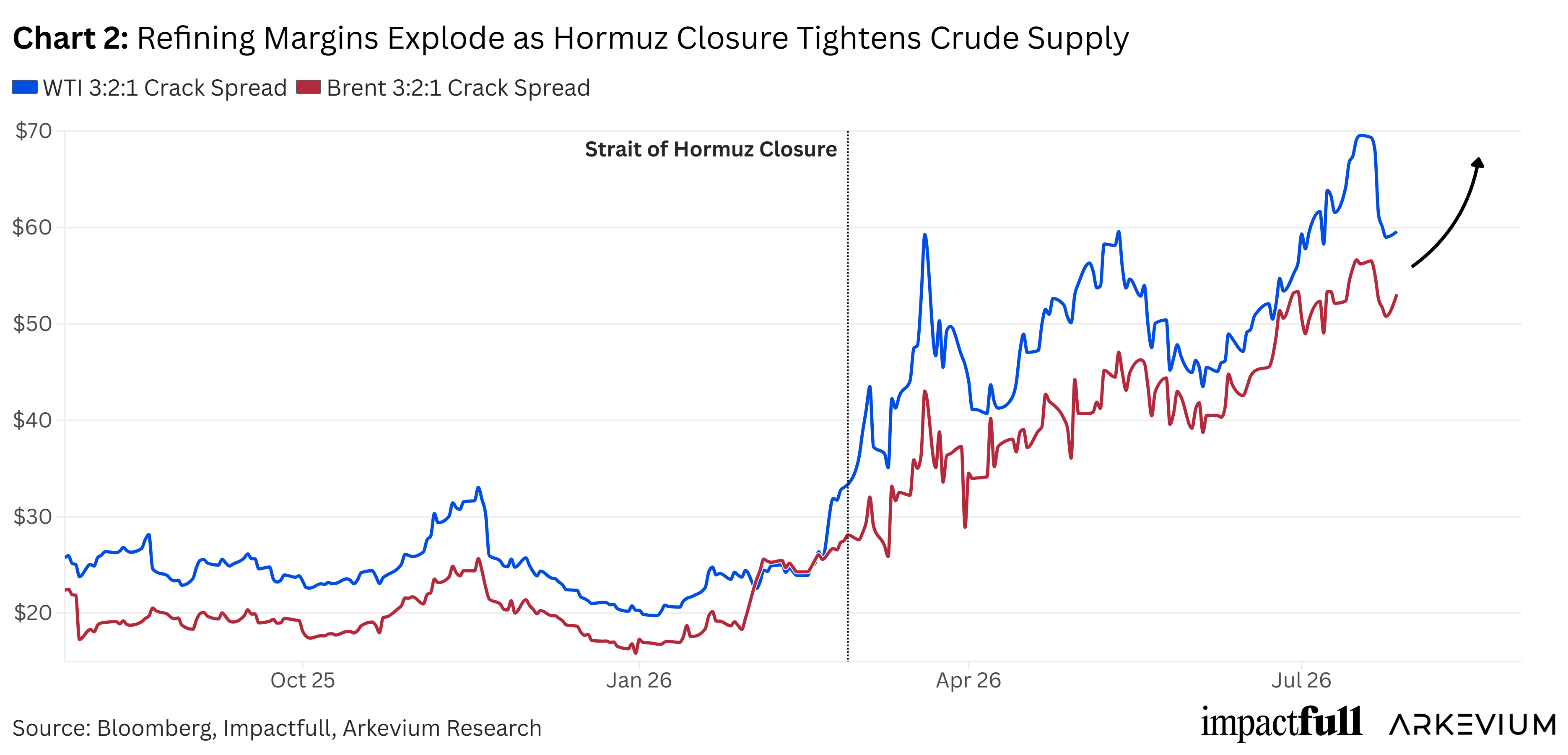
The Strait of Hormuz closure is a regime change. Margins reset to a new floor and have been grinding higher from there for five months. Spikes mean revert. Regime changes do not, at least not until the constraint that created them is removed.
From our perspective, three forces are compounding.
The first is capacity. The developed world retired an enormous amount of refining capacity between 2020 and 2023, when the pandemic made marginal plants uneconomic and the energy transition made them uninvestable. The replacement capacity that came online since was built east and south, in the Gulf, in Africa and in China.
The second force is crude quality. Hormuz took out medium sour barrels. Those barrels are dense and yield a high proportion of middle distillate. What has replaced them at the margin is light sweet crude from US shale and from strategic reserve releases. Lighter crude yields more naphtha and gasoline and less diesel and jet per barrel processed.
The system now has to run materially more crude to produce the same volume of distillate. That simultaneously raises crude demand and blows out the distillate crack. It also concentrates the profit in complex refineries with cokers and hydrocrackers, which can push heavier and sourer barrels through and still make distillate.
The third force is inventory. There is no cushion left. European distillate and jet stocks have been drawn down to the point where availability matters more than price. In parts of the world we are already seeing rationing.
The single most striking data point of this cycle arrived in July, when the heating oil to WTI crack spread briefly traded above the front month price of WTI itself.
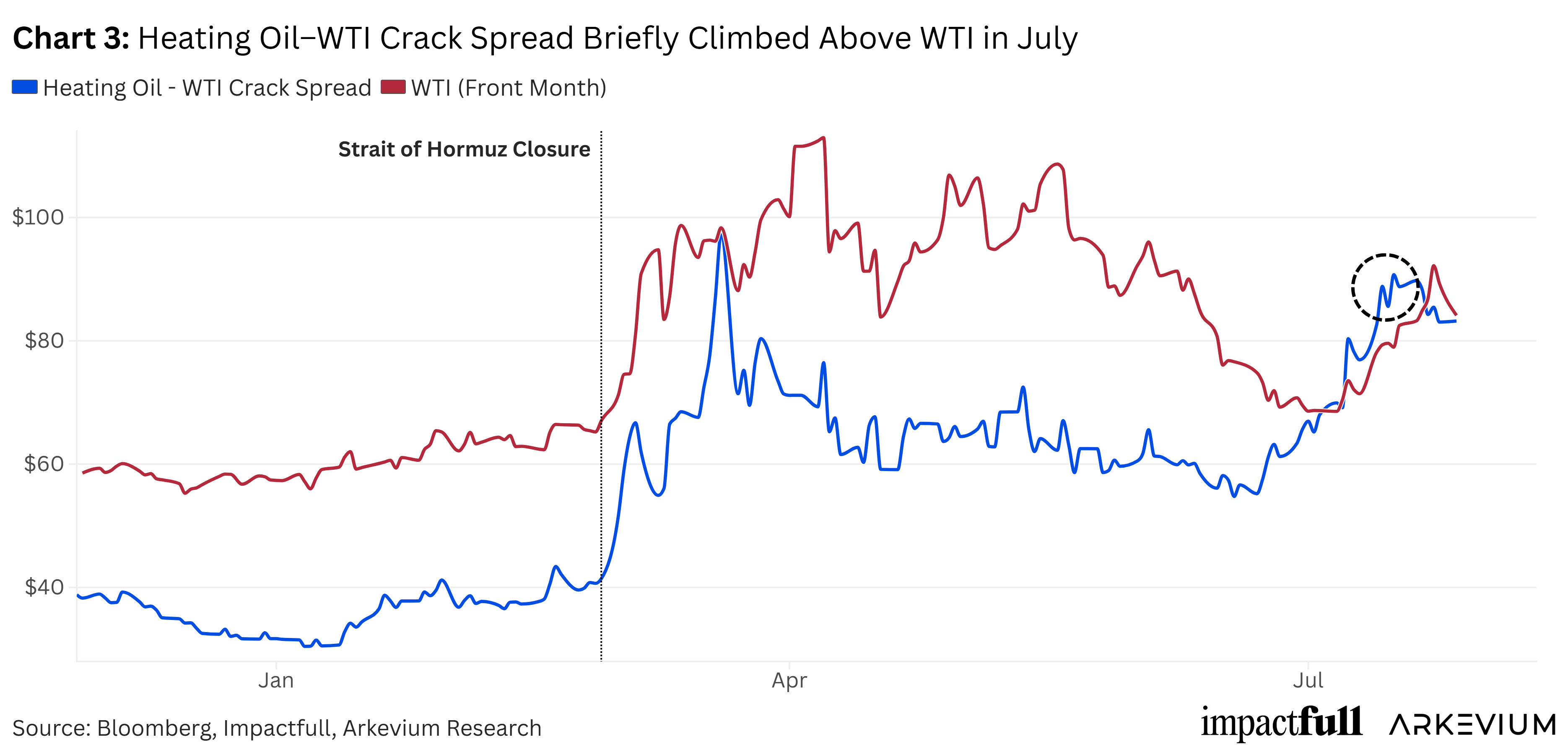
That tells you where the shortage sits. Crude is available. Anyone with spare capacity to turn it into diesel is not. When buyers pay more for the processing than for the feedstock, the scarcity has moved downstream and so has the profit.
The epicentre is diesel. Diesel is the fuel of the industrial economy. It moves freight, powers construction, runs agriculture and increasingly backs up electricity grids. US on-highway diesel is above $5 a gallon and gasoline is back above $4 in most states, with both series turning higher again.
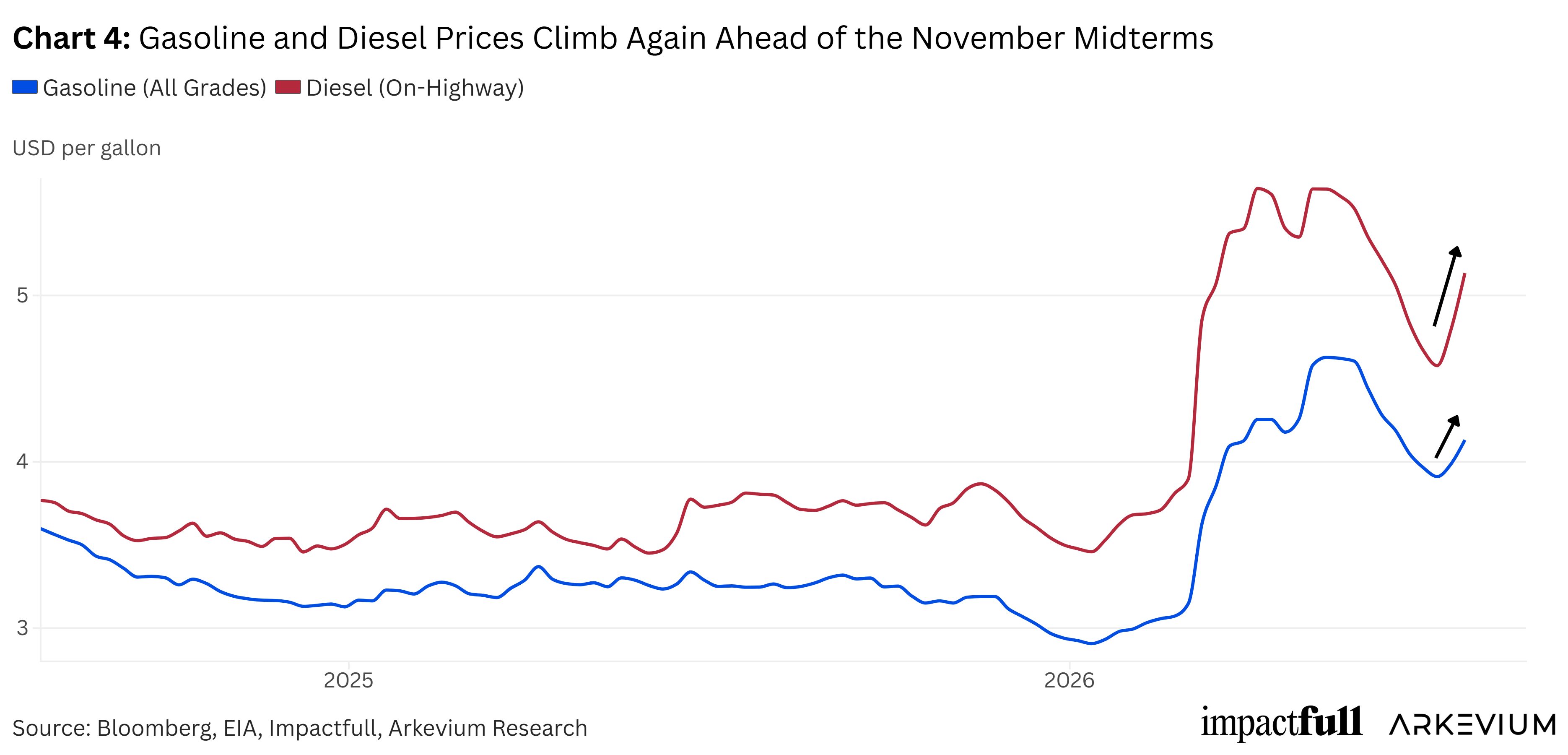
That is a supply side inflation impulse arriving at the worst possible moment for central banks and, in the United States, at the worst possible moment in the electoral calendar. This is where the investment case meets the political risk, and investors need to think through both.
The reason we are confident this does not resolve quickly is physical, and it is worth walking through the logistics.
When Hormuz closed, the global economy was rescued by a piece of infrastructure built forty years ago and largely forgotten. Saudi Arabia’s East-West pipeline allowed the kingdom to move crude to the Red Sea and keep exporting. For more than a hundred days that workaround held.
Roughly five million barrels a day of Saudi crude have been flowing through the Red Sea, and we would argue that single pipeline is the main reason Brent is near $90 rather than $150.
The Houthis have now attacked two Saudi-flagged tankers in the southern Red Sea and put the Bab el-Mandeb strait at risk. The bypass needs a bypass.
One exists. Rather than sending barrels south toward Bab el-Mandeb, Saudi Arabia can push them north through the Suez Canal into the Mediterranean. The problem is draft. Very Large Crude Carriers, which carry two million barrels each and are the workhorse of the Saudi export fleet, cannot transit the canal fully laden. The barrels have to be lightered, moved partly by pipeline, and reassembled at the other end. It works. It is slow and it is expensive.
There is a second theoretical option in the Israeli-owned Eilat to Ashkelon pipeline, built in the 1960s, linking the Red Sea to the Mediterranean. Riyadh does not recognise Israel and neither party would ever acknowledge such an arrangement publicly.
Now consider who is actually buying these barrels. India, China, Japan and South Korea together take the overwhelming majority of the Saudi crude moving through Bab el-Mandeb.
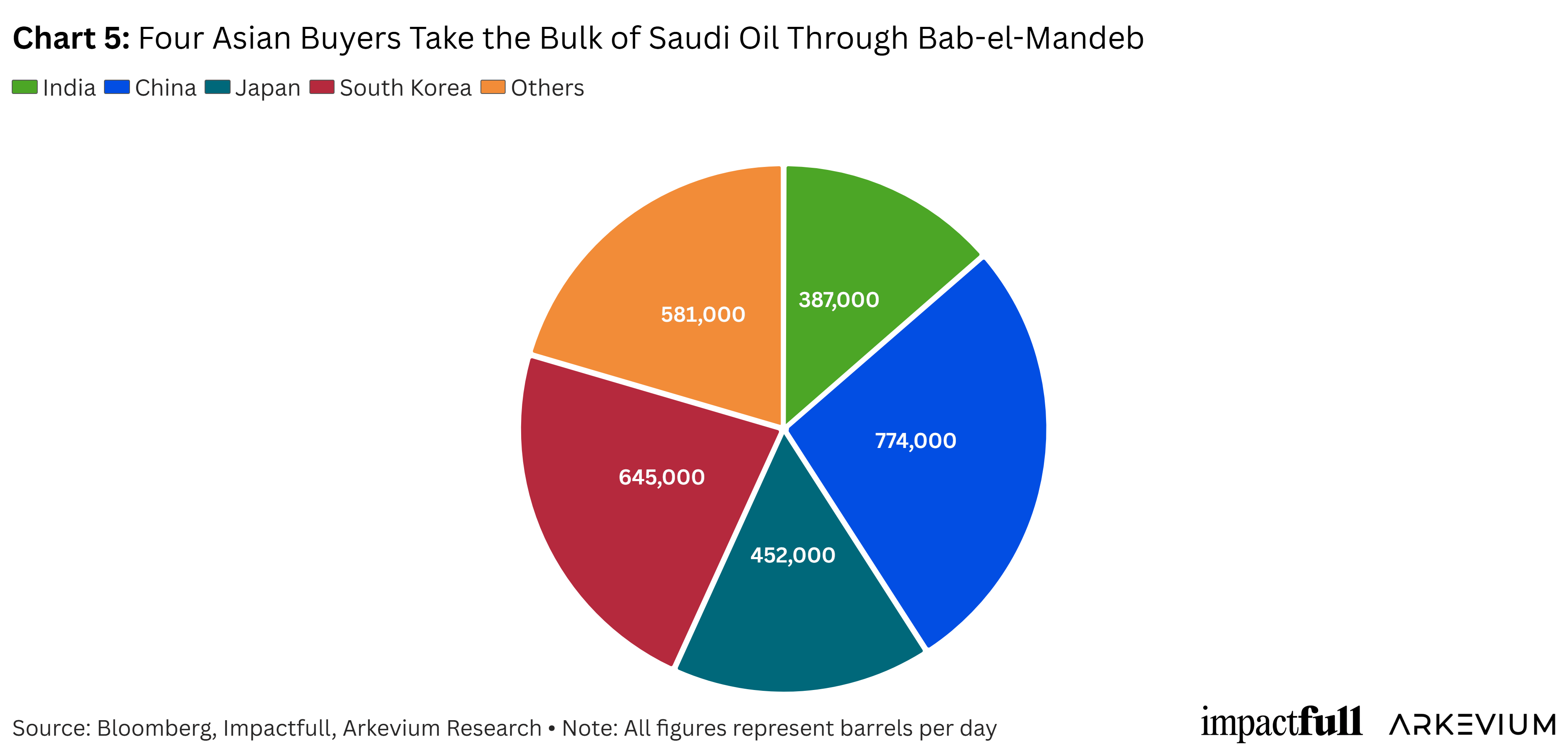
Every one of those cargoes rerouted through Suez emerges in the eastern Mediterranean, on the wrong side of the map, adding roughly 25 days to the voyage from Saudi Arabia to Japan. The return leg adds the same again.
Fifty extra days per round trip is an effective contraction of the global tanker fleet. It also imposes a locational tax on Asian refiners and hands a corresponding advantage to refiners in the Atlantic Basin, who can run domestic and nearby barrels. WTI, Canadian heavy, Guyanese, Brazilian, North Sea and West African crude all reach North American and European refineries without touching a contested chokepoint.
We frame the next six months around four scenarios.
In the first, oil stays below $85 while cracks remain elevated. Consumers grumble but do not revolt, refiners generate record free cash flow and spend it on buybacks. This describes the ceasefire period we lived through earlier this year. It is the best case for owning US refiners.
In the second, oil rises and cracks widen further on continued escalation. This is the regime of the past two weeks, with strikes being exchanged and the Red Sea in play. Here the pump price becomes a political object and the pressure on Washington to intervene becomes serious.
In the third, oil rises while cracks compress. We struggle to construct the conditions that produce this. It would require a demand collapse in products alongside a crude supply shock, and we assign it very low probability.
In the fourth, oil and cracks both collapse on a durable Middle East settlement. Energy positions lose money and everything else in the portfolio thrives. We would take that trade happily, and not only for financial reasons. We simply do not believe it is close.
Our base case is a blend of the first two, weighted toward the second. Which means the risk we spend our time on is political.
If Washington acts, the obvious lever is a ban on exports of finished products, gasoline, diesel, jet and heating oil, in order to depress domestic prices before November.
We have a clean historical analogue. In 2022, with pump prices above $5 and midterms approaching, the Biden White House signalled to refiners that it was considering a partial or full export ban and asked the Energy Department to model the impact, four weeks before the election. It was never imposed. We think the reason it was never imposed is the same reason it will not be imposed now, and it is mechanical rather than ideological.
The US refining system is not one market. The Gulf Coast is built to export and is physically connected to Latin America and Europe by sea. The East Coast is supplied by the Colonial pipeline and by waterborne imports, and Jones Act restrictions make it expensive to move Gulf Coast product north on domestic hulls.
Ban exports and Gulf Coast refiners lose their marginal buyer, run cuts follow, and total production of gasoline and diesel falls. The Northeast, which cannot easily access the stranded barrels, could plausibly see higher prices rather than lower ones. A policy meant to lower pump prices before an election could raise them from New York to Pennsylvania.
Add the diplomatic cost. European allies have restructured their entire energy supply chain around US exports. Cutting them off during a war would do lasting damage to relationships Washington is currently relying on.
We therefore assign a low probability to an outright ban. We do not assign zero. And we note the probability is a function of the crude price. Above $100 a barrel with gasoline heading toward $5, the political calculus deteriorates quickly, and quickly is how these decisions get made in October.
By now you are probably thinking this trade has already happened. US refiners have nearly doubled, with Marathon, Phillips 66 and Valero leading the pack. But treating this as a US trade means leaving the better part of it on the table.
A refinery is a big visible building that makes fuel used by millions of people every day. But when its profits triple because of a war, there are only so many places this excess profit can go. Either the government takes it back by putting a cap on excess profits, the customers take it through cheaper prices, or the shareholders take it in the form of dividends.
Now this question is answered differently depending on which country your refiner is in. To find the best option, we asked a few questions.
First, will the government let shareholders keep an abnormally large part of the profits, or will it impose a “special” windfall tax?
Second, will local politics allow fuel to be sold at global prices rather than artificially keeping prices low to protect drivers?
Third, has the share price already reflected this reality?
There is only one country that passes this test, but before giving it to you, let’s eliminate the obvious candidates.
US refiners are naturally the best way to own this theme, because they have the existing capacity to turn Permian shale, Canadian heavy, Guyanese crude and Brazilian pre-salt into distillates. That is exactly what everyone has bought, which is why Marathon Petroleum is up 89%, Valero 85% and Phillips 66 60% year to date.
However, the factories are already running flat out, so there is no volume growth left to buy.
And the price now assumes the boom is permanent. For example, the market values Marathon at about 9.7x its EBITA, above its ten-year average around 8x, which sounds unremarkable until you notice that this year’s operating profit is the highest the company has ever recorded.
To make money in Marathon or Valero from here, record margins are not enough. They have to keep breaking records.
On 3 April 2026, the finance ministers of Austria, Germany, Italy, Portugal and Spain formally asked Brussels to build a new Europe-wide windfall tax on energy profits, copying the 2022 version that collected about €26 billion from oil, gas and refining companies.
Italy has already moved, creating a fresh energy surcharge, and other countries are likely to follow suit. With Spain, the Czech Republic and Hungary having introduced similar measures in the recent past, this puts every major European refiner in a difficult position.
If such a tax were voted through, it would mean tough times for major European refiners such as TotalEnergies, MOL, HelleniQ Energy and Neste.
The UK has extended its windfall tax at 38% to 2030, a level no European country has dared to impose.
Australia’s last two refineries, Viva Energy’s Geelong refinery in Victoria and Ampol’s Lytton refinery in Brisbane, are only open because the government pays them a support fee to guarantee fuel security in a crisis.
A refinery kept alive by subsidy is a public utility with a chimney. A state that carries you through the bad years is not going to let you keep the good ones.
Normally you would tell us that Brazilian energy stocks are a solid idea, and on most days we would agree. Petrobras runs most of the country’s refining, the country exports crude at a scale never seen before thanks to its pre-salt basins, and the shares are cheap.
Not so fast. As crude jumped more than 30% after the Hormuz war began, Petrobras held gasoline prices flat to protect consumers.

When it finally raised diesel prices in March, the government cancelled federal diesel taxes so drivers felt almost nothing at the pump, and Lula paid for it with a new 12% tax on oil exports.
With Lula seeking re-election in October and the state controlling the board, Brazilian refining profit ends up with drivers rather than shareholders.
For three years, Reliance ran the most profitable refining machine on earth. Buy discounted Russian crude at more than 500,000 barrels a day, turn it into diesel, and sell it to Europe at full price.
American sanctions on Russia’s biggest producers forced Reliance to stop feeding Russian crude to its export refinery in November 2025. Europe went one step further. From 21 January 2026 it banned imports of any fuel made from Russian crude anywhere in the world, and identified Reliance’s Jamnagar complex as the single largest source of such fuel entering Europe.
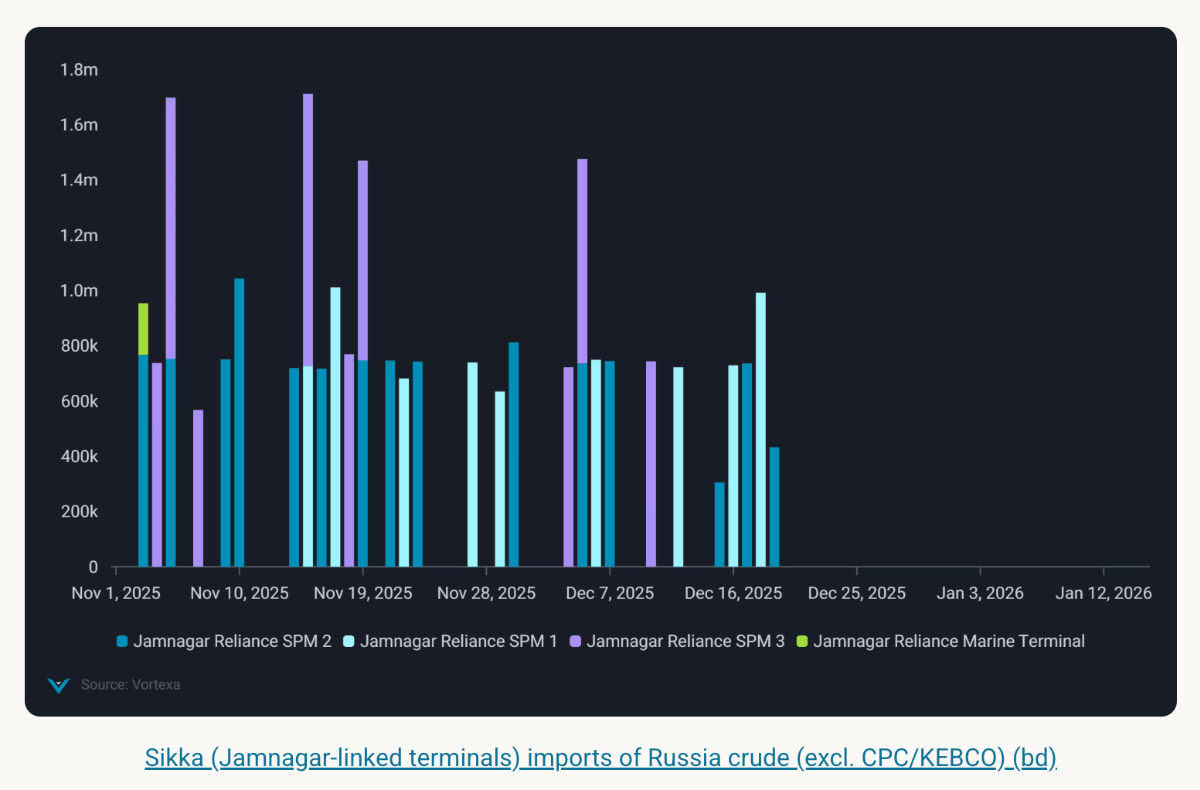
Add a government that imposed its own windfall tax from 2022 to 2024 and will always protect pump prices in a country that imports its oil, and the world’s largest refinery starts to look a lot less special.
Canada went through the same stress tests as the countries above and still passed.
Gasoline hit C$2 a litre this spring, or about US$5.50 per gallon. Campaigners put a US$66 billion figure on the industry’s Hormuz profits and demanded a 33% windfall tax.
Mark Carney’s answer in April was to suspend the federal fuel tax until September, handing drivers 10 cents a litre and leaving producer profits alone.
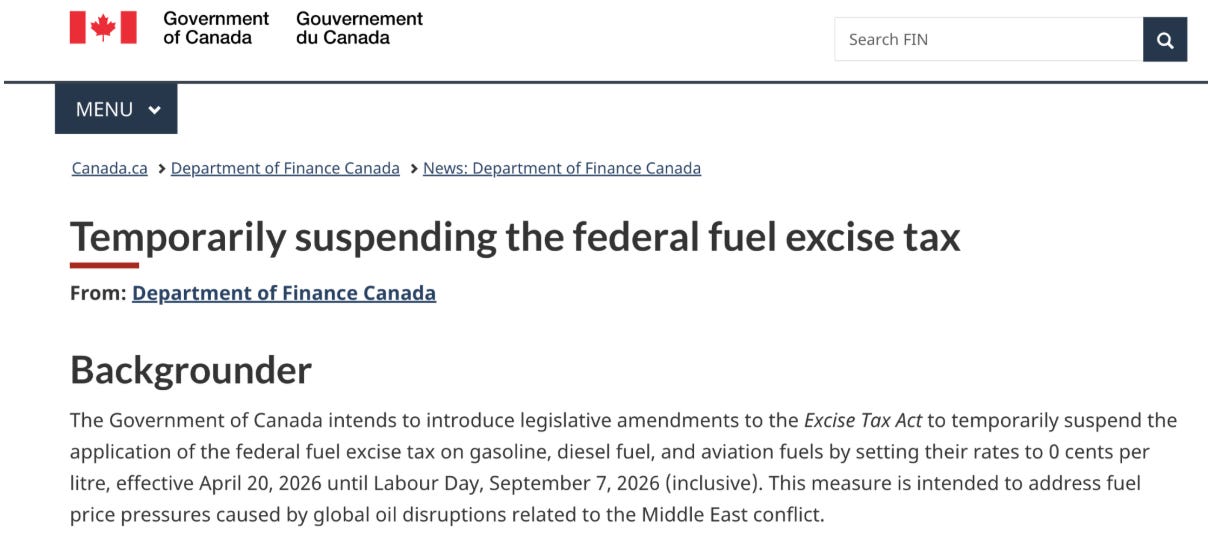
The only windfall tax Canada has ever passed, back in 2022, went after banks and insurers. Any Ottawa government that raids Alberta’s oil patch is signing up for a national unity crisis as well as a national profitability crisis.
Canadian heavy crude normally sells at a double-digit discount to the American benchmark because it is landlocked and thick. Canadian refiners buy that discounted barrel next door and sell the finished fuel at full North American prices.
Since Hormuz closed, that discount has narrowed from about US$14 to US$8 a barrel, because the war removed the world’s dense, diesel-rich barrels and buyers are now scrambling for the obvious substitute, Canadian heavy.
Suncor and Cenovus are hedged either way. When the discount is wide, the refining side captures it. When it narrows because the world is scrambling for heavy barrels, the production side gets paid more instead. They produce roughly twice what they refine, so the value does not leave the company.
Here are the three names we want to own. All have delivered against the broad market, and all still sit below the US majors, which leaves room to close the gap.
Disclaimer: Thoughts are my own and for informational purposes only. Not investment advice. Does not represent the views or strategies of Impactfull Partners. Not an offer to buy or sell securities or UCITS funds. May hold positions in mentioned assets. Do your own research.
No posts
Comments
Nothing yet. Say the first thing.
Sign in to join the conversation.