
Extreme heat, drought, wildfire, and flooding are reshaping access to safe housing, livelihoods, food, water, and basic services. In the UK, prolonged heat and drought are increasing wildfire risks, while people with limited financial resources may have less ability to evacuate, relocate, replace damaged belongings, or recover from losses. Across southern England, rising heat is also exposing a cooling divide, with lower-income households and renters more likely to live in homes that overheat and less able to afford or install effective cooling. In El Salvador, Guatemala, Honduras and Nicaragua, repeated climate shocks are disrupting crops, jobs, food and water access, while limited access to irrigation, insurance and credit leaves smallholder farmers with fewer ways to recover. For migrants from Central America, climate impacts are also intersecting with violence, unemployment and weak state protection, shaping who can safely remain, who can afford to move, and who may become trapped without either option.1
Need to read this in a language other than English? Try OpenL (up to 1,500 characters) or Google Translate—both offer free translations into 100+ languages.
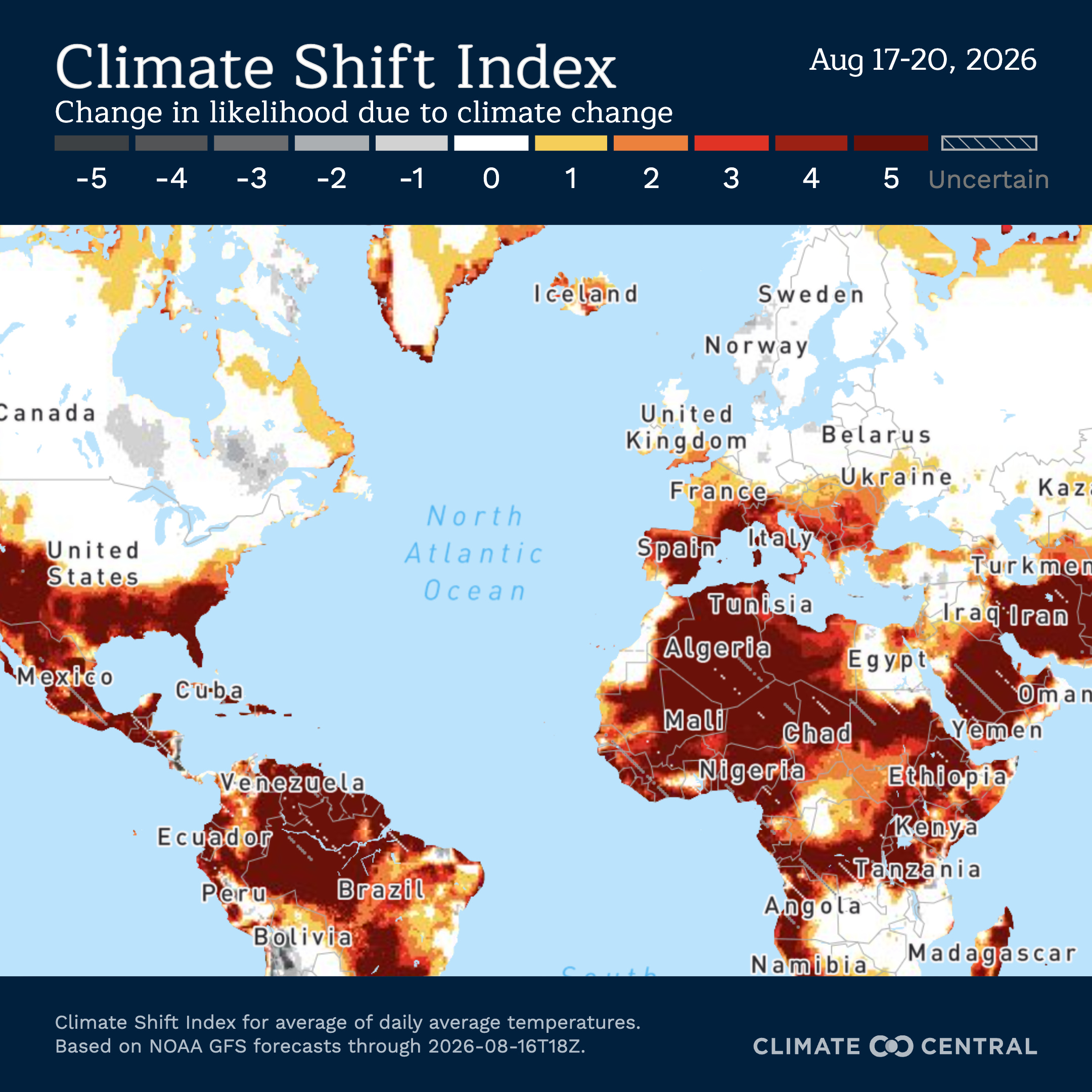
Climate change is drying landscapes and accelerating wildfire spread across England and Wales — Residents in the small English town of Stourbridge described the wildfires that destroyed more than a dozen homes last week as “horrendous” and “distressing.” On August 13, multiple fires spread across the West Midlands as temperatures reached 38.1°C during the UK’s fifth heatwave of 2026. Fifty-four people were treated at eight fires, including 19 who were hospitalized, while 19 homes in Stourbridge were destroyed and another 18 damaged. The fires are part of a record increase in wildfire activity across England and Wales. Firefighters responded to 966 wildfires between January 1 and August 10, including 185 during the first 10 days of August. The total has already surpassed the previous annual record of 1,017, set in 2025, while July was the busiest month on record. The surge has occurred amid prolonged heat and drought, with more than two-thirds of England and all of Wales officially in drought by early August. These climate-fueled conditions are priming vegetation for faster-moving and more intense wildfires. Hotter temperatures, reduced rainfall and recurrent drought are drying out soils and turning vegetation into increasingly dry “wildfire fuels”, the combustible organic material available to burn. When these fuels are exceptionally dry, fires can ignite more readily, burn more rapidly, and generate more heat, accelerating their spread. Low humidity can further limit moisture recovery, while strong or shifting winds can push flames across the landscape and carry burning embers ahead of the main fire, igniting new spot fires and allowing a blaze to expand rapidly. Once a fire starts, hot, dry and windy conditions can accelerate its growth and make it more difficult to contain. Climate change is making these high-fire-risk conditions more frequent. The consequences extend beyond the immediate danger of flames. Faster-moving fires can leave communities with less time to evacuate and place additional pressure on emergency services during periods when extreme heat, drought and other weather-related hazards already require resources to manage. They can also place additional pressure on emergency services during periods when extreme heat, drought and other weather-related hazards are already demanding resources. These impacts are not experienced equally. People with fewer financial resources may have less ability to evacuate quickly, temporarily relocate, replace damaged belongings or repair homes after a wildfire event. Renters may have limited control over the resilience of their housing, while people without reliable transportation or adequate insurance can face greater difficulty recovering after an evacuation or loss.
During a heatwave, closing windows can reduce smoke entering a home, but doing so can also allow indoor temperatures to rise. People without effective cooling, air filtration or well-insulated housing may have fewer options for reducing their exposure to either hazard. Wildfire smoke contains fine particulate matter, or PM2.5, along with gases and other pollutants. Acute exposure to fire-related PM2.5 can pose significant and immediate health risks, including respiratory and cardiovascular effects. Between 2010 and 2018, acute exposure to PM2.5 emitted from fires contributed to an estimated 99,000 deaths worldwide each year, on average.
Extreme heat is exposing a growing cooling divide across Greater London — Britain is experiencing its fifth heatwave of the year, with 2026 already recording a record four days with temperatures of at least 36°C (96.8°F). Two days have reached 38°C (100.4°F), matching the number recorded in 2022. More than 2,700 people may have died from heat-related causes in England and Wales during exceptionally hot weather in May and June, according to experts at Imperial College London, the Met Office and the London School of Hygiene and Tropical Medicine. More frequent extreme heat events across the UK is turning homes without air conditioning into potential hazards. England’s housing stock was largely built for a cooler climate. Many homes are designed to retain heat during the winter season rather than expel it during relatively mild summers. In August, Southern England experiences average daytime highs of 23–24°C (73–75°F) in Greater London, and 20–21°C (68–70°F) in the South West. However, climate-influenced extreme heat is altering these expected conditions. In Greater London, the number of days above 30°C (86°F) and nights above 18°C (64°F) more than quadrupled between 2016–2025 compared with 1961–1990. Hot nights are particularly concerning because nighttime heat can prevent the overnight cooling that allows the body to recover from extreme daytime temperatures. As heatwaves become hotter and longer, homes that were designed for a cooler climate can become increasingly ill-equipped to protect people from dangerous indoor temperatures. Research from the Energy Demand Research Centre found that air conditioning is currently used in only about 3% of UK homes, although demand for cooling is expected to increase substantially as temperatures rise. The National Energy System Operator estimates household AC adoption could reach 10% to 40% of UK households by 2050, depending on how the energy system evolves. But access to protection from extreme heat is not equal. The people facing some of the greatest risks of overheating can also have the fewest available resources to adapt. A Resolution Foundation analysis found that 54% of the poorest fifth of English households live in homes at high risk of overheating, compared with 18% of the wealthiest fifth. Two-thirds of social renters live in homes at the highest risk of overheating, compared with 17% of owner-occupied homes. Lower-income and minority ethnic households are also more likely to live in smaller flats, overcrowded properties and densely built neighborhoods that can trap heat. Housing tenure can further limit people's ability to adapt. Renters may have little control over improvements such as external shading, reflective materials or fixed cooling systems. The cost of cooling can also become a barrier, as households already struggling with energy bills may be unable to afford the electricity needed to run fans or potable air conditioners. The result is a cooling divide: households with greater financial resources can increasingly turn to air conditioning, better-designed homes and other adaptations, while those with fewer resources may have limited ability to change their living environment. The Energy Demand Research Centre study found that only 3% of households with someone over the age of 75 use air conditioning, compared with 4.6% of households without someone in that age group. AC usage also varies substantially by income, from 8.2% of households in the highest-earning fifth to 2.5% in the lowest-earning fifth. That disparity is particularly concerning as extreme heat becomes more common. The UK Climate Change Committee has warned that existing adaptation measures will not be enough to protect people from future heat and has called for greater attention to overheating in family homes, hospitals and care facilities.
Climate change is widening inequality across Central America as repeated shocks erode livelihoods — A recent report from Berkeley Law’s Human Rights Clinic finds that climate-related shocks are exacerbating poverty, disrupting access to food and water, and eroding fragile living conditions in El Salvador, Guatemala, Honduras and Nicaragua. More than 80% of surveyed migrants in Mexico experienced at least one climate event in the five years before leaving their homes, while 55% experienced four or more. Hurricanes, heatwaves and flooding were the most commonly reported hazards, followed by landslides, drought, changes in growing seasons and wildfires. The consequences are often cascading. Among respondents who experienced climate impacts, more than half reported losing jobs or crops, suffering property damage, or losing access to water or electricity. Large majorities also said climate-related impacts had left them without reliable access to clean water or food. Yet only about one-quarter said they had received government assistance. The inequitable ability to recover is particularly apparent in agriculture, where livelihoods often depend directly on unpredictable weather. El Salvador, for example, lies within Central America’s Dry Corridor, a region characterized by recurring drought, heavy rainfall and rising temperatures. The country has experienced three major periods of exceptional drought over the past decade. Around 87% of Salvadoran farmers are smallholders cultivating plots averaging roughly 1.2 hectares. Most rely almost entirely on rainfall and have limited access to irrigation, credit or insurance, leaving them with few financial buffers when extreme heat or drought damages crops. Recent research published in the American Economic Journal: Economic Policy found that extreme temperatures significantly reduce corn yields in El Salvador, with consequences for agricultural employment and international migration. For households already operating close to the edge, a climate shock can affect not only the harvest but also how much paid work is available and how much unpaid labor family members must provide. Farmers with limited irrigation or insurance may cut back on hired labor and rely more heavily on family members to absorb losses. Women often bear a disproportionate share of these pressures. Following climate events, women reported higher rates than men of lost work, disrupted access to food and water, crop losses and communication outages. Nearly half of female respondents said they became caregivers for sick or elderly relatives, while others took on responsibilities such as collecting water, securing food and providing emotional support. These burdens reflect a broader problem with climate adaptation: the ability to respond to climate hazards depends heavily on resources that are already distributed unequally. Farmers with access to irrigation, insurance, savings and/or credit have more options when a harvest fails. Households without those resources may have to reduce spending, rely on unpaid family labor or absorb losses that push them deeper into poverty.
The same pattern appears across the region. Honduran and Nicaraguan migrants reported the highest levels of climate exposure, with 95% of Honduran respondents and all Nicaraguan respondents reporting at least one climate event before leaving. In Honduras, hurricanes affected nearly three-quarters of respondents, while flooding affected two-thirds and heatwaves nearly 60%. In Nicaragua, hurricanes and heatwaves each affected 60% of respondents. For people already facing economic insecurity, repeated climate shocks can become cumulative rather than isolated setbacks. A damaged crop can mean lost income; lost income can reduce a household’s ability to afford food, water or healthcare; and each subsequent shock can leave fewer resources available to recover.
Climate shocks are driving migration across Central America — but repeated losses can leave people trapped — Climate change is shaping decisions about whether people can safely remain at home or have to leave, but the ability to migrate is itself unequal. A recent Berkeley Law Human Rights Clinic report finds that climate shocks are intensifying pressures on migrants from El Salvador, Guatemala, Honduras and Nicaragua, where environmental disruption intersects with violence, insecurity, unemployment and weak state protection. More than half of respondents who experienced climate events said environmental factors influenced their decision to leave, but climate change rarely acted alone. Insecurity (66%), violence (62%) and unemployment (54%) were also major drivers, illustrating how climate change can act as a threat multiplier. A flood, failed harvest or other environmental shock can undermine a household’s livelihood, while the resulting loss of income or access to basic necessities can increase exposure to other forms of harm. For people already living amid violence or discrimination, an environmental shock can narrow their options even further. Migration can become one of those options. Research published in the American Economic Journal: Economic Policy found that extreme heat in El Salvador can reduce agricultural productivity and contribute to international migration, as households respond to income losses by sending a member abroad. But migration is not equally available to everyone. For households with limited savings or other assets, a single climate shock may prompt a family member to leave in search of work. Repeated losses, however, can deplete the resources needed to finance a move. Families can become caught in a “mobility trap,” unable to sustain their livelihoods at home but also unable to afford the cost of leaving. That distinction complicates the idea of migration as a failure to adapt. When households have sufficient resources and agency, migration can be a deliberate strategy for managing climate and economic risks. After better years, for example, some families may have enough income to invest in migration and improve their economic prospects. But when repeated shocks erode those resources, migration can shift from a choice to an option that is simply out of reach. Gender can further shape who has the ability to move and under what circumstances. The Berkeley report found that women often took on greater caregiving responsibilities following climate events, including caring for sick or elderly relatives and helping secure food and water. For some, climate-related pressures also intersected directly with violence: 22% of female respondents said they were fleeing gender-based violence.
One woman’s experience in El Progreso, Honduras, illustrates how these pressures can compound. Flooding and crop losses caused her to lose agricultural work, while hunger and unemployment were compounded by the challenges of raising children alone and having limited formal education. Insecurity related to organized crime added another reason to leave. Her experience underscores why climate migration cannot be separated neatly from other forms of vulnerability. Environmental disruption may begin with a climate shock, but its consequences can spread through employment, food security, family responsibilities and personal safety.
Have you noticed the impacts of climate change in your community? Whether it’s unusual weather patterns or disruptions in local ecosystems, we’d love to hear your thoughts. Share your experiences or observations in the comments below and join the conversation!
At Global Climate Dispatch, we strive to provide accurate and equitable coverage of climate change and its impacts. If you come across anything that seems inaccurate or concerning, please don’t hesitate to let us know. Your insights help us ensure that the information we share remains truthful, balanced, and relevant to all.
Locations featured are chosen based on data from Climate Central’s Climate Shift Index map. Some graphics used may also come from Climate Central’s Climate Shift Index map. Any original analyses contained in this blog or any views expressed in this blog, unless otherwise noted, are solely the expression of its authors and are unaffiliated with Climate Central or any other entity or person referenced within.1
Comments
Nothing yet. Say the first thing.
Sign in to join the conversation.