
Polluted rivers, unstable rainfall, floods, drought, and warming forests are changing access to water, food, health care, land, and cultural life. In Iraq and Syria, drought, water scarcity, and years of conflict are limiting rural livelihoods, schooling, protection from early marriage, and access to reproductive and maternal health care, especially for girls and women. In Colombia, Indigenous children and Afro-Colombian families are facing health, housing, and displacement risks tied to unsafe water, damaged land, and weak state protection. Across the Amazon, warming could reduce the plants that carry food, medicine, and language-based knowledge. In Tanzania and Malawi, floods are straining aid projects, maternal care, infectious disease control, food security, and basic health services. In southern Madagascar, drought, heat, wind, and sandstorms are tying adolescent mental health to water, food, school, family resources, and the routines that make daily life bearable.1
Need to read this in a language other than English? Try OpenL (up to 1,500 characters) or Google Translate—both offer free translations into 100+ languages.
The cascading effects of climate change and armed conflict are intensifying pressures on families in Iraq, with consequences that can be particularly severe for girls and women — As climate-influenced water scarcity and environmental degradation undermine rural livelihoods, decades of war and displacement have weakened the social and economic protections available to Iraq’s most vulnerable households. In this context, forced child marriage can become a coping strategy for families facing extreme financial hardship. A catastrophic multi-year drought is easing in Iraq, but the country’s underlying water emergency persists. Ranked among the world’s most climate-vulnerable countries by the United Nations, Iraq experienced above-normal rainfall and a surge in transboundary river flows during the winter and spring of 2026, providing vital but temporary relief. Environmental experts and international humanitarian organizations warn that rising temperatures, desertification, and complex water politics with neighboring countries are driving a severe, long-term decline in water availability. Climate change and recurrent conflict disproportionately affect Iraqi girls and women through entrenched gender inequalities, legal and structural barriers, and unequal domestic responsibilities. Deeply rooted social norms, particularly in rural areas, confine many women to domestic roles, limit their financial independence, and restrict their participation in household decision-making.
Women also rely heavily on informal agricultural activities, including small-scale farming, livestock herding, and poultry raising, for household food security, family nutrition, and modest income. As drought and water scarcity degrade farmland and reduce livestock productivity, these livelihood opportunities diminish, often leaving women without access to formal employment, social protection, technical training, or alternative sources of income. Decades of external wars and internal conflict have compounded these vulnerabilities, leaving many women widowed and responsible for supporting their households alone. According to UN Women, widows constitute an estimated 80% of female-headed households in Iraq, with the remainder headed by divorced or separated women or women caring for sick spouses. As men have been killed or disappeared during successive periods of violence, female-headed households have faced significant barriers to land ownership, formal employment, and access to financial resources, increasing their exposure to poverty and economic insecurity across generations. At the same time, political instability and legal rollbacks have further weakened protections for Iraqi women and girls. Where civil institutions are weak, women and girls may have little recourse against domestic violence, exploitation, or forced marriage. For families pushed into extreme poverty, child marriage can become a desperate coping mechanism. When household income disappears, daughters may be viewed as an economic burden, particularly when families can no longer afford basic needs such as food, water, clothing, education, and medical care. Marrying a daughter can reduce household expenses by transferring responsibility for her care to another family. Additionally, the mahr, or marriage payment provided by the groom’s family, can also provide an immediate source of cash, which families may use to settle debts, purchase food, or finance voluntary migration.
Decades of violent conflict and forced displacement, combined with the climate-related loss of rural livelihoods in southern governorates such as Basra, can also force families to withdraw children from school to work, provide care, or relocate. For girls, leaving school can dramatically increase the risk of early and forced marriage. More than 46% of child brides in Iraq have no formal education, compared with fewer than 9% who have completed secondary school. Once girls leave school, their opportunities for economic independence narrow further, reinforcing a cycle in which climate and conflict erode livelihoods, poverty disrupts education, and lost educational opportunities increase vulnerability to child marriage and lifelong economic dependence.
The pressures of armed conflict and climate change are limiting access to essential health and reproductive care in Syria — After more than a decade of armed conflict, Syria’s humanitarian crisis remains one of the world’s largest. Forced displacement, extreme poverty, violence and environmental degradation fueled by climate change continue to undermine access to basic services. Within Syria, 6.7 million people are internally displaced, including 4.4 million women and children, while an estimated 2.4 million Syrian children are not in school. These overlapping crises have had particularly severe consequences for women and girls, who face heightened risks of sexual and gender-based violence and significant barriers to essential health and sexual and reproductive healthcare.
Climate change is compounding these pressures. Prolonged drought, extreme heat and widespread water scarcity are undermining agricultural livelihoods, with women comprising more than 60 percent of Syria’s agricultural labor force. In April 2025, nearly 100 percent of crops were reported to have been damaged due to a lack of rainfall in Syrian Kurdistan, the country’s agricultural breadbasket. As climate-related crop failures deepen poverty and food insecurity, families can face greater difficulty affording transportation and other costs associated with accessing healthcare. At the same time, years of sustained violence have severely weakened Syria’s health system. Only 52 percent of primary health centers remain operational, while an estimated 30 percent of healthcare workers remain. As a result, many women and girls lack access to essential services, including contraception, antenatal and postnatal care, skilled birth attendance and other sexual and reproductive healthcare. In conflict-affected areas, even basic reproductive health services can be unavailable.
These barriers to healthcare can be disproportionately dangerous for adolescent girls. Displacement, poverty and instability have contributed to increased rates of early and forced marriage in some Syrian communities, with one study finding a 34 percent increase in child marriage following the onset of the conflict in 2011. When child marriage leads to adolescent pregnancy, limited access to reproductive and maternal healthcare can increase the risk of life-threatening complications. Globally, pregnancy and childbirth complications are among the leading causes of death for girls aged 15–19. The consequences extend beyond pregnancy. Without access to contraception, reproductive health information and maternal care, women and girls have fewer opportunities to make informed decisions about their health, bodies and futures. According to the World Health Organization (WHO), approximately 12 million girls aged 15–19 and more than 750,000 girls under age 15 give birth each year in developing countries.
Climate change, polluted water, and food insecurity are affecting Indigenous children’s health in Colombia — In Caldas, Colombia, the Emberá-Dobidá Indigenous community, a name tied to their historical relationship with the river, is living with new environmental stress after being displaced by armed conflict from Alto Baudó, Chocó. Families were resettled near a polluted river with no fish and no clean drinking water. That move cut children off from the river-based fishing, farming, and food systems that had shaped daily and cultural life in their ancestral territory. The new settlement is hotter, with far less shade, tree cover, or water access than the community had known before. Children and caregivers described heat that made it harder to farm, fish, gather food, care for family members, work outside, and spend time outdoors. One 13-year-old described arriving somewhere with no river, less forest cover, and far less shade than the community had known. A 16-year-old said the sun made work difficult and damaged their skin. Nearly all families reported not having enough food, and more than 70% reported not having enough money to buy food. Among children, 50% had chronic malnutrition, 20% had incomplete vaccination, 35% had dental caries, and 30% each had palmar pallor, scabies, or fever.
Half of the children showed emotional problems, and 30% were identified as being at risk of suicide. Mental health problems were strongly linked with missing ancestral territory, limited access to clean water, difficulty reaching clean rivers, lack of traditional foods such as meat, eggs, and milk, problems cultivating land, and feeling out of place in the new settlement. Water loss cuts especially deeply for the Emberá-Dobidá because the community’s identity, health, and daily life are tied to rivers. One mother described dirty water, the disappearance of fish, children getting sick, and the injustice of children paying for damage they did not cause. A community leader described the Emberá-Dobidá as People of the River and said being far from clean water made the community sick because it separated them from their identity. Children are living with hunger, chronic malnutrition, illness, skin problems, unsafe water, fewer places to play, disrupted farming and fishing, and separation from the land and rivers that shaped family and community life. The results come from a small community already affected by armed conflict and displacement, so they should not be read as proof that climate change alone caused these harms. Climate-related heat, degraded water, food insecurity, and loss of ancestral territory are overlapping in the same children’s bodies, routines, and mental health.
Climate change is intensifying displacement for Afro-Colombian communities from Colombia’s Chocó — In Colombia’s Pacific coastal department of Chocó, Afro-Colombian communities are facing climate stress on top of armed conflict, poverty, illegal mining, logging, and long-standing state neglect. For families whose livelihoods depend on small-scale farming and fishing, environmental damage reaches food, income, land, and whether people can remain where they are. Families interviewed in Medellín described rainfall patterns that residents say have shifted substantially, with floods arriving with less warning, longer dry stretches than before, growing strain on drinking water sources, and soil degradation that makes planting and harvesting more difficult. Logging and gold mining have added to the damage by polluting rivers, increasing sedimentation, accelerating riverbank erosion, and leaving some farmland harder to use. One older woman from the San Juan basin described losing fields and animals before the water finally destroyed the family’s home. Requests to local authorities went unanswered, and with nothing left to hold them there, the family left.
Many families displaced from the Chocó end up in Medellín, but arrival in the city does not necessarily mean safety. Afro-Colombian families are often pushed to steep hillsides, informal settlements, flood-prone ravines, and neighborhoods where housing is precarious, land tenure is unrecognized, and basic services including clean water and sanitation are unreliable. Some families leave floods, polluted rivers, and failing livelihoods in the Chocó only to face landslide risk, water shortages, insecure housing, discriminatory treatment in rental markets and policing, and systematic exclusion from local governance in Medellín. Colombia’s legal framework recognizes internal displacement from conflict, but climate-related displacement has often been harder to register and receive support for. A 2024 Constitutional Court ruling recognized climate change as a contributing factor to internal displacement, opening a pathway for more protection, but Afro-Colombian families still face practical barriers to aid, housing, psychosocial support, and recognition.
San Basilio de Palenque, about 38 miles from Cartagena, carries another part of Afro-Colombian history. The village grew out of maroon communities formed by escaped enslaved people and is often described as the earliest place in the Americas where formerly enslaved people won lasting freedom and self-rule. Palenque has preserved language, music, funerary traditions, community governance, and women’s economic labor despite racism, poverty, weak infrastructure, limited political autonomy, and unreliable basic services. Palenquera women have become one of Colombia’s most recognizable tourism images, but many of the women who sell fruit and sweets under the coastal sun lack formal employment protections, health care, social security, retirement benefits, and a fair share of the tourism income built around their image. Afro-Colombian culture is visible to the country in both places, while the communities carrying it are still fighting for land security, basic services, and state protection.
Warming could erode Amazon plant knowledge along with the plants themselves — Amazonia is home to over a tenth of the planet's land-based species, more than 400 distinct Indigenous groups, and much of the region’s plant knowledge is tied to particular languages, territories, foods, medicines, and cultural practices. A basin-wide database compiled 90,536 records from 700 references across nine Amazon countries and 156 Indigenous languages. It identified 5,796 native plant species with documented human uses, roughly a third of all known seed plants in the Amazon. The most frequently cited species were all palms, including peach palm, ungurahua, moriche palm, açaí palm, and pambil palm. Palms have been used in the region for thousands of years and remain important for food security and cultural practice. Indigenous groups accounted for far more of the documented species than non-Indigenous ones, 4,305 species versus 1,012. A plant used for food, medicine, construction, ritual, or daily tools in one language community may not have the same recorded use anywhere else.
The plants documented as useful are projected to lose more range than plants not recorded as useful. Indigenous cultures in the analysis could lose an average of 28% to 34% of utilized plant species within their territories by 2060–2080, depending on the emissions scenario. The services connected to those plants could decline by 18% to 23%. The largest losses are projected in areas where languages are already threatened, adding another layer of risk for knowledge that is often passed through oral teaching and daily practice. Medicinal uses made up the largest share of records in the database, with nearly three times as many records as food uses and twice as many plant species documented. If those plants become harder to find locally, the loss can affect healing practices, food security, ceremonies, construction materials, and the everyday work of naming, harvesting, preparing, and teaching plants. If threatened Indigenous languages disappear by the end of the century, the Amazonian plant-knowledge network in the analysis would shrink by 26%, and possibly more under less conservative assumptions. The projections do not include deforestation, fire, mining, or extreme events. Those threats are already affecting plant use before local disappearance occurs. After the 2024 extreme drought, Brazil nut harvest losses in 2025 affected food security from Rondônia to Amapá, disrupting people’s relationships with important plants well before those species vanish from a place.
Floods are affecting aid projects in rural Tanzania — In Tanzania’s Kilosa District, new clinics, boreholes, bridges, nutrition programs, and farming support are being built for communities already living with poverty, long travel distances, unsafe water, and high health needs. Pregnant women in Madudumizi used to walk for hours to reach a clinic in another village, crossing a river that could become dangerous during the rainy season. A new clinic and deep borehole have changed access to maternal care and clean water, but the area around the Mkondoa River is now dealing with heavier rains, repeated flooding, damaged roads, eroded riverbanks, and fields buried under silt. World Vision’s Ulaya area programme covers 13 villages where nearly all people depend on rain-fed farming for food and income. When rains arrive at the wrong time, or floodwaters sit on farms for weeks, families lose crops, roads become harder to pass, and health workers see more malaria, respiratory infections, diarrhea, and other illnesses linked with standing water and unsafe water access.
Flooding is also complicating the work aid programs are trying to do. Mothers in Zombo had learned new nutrition practices through a mother-and-toddler group, but submerged farms left families worried they would not be able to grow enough food or earn enough money to buy what their children need. Deep boreholes have improved clean water access in some villages, while shallower boreholes elsewhere are drying out during dry seasons because heavy rainfall runs off compacted soil before it can replenish the water table the boreholes draw from. A bridge completed only two years ago is already cracking as the river expands after repeated heavy rainfall. Flooding is increasing illness just as aid cuts have made some malaria medicines previously supplied by USAID unavailable. Aid workers across Tanzania described heavy rains keeping children home from school and away from vaccination appointments, families facing hunger after failed harvests, and financially strained households making choices that put children at greater risk, from pulling kids out of school to arranging early marriages to increased exposure to violence. Farmers are being trained to use more resilient crops, including sunflower, sesame, pumpkin, and legumes, but some conflicts are already emerging where shrinking and degraded grazing land has pushed pastoral communities and their cattle onto farmland.
Floods are straining maternal care, child health, and food security in Malawi — Malawi’s rural health and food systems were already vulnerable before Tropical Cyclone Ana brought torrential rain in January 2022. About 85% of the population lives in rural communities, many households depend on rain-fed agriculture, and food insecurity was already widespread before the storm. When Ana flooded large parts of southern and central Malawi, the damage reached homes, crops, roads, water systems, sanitation systems, and health facilities at the same time. Several of the country's poorest southern districts, among them Phalombe, Mulanje, Chikwawa, and Nsanje, absorbed the worst of the damage. Displacement made pregnancy more dangerous at exactly the moment medical care itself was breaking down. Outages spoiled medicine stocks, knocked out vaccine refrigeration, and left reproductive health services badly disrupted. Nsanje District alone counted more than 55,000 displaced residents, roughly 1,500 of them pregnant. Displaced women faced longer journeys for water and firewood and shared inadequate sanitation facilities with many others, conditions that raised their risk of violence.
Damaged water and sanitation systems left families facing cholera, typhoid, and leptospirosis, while standing water created more mosquito habitat and drove malaria transmission higher. Women produce much of the food consumed locally, but when floods destroy crops and push food prices up, households headed by women tend to have fewer resources to fall back on. Years of forest loss from charcoal production and farming have left the land less able to absorb heavy rain, making floods worse and recovery harder. A flood can interrupt prenatal care, spoil medicine, break vaccine storage, contaminate drinking water, increase malaria risk, destroy crops, and leave families with less money to buy food. In places where households and health systems are already stretched, the water does not have to stay long to leave months of damage behind.
In southern Madagascar, climate distress is tied to hunger, thirst, and interrupted childhood routines — Across six rural villages near Ambovombe in Androy, southern Madagascar, adolescents described hotter days, longer drought, stronger winds, and more sandstorms. Because many families rely on farming and livestock, those changes were tied to crops failing, water sources drying up, school being interrupted, and possessions being sold to buy food. Survey and focus group data included 83 adolescents and young adults ages 10 to 24, all living with multidimensional poverty. Very few lived in households with electricity; almost no household owned any form of motorized transport or a computer. About 82% screened in the range for probable depression, 76% to 87% screened in the range for generalized anxiety, and climate worry was high. Food insecurity was severe too. Nearly all the adolescents surveyed, 90%, had lived in a household that ran out of food in the past year. A larger share, 95%, had gone hungry outright, and more than two-thirds, 69%, had spent a full day with nothing to eat.
Young people described climate change less as a distant fear than as food and water disappearing from daily life. Heat, drought, failed rains, and wind left crops struggling, boreholes dry, and some families eating cassava again and again because there was little else. Several adolescents described families selling pots and other belongings to buy food. Others described seeing people die from hunger, fearing starvation, or feeling trapped by weather they could no longer predict. Rain brought relief because it meant crops might grow. Drought, wind, and sandstorms brought fear, sadness, discouragement, and helplessness. Climate stress also disrupted the routines young people used to get through it. Sandstorms kept some adolescents out of school or led teachers to cancel classes, and lost household income kept others from paying school fees. Music and dancing came up as ways to cope, but many households did not have radios or had sold possessions to buy food. Some adolescents described having little to do except stay around, play, or think about hunger. The study was small and preliminary, but young people’s climate distress was tied to water to drink, food to eat, school to attend, family assets left to sell, and small routines that made daily life feel bearable.
Have you noticed the impacts of climate change in your community? Whether it’s unusual weather patterns or disruptions in local ecosystems, we’d love to hear your thoughts. Share your experiences or observations in the comments below and join the conversation!
At Global Climate Dispatch, we strive to provide accurate and equitable coverage of climate change and its impacts. If you come across anything that seems inaccurate or concerning, please don’t hesitate to let us know. Your insights help us ensure that the information we share remains truthful, balanced, and relevant to all.
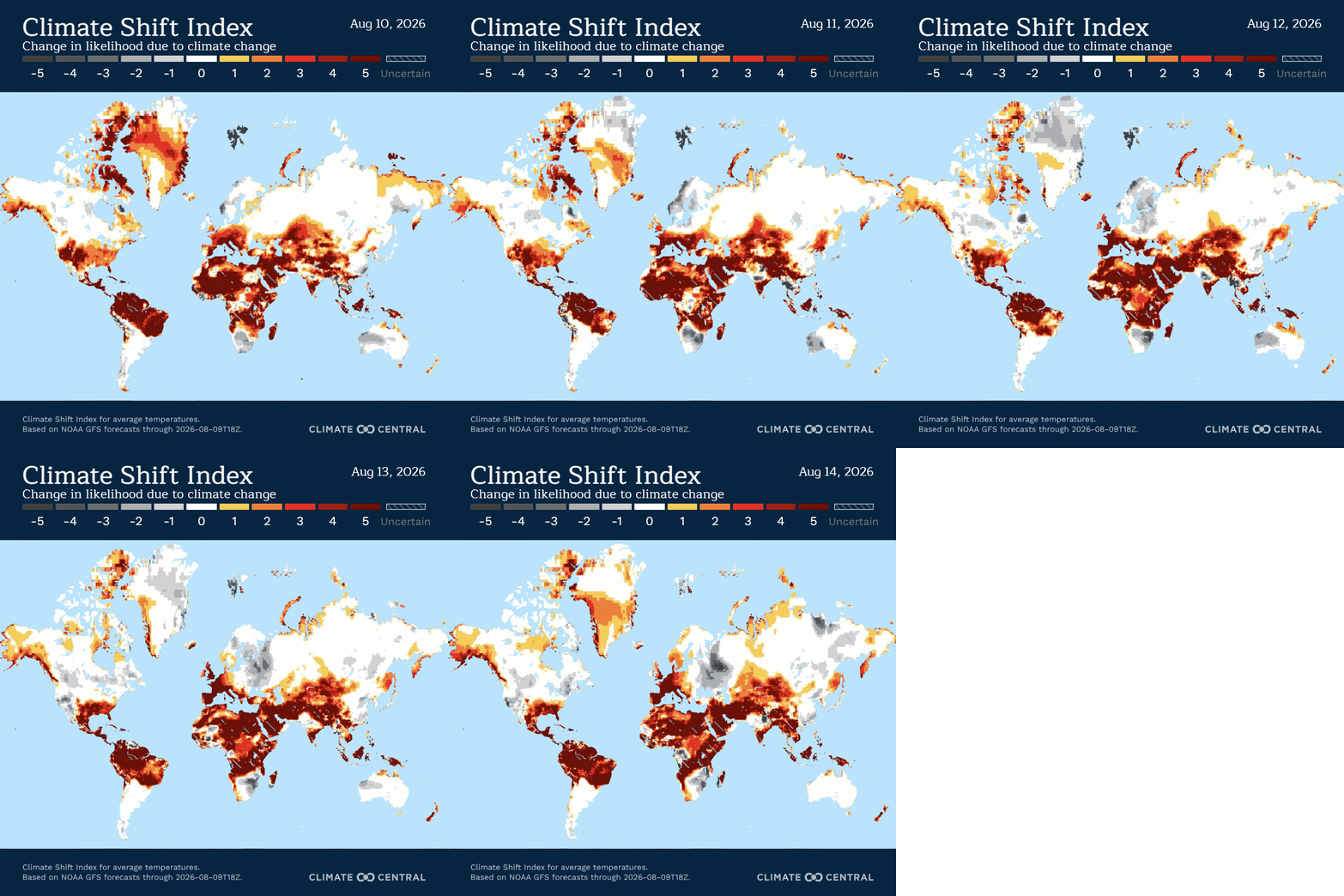
Locations featured are chosen based on data from Climate Central’s Climate Shift Index map. Some graphics used may also come from Climate Central’s Climate Shift Index map. Any original analyses contained in this blog or any views expressed in this blog, unless otherwise noted, are solely the expression of its authors and are unaffiliated with Climate Central or any other entity or person referenced within.
Comments
Nothing yet. Say the first thing.
Sign in to join the conversation.