
Extreme heat, floods, fire, and warming seas are changing daily life from East Asia to the Caribbean. In South Korea and Japan, dangerous heat is affecting outdoor work, livestock, rice, classrooms, public events, and the seasons people organize their lives around. In Indonesia and Papua New Guinea, climate change is narrowing safe places for animals and children, from shallow reefs and low-lying Komodo dragon habitat to a flood-damaged school route that still has not been rebuilt. In Thailand, forest monks are treating conservation and restoration as religious work as fires, drought, and forest loss make community forests harder to protect. And across the Greater Antilles, stronger disasters and rising heat are adding costs to countries that have contributed little to the warming driving those risks.1
Need to read this in a language other than English? Try OpenL (up to 1,500 characters) or Google Translate—both offer free translations into 100+ languages.
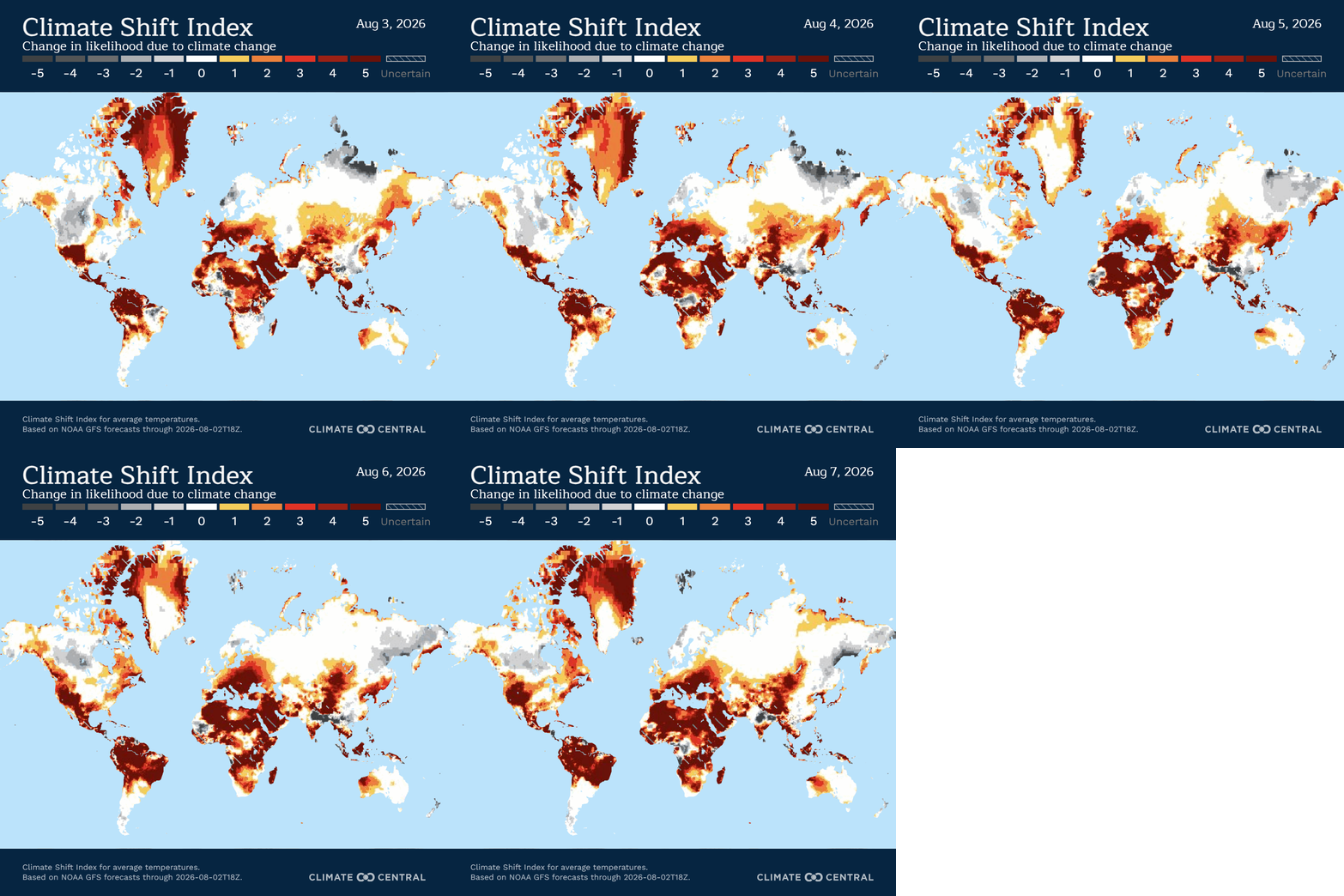
South Korea’s record heat is hitting workers, farmers, livestock, and public life — South Korea’s heatwave has pushed temperatures above 40°C (104°F), broken national records, and made daily life dangerous for people who cannot easily avoid the heat. On July 31, Yangsan in South Gyeongsang Province reached 41.4°C (106.5°F), the highest temperature recorded in South Korea since the national weather observation network was expanded in 1973. Yangsan had already climbed above 40°C (104°F) for three straight days, and the heat continued into August. The Korea Meteorological Administration linked the extreme temperatures to a double high-pressure system over the Korean Peninsula, with hot, dry air from the Tibetan high-pressure system above the country and warm, humid air from the North Pacific high-pressure system closer to the surface. The setup trapped heat over the country, and tropical nights kept temperatures from falling enough for people, buildings, roads, farms, and animals to recover overnight. The people most exposed include workers and farmers whose jobs still have to happen outside. Construction workers, delivery drivers, sanitation workers, palace guards, and farmers have continued working through dangerous temperatures. In Seoul, a sanitation worker in his 60s collapsed while cleaning streets in Jongno-gu. At Gwanghwamun, palace guards continued changing-of-the-guard ceremonies in long robes and armor, though tourist photo sessions were shortened and some ceremonies at Deoksugung Palace were canceled. In Cheongdo, an 85-year-old peach farmer began harvesting as early as 4:30 a.m. to avoid the worst heat. His adult children took time off work to help with the harvest and keep him from overexerting himself. Earlier start times, shorter ceremonies, cooling supplies, and family help can reduce some danger, but much of this work still keeps people outside and at risk.
Several of the deaths involved people working or found outdoors during the heat. South Korea’s disease control agency reported six heat-related deaths since July 14, including a 100-year-old woman found dead in a field in Wanju County with a reported body temperature of 42.2°C (108°F). A Thai worker in his 30s died after collapsing near a field in Haenam County, and a 93-year-old man died after being found collapsed in a rice field in Sacheon. By late July, more than 1,300 heat-related illness cases had been reported nationwide. Many occurred outdoors in farms, rice fields, construction sites, maritime workplaces, and other job sites where people have limited protection from the heat.
Farm animals are also struggling. At a Hanwoo cattle farm in Imsil County, six large fans ran continuously while barn temperatures stayed around 37°C (98.6°F). The farmer fed cattle mineral blocks, sweet potato vines, and corn to help them get through the heat, but said mother cows were producing less milk. By July 25, nearly 256,000 livestock had died from the heatwave, mostly poultry. Farmers were using ventilation systems, cooling pads, and ice, but the losses kept growing as temperatures stayed dangerously high.
The heat has reached markets, roads, and sports, too. In Yangsan, market vendors worked with wet towels around their necks and used ice packs and fans, but merchants said customer numbers had fallen by nearly half since the heatwave began. City workers sprayed roads with water to cool them down, but the water evaporated within minutes, forcing trucks to refill again and again through the day. South Korea’s baseball league canceled two professional games in Busan and Changwon on August 1 after the highest level of heat warning was issued in both cities. The cancellations were made to protect players and spectators as the heat made even evening public events harder to hold safely.
South Korea’s climate zones are moving north as the country warms — A Korea Meteorological Administration analysis found that South Korea’s annual mean temperature rose by about 0.3°C per decade from 1973 to 2025, with much faster warming over the most recent decade. From 2016 to 2025, the country’s annual mean temperature increased by 1.1°C per decade. The agency analyzed temperature and precipitation data from 66 locations between 1981 and 2025, along with national climate change scenarios through 2100, to track where subtropical climate characteristics are already appearing and where they could expand. Under the Trewartha climate classification, a region can be considered subtropical when the coldest month averages 18°C or lower and at least eight months of the year have average temperatures of 10°C or higher. During the 1991–2020 climate normal period, about 80% of South Korea had seven months above that 10°C threshold, from April through October. Warmer March and November temperatures are pushing more places closer to the eight-month threshold by lengthening the warm season.
The changes are already visible along the south coast and in some inland and eastern areas. Using the 1981–2010 normal period as a baseline, 13 locations along the south coast, including four sites on Jeju Island as well as Busan, Yeosu, and Mokpo, already met the criteria for a subtropical climate. Ulsan later crossed that threshold during the 1991–2020 normal period. In the most recent decade, Gwangju, Uljin, and Gangneung were added, bringing the number of locations with subtropical characteristics to 17. The Korea Meteorological Administration found that these conditions are advancing northward from the south coast into southern inland regions, while rapidly warming sea surface temperatures in the East Sea are raising temperatures along the east coast. By the late 21st century, the projected changes depend heavily on emissions. Under a low-carbon scenario, subtropical climates over land would remain mostly limited to southern regions. Under high-carbon scenarios, most of South Korea, except for inland Gangwon Province, is projected to shift toward a subtropical climate by 2081–2100. Those changes would reach beyond temperature averages, affecting crop-growing zones, animal habitats, plant productivity, fish populations, and the seasonal conditions that shape farming, ecosystems, fisheries, and daily life.
Climate change is pushing Japan into longer, harsher heat seasons — Japan’s summers are getting long enough and hot enough that the country has had to add new language for them. In April 2026, the Japan Meteorological Agency adopted the term “Kokushobi,” or “cruelly hot day,” for days reaching 40°C (104°F) or higher. Japan recorded 40°C days only three times between 1872 and 2017, but they have occurred every year since 2018, with temperatures reaching 41.8°C (107.2°F) in 2025. The shift is happening against a warmer baseline. Land temperatures in Japan have climbed roughly 1.4°C per century, while sea temperatures nearby have warmed at a similar pace, around 1.36°C per century. Summers have also lengthened by roughly three weeks since 1982, leaving less of the year in the milder spring and autumn seasons that have shaped farming, festivals, school calendars, and daily routines. Heatstroke deaths exceeded 2,000 for the first time in 2024, and older adults account for about 80% of heatstroke deaths. In Tokyo, about 90% of heatstroke deaths occur indoors. Air conditioning is common in Japanese homes, but running it through longer and hotter summers can raise household electricity use by around 40%, making cooling harder for lower-income households that are already trying to manage higher bills.
The heat is also reaching schools, workplaces, farms, fisheries, and familiar landscapes. In urban areas, schools are already cutting back outdoor playtime during extreme heat, including about 30.6% of schools in one survey and 35.3% of urban schools. Japan lost an estimated 1.42 billion potential labor hours to heat exposure in 2024, equal to about 43 hours per person and nearly $49.4 billion in potential income losses. Heatstroke cases at work have been highest in manufacturing, construction, commerce, transportation, and security, while deaths during work in agriculture, forestry, and fisheries have been rising in recent years. Agriculture is also becoming more vulnerable as temperatures climb. Japan’s environment ministry has warned that rice yields could fall by up to 20% under a high-warming scenario. Heat can also damage rice quality before yields fall. When average temperatures stay above 26°C to 27°C during the 20 days after flowering, more grains become white, opaque, and immature, lowering their commercial value. If temperatures reach 35°C or higher for several days during flowering, pollination can be disrupted, leaving grains sterile or undeveloped, a problem that was widespread in Kyūshū in 2024.
In the ocean, warmer water is changing fisheries as warm-water species expand and cold-water species such as chum salmon lose suitable habitat. Some of Japan’s best-known seasonal markers are changing, too. Cherry blossoms are reaching peak bloom earlier, and warmer winters can reduce bloom intensity. On Mount Fuji, subzero days at the summit are decreasing by about 15 days per century, raising the possibility of shorter snowcap seasons and changes to downstream meltwater. Japan is responding with workplace heat rules, fan-equipped jackets, and efforts to lower household cooling costs, but the heat is already altering how people work, cool their homes, grow food, manage fisheries, protect children, and mark the seasons.
Climate change and habitat loss are leaving Indonesia’s wildlife with fewer safe places to live — Indonesia’s forests, reefs, seagrass beds, mangroves, and coastal grasslands support some of the world’s most distinctive wildlife, but many of those habitats are being damaged by development and climate change. Forest loss is especially important because Indonesia’s rainforests are home to endangered species such as orangutans, Sumatran tigers, elephants, and rhinoceroses, and because forests help reduce the impacts of extreme weather. Trees and vegetation absorb rainfall, hold soil in place, reduce erosion, and release moisture during dry seasons. When forests are logged, burned, cleared for plantations, or opened by roads and mining, animals lose habitat, and nearby communities lose some protection from floods, landslides, drought, and fires. More than 74 million hectares of Indonesian rainforest have been logged, burned, or degraded since 1950, according to Global Forest Watch. That loss removes habitat now and releases stored carbon into the atmosphere, adding to the warming that is making floods, drought, fires, sea-level rise, and hotter seas more damaging for people and wildlife.
Komodo dragons have little room to lose. The world’s largest lizards live only in parts of Indonesia, mainly Komodo National Park and nearby Flores, and only a few thousand remain. The International Union for Conservation of Nature has listed the species as Endangered, citing habitat loss, wildlife trafficking, tourism development, rising temperatures, and sea-level rise. Komodo dragons live in forests and open grassland, but they cannot survive above 700 meters, so moving uphill is not a simple escape as low-lying habitat becomes more exposed to rising seas. The IUCN projects that rising temperatures and sea-level rise could reduce their habitat by at least 30% over 45 years. On Flores, where dragons outside protected areas are especially vulnerable, habitat had already shrunk by more than 40% between 1970 and 2000 because of human activity. Tourism projects in and around Komodo National Park add another layer of risk by pushing development into places the species still needs.
In Raja Ampat, habitat loss is also reaching shallow coastal waters, affecting the epaulette shark, also known as the “walking shark.” Juveniles use coral reefs as nursery habitat, and adults forage among seagrass and mangrove roots. The sharks stayed close to home, with individual movements rarely exceeding 475 meters and no crossings between islands recorded during the study. Local damage can matter a lot for this species because a shark whose reef or seagrass bed is degraded may not be able to shift somewhere else. Tourism development is already affecting some of those areas, including overwater homestays built above seagrass beds. Warmer seas and more frequent marine heatwaves add risk for a species that depends on stable shallow-water ecosystems, while untreated wastewater from tourism can fuel algae growth that damages coral reefs. For Indonesia’s wildlife, climate risk is habitat risk. As forests, reefs, seagrass beds, mangroves, and coastal grasslands are cleared, warmed, polluted, or flooded, animals lose the food, shelter, breeding sites, and room to move that keep populations alive.
Climate change is putting children in Papua New Guinea at risk before, during, and long after disasters — Children in Papua New Guinea are facing climate risks that overlap with existing gaps in health care, nutrition, education, safe water, and sanitation. A 2026 UNICEF report found that around 1.5 million children, or 1 in 3 children in the country, are exposed to at least two overlapping climate hazards. More than 305,000 children are exposed to three overlapping hazards. The risks include more than 2.6 million children exposed to drought, more than 1.8 million exposed to frequent, longer, and severe heatwaves, more than 600,000 exposed to tropical storms, nearly 200,000 exposed to riverine flooding, and close to 150,000 exposed to frequent fires. Almost 4 million children, nearly every child in Papua New Guinea, are exposed to malaria, a climate-sensitive disease and one of the country’s most serious health risks. Less than half of children in Papua New Guinea receive routine immunization, one in four children experiences severe food poverty, and many communities still have limited access to safe water, sanitation, and hygiene services. Floods, droughts, storms, and extreme heat can damage schools, contaminate water sources, disrupt health care, interrupt learning, deepen food insecurity, and make it harder for children to reach the services they rely on.
One school route in Papua New Guinea shows how long climate-related damage can stay in a child’s life. In the Rigo District, an extreme flood washed away the footbridge connecting one village to its primary school and health post in 2012. More than a decade later, children still swim across the Kemp Welch River to get to class. They carry school bags and uniforms in a dish, cross a river known for strong currents and crocodiles, change into dry clothes after reaching the other side, and continue on to school. Monsoon rains make the crossing more unpredictable, as debris and fast-moving water create additional hazards, and children arrive at school sick or have lost their belongings to the current. Girls can miss school during menstruation because elders fear blood could draw crocodiles. The destroyed bridge turned one flood into years of missed classes, unsafe crossings, illness, and lost access to a nearby health post. Papua New Guinea’s climate risks are measured in droughts, heatwaves, tropical storms, river floods, fires, and malaria exposure, but they also appear in the daily routes children take to school, the water they cross, the clinics they can reach, and the services that are still missing after the last disaster.
Climate change is changing the work of Thailand’s forest monks — In northern Thailand, Buddhist environmental work has grown out of a close relationship between forests, farms, water, and rural livelihoods. In Nan Province, Buddhist monks have worked with farmers, nongovernmental organizations, and sometimes state agencies to move away from cash-cropping and contract farming that contributed to deforestation, debt, soil erosion, flooding, drought, and biodiversity loss. One approach, known as dhammic agriculture, connects Buddhist ideas of Right Livelihood with practical farming changes. Farmers are encouraged to grow a mix of crops, raise animals, protect forested watersheds, reduce dependence on chemical-intensive monocultures, and earn income from smaller areas of land without clearing more forest. The point is not only spiritual retreat or symbolic tree protection. Forest conservation becomes part of how communities protect water, soil, food, and livelihoods in places where environmental damage has already made farming harder.
Around Wat Pa Sukato in Chaiyaphum province, forest protection has also become part of religious practice. Monks and community members have used tree ordinations, dhamma walks, public education, organic farming, and reforestation to defend community forests and teach children and officials about the value of forest conservation. One nearby community forest, connected to Wat Pa Mahawan, once held old-growth trees and wildlife including hornbills, elephants, binturongs, and macaques. Fires in 2020 burned the remaining old-growth stands and 10 years of restored former plantations. The fire killed some wildlife and drove other animals out of the forest, while monkeys displaced by the damage began spending more time around the temple. After the fire, restoration has become more careful work. Monks and villagers are planting native seedlings while paying closer attention to drought and fire, because the forest they are trying to bring back may not return under the same conditions that once sustained it. Hotter, drier, and less predictable weather can affect which trees survive, how much water young seedlings need, and how often fire threatens the work. Climate change is now shaping religious conservation at the level of daily practice, from what gets planted to how communities protect the forests that support people and wildlife.
Climate change and escalating extreme heat risks across the Greater Antilles — For many Caribbean nations, human-caused climate change presents a stark contradiction: the countries facing some of the greatest risks from rising seas, stronger storms, and extreme heat have contributed the least to greenhouse gas emissions driving global warming. Small Island Developing States (SIDS) are highly exposed to climate impacts due to their geographic location, finite land resources, dependence on coastal infrastructure, and limited financial capacity. Yet, their carbon emissions footprint remains tiny when compared with those of larger industrialized economies. Across the Caribbean, this imbalance is tangible as government agencies contend with increasing climate disaster costs while the international aid available for adaptation lingers far below what is needed. Between 2000 and 2024, Caribbean countries endured an estimated $53.2 billion in damage from climate-fueled disasters, according to new research examining the economic costs facing developing island states. The figure represents more than 90% of the $57 billion in total losses caused by extreme weather across 39 developing island nations in the Caribbean, Pacific, Atlantic, Indian Ocean, and South China Sea, according to ODI Global, a non-partisan, non-profit research organization. For small island economies, a single extreme event can have huge consequences by damaging critical infrastructure, disrupting tourism and agriculture, straining public budgets, and diverting resources from long-term resilience planning. Unlike larger economies, many Caribbean nations have limited capacity to recover from repeated climate-related shocks while also investing in adaptation.
The scale of these challenges was laid bare by Hurricane Melissa that devastated Jamaica in October 2025. The Category 5 storm (on the Saffir-Simpson hurricane wind scale) made landfall near the town of New Hope with maximum sustained winds of 185 mph (298 km/h) — the strongest hurricane ever recorded in the country. According to ODI Global, of the estimated $12.2 billion in damage and losses in Jamaica from Hurricane Melissa, approximately $9.7 billion, or nearly 80%, can be attributed directly to climate change. These figures far exceed current commitments to the United Nations’ loss and damage fund, established to help countries recover from unavoidable climate impacts. And the risks facing the Greater and Lesser Antilles extend beyond individual disasters. Rising temperatures are reshaping daily life across the region, particularly in cities where dense development, limited vegetation, inadequate housing, and aging infrastructure leave many communities vulnerable to extreme heat.
Across Latin America and the Caribbean, urban temperatures are projected to rise significantly this century. Under the middle-of-the-road emissions scenario SSP2-4.5, average daily maximum temperatures in cities are expected to increase by 1.5-1.7°C (2.7-3.6°F) by mid-century (2040–2059) and 2.3–2.7°C (4.1-4.9°F) by late century (2080–2099) compared with the 1986–2005 baseline period. The number of extreme heat days is also expected to increase substantially. Days when temperatures exceed the 95th percentile for a location (during the 1986–2005 reference period) are projected to rise by an average of 36 to 69 additional days per year by mid-century and 66 to 116 additional days annually by late century. The largest increases are projected in tropical and cooler cities, showing that rising heat is not limited to areas already accustomed to high temperatures.
Across the Greater Antilles, including Jamaica, the Dominican Republic, Haiti, and Cuba, urban communities are likely to experience more frequent and prolonged periods of dangerous heat, the health impacts of which are already well documented. Heat exposure contributes to tens of thousands of deaths worldwide each year and disproportionately affects older adults, young children, pregnant women, people with chronic health conditions, and outdoor workers. The ability of Caribbean nations to protect residents and communities depends heavily on access to climate financing, yet funding has not kept pace with need—instead, some wealthy countries are actively reducing foreign aid commitments, including the United States.
A widening gap between climate risks and climate finance — As climate impacts intensify across the Caribbean, the resources available to prepare for and respond to these challenges are not keeping pace with the scale of the threat. For Small Island Developing States, climate adaptation is often expensive by necessity. Limited land area, small populations, and geographic isolation can make infrastructure upgrades more costly. At the same time, international financing dedicated to climate adaptation and child-focused programs is severely lacking. In Latin America and the Caribbean, only 3.4% of multilateral climate finance is directed toward children, according to a report by the UN Economic Commission for Latin America and the Caribbean (ECLAC) and the UN Children’s Fund (UNICEF). The funding gap comes as more frequent extreme weather strains essential services. Power grids, transportation systems, housing, and schools across the region were generally not designed with today’s levels of extreme heat in mind. As temperatures rise, communities are facing increased risks of power disruptions, reduced worker productivity, school interruptions, and unsafe indoor conditions. For children, these disruptions can compound existing inequities. Prolonged and/or extreme heat can affect learning environments, while climate-related damage to homes, agriculture, and local economies can increase financial pressure on families. The reduction of international development assistance has added another hurdle for some Caribbean countries. In Jamaica, U.S. government foreign aid commitments declined by well over half, from approximately $48.7 million in 2024 down to $18 million in 2026. Among the remaining contributions were $4.5 million for the World Food Programme’s Emergency Response to Hurricane Melissa and $4.5 million for life-saving assistance to vulnerable populations. The Dominican Republic experienced an even larger reduction. U.S. foreign assistance declined from approximately $107.8 million in 2024 to $56.1 million in 2025, before the most recent dramatic cut to approximately $897,873 in 2026. Programs affected include development food assistance, food security programs, and efforts to strengthen infectious disease detection systems. These reductions come at a time when governments across the Caribbean are committed to expanding adaptation efforts, strengthening disaster preparedness, and protecting essential services from rising temperatures and more frequent and intense extreme weather.
Children are among those most affected by rising temperatures and climate-related disruptions, making their needs a critical consideration in climate adaptation planning. The ODI Global report on loss and damage in Small Island Developing States highlights the importance of strengthening social services and critical infrastructure, with particular attention to the first 1,000 days of life—a critical period when exposure to environmental stressors can have lasting effects on health and development. Governments are also being urged to increase child-sensitive climate financing, ensuring that adaptation efforts address the specific needs of children at different stages of life.
Have you noticed the impacts of climate change in your community? Whether it’s unusual weather patterns or disruptions in local ecosystems, we’d love to hear your thoughts. Share your experiences or observations in the comments below and join the conversation!
At Global Climate Dispatch, we strive to provide accurate and equitable coverage of climate change and its impacts. If you come across anything that seems inaccurate or concerning, please don’t hesitate to let us know. Your insights help us ensure that the information we share remains truthful, balanced, and relevant to all.
Locations featured are chosen based on data from Climate Central’s Climate Shift Index map. Some graphics used may also come from Climate Central’s Climate Shift Index map. Any original analyses contained in this blog or any views expressed in this blog, unless otherwise noted, are solely the expression of its authors and are unaffiliated with Climate Central or any other entity or person referenced within.
Comments
Nothing yet. Say the first thing.
Sign in to join the conversation.