
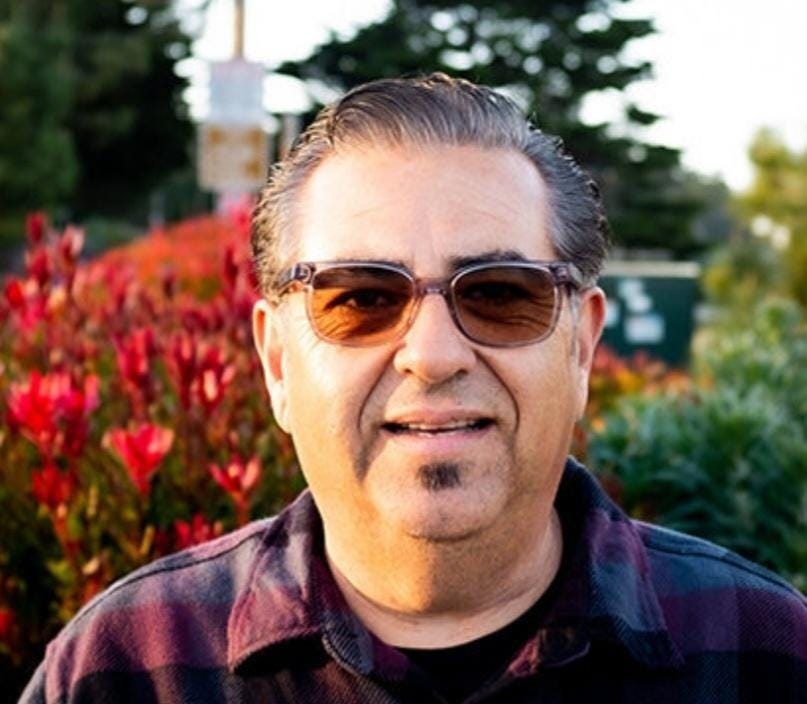
José T. Bravo is a veteran environmental justice organizer and executive director of the Just Transition Alliance, where for more than 25 years he has led a coalition of environmental justice and labor organizations to work with frontline workers and fenceline community members who live next to polluting industries in creating healthy workplaces and communities.
José has spent much of his life thinking about and taking collective action on the lived realities of climate breakdown for workers in the US, so it was a pleasure to host this generative conversation to find out more about his perspective on labor, production and local economies through the lens of just transition.
Note: Since this conversation took place in January 2025, the US context has continued to shift — with intensifying political polarisation, deepening precarity for workers and migrants, and renewed questions about whose lives and labor are protected, and whose are treated as expendable. Against this backdrop, José’s insistence on presence, solidarity, and local-to-regional economies feels even more urgent.
What is a just transition in your view? What does that phrase mean?
Simply put, I think a just transition is just looking at something in the circular part of production, looking at it from different impact points, and making sure that everything is not posing a threat to workers, communities, health and Mother Earth. If there's something in that circle of production that's causing a health issue, what can we do to transition out of that into something that doesn't pose the risk to health?
Why is just transition important to you personally?
Just transition is important to us because it's really been our baby for about 30 years. Coming together with labor at the behest of labor, not environmental justice, listening to labor coming to us and saying, ‘Hey, we're part of the Oil, Chemical and atomic Workers Union. We make everything from a nuclear weapon to 90,000 chemicals, and literally some of those things we make should not be made. They shouldn't be on the face of the planet. So given that,
How do we justly transition our workplaces, our workers to make things that would not pose a danger to the planet and people?’
Coming together and hearing that from workers, especially thought leaders like Tony Mazzocchi, who literally was one of the thinkers behind just transition, was really interesting for us. It has become a solution-oriented process, and that's what's important. It's not just posing the problem, it's also putting up the solution.
Personally, is there anything you would add?
My parents were farm workers, so when they came to the United States in the '60s, they came here to work in the fields here in Southern California, both my mother and my father. They loved nature. They loved natural order. They love planting. They love harvesting, making things out of those food, from what they harvested, what they planted.
But they also had this really interesting relationship with chemicals such as pesticides and herbicides. My father didn't refer to them as poisons – he referred to them as medicine. He thought that by applying these things, it made the plant better. There were larger yields. He didn't have to work as much pulling weeds. So it was beneficial.
He passed before I was able to really have a conversation about [the fact] that these were designed to be poisonous, designed to kill and designed to impact. Not only at that immediate time that he was applying these chemicals, but most of these chemicals were ‘forever chemicals’ that would keep on posing an impact to the natural order forever. That's the way they were designed.
What are you involved in or aware of related to just transition that you'd like to see more of?
The three main areas that we are involved in are climate, plastics and food. They're all interlinked.
When we're talking about climate and what affects climate, we say fossil fuels affects climate and carbon in the atmosphere affects our climate. We're so dependent on the chemicals that are made in the fossil fuel industry that, because of the production of these chemicals, we're affecting the climate, and we're also ingesting a lot of things that we shouldn't be ingesting in our food. And then the plastics piece is tied to both of those. Why? Because it's much easier nowadays to get food in plastic containers than it is in glass or something that's safer.
And then there's also the different types of chemicals that go into plastic production, and supposedly some of those chemicals go into our food system to make us healthy.
If you biomonitor people's blood, most everybody on the planet has PFAS [forever chemincals] in their blood. Some of these things are made just for the process, to make a bottle more pliable or a container more useful. And for us, that's not good.
Let's say that tomorrow we wake up and we don't make any more gasoline, no more diesel, no more kerosene. Well, just because of our thirst for plastic around this planet, the same companies will still be producing things out of fossils, right? They no longer will be fuels, but they'll be the chemicals that plastics are made out of. So we have to really dig deeper into looking at things, how to make things from better products.
That's how we have to think out of the box and make sure that what we produce poses no threat. What we make today has impact for seven generations, and we have to start practicing the fact that what we make should not have an impact for more generations ahead.
From the movement side, what is it that you'd like to see more of, working to actually enact these tangible changes?
From a movement perspective, I think we've been siloed into working on very specific things, and we haven't done our due diligence to connect the dots on how they're all interrelated.
Everybody's working on climate. Everybody goes to the COP, to the Conference of the Parties. Everybody's working on plastic. And the UN also has a food thing, right? Everybody runs there, instead of people seeing the link between everything. That's one of the roles of the Just Transition Alliance, and that's why we're pushing for people to say, ‘Hey, if you're fighting an incinerator there, and you're fighting a plastics plant there, and you're fighting for access to food here, and you're finding a refinery there, each one of us brings something to the equation that could help each other. Because that plastic is going to end up in the incinerator. That refinery is going to end up making chemicals for that food, and all of that is going to contribute to carbon emissions.’
So that's where I think we need to see bigger pictures.
How do you see what we've just talked about manifesting at local, neighborhood or street level? And can you see promising relationships or connections between the local scale and the planetary scale of this work?
Let me just start out by saying that we got to be careful when we say ‘at the planet level’ and ‘at the global level’. I think justice needs to be practiced at the global level. And I think what's been happening since, after the Second World War, maybe 50-60 years, has been the fact that things are made and produced all over the planet.
Now what we have in 2025 is you’ve got packages that have more rights than humans do. So the US will say to its neighbors in the Pacific Rim, ‘Oh, we're going to give you an army base. We're going to give you a military base, just so that you can protect yourself from this war on terror.’
But what ends up happening is that those same bases protect commerce. Same thing with Afghanistan, to protect oil. So things have more rights than humans. A human has no ‘priority’, can't cross borders freely and again, isn't seen as something that's beneficial.
There was a movie that came out probably about ten years ago, it was called A Day Without A Mexican. Basically, this fog that came about in California and then all Mexicans disappear, so nobody took care of their children, nobody harvested in the fields, nobody cleaned houses, nobody cleaned buildings, nobody washed cars for a day. What's happening now is you're seeing some of that because of these draconian measures that are being taken. You're seeing that people aren't showing up for work.
I think in order for us to really move forward jointly and strategically, it has to be a month without farm workers. Then people will say, ‘Oh, my god. I guess there was a human that actually made it possible for us to have milk in the refrigerator.’ The folks that support this administration aren't going to be the ones picking strawberries in the fields or putting the milk in milk containers. So again, I think there's an opportunity there for us working with labor.
You were saying something interesting, that we have to be careful about when we talk about planetary scale?
The way we always say it is that we want to support local to regional economies to scale.
A global economy has not paid off for us. Even though we have North American Free Trade Agreements, certain people got richer, but the working folks didn't necessarily reap the benefits of it, right? And then what we started to see was that different countries are pitted against each other, trying to see who could drive down the cost of labor.
If folks are still saying, ‘Well, I don't know about that,’ let me just remind folks that in the Suez Canal, the ship that got sideways maybe a couple years ago – because that ship was blocking the Suez Canal, 14% of all globalized products were slowed down. Globalised products, but it was one ship. We can't put all our eggs in that basket, not as a society of humans that depend on each other. We didn't have electronic microchips, circuit boards, oxygen machines in hospitals. One ship.
Wow… So building on that, what is the best thing that could happen with the things you've just described?
I think putting people back to work in things that we need to produce, the things that we need to make sure that people have not only a right to work, but a basic need for.
It's important to understand that a lot of things nowadays are going towards the track of privatizing, and that doesn't pay off for folks, because somebody reaps the benefits.
We have energy shutdowns here when wind gets up to 30 miles an hour. So is it more feasible for you to have solar panels on your roof? Well, yeah, but where are solar panels made right now? They're made primarily in China and other countries. And what's the energy source that these solar panels are made with? Coal. So if a panel is made in China and it's put on my roof here at the house, it would probably be about two and a half to three years before it becomes carbon neutral and beneficial to the environment. Before that, it's part of the problem. So a local economy – ‘good things made here’ – is what we should be striving for.
What might your invitation or asks of other people and groups be?
Be present. Facebook, social media isn't always being present. It's really easy for us to to put a post out there and say, ‘Hey, we support so and so.’ No, show up at a public meeting when somebody else is being brutalized, then be present when we want to say, ‘Here's a model that we should replicate, like growing our own food.’
People might think, ‘Well, okay, but in the big picture, we got to stop the thing that's crushing folks.’ Well, yeah, we do, but at the same time, we have to take it in a way that makes sense and is practical and folks can do, and we can start seeing tangible evidence that it's working.
I always say that in organizing, you can build a strategic plan that has a ten-year outcome, then a five-year outcome, then a two-year outcome. But if you don't have short outcomes, one right after another, people aren't going to stick around for that ten years, because they need to see things working right.
What meaning was made for you during the course of our conversation today?
I think it forced me to think a little bit more. Some things need to really come together, and we have to put some checks and balances on stuff. It's easy for us to say, but clear examples came to mind – clear examples, and make sure that people see that we're all together.
I don't know if you listening to the panel [at the Protecting Mother Earth Conference] that I was speaking at, but one of the people there, a native person, said, ‘Hey, if in the United States things get violent, it's going to be us, primarily, defending ourselves, because a lot of our liberal white brothers and sisters will probably not take up arms to defend us. They won't, and they probably won't get in that kind of harm’s way.’
During this past holiday I saw a movie [about] those students that went out during the civil rights fight and then they were murdered. They were white students. I'm sure they didn't start out thinking, ‘Oh yeah, I'm gonna be out there and I'm gonna put that kind of commitment in,’ But once it happened, I think it was really interesting too to see how people responded. During the marches, it was commonplace for dogs and water cannons to be focused on black folk, but they weren't necessarily focused on white folk.
And so there are formations of folks, organizations built to support, push back against that brutality. I think we might have to get into that kind of thinking again, in a proactive way more than in a reactive way.
Thank you to Jose and everyone we spoke to as part of this generative inquiry. Learn more and read the other stories here.
No posts
Comments
Nothing yet. Say the first thing.
Sign in to join the conversation.