
Here's my second post, and it took me forever—almost a year! Considering I only had to revise and translate my previous writings from Italian, it's ridiculous. But such is life. Not that anyone's been holding their breath for my posts anyway! Here it is.
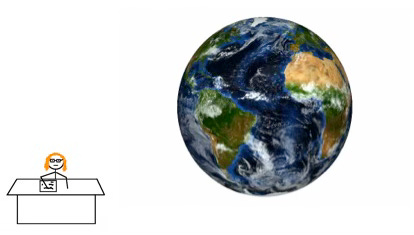
As I sit at my desk, contemplating the world, I realize: it is round! This reminds me of a famous Italian song (yes, I’m Italian!) where the singer observes the world from his kitchen and notes its roundness1. Without knowing it, the singer touched on a very exciting mathematical problem: What can be said about the shape of the Earth when seen from such a perspective?
Let's start with a quiz. Consider three geometric figures: a plane, the surface of a cylinder, and the surface of a sphere. How would you naturally group these objects? Here are three options:
A. The plane and the cylinder in one group, and the sphere in another.
B. The plane and the sphere in one group, and the cylinder in another.
C. The cylinder and the sphere in one group, and the plane in another.
Many of you might choose answer C, reasoning that the plane should be in its own group because it’s flat, while the cylinder and the sphere are curved. Fair enough. But have you ever thought about what it really means for something to be flat or curved?
Geometry is the branch of mathematics that deals with concepts like straight, curved, near, and far. The word “geometry” derives from the Greek geo (earth) and metron (measure). Nowadays, geometry has evolved into many distinct branches. However, its roots lie in the study of quantities such as lengths and areas. Modern mathematicians study extremely abstract concepts. But is it really so abstract to investigate the shape of the universe?
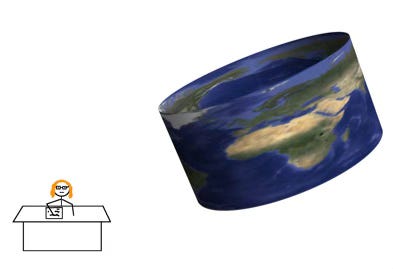
Returning to the quiz, I would choose A (certainly informed by many years of studying geometry!), and here’s why. Take a sheet of paper (a plane) and roll it up to create a cylinder. This experiment suggests that the plane and the cylinder are related in some deep way. As I’ll explain later, it is impossible to turn a sheet of paper into a sphere without crumpling it. No relation there.
At the heart of this are two different types of geometry: intrinsic and extrinsic. Intrinsic geometry studies the properties of an object (say, a surface) from the point of view of a being (let's call him Simon) who lives in the surface. Notice how I said Simon lives in the surface, not on it. Saying "on the surface" presupposes the existence of something outside the surface. Extrinsic geometry studies the surface from Simon's point of view as if he were able to observe it from outside, like an omniscient narrator.
In the beginning, the study of the Earth was necessarily an intrinsic study (not really! Keep reading). Only when we became able to travel into space and observe Earth from the outside did the study become extrinsic. To be precise, since we live on the surface of the Earth, not in it, extrinsic studies began before the invention of space rockets! For example, people observed the shadows the Earth casts on the moon, or the shadows objects cast on Earth. But that’s another story.
Do you see why I would have chosen A? If Simon were forced to live in the surface of a sheet of paper, he would not know whether he was living in a flat sheet or a sheet rolled into a cylinder2—or even a cone! In short, Simon would not be able to tell if he were living in a flat sheet or a rolled-up one. But would he be able to tell if he did not live in the surface of a sphere?
Yes. Here’s how: Gaussian curvature is an intrinsic property of a surface that Simon can measure, and it informs us of how a surface is curved. Without going into too much detail, for this story we only need to know that the Gaussian curvature of a flat sheet is zero. Most importantly, the Gaussian curvature of any surface that can be obtained from the sheet without crumpling it (such as a cylinder or a cone) is also zero3. However, the Gaussian curvature of a sphere is not zero; in fact, it is equal to 1 over the square of its radius. For example, for a sphere with a radius two, the Gaussian curvature is one-quarter. If Simon were living in the surface of a sheet, measuring the Gaussian curvature would give zero. From this, Simon could infer that he was not living in the surface of a sphere. Even Simon knows that zero (the curvature of the sheet) is different from non-zero (the curvature of the sphere)! Clear?
The plot thickens. Simon can use Gaussian curvature to figure out whether he is not living in a plane, a cylinder, or a sphere. He can rule out possibilities. But can Simon use Gaussian curvature in a more constructive way to determine where he does live? If Simon were living in the surface of a sphere, could he know? If Simon were one of us, would it be possible for him to prove that the Earth is a sphere? I know, I know—the Earth is not exactly a sphere. Just as there is poetic license, let’s call this mathematical license. If Simon had access to a space rocket, he could comfortably observe the Earth’s spherical shape from space while sipping a mojito. But what if he doesn’t own a rocket?
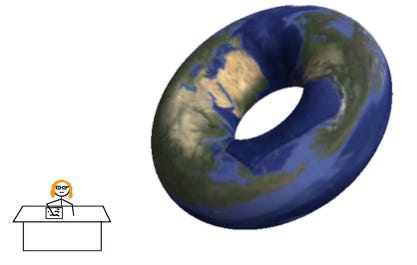
Today’s photographs of the Earth don’t make the question any less interesting because there is a sequel to this. Ready? What can we say about the geometry of our universe? And I challenge you to take a photograph of the entire universe from “outside.” As it happens, the sphere and the plane are mathematical objects so symmetrical, so "unique," that they are characterized by their Gaussian curvature. After measuring the Gaussian curvature of the Earth at various points—around 0.0000000246368279 at each point (a difficult but not impossible task)—Simon could deduce that he lives on a sphere with a radius of 6,371 kilometers. Well done, Simon! But what about the universe? Or rather, the multiverse?
Vasco Rossi: Fegato, fegato, spappolato! “La primavera insiste la mattina, dalla mia cucina vedo il mondo tondo.”
Here, I’m assuming Simon has neither the time nor the desire to travel around the cylinder, come back to where he started and realize there is in fact an intrinsic difference between the plane and the cylinder. But that’s another story.
And the surface of a doughnut in 4-dimensional space (whatever that might mean!) has also Gaussian curvature zero.
No posts
Comments
Nothing yet. Say the first thing.
Sign in to join the conversation.