
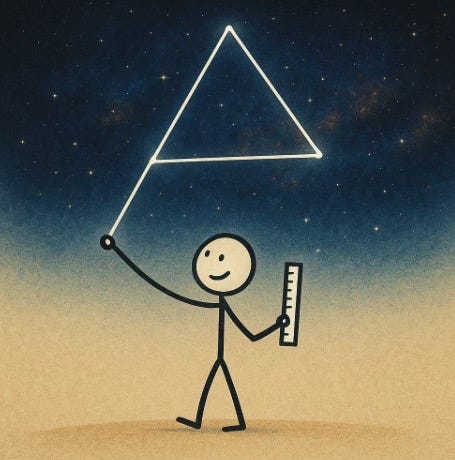
If you haven’t read my previous post, I suggest you do so. It’s a blast! But here are a few things I touched upon. There are essentially two ways of looking at a surface: from the perspective of a being living in the surface (intrinsic perspective) and from the perspective of a being living outside the surface (extrinsic perspective). Nothing mathematical about this statement. For example, from the intrinsic perspective, a cylinder is more like a plane than a sphere, no matter how it looks from the outside. After all, you can bend a piece of paper into a cylinder, and a bacteria living on it would be none the wiser. But, as it turns out, you can’t bend a piece of paper into a sphere without crumpling it.
The mathematical quantity that captures this phenomenon (whatever “this” is) is called Gaussian curvature, or just curvature. In fact, calculating the curvature of a surface isn't just a mathematical flourish; it reveals fundamental geometric properties. A surface with zero curvature is called flat and it has the geometry of a perfectly straight, infinite plane. And one can use the curvature to tell apart a sphere from a cylinder “without” looking at it from the outside. Again, read my previous Substack!
Sometimes one can distinguish between different geometric objects just by “looking at them.” But what if there is no way to “look at them” in the way we can look at a cup or a table? For example, what if we care to explore the geometry of the universe? We can only do that from the inside. At least at the time of this writing, there is no rocket ship that can leave the universe!
So, without further ado, what is the curvature of the universe?
Disclaimer: Why do we care to study the geometry of the universe? Why does its curvature matter? If you’ve never wondered about such things, that’s fine. This post may not be for you. But for me there's something deeply satisfying in chasing these ideas. Is the job of a surgeon who saves lives more important than writing this post? 100%. But we all have our passions.
Before we can answer that question properly, let’s start with: how do we calculate the curvature?
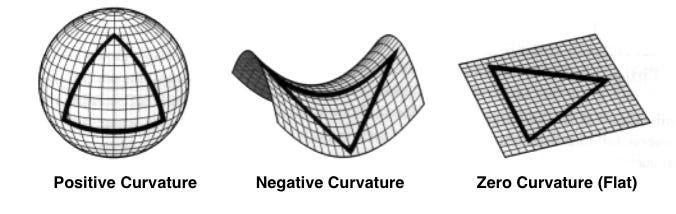
There are many equivalent methods to calculate it. One very geometric way is using triangles. For example: the curvature of a plane is zero, that is a plane is flat, because the sum of the angles of any triangle on it is 180 degrees. Positive curvature means the sum exceeds 180 degrees (example: a sphere); negative curvature means it’s less (example: a saddle).
Note for geometry buffs: If you're already familiar with concepts like geodesics, curvature via triangle angle sums, and how light paths relate to spacetime geometry, feel free to skip ahead to “It’s time to begin this Substack…”
But wait—what is a triangle when the surface is a sphere? To answer that, we need to go deeper and discuss the concept of a line segment.
In a plane, a line segment is straight and a triangle is three line segments connecting three points. However, the idea of “straightness” dissolves when we consider other surfaces. What are the “straight” lines on the surface of a sphere? Note this: if you draw a straight line on a sheet of paper, then bend the paper, the line is no longer straight in the usual sense. Yet it’s the same line on the same sheet! Clearly, “straight” is a slippery concept here.
As it turns out, it is better to focus on a more fundamental property: a segment is the shortest path between two points. In a plane, saying “let’s consider the shortest path between two points” and “let’s consider a segment between two points” gives you exactly the same thing. However, the idea of a segment as the shortest path can be more easily exported.
On the surface of a sphere, given two points, we can decide to call the shortest path a “segment.” Why not? But the actual mathematical term is geodesics. Geodesics are the straight lines on surfaces where the lines aren’t straight, in the sense we are used to! (Note: on a sphere, geodesics are great circles.)
Using this observation, a triangle is the shape formed by connecting three points with three segments (shortest paths, geodesics). This is good because, in a plane, it gives us the familiar segments and the triangles Euclid loved, with their angle sum of 180 degrees.1
On a sphere, where the “segments” are arcs of great circles, you can check that the sum of the angles in a triangle exceeds 180 degrees. And so, we find that the curvature of a sphere is positive.
Quick recap:
A “segment” is the shortest path connecting two points.
A “triangle” is formed by connecting three points with three “segments.”
Curvature is:
Zero if the angle sum is 180 degrees (flat),
Positive if it’s more,
Negative if it’s less.
This is something we can investigate in our universe, after we figure out what straight segments, and thus triangles, are. Luckily that’s been done. It wasn’t easy, but thanks to Einstein, we know that the presence of mass influences the calculation of distances. Also thanks to Einstein, we know that segments—in the sense (and I repeat this for the last time) of the shortest paths between two points—are given by the trajectories travelled by light. Light, which is not wasteful, always chooses the shortest route. Voilà! Now we finally know how to create segments, how to create triangles, and thus how to study the curvature of the universe. Phew!
It’s time to begin this Substack…
As we know, we are not at the center of our solar system, galaxy, or universe. However, it’s not egocentric to say that we are at the center of the universe we can observe, just as we are at the center of our own horizon. We can thus imagine the universe visible to us as a sphere with us at the center. It’s inconceivable (to me) that there’s nothing beyond this sphere; however, we cannot see light from galaxies outside this sphere because it hasn’t yet reached us, and thus, in a sense beloved by certain philosophical physicists, those galaxies don’t exist for us.
If we are at the centre of a sphere that constitutes our visible universe, what is the radius of this sphere? The radius is, interestingly, the age of the universe; that is 13.79 billion years. Here’s the sleight of hand: because light travels at a constant speed (thanks again, Einstein), distance and time are interchangeable once you multiply by the speed of light. That’s why we’re allowed to talk about lengths (the radius of our universe) using time (the age of the universe). And the time that light has had to reach Earth from the edge of our visible universe is—by definition—the age of that visible universe. No more, no less.2
Let’s call the age of the universe, this distance—this radius—T. If we take two points on the surface of the edge of our visible universe, these two points are equidistant from us, and by using ourselves as the vertex, we can construct an isosceles triangle with two sides of length T. If we could find two points on the edge of the universe that are also T apart from each other, we would have constructed a stupendous equilateral triangle. Spoilers: we can do that! But first, assuming we have this triangle, what can we do with it?
Well, we can measure the angle at its vertex—that is, us—and then we have this: Since we’re studying an equilateral triangle, if the angle were 60 degrees, the universe’s curvature would be zero (the angles of an equilateral triangle are equal and 60 + 60 + 60 = 180!); greater than 60 degrees means positive curvature, and less than 60 degrees means negative curvature.3
So, at least in theory, we have a plan for calculating the curvature of the universe. Back to constructing this equilateral triangle. Given a point on the edge of the universe, we need to find another point on it at a distance T. We know light moves at a constant speed—the speed of light. But not just light; gravitational and electromagnetic influences also propagate at the speed of light.
For example, sunlight takes about eight minutes to reach us. If the Sun were to disappear instantly, we would only notice its disappearance eight minutes later. Similarly, we would only feel the Sun’s gravitational pull stop eight minutes after its disappearance—not immediately.
How much time, then, have points on the edge of the universe had to “influence” one another? As discussed earlier: exactly T. If you pick a point on the edge of the universe, points at distance less than T have felt its influence (gravitational, electromagnetic, whatever), while points at distance greater than T have not.
The idea, then, is to take a picture of the edge of the universe and spot differences due to this fact—to identify two points that are T apart and construct the most magnificent equilateral triangle ever. Physicists (not me!) know how to observe this. Following this reasoning, and based on the properties of triangles in our universe, they predicted three different pictures, depending on the curvature:
The first assumes positive curvature.
The second assumes zero curvature.
The third assumes negative curvature.
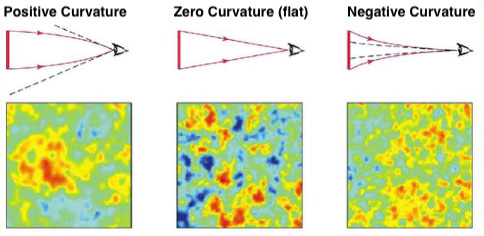
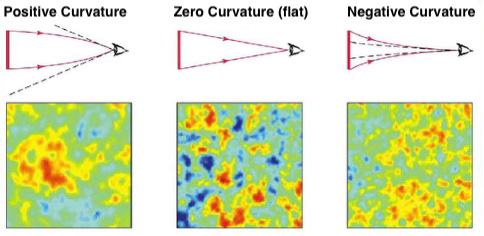
In 2000, the edge of the universe was photographed during the so-called BOOMERanG experiment. It didn’t capture visible light but rather the faint afterglow of the Big Bang—the cosmic microwave background radiation. And when the data came in, this was the picture.
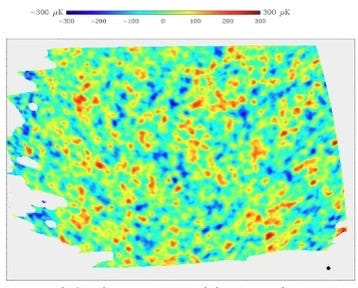
Am I the only one noticing a resemblance to the zero-curvature picture? I hope not.
Amazing! The geometry of the universe turned out to be—if not perfectly flat—so close to flat that its curvature is undetectable with current instruments. In a sense, the universe is a sheet of paper stretching across billions of light-years.4
This is equivalent to Euclid’s fifth postulate.
In reality, calculating the age of the universe is much more complex, partly due to the fact that the universe has been expanding—and not at a constant rate—since the Big Bang.
Clearly and unfortunately, due to measurement errors, it’s impossible to determine whether this angle is exactly 60 degrees.
Of course, the universe doesn’t have constant curvature everywhere. As general relativity tells us, the presence of mass warps space and influences distances. That means triangles behave differently near massive objects like black holes than they do in intergalactic space. However, if we go far back (very far!) to a time when the universe was more homogeneous, we can meaningfully speak of its curvature on a global scale. And that’s what the BOOMERanG experiment measured.
But in fact, things are even more complicated than that: the standard model of cosmology describes the universe using the FLRW metric, which assumes large-scale homogeneity and symmetry but allows for expansion and curvature.
No posts
Comments
Nothing yet. Say the first thing.
Sign in to join the conversation.