
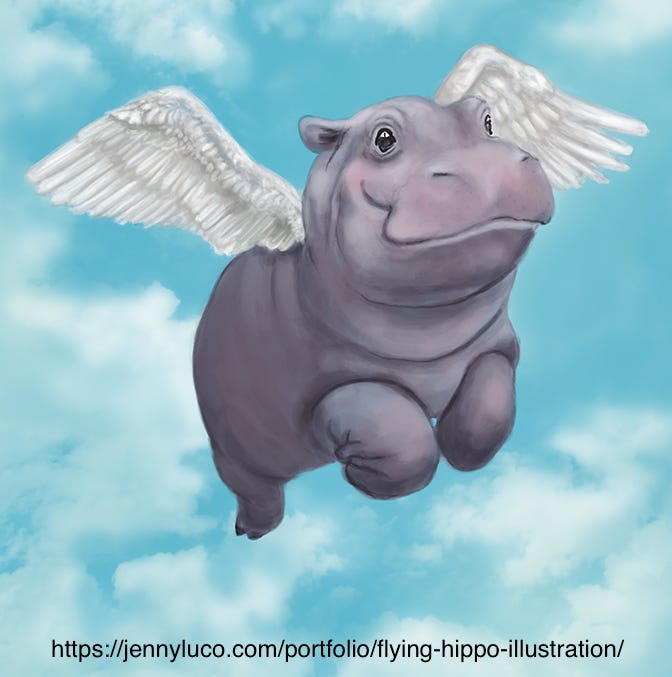
We are all more or less aware of the theory of natural selection (I hope!). However, it's fun (and important) to reflect on the fact that natural selection and the struggle for survival are not the only factors that determine the shape of plants, animals, etcetera. Nature is also shaped by the laws of chemistry, physics, and, believe it or not, mathematics. Who would have thought?
Let me explain further. Is it true that, in theory, if there were no predators, an animal could evolve as it pleases? I can hear your objection “Without predators, why would an animal need to evolve?” A valid objection. So let's try another way.
Is it possible to genetically construct any animal you want? The answer is certainly no, for several reasons. In this article, I want to explore the geometric reasons for why not and focus on various aspects of an animal, including the ability to fly. But before we begin, let me pay tribute to D'Arcy Thompson1, who, with his book “On Growth and Form,” in 1917 championed this way of thinking.
In good mathematical tradition, let's start by talking about a shape that's familiar to all of us: the cube. The volume of a cube with a side length of R is R cubed. While the area of one of its faces, a square with a side length of R, is of course R squared. So, the surface area of a cube with a side length of R is 6R², while the volume is R³, and the ratio of volume to area is R/6. In particular, this ratio increases as R increases. This tells us that by enlarging a cube, its volume grows much faster than the area of its surface.
Let's take another example, the sphere. The volume of a sphere with a radius of R is 4/3πR³, while the surface area of the same sphere is 4πR². So, in this example, the ratio of volume to area is R/3. Again, this tells us that by enlarging the sphere, its volume grows much faster than the area of its surface. But it's not obligatory to stop at the cube and the sphere. If we take an object with a certain volume, let's call it V, and a certain surface area, let's call it A, and imagine magically enlarging it, then its volume grows much faster than the area of its surface. More precisely, the initial ratio is V/A and if we enlarge this object n times, then the ratio of the new volume to the new area is nV/A, and since V and A are fixed, this ratio increases as n grows.
I'm telling you that this discussion about volume and area helps us understand why a hippopotamus cannot fly. And no, it's not just because it doesn't have wings! Even an ostrich can't fly. To understand the nature of the problem, take your favorite flying animal, whether it's an insect, a bird, or a mammal, it doesn't matter. Let's take a swallow, for example. The question is this: if it were possible to magically enlarge a swallow at will, would this gigantic swallow still be able to fly? As you can see, the question is a bit more refined, and even though the answer is no, it doesn't mean that a large object cannot fly. After all, airplanes exist. But we'll come back to that later. So, can a giant swallow exist in nature? The answer is no, and the mathematical explanation lies in our discussion of area and volume and the fact that:
The volume of the swallow determines its weight.
The surface of its wings determines the weight it can lift.
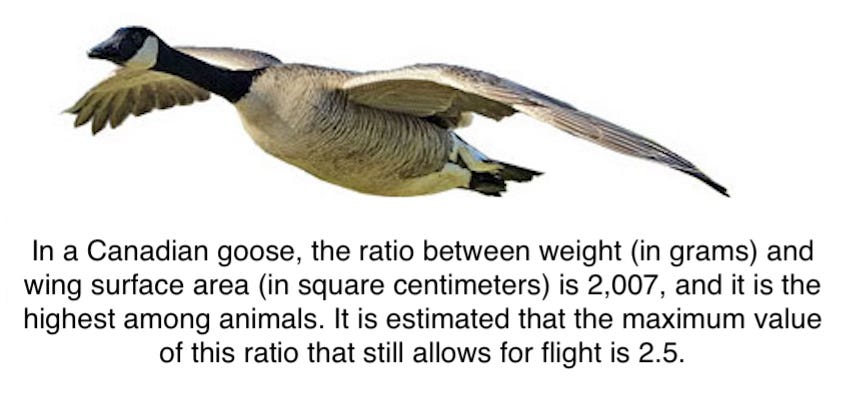
The fact that the volume of the swallow determines its weight is quite obvious. That is, when we enlarge the swallow, its weight increases as rapidly as its volume. If the volume doubles, the weight doubles, and so on. The second statement, a bit less obvious, says that the weight the wings can lift increases with the surface area of the wings. In other words, if the weight doubles, then to be able to fly, the surface area of the wings must double. These ingredients are enough to understand why a giant swallow would not be able to fly. As the swallow grows, its weight increases in step with the growth of its volume, while the weight the wings can lift increases in step with the growth of the surface area. However, from the previous discussion on area and volume, it follows that as the swallow grows, its volume, and hence its weight, increase much more rapidly than its surface area, and therefore, the weight the wings can lift. In short, since volume "wins" over area, eventually the swallow remains on the ground! This discussion does not mean that large objects cannot fly. However, it allows us to study the limits of certain type of flight.
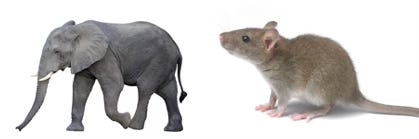
Is that all? No! The fact that with the enlargement of an object, volume "wins" over area had already been used by Galileo2 to illustrate how an animal cannot be too large (or, returning to the previous discussion, an airplane). The reasoning is very similar and is based on this principle: the weight that a limb (the leg) can support does not grow like its volume but grows like the area of the cross-section of this limb. On the other hand, it is evident to everyone that the force needed to break a rope does not depend on how long it is but on how thick it is. So, how much can you enlarge a mouse? Not at will. As in the example of the swallow, when it grows, its weight increases in step with the growth of its volume. However, the weight that its legs can support only grows in step with the area of their cross-section. So if we enlarge it too much... snap! That's why the legs of an elephant are, in proportion to its weight, much thicker than the legs of a mouse.
But let's have Galileo3 say it:
“...nature cannot produce a horse as large as twenty ordinary horses or a giant ten times taller than an ordinary man unless by miracle or by greatly altering the proportions of his limbs and especially of his bones...”
From this discussion, some very important things arise, some of which Galileo, a man of another era, could not have deduced:
If we assume that King Kong, Godzilla, or Megaloman are made of biological material, then they cannot exist—they're too large! (and no, Ant Man cannot grow big!) However, Optimus Prime, which is made of a different material (metal?), can.

Small animals “seem” stronger if you pay attention to their weight. How many times have you heard phrases like, “a spider can lift 10 times its own weight,” interpreted as “wow, these spiders are so strong!” Maybe it's true that spiders are much stronger relative to humans, but now we know that comparing how much a spider and a human can lift relative to their weight is not correct. How do we explain the super strength of Spider-Man?
Returning to large flying things like airplanes: even when enlarging an airplane at will, either a different material must be used, or sooner or later, the wings break.
The largest animal in the world, the whale, lives in the water. It's no coincidence4.

Is that all? Not quite. To finish, the ratio of volume to area also comes into play when an animal needs to stay warm, and that's why small animals tend to NOT live in cold places. Why is that? The amount of heat in a body grows in step with its mass, and therefore its volume. However, the heat exchanged between a body and the environment is proportional to the surface area. In this case, being large, or rather having a large volume-to-surface area ratio, helps to stay warm longer. That's why elephants, which live in hot places, need large ears: to increase their surface area and dissipate heat more quickly. So, if you have children, think twice before letting them take off their jackets: because their volume-to-surface area ratio is smaller than that of an adult, they cool down faster! But don't blame me, make that clear!
Galileo Galilei, Dialogues Concerning Two New Sciences.
It's a matter of weight and the force of gravity, so in water (or on Mars), it's a whole different story!
No posts
Comments
Nothing yet. Say the first thing.
Sign in to join the conversation.