
Hello again, everyone!
It has been a while (again).
I’m writing this from my apartment in Kokand, but I’m not here that often these days. Between Navro’z1 vacation travel and an intense slate of teaching/Fulbright conferences, I’m bouncing back and forth across Central Asia pretty much all Spring. It is tiring, of course, but also a lot of fun.
Today, I’d like to write a bit about one of my favorite weekends so far in Uzbekistan, and about how I discovered my new favorite sport in the steppes of Central Uzbekistan.
One of the best things about Uzbekistan is that they have a region (and a city) called Jizzakh. They also have a meat dish called Jiz-Biz. One American, named Jimmy, was even lucky enough to be assigned as an ETA there. Not unlike Kokand, Jizzakh is rather quiet, but not without its own small-town charm. I went there with a group of fellow Americans to attend a conference called something like “Innovations in English Teaching.” At the local pedagogical institute. It was fun. If you happened to be watching Jizzakh’s regional TV network that evening, maybe you heard about it.
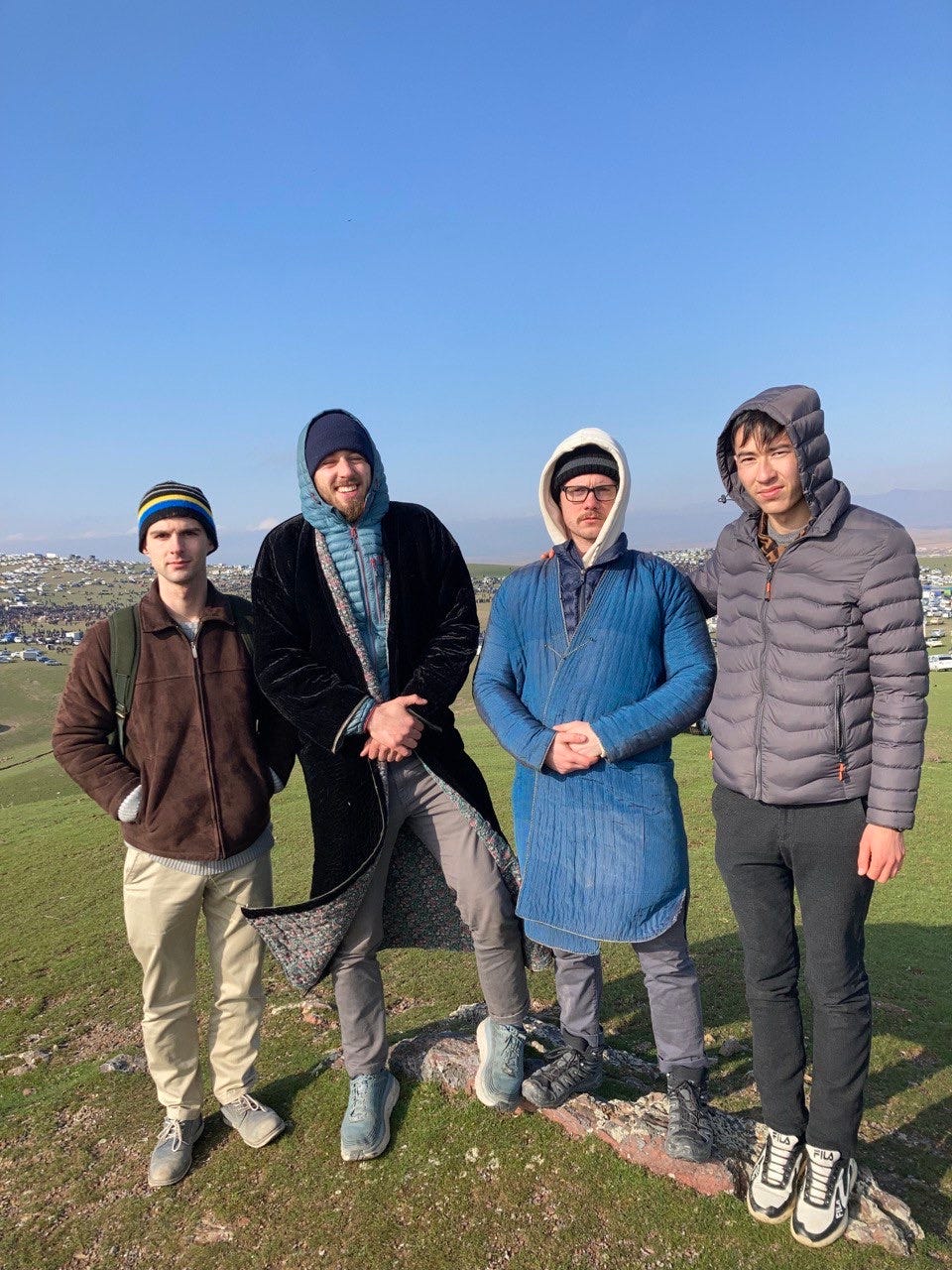
After the conference, two of us—myself and Daniel, the ETA in Nukus—decided to stay in Jizzakh through the weekend. We both had our own logistical reasons for doing so, but we really got excited about it when Jimmy told me we had been invited by a local friend of his to go out to his village. Never ones to miss an opportunity to have a big feast in the Uzbek countryside, we were happy to accept.
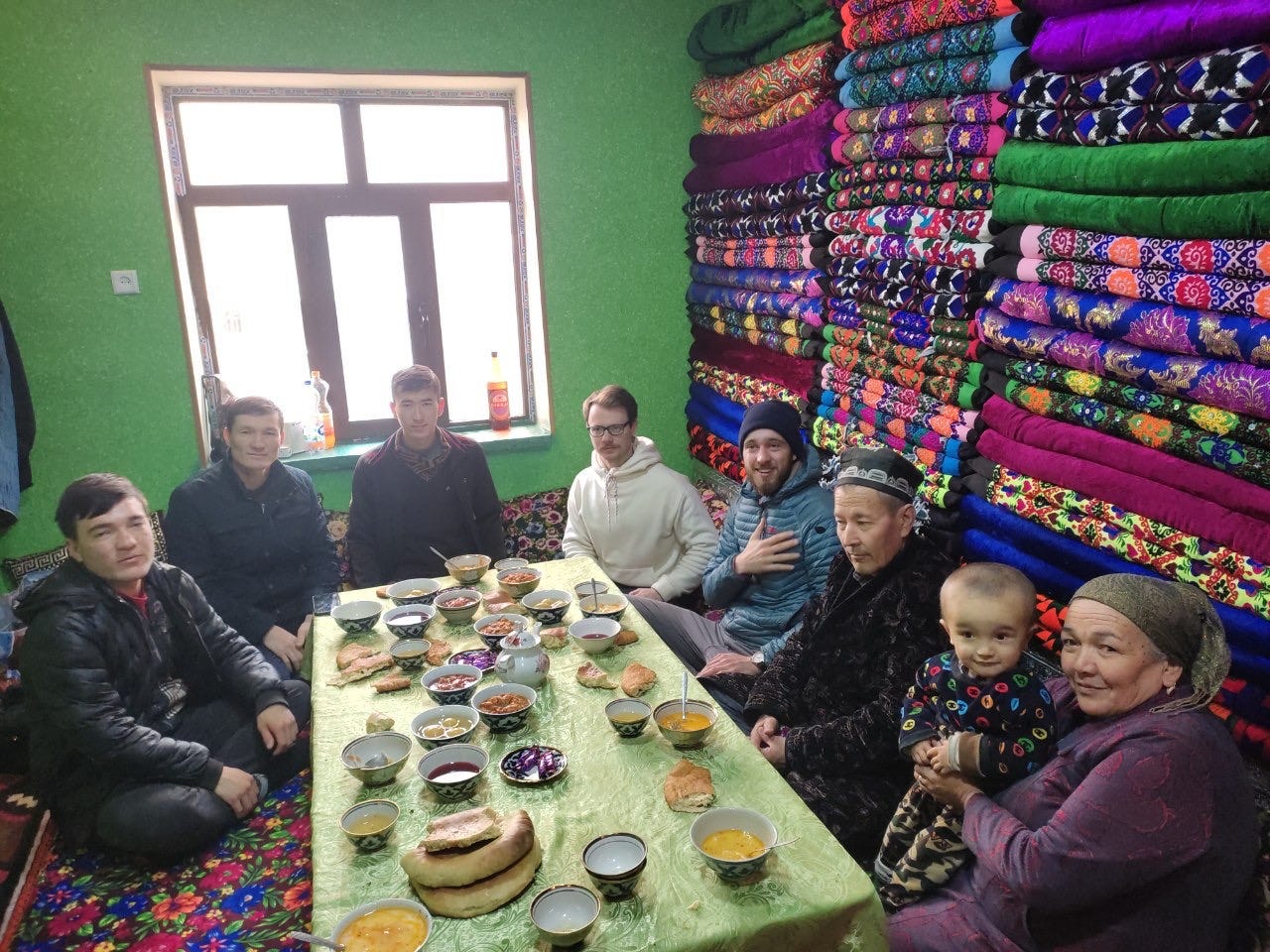
Jimmy’s friend, Abdulaziz, lives in a village about an hour and a half away from Jizzakh, just over the border in the Samarkand region. We had a fantastic time, and his family showed us the typically wonderful Uzbek hospitality that all of us as foreigners are treated to here. After a massive meal followed by an intense and harrowing 10:30pm pick-up soccer match, Jimmy, Daniel and I hunkered down on the floral-print mattress pads (which families here have by the hundred, since they’re given as wedding gifts) to get some rest.
The next day, it was time for the main event. The three Americans, alongside Abdulaziz, his cousin, and his friend Otabek, piled into the family Damas and headed even deeper into the boonies. After about three hours of bumpy roads, we finally pulled to the side of the road among a crowd of horse trailers, Ladas, and white Cheverolets. We had arrived at the Kupkari field.
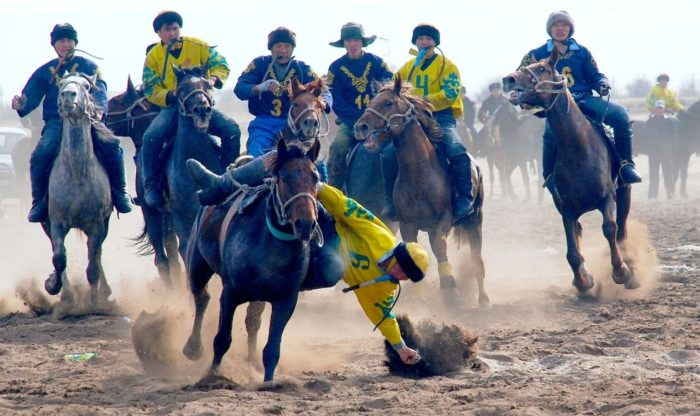
Kupkari, also known as Buzkashi in the Persian-language world, is a widely advertised component of Central Asian culture. This is mostly because it sounds awesome to refer to “that game they play on horseback with a decapitated goat carcass.” It’s kind of like polo, in the sense that it’s played on horseback, and also kind of like hockey, in the sense that they’re allowed to beat each other up, and also not at all like either of those games at all in terms of how it feels to watch.
Now, the crucial thing that I have to add here is that there are two basic versions of this game that are played, and they are very different from one another. If you look the game up online, you’re likely to learn about a game which is pretty clear and understandable as a “sport” to those of us who grew up watching team sports. Two teams on horseback compete against each other to carry the aforementioned decapitated goat2 carcass, called an uloq from one end of a field to the other. They score by dropping the uloq in a circular goal, called a qozon (this also means “pot” in Uzbek, which makes sense when you see that some qozons have high sides and look a bit like a cauldron. Most, however, are just circles made from fabric, stones, tires, or whatever else). The two teams score points by bringing the Uloq successfully to their opponents end and scoring. The team with the most points wins. This sport does exist, and that’s what I understood Kupkari to be when we went to see it.
However.
There’s another version, which gets significantly less airtime on the English and Russian internets. In this version, there are no teams. Or more accurately, no formal teams, no teams recognizable to the outside observer. Family members and friends work together, and informal alliances seem to be struck ad hoc during the game. But mostly it’s just chaos. The chaos is enhanced by the fact that there is no real limit to the number of players on the field at any given time, nor is there any particular requirement that everyone on the field be taking active part in the game. As a result, these kupkari matches (which are the ones you’ll see if you look up something like “Kupkari Uzbekistan” on youtube) are very confusing to watch. There are upwards of a hundred horses on the field at a given time, and half of them are standing far from the action, their riders chatting casually. Of course, it was this more chaotic, confusing version of Kupkari that awaited us in Jizzakh.
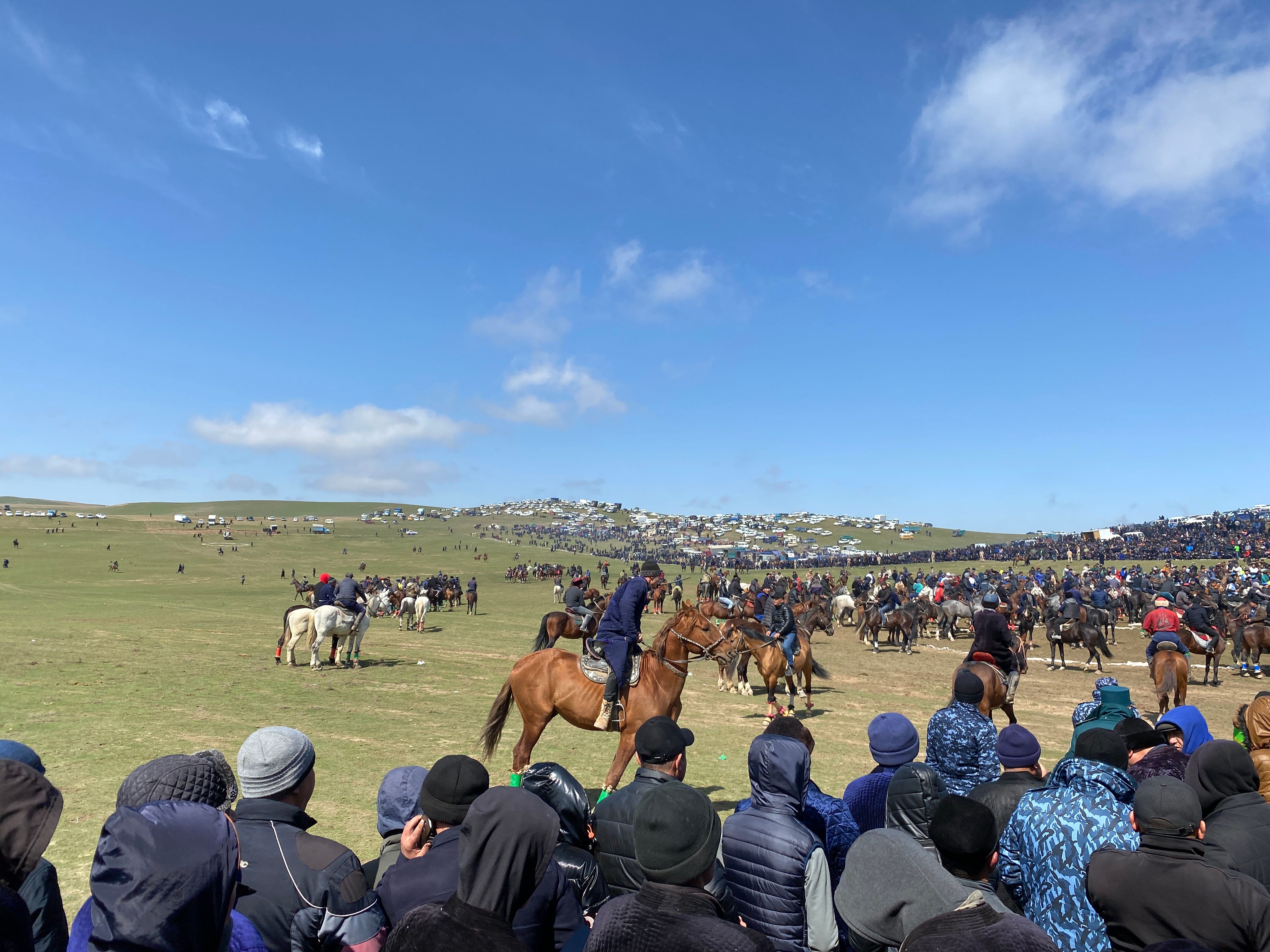
While we began the day deeply confused, we slowly pieced together a few crucial pieces of information that helped the game make a great deal more sense. First, and most helpful, was the revelation that this version of Kupkari isn’t played for points. Rather, it can be thought of as a collection of distinct competitions, with a material prize up for grabs each time the uloq is brought from one qozon to the other. If I manage to score on one end, I win something—usually a combination of money, livestock, and rugs. I rush back to the announcer’s booth to collect my prize, and the rest of the field starts fighting over the uloq to bring it back to the other end, for another prize. Of course, as one would expect from a good festival-style show, the prizes get bigger throughout the day. At noon people were fighting for a calf and a rug or a couple of colts, but by sunset they were winning veritable herds of livestock. One guy won a Soviet Zhiguli-brand car, and that wasn’t even the biggest prize—the final trophy of the day was a staggering nine camels. This makes sense when you realize that camels sell (apparently) for around $700 a head. Those nine camels are suddenly worth $6,300—roughly two and a half times Uzbekistan’s average annual income.3
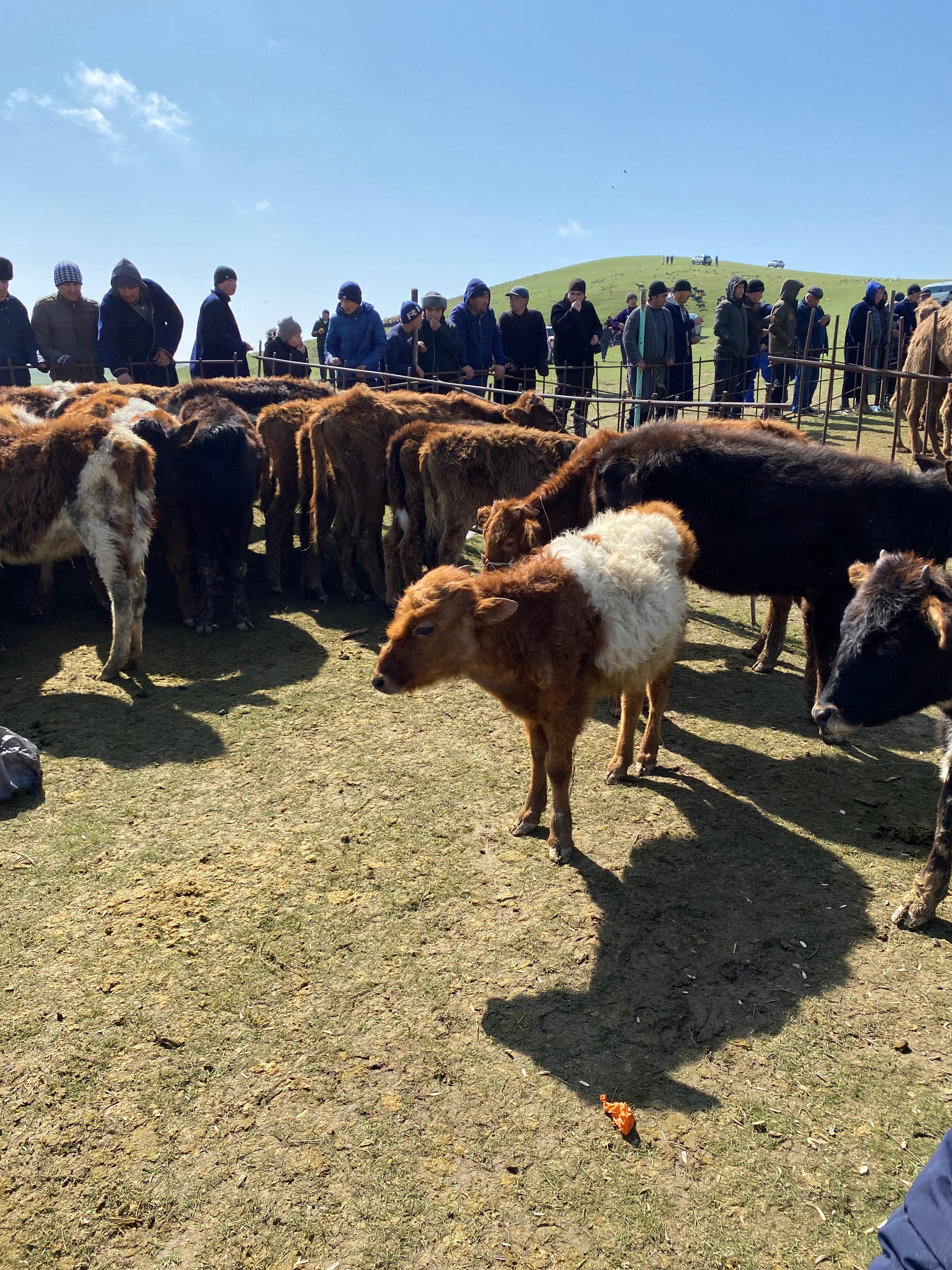
Understanding the prize system also explains, in part, why not everyone competes on every “end.” Kupkari is exhausting and dangerous for both horse and rider, so it makes sense to wait for a prize you really want. Jimmy, Daniel and I eventually chalked a significant amount of that dynamic up to an apparent split between the “pros”—who travel from all over Uzbekistan and Central Asia more broadly to compete—and the “amateurs”—random men from the nearby village who happen to have a horse. After all, why sit courtside when you can hang out on the court itself!
Our group spent most of the day huddled in Abdulaziz’s family horse trailer (they had three horses competing), trying to spot the uloq through the mass of horses. Mostly, we ate our body weight in sunflower seeds. When the action got close to us, things got intense quickly. The crowd of spectators run for their lives as the horses approach, since, you know, horses don’t care about going out of bounds when they’re getting beaten from all sides, and the brutality of the sport comes into full view. Horses and riders alike are bloodied, and the scrum for the uloq is incredibly intense.
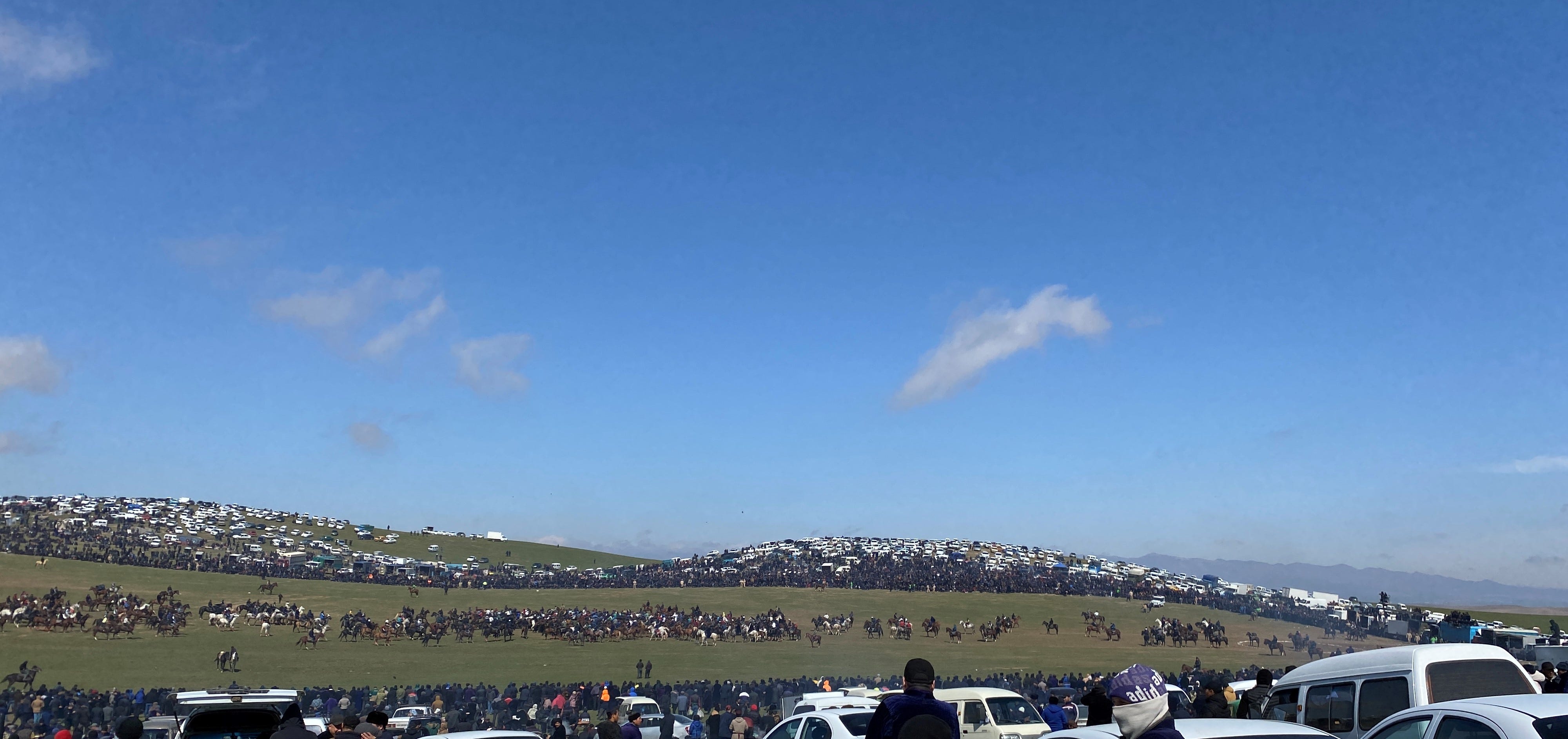
The best part of the day came when the announcers realized there were Americans in the audience, and invited us to the microphone to say something. This is something we definitely saw coming, so we had a few lines of embarrassing Uzbek ready in order to praise the organizers and exalt the tradition. In order to get to the announcer’s platform, however, we had to leave the safety of the trailer and traverse the boundary of the playing field. We hopped down while the scrum was all the way at the far end of the field, thinking we would be safe. Wedging our way through the crowds of Uzbek men, we started off slowly towards the announcers. All of a sudden, we hear a roar and the thundering of hooves, and the worst has happened. The whole pack is barreling down on us, no intention of stopping. Around us, people are literally diving for cover, running back and throwing themselves under the trucks. Jimmy and I turn to run, but realize that we’re boxed in by people on one side and a solid wall of trucks on the other—stuck. In this moment, I feel true fear. I know people get trampled watching this game, and this is the exact situation in which one gets trampled. Looking around, I realize that I’m close to the cabs of one of the trucks, and that the only way is up. I jump onto the bumper of the truck, wedging myself between it and the side of the neighboring truck. A split second later, Jimmy goes flying over my head onto the roof of the same truck. More people pile in around us, and we have the best seat in the house for the ensuing battle. Nobody (as far as we could tell) gets trampled.
After the fact, Jimmy and I agree that this was as close as we have come to seeing our lives flash before our eyes. It was incredibly fun.
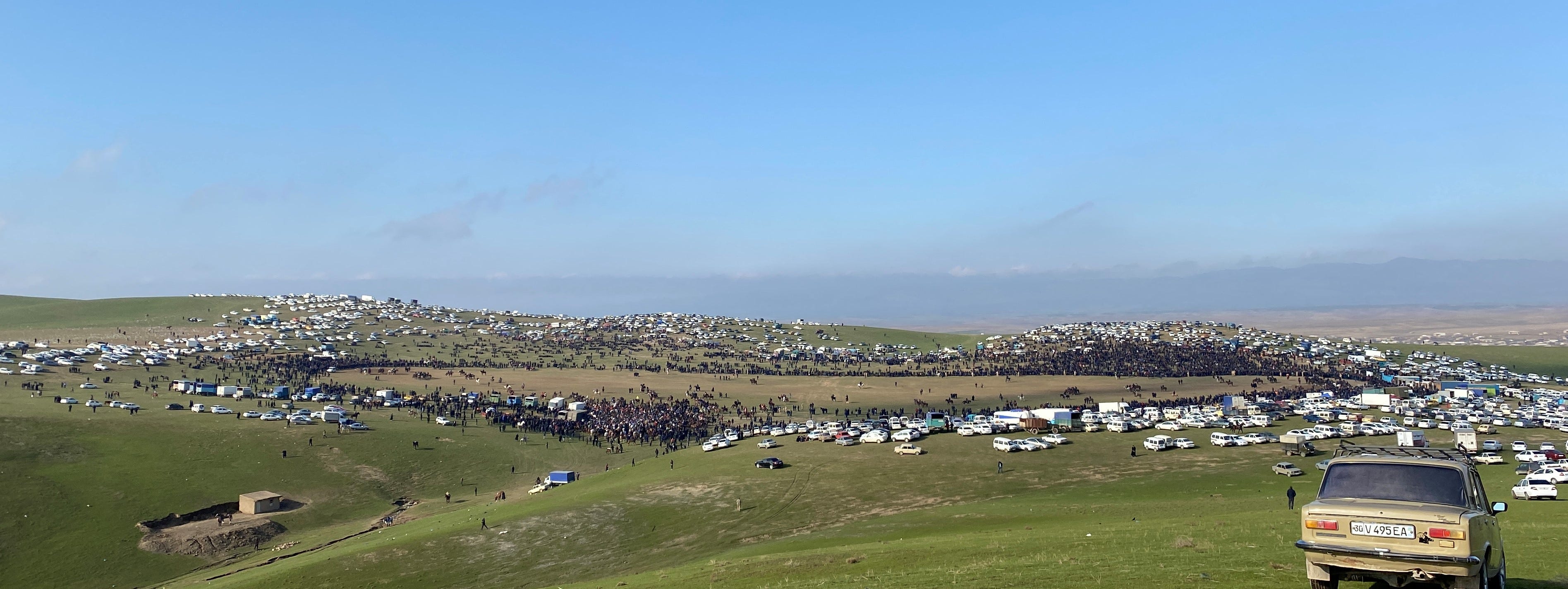
It’s always cool to see a unique component of another place’s culture, but Kupkari felt extra special. I think this is largely because of how legitimately popular it still is—we see a lot of “cultural activities” here that, while historically important, have become more of a costume than a custom in the modern age. That, of course, is perfectly fine, but there’s a certain removal from reality that comes with being treated to a tourist-oriented piece of “tradition” that only really exists for tourists. Kupkari, on the other hand, is a seriously big deal. There were thousands of people at the event we went to, and there are at least three youtubers who cover the sport closely and garner tens of thousands of views per video.4 It’s also very much a village thing—Jimmy and I have both asked our friends from Jizzakh and Kokand cities, and they don’t know much about it. Kupkari has a long history, and it hasn’t changed all that mich over the years. It’s a lot of things combined into one: it’s a sport, a circus, a lottery, a battle simulation, a community gathering, a formation ground for masculinity,5 and more. Jimmy, Dainel, and I, as nerds, had a great time trying to figure out how the mechanics and economics of the game work,6 but at the end of the day it was just a really good time. It was one of the days that reminds me why I wanted to come here, why I’m glad to be here, and how grateful I am for it all.
Salomat Bo’ling until next time,
Patrick
Navro’z (or Nowruz) is the Persian New Year, but it is also celebrated throughout Eurasia from Turkey to Xinjiang as a way to mark the coming of Spring. The holiday has its roots in Zoroastrianism, but has been interpreted and integrated in a wide variety of ways into the social and religious fabrics of the various regions where it’s celebrated.
Sometimes it’s also a calf or sheep carcass, or apparently even an imitation carcass made from leather and filled with sand.
One seemingly important question we never managed to get a clear answer on: how in the world do you take physical delivery of nine camels?
Which is insane, given how terribly the sport (at least the chaotic version of it) lends itself to casual viewing! I mean these are two-hour videos where all you really see is a bunch of guys standing around on horses while some undiscernible action happens in the distance!
Abdulaziz didn’t call them “players” or “athletes,” “riders,” or anything else—they called them “strong men.”
The rules were so vague that it took us a long time to put together what I’ve included here, but think about the economics for a minute. How is this free? Who sponsors it? Who has nine camels to put up as a prize? We eventually concluded that it’s all about family reputation, but it’s an interesting set of questions to entertain. Also, logistically, how do all these people know how to show up at this particular random field at this particular time?
No posts
Comments
Nothing yet. Say the first thing.
Sign in to join the conversation.