
Since posting the piece about Kazakhstan, I’ve received some really good questions from some of you1 that I think are worth addressing in a separate post. I want to get this out relatively quickly, so this isn’t going to be as thoroughly researched as the last one—more personal opinions and knee-jerk reactions.
In my original piece, I claimed that the fuel-price protests weren’t really what brought Kazakhstan to the front page of international new cycle last week. However, I didn’t really explicitly answer the obvious question that arises: why are the events getting front-page recognition?
In a comment on the original piece, Peggy touches on the issue:
One of the things I notice about news coverage is that anything going on in “smaller” countries is ONLY of interest when framed as proxy jostling. What will Russia do? How will US respond? Ignoring the fact that Kazakhs (or whoever) have their own agency.
In a nutshell, this is what I think happens in general, and it’s what I see happening here. Let’s look, for the sake of example, at the New York Times’ coverage of the events. Kazakhstan was on the front page of the US edition for two days, on January 7th and 8th. Articles ran beforehand and afterward in the international section and the online edition, but let’s focus first on the front page. On the 7th, the article was “Putin Exploits Kazakh Turmoil to Extend Grip,” while on the 8th it was “Power Struggle May be Driving Kazakh Chaos.” Both articles were written (or co-written) by the Pulitzer prize-winning and veteran Russia journalist Andrew Higgins, and I think they actually do a good job showing the two main entrance points the big-time media seems to have for the region.
First, and most obvious, is Russia. The idea of a post-Soviet space is incredibly appealing for the sake of simplicity and storytelling, as is the prevailing narrative about Russia as a fallen and vindictive superpower whose primary goal is to drag as much of its former territory as possible back into its nefarious clutches. This is a wonderfully convenient narrative, because it allows us to copy and paste an understanding of regional power struggles forged during the Cold War directly onto the 21st-century world. This approach to storytelling is, in my view, practically irresistible for major news outlets. First of all, it allows for the Caucuses and Central Asia to be spicy little additions to a familiar story with familiar characters, exempting us from having to actually dive into the messiness of national politics and really start to crack open the monolithic facade of the “former Soviet Union.” Secondly, and more directly, the narrative works! We have only to look at Ukraine,2 the Russia-related story that features most consistently in U.S. headlines, for a clear example.
The “it’s all about Russia” theory of media coverage is also backed up by the little collection of links the NYT puts above their Kazakhstan stories: “What to Know,” “Putin’s Geopolitical Triumph,” and “Kazakhstan’s Leader Embraces Russia.”
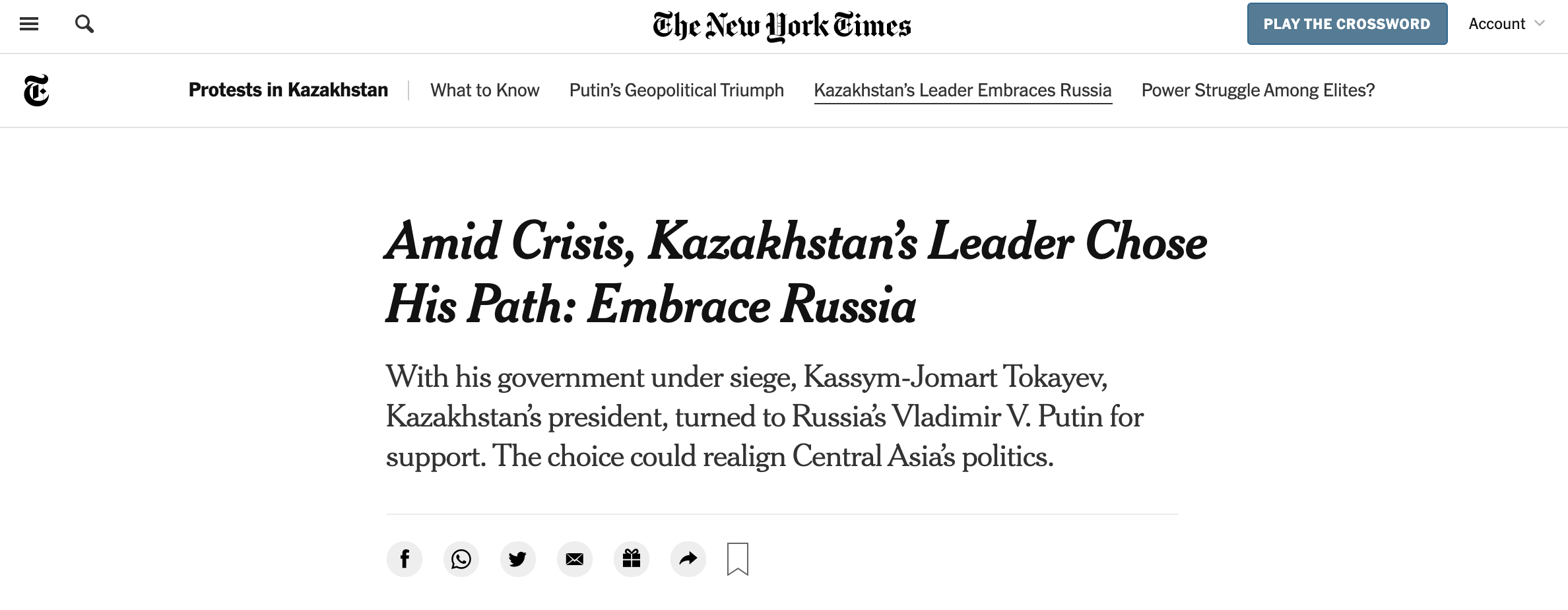
This Russia-centric coverage does, as Peggy points out, limit our perception of the agency of Kazakh people and political systems. It also holds our understanding of the whole of Eurasia within an increasingly outdated framework.
See, the thing is, the idea of a single “post-Soviet space” gets increasingly tricky with each passing year, as the different regions and nations take increasingly different paths from one another. While Russia still plays significant cultural, linguistic, and political role in many of these places, the various regions and countries have huge and important differences which have been and will continue to grow as their shared Soviet history slips further into the past.3 In many of these places (see the Baltics, Georgia, Armenia, and increasingly Uzbekistan), Russia’s cultural influence is being actively and successfully fought against. Even within regions, countries have grown apart meaningfully in the past 30 years. Each of the five post-Soviet Central Asian republics,4 for example, have very distinct political, economic, and social environments from one another. In short, my qualm with this approach to the region is that it perpetuates the idea that places like Kazakhstan are, as the New York Times’ Dan Bilefsky reported last week, “a body double of sorts for Russia.”
So that’s the first entrance point, the first reason this stuff gets front-page attention (in my non-expert opinion). But what’s the other? Looking to the last article in that header (which is also the second article that made the front page), “Power Struggle May be Driving Kazakh Chaos,” my answer is…. because it’s a great story!
Ok, maybe that’s a lazy answer, but once the Russia connection has your foot in the door, the explosive protest and palace intrigue makes for a great read. I mean sure, there’s also a line that can be drawn from the elite power struggle back to the involvement and influence of Russia in the region—and Higgins does make that connection in the article—but I think it matters that such an intriguing and engaging story could be told at that particular moment in time. Of course, that incentive doesn’t do much to serve the goal of a nuanced understanding of the region.
So that’s why, in my opinion, this stuff makes it to the front page. However, while I have my critiques of the way we cover the region in the West, I don’t feel comfortable lambasting the Times and their reporters too much. First of all, a lot of these stories are really good—especially the bits that get buried towards the bottom of long articles and the articles that get buried deep in the online edition or the international news section. I certainly couldn’t do better reporting myself. More importantly, however, I think the New York Times and its journalists could basically say, “what else do you want from us? We’re trying to cover the entire world, we need people to read the things we write, and this is still beyond the geopolitical interest of the majority of our readership.” And they’re right.
Ultimately, it’s a bit like trying to fit a square peg through a round hole. The NYT and other similar institutions could certainly do better in the way that they cover the region, but I think it’s equally important for readers to understand how unlikely and unrealistic it is for the NYT to completely overhaul their coverage of this or any region. It doesn’t make any sense for them. Rather, I think it’s important that we keep in mind the fact that there are experts around the world who write much more in-depth and thoughtful analyses about these things, and spend much more time focusing on a single region or issue than could ever be done within the churning confines of the news cycle. Not to tell you what to do, but if you come across an international story that interests you, use the stories you find on the NYT, BBC, and so forth as a diving board to access the forums where sustained, nuanced discussions have space to play out. For Central Asia, Eurasianet and The Diplomat are my go-to. From there, I can find scholarly articles if I really want.
All that is to say, keep reading the NYT, just don’t only read the NYT if you want to get a fuller picture of things.
I knew this question was coming, and sure enough, there it is: “is there a chance that what is happening there will bleed over into Uzbekistan? How does the situation over there compare toKazakhstan?”
It’s a good question. It’s also quite the can of worms, and one which I can’t open all the way. My short answer is that no, at least in the short/medium term, I don’t see a similar situation playing out here. I’ll also link right off the bat to this article posted yesterday on Eurasianet, since it does a great job summing up everything I would have to say and then some. Basically, the article outlines three main differences between the Uzbek and Kazakh situations:
Uzbekistan has less elite infighting. The Tokaev-Nazarbaev duopoly thing is very weird and very messy. Things are a bit more standard here.
There aren’t as many active price-raising privatization efforts. Comparatively more Uzbek industries remain state owned or heavily regulated with a stronger safety net and more price controls.
Uzbekistan runs a tighter ship. Kazakhstan has seen more protests in recent years, and according to the article, Kazakhstan and Kyrgyzstan are less “deeply penetrated by state security services” than Uzbekistan, Tajikistan, and Turkmenistan.
I would add one more thing here, that I think is really key: timing. Uzbekistan gets to see the example of Kazakhstan, and immediately take actions to make sure nothing similar happens here. Uzbekistan notably cancelled price hikes and gas exports to China, and announced on the domestic UzNews Instagram feed that it was pausing the export of natural gas altogether for an “undetermined amount of time.”
Moreover—and now we enter the realm of speculation—the winter holiday for schools and universities was supposed to end on the 11th, but was extended at the last minute to the 24th. Officially, this has to do with the ongoing transition to the Western-style credit model within the universities. There’s some truth to that, but then they also postponed the elementary and secondary schools. Now, this could very well have nothing to do with Kazakhstan and everything to do with the terrifying and nebulous COVID surge, which we know is ripping through the country but which we don’t have any transparent data on. However, my gut (and the rumor mill) tells me it’s a mix of everything. I think the fact that the situation got so bad in Kazakhstan is the biggest reason I don’t think it will happen here. The leadership in Tashkent certainly took notes, and I think the various organs of the State are strong and stable enough to prevent similar chaos from breaking out.5 The big disclaimer on all of this is that I didn’t see the Kazakhstan protests coming at all, so I could very well be surprised.
I’m going to end things here, hoping to have provided some answers to your questions. Really do give that Eurasianet article a read, it’s short and well-written.
Thanks as always, and please keep commenting and sharing away if you find this stuff engaging!
Salomat bo’ling,
Patrick
All views expressed above are mine alone, and do not reflect the position or opinion of the U.S. Fulbright Program, the U.S. Embassy in Uzbekistan, or any affiliate organizations of the U.S. Department of State.
When I say “some of you” I am, of course, referring exclusively to my mom.
Which, although I’m not an expert, I do think is appropriately interpreted as a proxy fight against NATO and a manifestation of Russia’s (well-founded) fears of NATO expansion. Ukraine experts, please set me straight if I’m wrong.
How similar do you think Estonia and Tajikistan are?
That’s Uzbekistan, Kazakhstan, Tajikistan, Kyrgyzstan, and Turkmenistan, from most to least populous.
I’ll say, a bit more quietly, the even more pessimistic bit. If protests do break out, I have a feeling they’ll be treated with swift brutality.
No posts
Comments
Nothing yet. Say the first thing.
Sign in to join the conversation.