
In late March, I was sitting in my living room with my local friend, Fakhriddin, talking about weddings. His 19 year old sister had just been married the week before, and he was explaining to me the complex marriage process followed by deeply religious families like his. Struck by the beauty of the young bride’s Quran recitation,1 and fascinated by a bizarre legal debate we had gotten into earlier around the permissibility of shrimp under Islamic law,2 I decided I needed to dive more deeply into Islam than I had before.
Especially in Kokand, especially among those born after the collapse of the Soviet Union, a religious revival is underway. For many of my students, Islam is not only a religion, but a hobby, a pastime, and even an obsession.
Throughout my time in Uzbekistan so far, I have come into tangential contact with Islam through my students, but have never really felt comfortable exploring with much depth. As much as I have been curious, my deep-seeded agnosticism and nervousness around discussing religion with my students (as well as their sometimes-intense views3) had always been too much of a barrier. However, this time, the Islamic calendar provided me with a path forward. Ramadan, observed by Muslims worldwide as a month of fasting, was due to start in just a couple of days. With two days to prepare, I made the snap decision to do the fast.
My motivation to participate in Ramadan came not only from a desire to learn about Islam, but from a desire to push my body to a new limit, to see if I could physically complete the challenge. I’ve always been a three-meals-a-day kind of person, and I tend to get hangry (hungry+angry) and exhausted if I skip meals. While I have no interest in starving myself or using fasting as a means to lose weight, I began to wonder if I couldn’t use Ramadan, in part, as an opportunity to overcome this tendency.
In reflecting on the experience, I’d like to separate things into three parts: the physical, the social, and the spiritual. It was a long month with a lot to reflect on, and I did a characteristically bad job documenting it, so I’ll do my best to lay things out in a way that makes some sort of sense. Before that, though, I guess I should briefly say something about what Ramadan actually is.
Ramadan is the ninth month of the Islamic calendar, and the reason for its holiness is summed up in the 185th ayah of Surah al-Baqarah in the Quran:
2:185
شَهْرُ رَمَضَانَ ٱلَّذِىٓ أُنزِلَ فِيهِ ٱلْقُرْءَانُ هُدًۭى لِّلنَّاسِ وَبَيِّنَـٰتٍۢ مِّنَ ٱلْهُدَىٰ وَٱلْفُرْقَانِ ۚ فَمَن شَهِدَ مِنكُمُ ٱلشَّهْرَ فَلْيَصُمْهُ ۖ وَمَن كَانَ مَرِيضًا أَوْ عَلَىٰ سَفَرٍۢ فَعِدَّةٌۭ مِّنْ أَيَّامٍ أُخَرَ ۗ يُرِيدُ ٱللَّهُ بِكُمُ ٱلْيُسْرَ وَلَا يُرِيدُ بِكُمُ ٱلْعُسْرَ وَلِتُكْمِلُوا۟ ٱلْعِدَّةَ وَلِتُكَبِّرُوا۟ ٱللَّهَ عَلَىٰ مَا هَدَىٰكُمْ وَلَعَلَّكُمْ تَشْكُرُونَ ١٨٥
Ramaḍân is the month in which the Quran was revealed as a guide for humanity with clear proofs of guidance and the standard ˹to distinguish between right and wrong˺. So whoever is present this month, let them fast. But whoever is ill or on a journey, then ˹let them fast˺ an equal number of days ˹after Ramaḍân˺. Allah intends ease for you, not hardship, so that you may complete the prescribed period and proclaim the greatness of Allah for guiding you, and perhaps you will be grateful.
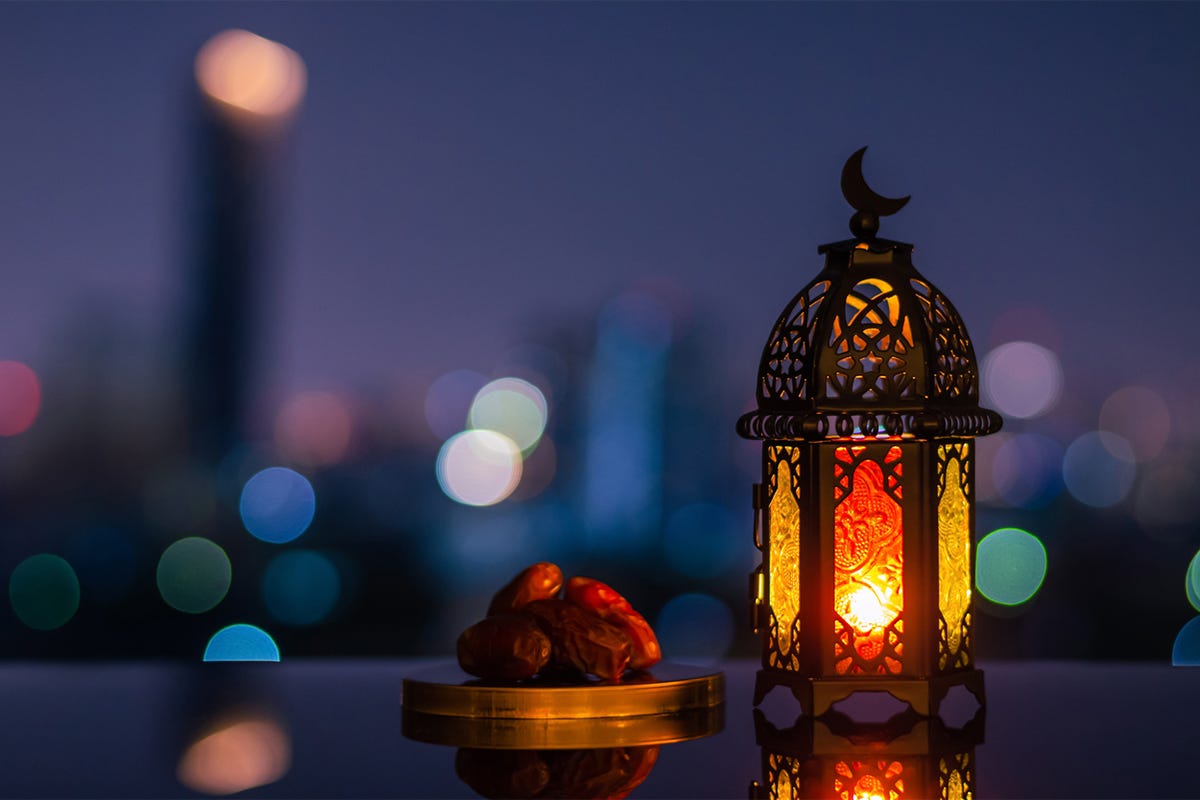
For 30 days, Muslims fast from the pre-dawn prayer, Fajr, until the sunset prayer, Maghrib. The fast prohibits both food and water, along with smoking, sexual activity, and other vices. The Islamic calendar is lunar, so Ramadan falls at different times on different years. This year, Ramadan coincided almost perfectly with our month of April.
I mean, it was tough.
But not that tough? I don’t know, it was a challenge every day, but there are, after all, around a billion people every year who do it. So it isn’t insurmountable. In any case, coming to it for the first time as an adult definitely didn’t make things easier. Throughout the month, the sticking points evolved. Different aspects—hunger, thirst, fatigue—became the predominant challenge, and different parts of the day arose as the hardest parts to push through.
The greatest factor as far as physical difficulty in all of this stems from the fact that Ramadan is not really, as is often said, a sunrise-to-sunset fast. The Fajr prayer takes place before the first rays of sun glint over the horizon, meaning that the fast must begin well over an hour before the sun is actually due to rise. The exact times depend on the time of year and where you are within your time zone, but I was waking up around 3:15am for Suhoor (the morning meal). Usually, people wake up, eat, and then go back to sleep. For someone unaccustomed to the practice, this was extremely difficult. Not only was it difficult to get myself out of bed and then go back to sleep—it was really tough to get hungry at that hour. You’re coming off a big Iftar (evening meal) the night before, you’re completely groggy and delirious, and you know you’ve got to crush as much fat, protein, and water as possible if you’re going to make it through the day. And then if you’re me, with a crippling caffeine addiction, you have to go back to sleep before the 3:30am coffee kicks in.
At first, hunger and thirst were equally challenging. As early as 9:00am I felt parched, and the psychological effects of knowing I couldn’t have water for 10+ more hours only made me fixate on it more. Around 11:00 or noon, the hunger would start to kick in. During the first two weeks, this was incredibly hard to ignore. However, the hunger was actually one of the easiest physical aspects to overcome. One big personal success from Ramadan was that I learned how to push through the wall of hunger and continue to function, albeit at a slightly lower level. During those first ten days, I had a hard time dealing with cravings and pangs of hunger, but it was ultimately easy. I think a sufficiently small amount of time had passed that it felt like a game. Like when you’re on a trip and your body is okay being pushed to wake up early and go to bed late for a couple days.
Eventually however, my body had to confront the fact that it was running a marathon, not a sprint. This second phase was characterized by loud stomach grumbles, intense grumpiness, and long, lingering glances at the tables of food unhelpfully laid out by conference organizers at the various professional events that happened to be going on during April. At the same time, however, my body began to settle into a more regular—if still uncomfortable—rhythm. The thirst stopped getting to me so much, and I became able to predict when I would have the most and least energy. In the afternoon particularly, I noticed my body going through a predictable journey: First, the valley. I usually found myself in the valley around 3:00pm, when a second wave of hunger and thirst would unavoidably come crashing down. The air feels like molasses, the body feels like lead, the brain is reduced to a pallid, saltless soup, and the smallest tasks become great oppressions. Still unable to take real naps, I was resigned to trudging through the valley, wallowing in grouchy self-pity. And yet, eventually, my head would pop up above the edge of the valley and I would find myself on the steppe, a final state of being that would last until sundown. The steppe feels like a steppe because it feels endless, and while it isn’t necessarily comfortable, it’s flat, and you can move through it easily. During those last couple hours, my body seemed to resign itself to its depleted state, quit whining, and free me to plod along into infinity. This grim, determined purgatory’s effect was so strong that I often didn’t feel noticeably hungry when it was time to break the fast, my body having been convinced that it wouldn’t be fed for a long time. Of course, as soon as ate the first couple dates and took the first sips of water, I was more than ready to eat.
To the extent that there was a third physical stage of the month, it really came towards the end and was all about fatigue. Even when I managed to go to bed early, the weeks of waking up at 3:30am, stuffing my face, and trying to go back to sleep had really begun to catch up to me. While things got easier in the sense that I got used to the feelings I went through during the day—for example, “the valley” became a much less whiney ordeal—I started to get a lot more exhausted during that afternoon slump. I finally reached a point where my body, usually immune to mid-day sleep, actually allowed me to take naps. Those afternoon naps saved me during the final week and a half especially.
A huge part of my desire to observe Ramadan in the first place came from its potential social benefit. My students had tried to teach/convert me to Islam many times throughout the year, and although it really turned me off at first, I quickly realized that my students, as I wrote earlier, were excited to share these traditions and practices with me not just as a religion, but as a sort of very intense hobby. I knew that, even if I wasn’t planning on converting anytime soon, my participation would bring me closer to my students in a really meaningful way.
As it turns out, coming closer to my students was only the beginning of the social benefit that came with Ramadan. As I’ve mentioned before here, Uzbeksitan’s designation as a “majority Muslim country” is a bit misleading. Some cities are much more and less religious than others, and a secular shadow left over from the Soviet Union is still cast over many aspects of Uzbek life. It’s a confusing dynamic.4 However, Kokand is one of the few cities in Uzbekistan where religiosity is consistently strong enough for the whole city to really feel like part of ~Muslim Society.~ This made Ramadan feel like a real community event, and it was really special to be a part of it—even as a clear outsider.
Every night when I woke up in the wee hours of the mornings, the same lights in the neighboring building were on, and my mystery neighbors and I ate our morning eggs in groggy, silent solidarity. For Iftar, it was even better. Neighbors, students, colleagues, and taxi drivers I had never met before in my life all invited me for meals, and the city took on a fantastic energy as it came alive at dusk. It was in this month, more than at any other point during the year, that I felt at home in Kokand.
No, I didn’t convert to Islam.
But it was still a super meaningful experience! I’ve talked a lot with friends both before and during my time in Uzbekistan about my relationship with religion and faith, and it became a huge part not just of Ramadan, but really of the final third of the grant.
I had initially intended Ramadan as a completely secular experience, but it quickly became clear that this approach was untenable. My students-turned-mentors insisted that Ramadan isn’t Ramadan without the religious aspect, or at least a sincere attempt at spiritual reflection. Even more practically, they insisted that I would fail at the fasting without spirituality. The burden is made light by Allah, but to undertake the physical challenge without that understanding felt, to them, impossible. Despite being wary of their most enthusiastic attempts at conversion, I was fairly receptive to their insistence that I take the month as a spiritual, as well as physical, undertaking.
I was raised as an atheist, and I never had an issue with that position growing up. However, as early as high school, I had moments of feeling like I was missing out on, if not literal salvation, at least some aspect of cultural fullness and community. With my extended family physically dispersed across the country and my sociocultural standing firmly among the educated and mobile—those who could realistically aspire to the liberal ideal of the “global citizen”—I began to feel the creeping ache that has driven so many young people in recent history to niche subcultures, all-consuming discord servers and subreddits, and fringe political ideologies. The half-submerged feeling that, after all the attempts we make to gain perspective and expand our world, we will find ourselves out to sea with no land in sight. A fear that while I’ve learned how to deconstruct the world into little pieces I can pick up and examine from interesting angles, I’ll eventually realize that I’m sitting in a void full of scraps and be completely unable to reassemble them into anything meaningful.
More practically, I started having moments of yearning for the community and the structure offered by religion. This interest got expanded to the embrace of the unknown and the absurd during my time at Oberlin, as religion ended up playing a significant role in my research. I had—and still have—moments of real envy for those who believe, who belong to a community, who belong to a side and know where they stand. I’ve expressed this jealousy a few times to friends, at least to the other Fulbrighters, and it looks like I’m not entirely alone in the sentiment.
I made one real attempt to connect with religion during my freshman year of college, when I tried to get in touch with my Irish-Catholic heritage and attend Oberlin’s Catholic service. My thinking went, basically, if there’s anywhere where Catholicism won’t turn me off, it will be here, among a bunch of politically progressive young people (not the average Catholic Mass demographic). It didn’t work. It felt completely disingenuous and I stopped going after two weeks.
In any case, I found myself in Kokand immersing myself in Islam, making a legitimate attempt to learn about it and, perhaps, even open my heart to it a bit. While it was incredibly rewarding, I ran up against the same wall I’ve always been faced with, and that I’ve never been able to break through. To move beyond intellectual interest, to actually believe, to take Kierkegaard’s “leap into faith.” I couldn’t do it with Catholicism, and I can’t do it with Islam.5
This is frustrating, and I’ve spent a lot of time thinking about why I get stuck where I do. I think there two answers I keep coming back to:
Cynically: The organization of economy and society that gives rise to produces these anxieties and desire for community, at the end of the day, benefits me too much, personally, for me to be willing to give it up. I am too rewarded by the globalized world, I get to be among the winners, the people who go to college and Fulbright and law school and so on. I get to dabble and travel and explore all the different sides without having to settle on any one and defend it. In this context, my inability to pick a side (because I can’t bring myself to muster a full-throated defense of atheism, either) is a weakness and a manifestation of my inability to sacrifice the little treats I get from global capitalism.6
More sympathetically to myself: I actually do have my own belief system, I have picked a side, and I do unironically believe that while religion is fascinating and cool and important for societies, I don’t believe and won’t ascribe to any particular one. In this context, I am “actually” progressive in the sense that my desire in response to the existential issues of the current moment is not really to retreat into an imagined traditionalism where things make sense, but to push forward and try to find/build community in more creative ways.
Or something like that.
I think the questions about faith and the metaphysical in my life are far from settled. They may never be settled, and that’s probably a good thing, ultimately, if I want to actually be a person who continues to grow and learn throughout my life. Sometimes I may feel like I’m an amorphous blob of matter shifting through the universe aimlessly, but maybe that’s alright. I don’t really know. I do know, however, that I’m glad I did Ramadan this year, I’m glad I got to experience it where and when I did, and I’m very glad that it was more than just a physical challenge for me.
Until next time,
Patrick
The views expressed above are mine and mine alone, and do not reflect the official opinion of the United States Department of State, the US Embassy in Tashkent, the US Fulbright Program, or any other official individual or entity.
Most of the footage from the wedding was Quran recitation, either by the bride or by an Imam.
This debate was sparked by my fellow ETA Daniel (the one who got COVID with me, remember that little saga?), who was confronted by his students Nukus about the permissibility of alligator consumption after a lesson on Cajun food.
I suspect there is a small but decidedly nonzero number of T*liban apologists among our students.
For example, the summer camp at which I’m working right now has an official “no religious dress” policy which the Uzbek administrators absolutely insist on maintaining as a rule, although none of the hijabi girls or tubeteika’d boys seem to have run into any real issues.
That is to say nothing of the obviously bad look of coming back to the states as a super-based-white-guy-Muslim. Yikes. In the moment, though, I tried to put that aside to give myself space to experience the experience without pre-shaming myself, especially because the real internal debate is less about Islam in particular and more about spirituality and religion writ large.
Progressive commentator Hasan Piker frequently refers to the idea that we live in a “treat-based” economy, and that Americans will put up with all measures of neo-feudalism as long as they can still get jalapeno poppers at Arby’s.
No posts
Comments
Nothing yet. Say the first thing.
Sign in to join the conversation.