
It’s been a long 10 days in Kazakhstan. You’ve probably read something about what’s been going on there already, and there’s a lot that we still don’t know, but let’s review:
On January 2, protests began in Zhanaozen, a small city of about 150,000 people in Kazakhstan’s southwestern Mangystau Region.
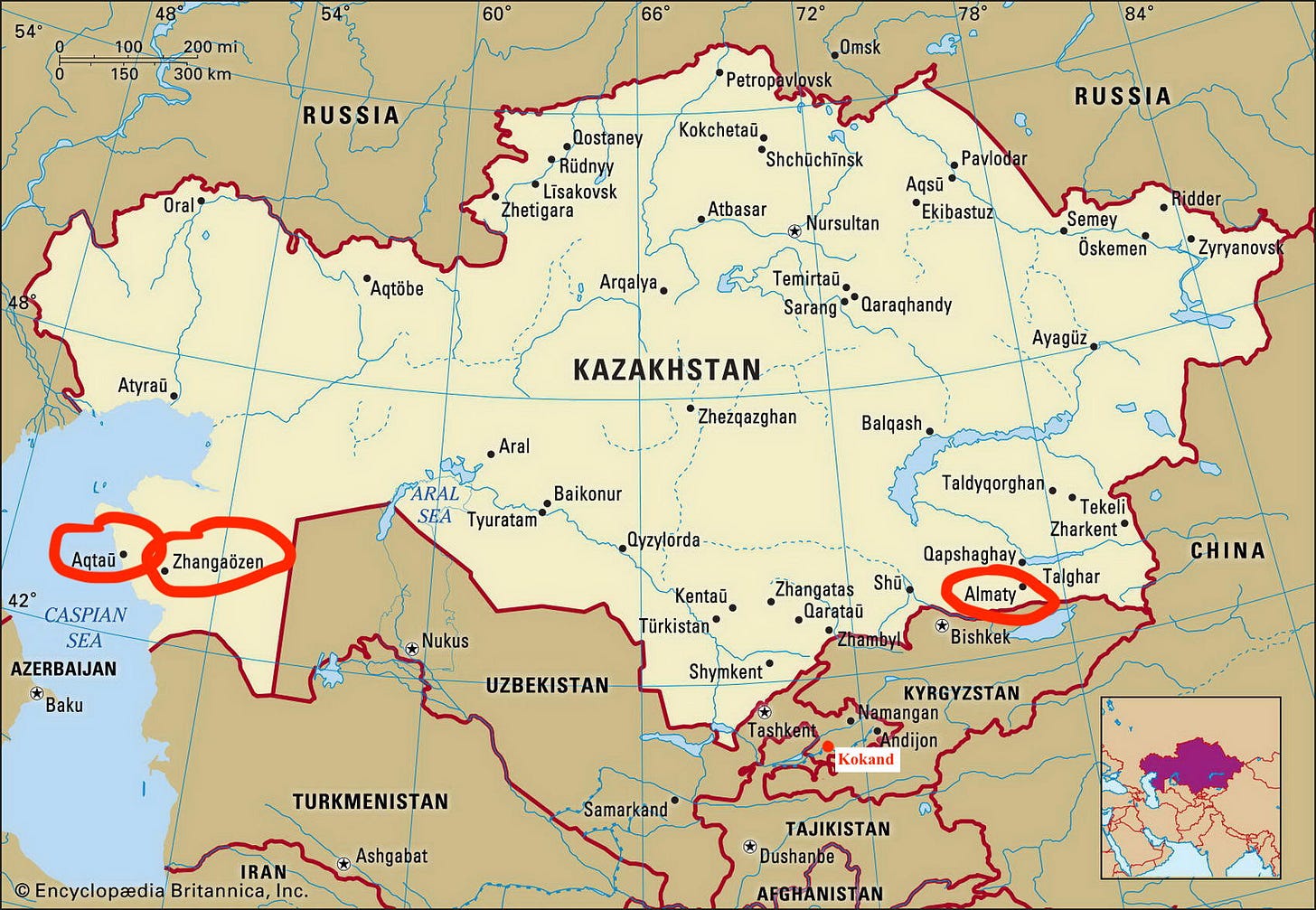
The protests spread over the next few days—first to the regional capital Aktau, and then eastward to the country’s largest city, Almaty, and the capital, Nur-Sultan (formerly known as Astana).
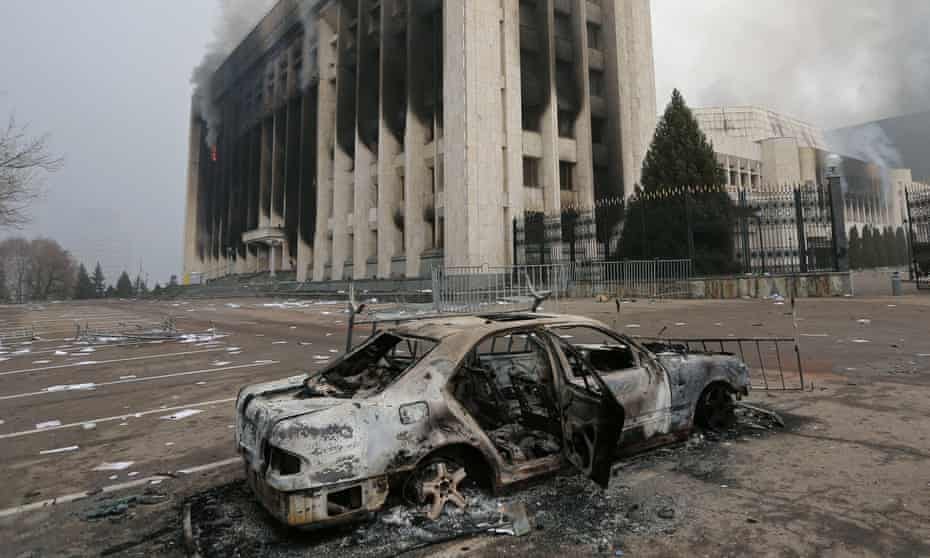
By January 5, the protests had taken on a markedly different tone. Reports and footage emerged of burning cars, looted buildings, and increasingly aggressive police responses. Throughout the day, reports became increasingly intense. The Kazakh president, Kassym-Jomart Tokayev, declared a state of emergency the next day, and began restricting internet access throughout the country. Internet access in Almaty remained restricted until yesterday.
That same day (Jan. 5), President Tokayev fired his government and restored price controls. He also removed former president Nursultan Nazarbayev from his position at the head of Kazakhstan’s defense council, claiming the position for himself.
The situation continued to intensify over the following days. Government buildings and vehicles going up in flames, and at one point it was reported that protesters had gained control of the Almaty airport. This was, of course, accompanied by increasingly violent responses from the state. Tokayev’s government arrested thousands, and over 150 people (including mostly civilians as well as some police officers) have been reported killed.
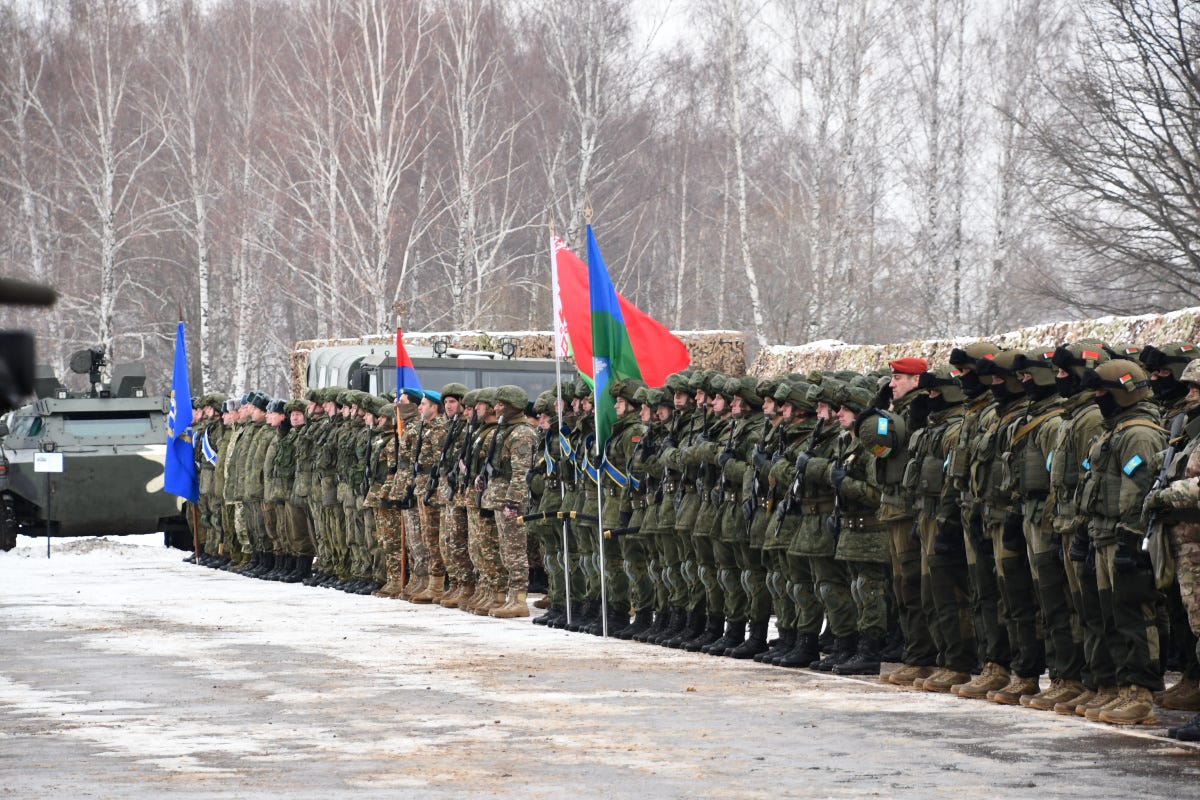
On Jan. 6, peacekeeping forces (mostly from Russia and Belarus) began arriving from Kazakhstan after being requested by Tokayev under the auspices of the Collective Security Treaty Organization (CSTO)
Yesterday, President Tokayev gave a sprawling address to the Kazakh parliament. He announced that the most intense phase of “counterterrorism operations” had concluded, claimed that the CSTO troops would be gone within 12 days, and named a new Prime Minister. He also turned his attention to the systemic issues facing the country, signaling a wide range of areas for reform.
Ok. Clearly there’s a lot to unpack here, and I hope it’s clear that I’m not the most qualified person to do all the unpacking. There are lots of people who study Kazakhstan professionally, study protest movements professionally, and, you know, live in Kazakhstan that have a lot more to add on the topic. This post isn’t going to be so much about my nonexistent analysis of the situation as it is about me trying to give a tiny tiny bit of context, draw on some Russian-language sources that most of my audience can’t access, and compile a bunch of links and resources to help your understanding of the issue and region extend beyond those fleeting moments when the BBC or New York Times decides to cover it.
I know I have a lot of free time right now since I’m in COVID quarantine, but in order to save myself some time and give this thing a little structure, I want to focus on three pieces of context/nuance that I feel are important as we consider the situation: the popular socio-economic origins of the protests, the underlying power struggles among the elites, and the every-thorny discourse around terrorism, “outside groups,” and the sudden escalation of the unrest.
How did it start?
Much like in Uzbekistan, many Kazakhs rely on compressed natural gas or liquified propane gas (LPG) to fuel their cars (remember when I wrote about that?). As is the case all over the world, (including in the USA), the government subsidizes the fuel industry in order to hold prices lower at the pump. In Kazakhstan’s particular case, this meant a fuel cap that kept prices around 60 tenge, or $0.14, per liter. Kazakhstan has been, as is the fashion, undertaking some efforts to continue the half-finished job of privatization left over from the Soviet period (that is, the magical and unimpeachably emancipatory process of transferring ownership of major industries from the State to the individuals who run said State). As part of this, they’ve been moving to roll back gas subsidies and allow markets to dictate the price. As this transition came to fruition at the beginning of the new year, and with demand for gas seasonally high during the cold winter months, prices spiked overnight, doubling to 120 tenge ($0.28) per liter. Unsurprisingly, people were upset.
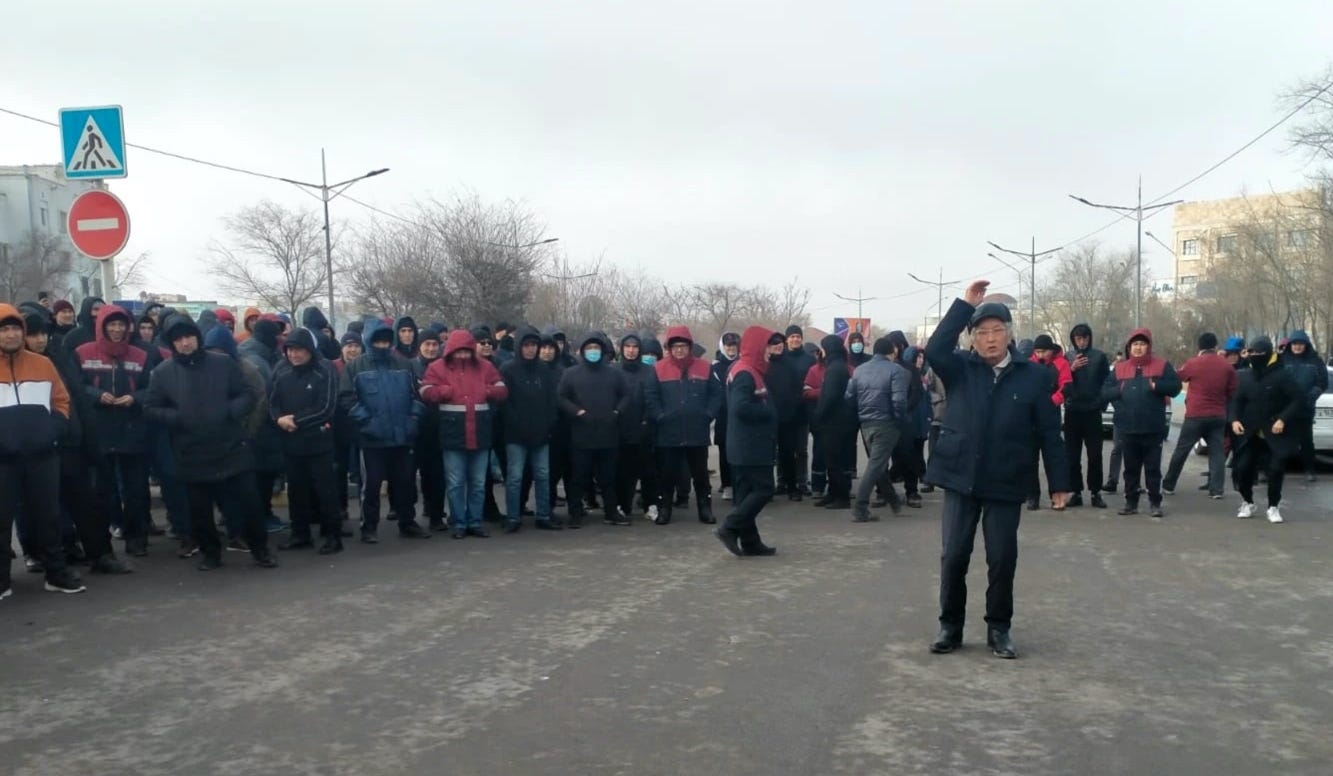
“But,” you must be asking, “why did the protests start in Zhanaozen, of all places?”
I don’t know. It’s a good question. Or is it? Why does any mass movement start in any one of a hundred places with similar conditions? I really don’t know. But there are some contributing factors worth mentioning. First, Zhanaozen, and the Mangystau region more broadly, is relatively poor and has a generally lower standard of living when compared to the country’s East. This makes price spikes of any kind more severely felt, generally speaking. Moreover, the economic situation means that relatively more people use the cheaper fuel—LPG—in their cars. In other words, more people are directly impacted by the price change in a place like Zhanaozen than, for example, in Almaty. Finally, Zhanaozen is no stranger to protest. in 2011, oil workers went on strike in the face of low pay and unsafe working conditions, occupying the city’s center square for over six months. The movement turned deadly when police opened fire on the unarmed crowd, killing at least 16. The massacre happened on December 16th—Kazakhstan’s Independence Day.
To be clear, that doesn’t mean that the two protest movements are connected in any way. I haven’t seen or heard anything to suggest that. What I am saying, however, is that people in the region are conscious to the material issues they face and able to mobilize around them.
And mobilize, they did. However, as we’ve already established, and as you have probably already seen, a provincial protest over fuel prices isn’t the reason this story has been getting front-page coverage on the international news.
Palace Intrigue
From independence in 1991 until 2019, Kazakhstan was ruled by Nursultan Nazarbayev, who had previously been the Prime Minister of the Kazakh SSR. Nazarbayev maintained unilateral control over the country through the post-Soviet transition, holding to what many call a “soft authoritarian” model of governance; prioritizing stability and political hegemony while simultaneously working to attract foreign investment, tourism, and international credibility.
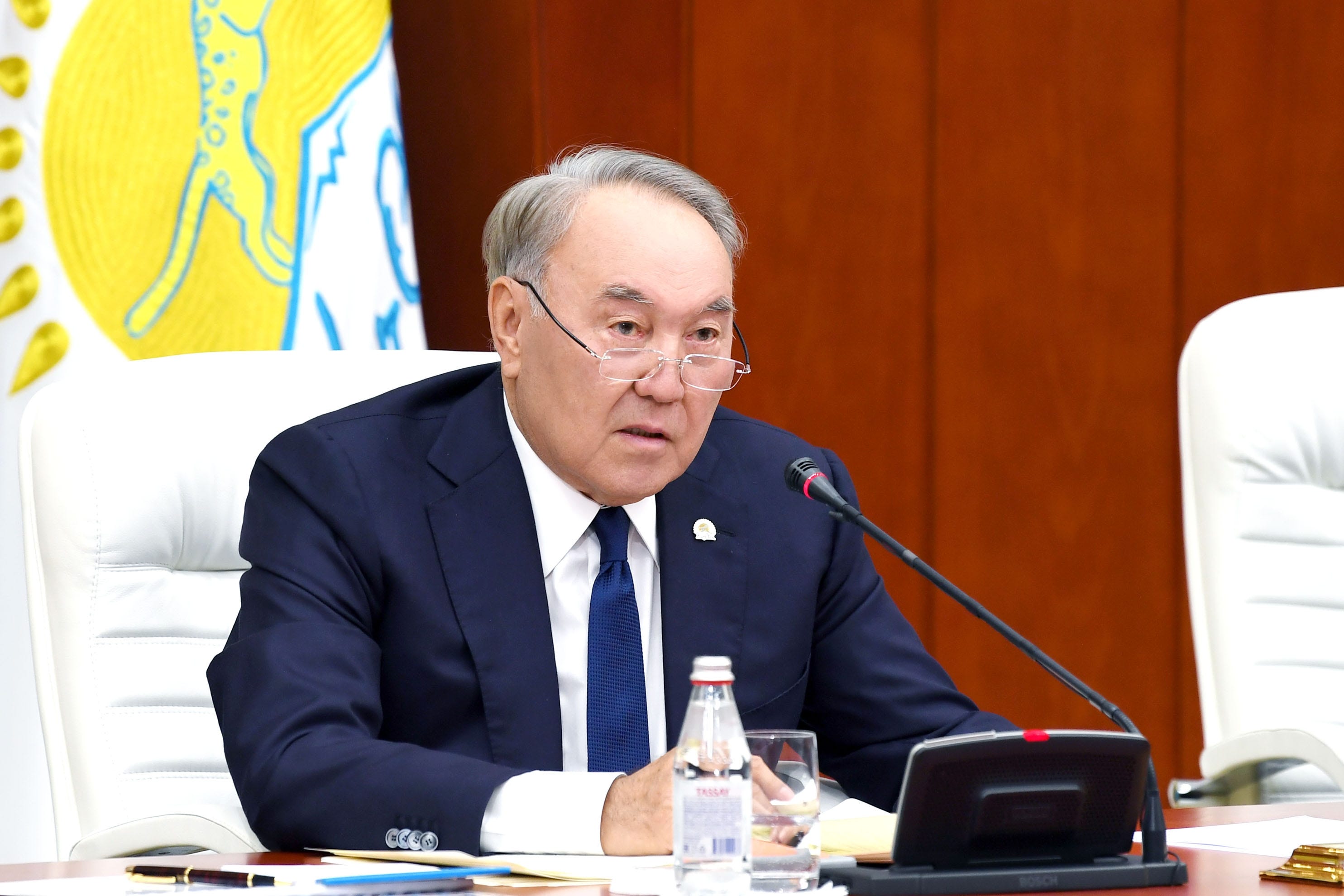
As time went on, Nazerbayev’s health inevitably began to falter, and rumors began to spread about his unavoidable replacement. Looking to the long history of authoritarian regimes that faltered after the death of the leader, Nazarbayev became dedicated to ensuring a smooth transition while he still could. This issue was undoubtedly pushed further to the forefront of his mind during the 2010s, as the presidents of both Turkmenistan and Uzbeksitan passed away while still in office.
In 2019, Nazarbayev resigned. He handed the position of acting president to his then-second-in-command, Tokayev, but retained a good deal of power for himself. In addition to retaining the formal title1 “Elbasy,” or “leader of the nation,” Tokayev appointed Nazarbayev as the lifelong chairman of the National Security Council and lifelong leader of Nur Otan, the political party to which he and Tokayev both belong.
These changes implied—and were meant to project—a highly managed transition of power, overseen completely by Nazarbayev. From the beginnings, however, there were rumblings of discontent and power struggle. When additional veto powers and privileges were announced for Nazarbayev a few months after his official retirement, it became clear that Tokayev was not entirely satisfied being a placeholder for his predecessor, and that the concessions to Nazarbayev were being made begrudgingly. Rumors of Tokayev’s struggle against puppethood intensified in 2020, when he abruptly demoted Darigha Nazarbayeva, Nazarbayev’s eldest daughter and heir-apparent, from her position as chairwoman of the Senate.
Fast forward to last week. I mentioned that Tokayev dissolved his government at the beginning of the unrest. Unsurprisingly, that government was full of Nazarbayev loyalists. Tokayev also removed Nazarbayev from his Security Council position, drawing the world’s attention to the possibility that the governmental re-shuffling was not simply a panicked attempt to appease protestors. Even more dramatic was the January 6 arrest of Karim Massimov, the director of Kazakhstan’s intelligence and security service, on charges of treason.
The move stoked talk of a potential power grab—or power grab gone wrong—playing out in Nur-Sultan in parallel to the protests rocking the country. As Catherine Putz writes for The Diplomat, “A likely reality is that underneath the swell of protests in the streets, Kazakhstan’s opaque elite political circles made their moves: Massimov’s arrest on treason charges suggests that whatever power play he was a part of has failed.”
Yesterday, Tokayev’s speech to parliament seemed to re-affirm suspicions that Tokayev plans to emerge from the recent turmoil as a fully-fledged leader, no longer standing in the shadow of his predecessor. In the speech, Tokayev called out corruption within the government, even implicating Nazarbayev in the creation of an oligarchy and perpetuation of socio-economic inequality.
Tokayev seemed to take a page out of Uzbek president Shavkat Mirziyoyev’s book, branding himself as a visionary reformer by calling out the failings of the former regime (of which he himself was a key figure) and promising structural reform.
One way or another, it seems that Tokayev has prevailed in an intense, opaque struggle within the halls of power. Did he wrest power from Nazarbayev with finality? did he, as many speculate, survive an attempted coup from Massimov and other elements within the Kazakh security apparatus? Did he, as his government claims, survive an attack from a shadowy group of terrorists and “foreign agents?” I don’t know. But it’s certainly interesting.
Frustrating Narratives
The last thing I want to touch on here is important because it’s not being discussed anywhere you would see it if you don’t speak Russian and/or don’t follow Central Asia closely.
Whenever a country like Kazakhstan—a place many Americans know little to nothing about—appears in the international news, there are issues with the way it’s covered. Some of those issues are predictable, routine, and easily criticized.2

Dr. Aijan Sharshenova@AijanCo
How is that a joke for you @nytimes @trbrtc @INechepurenko? Maybe try finding a writer who sees Central Asians as humans not objects for your poor taste banya jokes #kazakhstan #kasachstan22

1:26 PM · Jan 8, 2022
3 Reposts · 6 Likes
However, in this case, I’ve seen a lot of discourse around one particular simplifying tendency of our media coverage that I think is worth reflecting on. Throughout the protests, Tokayev’s administration has increasingly blamed foreign actors, anarchists, and other vaguely defined “terrorists” for the escalation of the protests. We recognize this language as a textbook tool of authoritarianism, and rightly scrutinize it. However, in doing so, we may allow ourselves to indulge in our own simplifying narrative—one about the democratic spirit of an oppressed people rising up in a natural burst of passion, boiling over from material grievances to a heroic bid for that elusive ideal of “freedom.” We3 see a people rising up, and we idealize them as a freedom movement—the same ideal we ascribe to uprisings around the world, but never at home.
If you listen to the scholars who have dedicated their lives to the region, or, even better, the people who actually live in the region, a more complex story emerges. While the government-sponsored fear mongering about “foreign agents” is dubious and unproven as of yet, there is a significant amount of pushback coming from Kazakh and Kazakhstan-adjacent voices about the idea that the protest movement that began in Zhanaozen is the same one that sacked government buildings in Almaty.
Dr. Diana T. Kudaibergenova@CreativeCorazon
One more inside from Kazakhstan where the internet is blocked: protests were peaceful! In Almaty peaceful protests were hijacked by organised criminal groups. This account is by Kazakh philosopher Zira Nauryzbayeva via Aisana Ashim telegram channel.

8:48 PM · Jan 8, 2022
28 Reposts · 69 Likes
That is to say, it’s a complicated and nuanced situation, and one which played out largely without live feedback from people on the ground (remember, they didn’t have any internet at all for days!). The regime’s attempt to paint the movement as a whole as terroristic is clearly in bad faith, but it’s easy to be just as reductive as we push back against those narratives. We think we know what’s going on in other countries because the events there seem to follow familiar patterns. We do this, all too often, while ignoring the experts—especially those from the region in question—who are actively trying to inject the nuance, context, and firsthand accounts back into the testimony.
I’ve spent way too much time and energy on this piece, which ultimately doesn’t say anything new at all, but I’ll finish by adding a list of sources that you can access if you want a more in-depth view of the region and the context behind the events of the past weeks.
Thanks as always for reading, and don’t hesitate to reach out if you have feedback, questions, or something you’d like to hear me write about!
-Patrick
Sources in English
Oxus Society: The Oxus Society for Central Asian Affairs is an incredibly useful organization, and they’ve compiled an incredibly useful list of resources to help get a better grasp on Kazakh politics.
Meduza English: the English-Language branch Meduza, my go-to site for investigative and critical journalism about Russia and the former USSR
Eurasianet: writing from experts about all the pressing issues in the various Eurasian regions! I rely on their work heavily.
The Diplomat: magazine about the Asia-Pacific, with great writing on Central Asia. Managing Editor Catherine Putz is always on the ball with CA coverage!
For the academically-minded: This special issue of Communist and Post-Communist Studies is all about the issues behind the protests in Kazakhstan, and the articles are free for a limited time!
For the Twitter-minded, I follow a number of scholars and commentators including:
Edward Lemon @EdwardLemon3 (president of Oxus Society)
Joanna Lillis @joannalillis (writer for Eurasianet and The Economist)
Asel Doolotkeldieva @ADoolotkeldieva (political ethnographer based in Bishkek)
Diana T. Kudaibergenova @CreativeCorazon (Sociologist at Cambridge)
Nargis Kassenova @KassenovaNargis (senior fellow at Harvard’s Davis Center for Russian and Eurasian Studies)
Eilish Hart @EilishHart (Meduza English editor and astute commentator)
Ok, that’s it! that’s not everything by any means, and I’m sorry if there are already inaccuracies or omissions here. The other lesson is that if you are REALLY interested in this stuff, you need to learn some Russian! There’s a whole world of high-quality Russian-language stuff out there on the internet, and a lot of the source material gets published/posted in Russian alongside other regional languages. You can study those national languages as well, if you’re really dedicated.
ok bye!
All views expressed above are mine alone, and do not reflect the position or opinion of the U.S. Fulbright Program, the U.S. Embassy in Uzbekistan, or any affiliate organizations of the U.S. Department of State.
The title is not purely ceremonial. In fact, it apparently protects him and his family from civil or criminal prosecution.
See the incessant “Why does Kazakhstan matter? Because they have oil!” “it’s all about *tribal* (or clan) rivalries” and “This must be all about Russia” content from western media outlets.
And I’m talking here not only about the news media from the US and Western Europe, but also the Russian opposition commentators and free journalism outfits like TV Rain and Meduza (yes, I know they’re technically based in Latvia)
No posts
Comments
Nothing yet. Say the first thing.
Sign in to join the conversation.