

There is nothing wrong with eating food simply for the enjoyment – food is not exclusively for the nourishment of the body, but also for the nourishment of the soul. Sometimes, a tub of ice cream can make unpleasant news more palatable, while other events call for a celebratory ham. Yet some people seem to think that they need to justify their choices – and what better justification than making a sacrifice for health? And suddenly wine is no longer a drink to be simply enjoyed – it consumed because it is healthy.
The same is true for chocolate – instead of seeing it as a delicious treat, it has to be healthy. After all – many scientific papers seem to confirm this!
The science behind these claims is real – but it's not actually about chocolate.
Why the confusion? Over recent decades, extensive research has examined the health benefits of plant-derived polyphenols This diverse class of compounds appears in most plant foods, and many are believed beneficial to human health. For years they were called antioxidants, though most can no longer function as antioxidants once absorbed. They more likely act as signalling molecules.
One group of polyphenols that has received a lot of interest are flavanols – compounds found in tea, apples, berries … and cocoa. There are two main groups of flavanols with many different subgroups – and each of these compounds has a different effect on the body. And this is why flavanols from cocoa – cocoa flavanols – are ideal for research: they contain both types of flavanols.
It’s easy to see why this can lead to confusion:
flavanols → cocoa-flavanols → chocolate.
While the research is about individual compounds, the story often ends up being about chocolate – even though it had nothing to do with chocolate.
There is very good evidence that flavanols – the compounds – have a beneficial effect on health. A large randomised controlled trial with more than 20,000 participants (the COSMOS trial) showed that flavanols reduce the risk for heart disease and improve cognitive function. There is even a recommendation for flavanols by the US Academy for Nutrition and Dietetics.
None of this is about chocolate, because it would be very difficult to consume sufficient amounts of flavanols from chocolate – there are many other, and healthier, sources.
It seems to be strange: when cocoa flavanols are so good for us, why not chocolate? Chocolate is a fascinating food with a long and colourful history. It is also a food which undergoes many processing steps from harvesting the beans to the bar on your table – and in each of these steps, flavanols are lost. About 80% of some flavanols are lost in the first fermentation step alone! There is therefore often not much flavanol left in chocolate – and without measuring it, we simply don’t know.
But surely, dark chocolate with high cocoa content must be fine? After all, this is what many experts recommend?
Having worked with cocoa flavanols for many years means that I am always very surprised when people make such claims. There is not really any evidence that dark chocolate is in any way healthier or contains more flavanols a detailed analysis of chocolates showed that quite a few dark chocolates contain much less flavanols than milk chocolates.
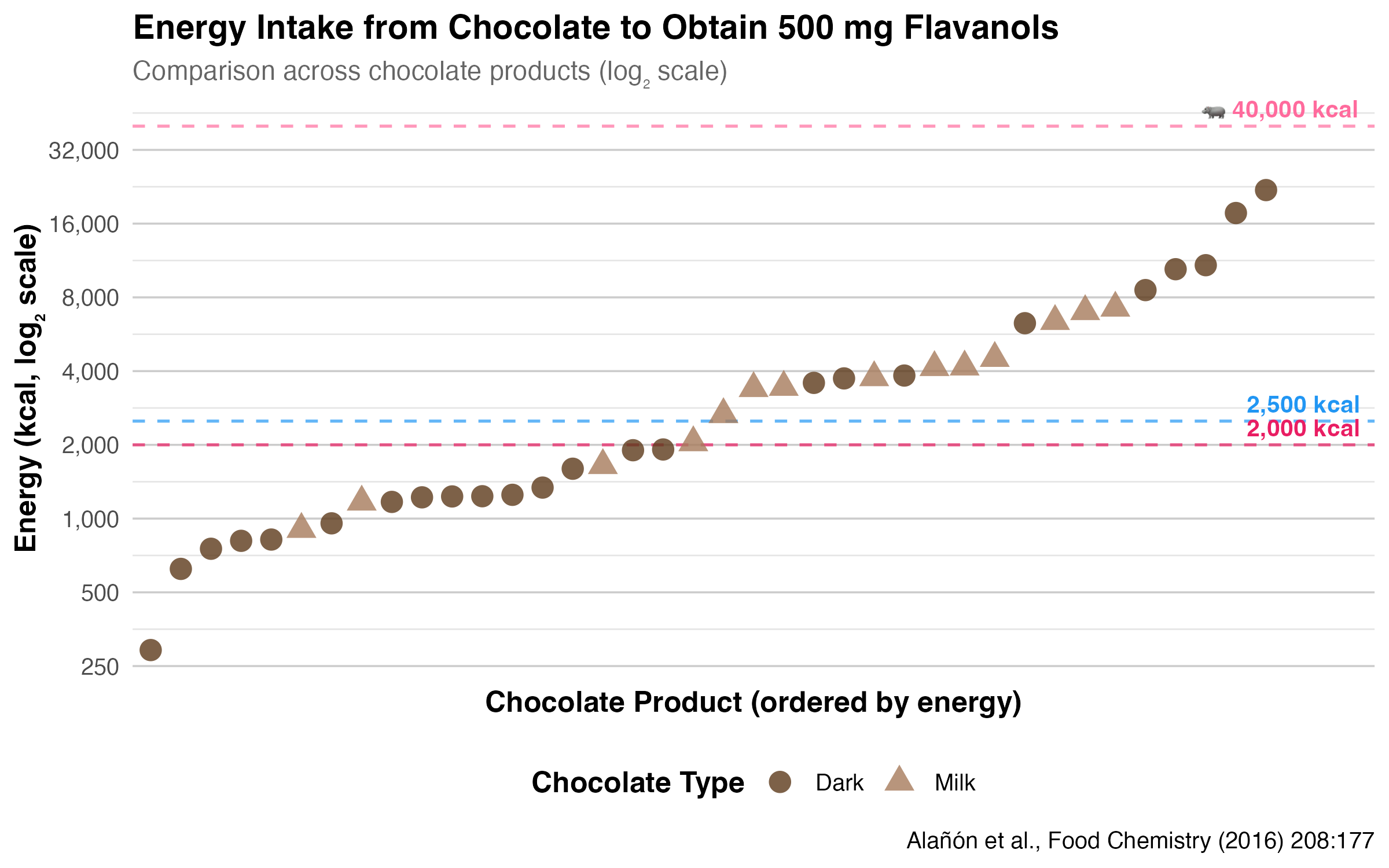
Chocolate is clearly not a very good source of flavanols. A few squares of chocolate – even very dark one – is unlikely to contribute significantly to total flavanol intake. It would require an entire bar, 100 g, to get about 50 mg of flavanols – that is 10% of the amount used in the COSMOS study.
And there is another problem: chocolate is quite calorific, and eating enough chocolate to achieve a meaningful flavanol intake would easily exceed the daily energy requirement of humans.
Chocolate is a treat – and it should be enjoyed as a treat, because food is not just a source of energy and nutrients. But it’s not a health food. If you want to increase your flavanol intake, there are many better (and healthier) foods which can be found here. I recently also discussed these issues in more depth on BBC Radio 4's Sliced Bread programme.
No posts
Comments
Nothing yet. Say the first thing.
Sign in to join the conversation.