
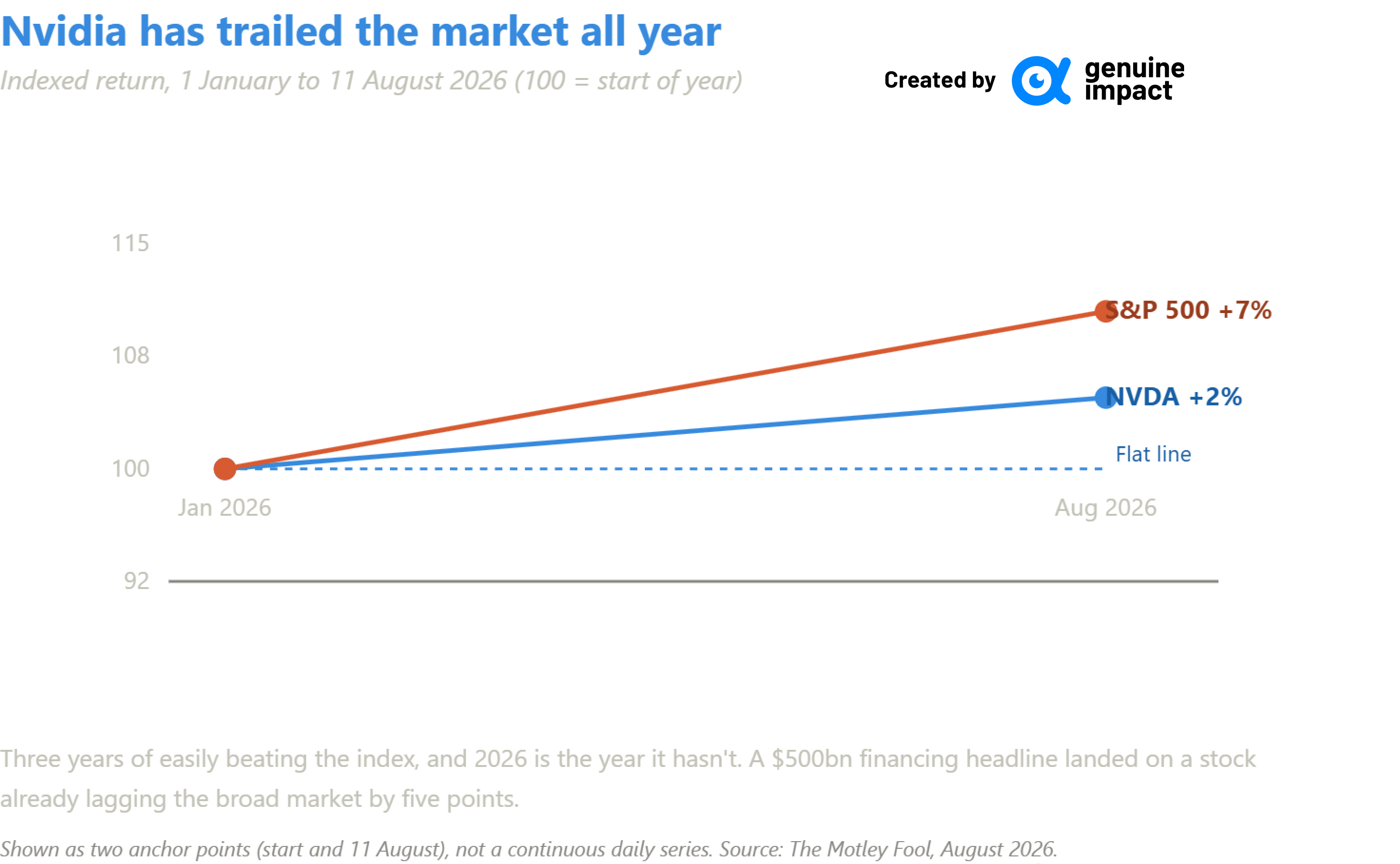
On 10 August, Nvidia announced memorandums of understanding with six of the largest pools of capital in the world — Apollo, BlackRock, Blackstone, Brookfield, Goldman Sachs and KKR — to build financing platforms designed to mobilise more than $500 billion in third-party capital for AI infrastructure. Jensen Huang’s framing was explicit: Nvidia began by building chips, and is now helping create “a new class of productive, investable infrastructure.” The stock fell roughly 2% on the news, to around $219, on a stock that was already essentially flat for the year against a market up 7%.
A $500 billion capital-mobilisation announcement that gets sold off is itself the story. The market did not misread the announcement as small; it read it correctly as large, and marked it down anyway. We think that reaction is legible once you separate what Nvidia actually did from what the headline number implies. Nvidia did not commit $500 billion of its own money. It agreed, via non-binding MOUs, to help six asset managers build the plumbing — special-purpose financing platforms — through which other people’s money can be lent against Nvidia compute as collateral. That is a different transaction than the number suggests, and it lands on the exact question the market has been asking about Nvidia all year: how much of the demand underneath its results is being financed by Nvidia itself, directly or indirectly, rather than by independent buyers.
The China dimension sits underneath this without appearing in the press release at all. The same company asking six of the world’s largest capital pools to help financialise its compute for the rest of the world has, over the same twelve months, gone from roughly a quarter of its data-centre revenue to a guided assumption of zero data-centre compute revenue from China. The $500 billion platform is being built specifically for the market Nvidia can still serve. It says something about where that market now ends.
Strip the release to what it commits Nvidia to, rather than what the $500 billion figure implies. The company signed non-binding memorandums of understanding with six financial institutions to establish “independent compute financing platforms” — dedicated pools of capital that will lend to Nvidia’s customers, at scale and at what the release calls attractive rates, against the value of the compute those customers buy. Nvidia’s role is to make the underlying asset investable: it is providing the technical case that a GPU fleet is a durable, cash-generating asset comparable to the aircraft, power plants and toll roads that firms like Apollo, Blackstone, Brookfield and KKR have financed for decades, rather than a rapidly depreciating piece of technology hardware. Huang’s language leaned on that comparison directly: “in AI, compute is revenue.”
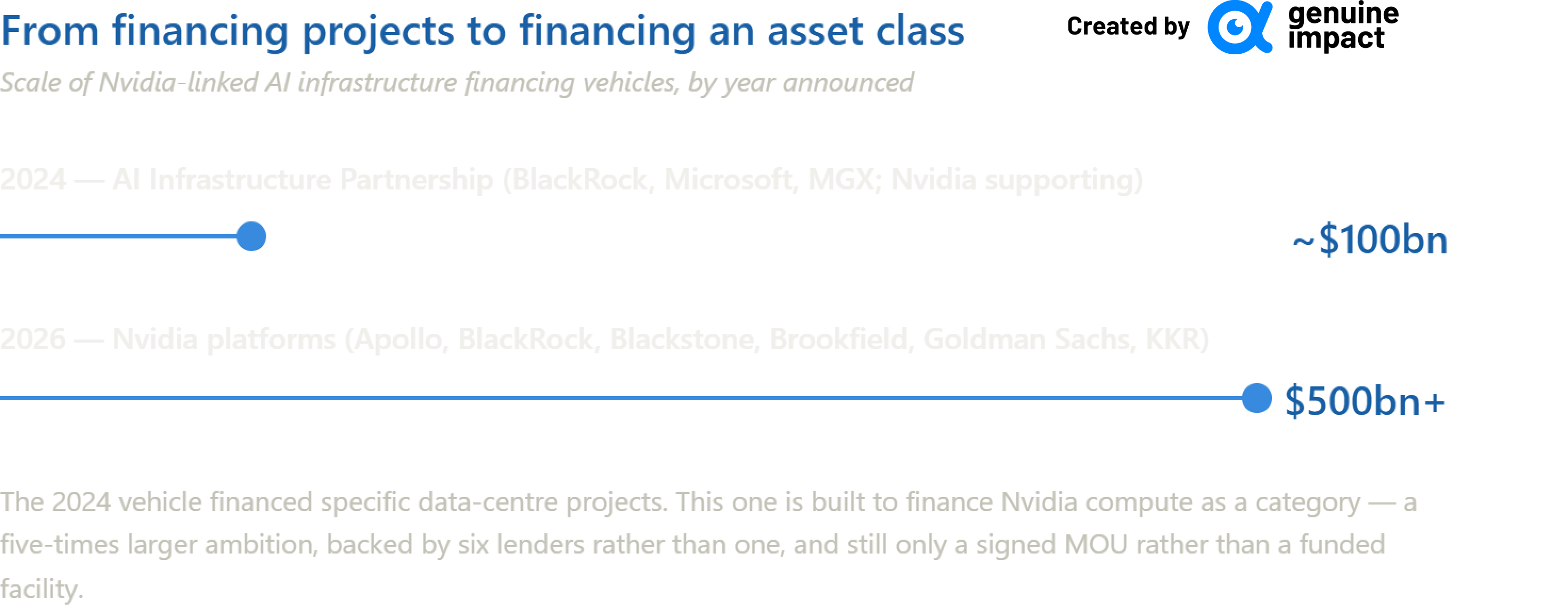
This is a significant step change in the plumbing rather than a rerun of prior deals. Two years ago, BlackRock, Microsoft and the UAE’s MGX vehicle formed the AI Infrastructure Partnership, with Nvidia in a supporting role, to bankroll data centres at a scale that reached roughly $100 billion including debt. That structure financed specific projects. This one is being built to finance an asset class — Nvidia compute generally, across “leading frontier AI labs, enterprises and AI clouds” — which is a materially larger ambition and explains both the size of the number and the size of the reaction to it.
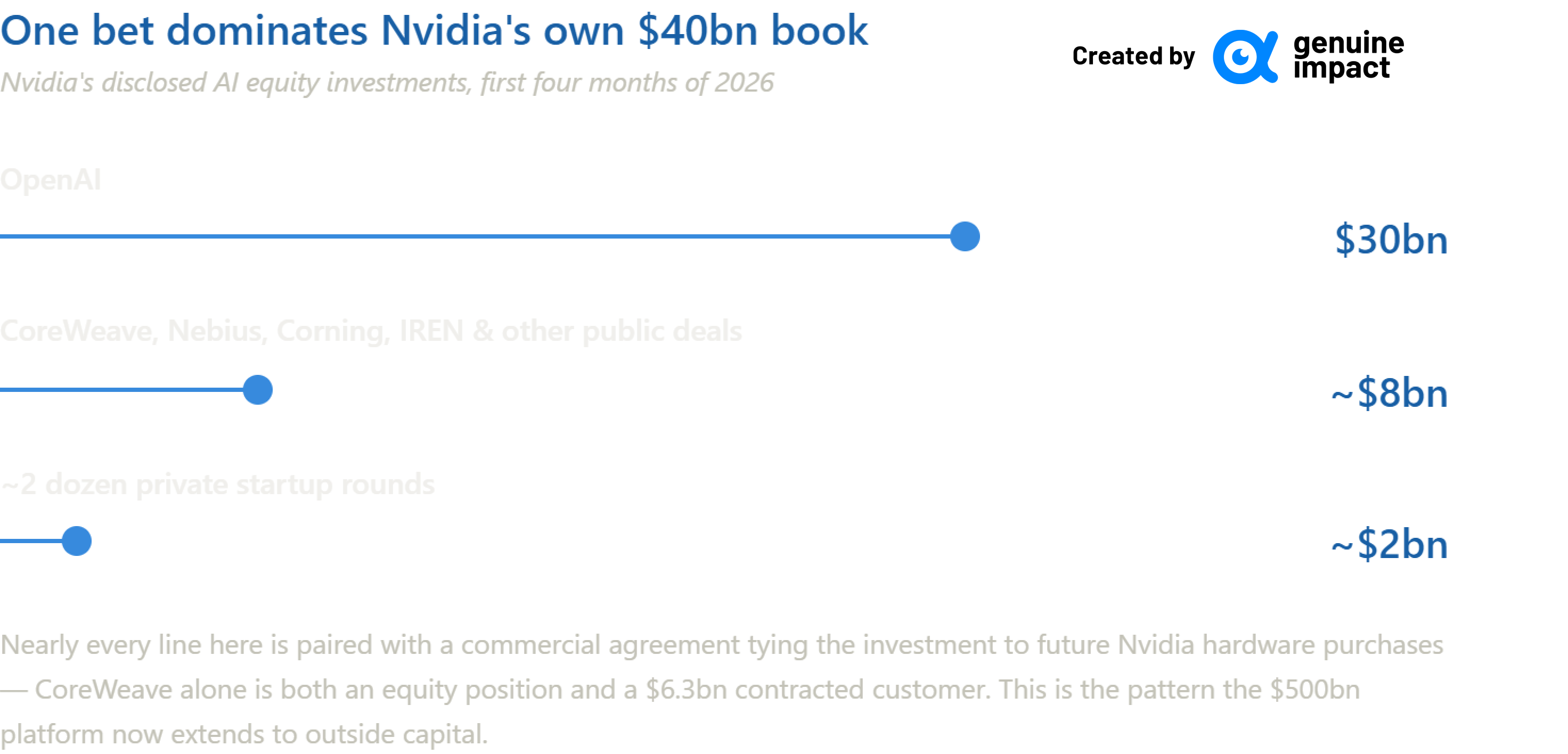
The immediate reaction sits on top of a critique that predates this announcement by months. Nvidia had already disclosed more than $40 billion in AI-related equity investments in the first four months of 2026 alone — $30 billion of it into OpenAI, the rest spread across CoreWeave, Nebius, Corning, IREN and roughly two dozen private rounds — nearly all of it paired with a commercial agreement that ties the investment to future Nvidia hardware purchases. CoreWeave’s position is the clearest example: Nvidia is both a meaningful equity holder and a $6.3 billion contracted customer of the same company. Analysts have been calling this pattern circular financing for the better part of a year: Nvidia money flows into a customer, the customer spends some of it on Nvidia chips, and the resulting revenue looks like independent demand in Nvidia’s income statement.
The $500 billion platform does not directly repeat that structure — the capital comes from Apollo, BlackRock and the rest, not from Nvidia’s own balance sheet — but it extends the same underlying dynamic one level further into the financial system. Nvidia is no longer only investing in the companies that buy its chips; it is now underwriting the investment thesis that makes it possible for outside capital to lend against those chips at all. Morgan Stanley’s read, published shortly after the announcement, was that bringing in third-party capital with limited Nvidia co-investment should ease the circular-financing concern, precisely because it is not Nvidia’s own money doing the lending. The stock’s initial reaction suggests the market has not fully accepted that distinction yet, and the ZeroHedge-end of the commentary has been blunter, framing the platforms as an off-balance-sheet mechanism whose main function is to keep the broader capex cycle funded regardless of where the money technically originates.
The mechanism matters more than the headline number. Historically, hyperscaler capex has been financed largely from operating cash flow, supplemented by corporate bonds sized in the tens of billions per issuer. What Nvidia is describing is closer to project finance and asset-backed lending — the toolkit used to fund infrastructure with long, predictable cash flows — applied to a five-to-six-year depreciating asset class whose obsolescence curve is contested even among the companies buying it. The pitch to lenders is that Nvidia compute has “the lowest token cost, highest revenue and longest life” of any comparable asset, extended over time by CUDA software rather than fixed at the point of sale. That is a claim about residual value, and residual value is precisely the variable that determines whether asset-backed lending against GPUs behaves like lending against an aircraft or like lending against a smartphone.
If the claim holds, this does what the release says: it broadens who can build AI infrastructure by giving lenders a defensible basis to underwrite it, at rates below what a single AI lab or neocloud could achieve borrowing on its own. If it does not — if newer architectures shorten the useful life of currently deployed GPUs faster than the schedules assume, the same question already being asked of the hyperscalers’ server depreciation schedules — the financing platforms transmit that risk directly into six of the largest credit books in the world, rather than containing it inside Nvidia’s own investment portfolio the way the $40 billion in 2026 equity deals did.
Nvidia’s own guidance is the cleanest evidence of where this initiative is aimed. The company’s outlook for the first quarter of fiscal 2027 explicitly assumed no data-centre compute revenue from China at all. That is a reversal from a business that, as recently as two years ago, drew close to a quarter of its data-centre revenue from the country. Along the way Nvidia took a $4.5 billion charge tied to export restrictions in a single quarter, and Huang himself has described Nvidia’s share of China’s AI accelerator market as having gone from roughly 95% to zero, even as Washington and Beijing have each partially reversed course — the US approving H200 exports in principle, China then instructing its own tech companies to limit Nvidia chip use and slow-walking customs clearance, protecting Huawei’s Ascend line and the broader push for domestic supply in the process. Morgan Stanley estimates China’s AI chip market could reach $67 billion by 2030, with domestic suppliers meeting roughly 86% of it; Huawei’s own AI chip revenue is projected near $12 billion in 2026, up sharply from the prior year.
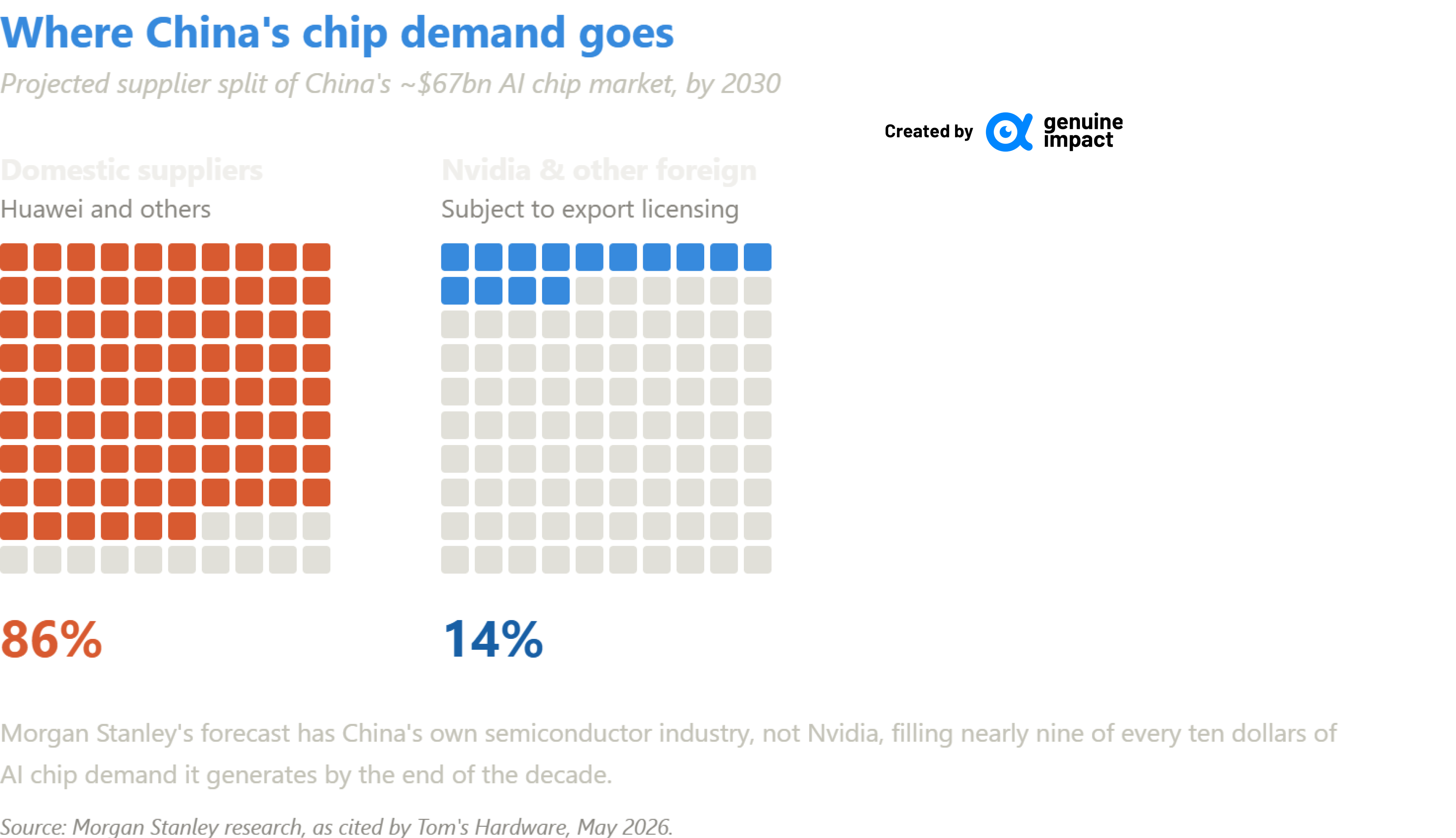
Put those two facts side by side. The world’s largest asset managers are being recruited to build a $500 billion financing architecture that turns Nvidia compute into an investable asset class — and the market where Nvidia’s own compute is least investable, having been effectively priced and regulated out by both governments simultaneously, is excluded from it by construction, not by choice. China is not skipping this kind of financialisation; it is building its own version, denominated in Huawei silicon and domestic capital, running on a parallel track that this announcement does not touch and was never going to.
The equity-investment gains-and-losses line. Nvidia’s existing $40 billion-plus book of AI equity stakes will eventually need to be marked, written up or written down. The first disclosed loss on a customer-investor position — rather than a write-up — would be the clearest signal yet on whether the circular-financing critique is a labelling dispute or a real credit exposure.
Any language on the financing platforms moving from MOU to binding commitment. Memorandums of understanding are statements of intent, not funded facilities. Watch for whether any of the six partners disclose an actual first platform, its size, and — critically — whether Nvidia takes any residual-value guarantee or first-loss position, which would reintroduce the circularity the third-party structure is meant to avoid.
China revenue guidance for the following quarter. Given the zero-China assumption already baked into the current outlook, any upward revision — tied to further loosening of the H200 licensing standoff — would be the more important number for the stock than the financing platform itself, precisely because it would represent demand this announcement was not built to capture.
There is a version of this that works cleanly: outside capital absorbs infrastructure risk that would otherwise sit on Nvidia’s or its customers’ balance sheets, lending standards hold, and the platforms scale into the productive asset class Huang describes. But the stock’s reaction on the announcement itself says the market is not yet convinced that six large asset managers lending against Nvidia’s own description of Nvidia’s residual value is meaningfully different from Nvidia lending against it directly. The 26 August print, and the pace at which “over $500 billion” becomes an actual funded number, is where that question starts to get answered.
Figures and quotations on the financing platforms are drawn from Nvidia’s 10 August 2026 press release and matching disclosures from Apollo Global Management. Figures on Nvidia’s prior AI equity investments are compiled from CNBC, TechCrunch and Bloomberg reporting published in May 2026. Share price and market capitalisation figures reflect NASDAQ-listed trading through 11 August 2026, compiled from Yahoo Finance, Capital.com and Fortune reporting. China market-share and revenue figures are drawn from Nvidia’s Q4 FY2026 SEC filing, Morgan Stanley research cited by Tom’s Hardware, and Jensen Huang’s public GTC 2026 remarks as reported by Beam.ai. Nvidia’s Q2 FY2027 earnings are confirmed for 26 August 2026 after market close. This information is for guidance purposes and may become out of date at any given time. It is not investment advice. Investments can rise and fall in value. If you are unsure of the suitability of any investment, investment service or strategy, you should seek independent financial advice. Past performance does not indicate future results. Your capital is at risk.
Global markets pushed higher again this week, though the composition shifted once more. Nikkei 225 led with a 1.8% gain, the Nasdaq 100 added 1.1%, and the CSI 300 rose 0.8%. The STOXX 600 and S&P 500 both gained 0.4%. Against that, the previous week’s China-tech leaders reversed hard: Hang Seng Tech fell 3.2% and the KraneShares CSI China Internet ETF 3.5%, with the Hang Seng itself down 1.8%. The VIX short-term futures position dropped 4.6% as hedges came off.
Commodities had their strongest week in the series so far. Brent Oil surged 11.7% and is now up 45.8% on the year, silver rose 5.3%, and gold added 3.6% — a broad-based commodity rally rather than a single-asset move.
Fixed income flipped negative at the long end again. The US 20+ Year Treasury and 15+ Year Gilts both fell 1.1%, with Gilts 5-15yr down 0.5% and US Investment Grade Corporate Bonds off 0.6%. Short-duration and high yield held up better: Euro High Yield and US High Yield both rose 0.2%, and most T-Bill and short Treasury lines stayed close to flat.
Crypto was the most dispersed book of the week. Chainlink jumped 7.1%, TRON 2.5% and Solana 2.2%, while XRP fell 5.5%, Zcash 4.1% and Toncoin 3.6% — a split market rather than a uniform move in either direction.
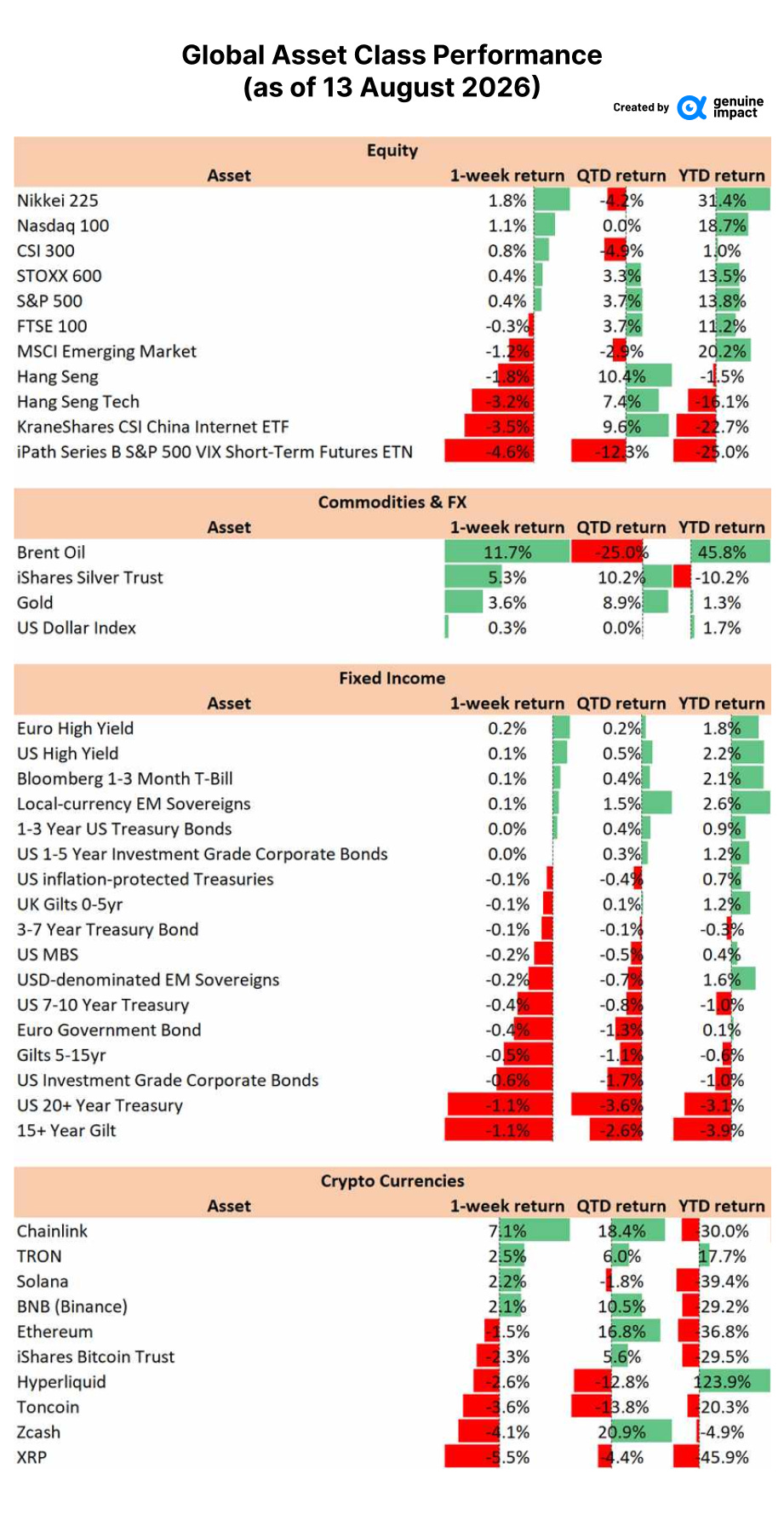
‼️ Last week duration and defensives were doing the work. This week it was commodities and the momentum names that snapped back hardest. The question is whether this is legitimate risk appetite returning, or a short-covering bounce in positions that had simply fallen furthest.
While the mega-caps barely moved, our best performer gained 28.1% in a single week — and it is the holding with the weakest position P&L so far this year. Want to see which stocks, at what weights, and what we are watching next? Subscribe to unlock the full holdings and performance below ⬇️
Comments
Nothing yet. Say the first thing.
Sign in to join the conversation.